How To Double Your Creative Output in Fifteen Minutes with Tom Corson-Knowles

In this episode we explore strategies to jumpstart your creativity, how to think about the definition of success, how to retain the knowledge from all of the books you read, and how to be a better writer with best-selling author and publishing expert Tom Corson-Knowles.
Tom is a serial entrepreneur, blogger and international bestselling author. He started his first business at age 13 and is the founder of TCK Publishing whose mission is to help every client earn a full-time income as an author. Tom’s bestselling books include Secrets of the Six-Figure Author, The Kindle Publishing Bible, and The Kindle Writing Bible, among others.
In this episode we discuss:
Why creativity is a learned skill and not an innate talent
Why creativity is important for everyone, not just “starving artists"
3 simple strategies you can use to improve you creativity right now
The incredible importance of “thinking time"
The two parts of the creative process
How to improve your writing skills
How you can double your creative output in 15 minutes per day
How to stop yourself from pressing the gas and the brakes at the same time when trying to create
And much more!
If you want to boost your creativity - check out this episode!


Thank you so much for listening!
Please SUBSCRIBE and LEAVE US A REVIEW on iTunes! (Click here for instructions on how to do that!).
SHOW NOTES, LINKS, & RESEARCH
[Book] 2k to 10k by Rachel Aaron (see here).
[Book] The Art of Learning by Josh Waitzkin (see here).
[Book] Unlimited Memory by Kevin Horsley (see here).
[Book] Moonwalking With Einstein by Joshua Foer (see here).
[SOS Episode] The Neuroscience Behind Einstein and Isaac Newton’s Biggest Breakthroughs (see here).
[SOS Episode] How You Can Memorize a Shuffled Deck of Cards in Under A Minute - The Science Behind Memory (see here).
If you want to learn more about self publishing, get Tom's free self-publishing course (see here).
EPISODE TRANSCRIPT
Matt:	In our last episode we went deep into limiting beliefs. We looked at how random childhood experiences can shape your worldview for decades; discussed how your outer world is created by your inner world; examined how to reverse engineer bad behavior, and much more with our special guest, Catherine Plano. If you feel like something’s been holding you back, but you can’t figure out what it is, listen to that episode. Today, we have another great guest on the show, Tom Corson-Knowles. Tom is a serial entrepreneur, blogger, and international bestselling author. He started his first business at age 13, and is the founder of TCK Publishing, whose mission is to help every client earn a fulltime income as an author. Tom’s bestselling books include, Secrets of the Six Figure Author, The Kindle Publishing Bible, and The Kindle Writing Bible, among many others. Tom, welcome to The Science of Success.

Tom:	Thanks for having me, Matt. It’s great to be here.

Matt:	Well, we’re very excited to have you on. Tom, to kind of get started, tell us a little bit about your story, and how you got into the world of publishing and writing.

Tom:	Yeah, sure. I kind of started my writing journey... Well, actually when I was 12 years old I would just write poetry on my computer. I had no idea what I was doing, and I had this really old Word processor. No one I knew wrote poetry. No one in my family wrote poetry. It was just this weird thing I did, but I never really thought about it until years later when I was in college—I was a freshman in college—and I was in business school, and all of my classmates, their dream in business school was to go to Wall Street, and become an investment banker, earn six figures right out of the gate, and work like 100 hours a week on Wall Street in investment banking. That, to me, was an absolute nightmare. So, the dream of everyone around me in business school was my nightmare, and I was freaking out. Like, I had to find something else to do because I didn’t want to end up in that career path. It didn’t fit for me, for my personality, for sure. So, I started studying entrepreneurship, I started side business, anything I could do to earn extra money, and one of the projects I started was this random thing. I just opened up a Word document on my computer and just started writing. It was never meant to be a book, really, it was just meant to be my personal manifesto of my personal beliefs of what I thought it meant to live a successful life beyond just having money. For me it was more about freedom, and having great relationships, and being able to go wherever I want, whenever I want; wherever I want with whoever I want in my life. So, I started writing this manifesto, and shared it with a few people, and they loved it, and recommended I actually get it published. So, I started trying to get a traditional book deal, trying to find an agent, trying to find a publisher, and just completely failed miserably. Six years and didn’t get anywhere. Banging my head against the wall, basically. Then about four or five years ago a friend mentioned a comment, “Why don’t you just self-publish your book on Kindle?” I had a Kindle since the day it came out so I knew about how amazing eBooks were. I loved eBooks, I loved my Kindle Reader, but I had no idea you could self-publish because when I first started writing my first book, I looked into self-publishing and it was like, the business model was, you needed at least $25,000 investment to buy 5,000 books to have them all shipped to your garage so you could store them there. And every time you wanted to sell a book, you had to collect the money from the customer, you had to put it in an envelope, stamp it, seal it, send it to the customer; it was just this crazy business model. I didn’t have the money to invest the time, let alone the time and inclination to store 25,000 book...or 5,000 books in my garage. So, when I heard about eBook publishing I was like, “That’s amazing.” I just studied everything I could, and long story short, my first year, I had my first $12,000 month just from eBook royalties alone on Amazon Kindle. That’s when I kind of knew that I had made it, so to speak, in the publishing world, just by myself.

Matt:	That’s fascinating. What was the name of that book?

Tom:	My very first book, it’s now called, Rules of the Rich. It had a different name back then, but I’ve since rebranded it. That’s my personal manifesto of what I think it takes to live a successful life.

Matt:	What are some of the things that you shared in there in terms of success beyond traditional monetary success?

Tom:	A big thing for me was freedom, because a lot people might have a lot of money, and I knew a lot of people in my life, especially when I was growing up, who had a lot of money, but they did not like the work that they did. They didn’t like their family, they didn’t like their wife, they didn’t like so many things about their life. Growing up I observed these older people in my life, family friends and so forth, because my parents were doctors so they had a bunch of friends who were doctors. Doctors are actually one of the professions that have the highest suicide rates, which is crazy. So, I’d see these people who were millionaires. I mean, so much money; they had yachts, they had all kinds of great things, and they hated their life. They were stressed out, they were overweight, they weren’t taking care of their body, and all these different things. I learned really quickly, that’s important to me. I don’t want to end up being 50 being overweight, being sick all the time, hating my family, hating my life, hating my work. I wanted the opposite of that. I wanted the money, right? I’ll take that, but if I have to also have the freedom, the health, the relationships. That to me, were the related keys to a successful life. That’s what I’ve tried to strive for since then.

Matt:	That’s great. I think that’s a really great way to think about it and look at it. Shifting directions a little bit, one of the things that I really wanted to discuss with you is the idea of creativity, and obviously creativity is a huge part of the writing process, and something we’ve talked about before on the show. We actually did a whole episode on some of the neuroscience behind creativity and how to spark it, but I’d love to hear some of your insights about what you’ve learned, and how people can jumpstart their creativity and harness it.

Tom:	Absolutely. For me, creativity is everything, whether you’re in business, whether you’re writing a book, any kind of project, you’re creating something new. That’s going to require creativity. One of the issues I have with the word ‘creativity’ is that it becomes a stereotype like, if you’re a creative person you’re like a starving artist. Most people think that, right? We think that either you have creativity or you don’t, but that’s just not true. It’s a learned skill. Like everything in life, it’s a learned skill. You can learn to be really, really creative. We all have creative faculties, we all have the creative ability in our minds, we just have to learn how to actually harness that. That was actually one of my big challenges as a budding writer, because in school I was really good at math. I was that math guy; I was the analytical guy; I was very left brain. No one would ever say that I was a creative person when I was in school because I didn’t appear that way, and I didn’t have the skills, but now everyone thinks I’m a creative genius; all the books I’ve written and things I’ve done, but it’s not because I was born this way, or because I was born with special skills, it’s because I learned habits and strategies that actually helped me be creative. One of my favorite creative strategies, Matt, that is hugely impactful in my life and many of my students, is something called thinking time. Just scheduling thinking time. Essentially what it is, is that I’ll actually schedule my calendar like, 11 AM to 11:30—thinking time. So, I’ll lock myself in the room: no distractions, no cell phones, no interruptions whatsoever, and I just sit down with a pen and paper and I write down some questions. Questions could be anything from, how can I improve my health? How can I improve my relationship with my wife? How can I improve my finances? How can I earn more income? How can I grow my business? How can I better serve my clients? Just asking basic questions about how I can actually improve my life. What I’ve noticed is just by writing down a question and writing whatever comes to mind—any idea that comes to my mind—writing that down on paper, I have had the most incredible ideas. I’ve had some terrible ideas, for sure, we all have that, but I found some of the biggest leaps in my personal success have come just from asking myself questions. One of the things I’ve noticed is, for example, Matt, we’re in the Mastermind group together, and in our Mastermind sessions someone will ask a question, and other guys in that group will give their answers, their feedback, on how they would deal with that situation or problem, but you don’t need a Mastermind group. You don’t need a mentor to tell you what to do. A lot of times in life, if you just ask yourself, you already know that answer. You ask someone who’s overweight what they could do to lose weight, they already know the answer; the thing is they’re just not doing it. They aren’t focused on it. It’s very easy to ignore things in life. It’s very easy to get stuck in old habits. For me, creativity is about more than just coming up with the idea, but it’s also changing the focus of your mind to the solution rather than the problem, and actually admitting to yourself that there is a problem, and that you’re willing to fix it. That’s what creativity is about is really getting the ideas first of all, but then also changing your focus and your attention.

Matt:	You made a bunch of really good points there. Just kind of starting off, for listeners who might be unaware, could you describe, basically, for them, what a Mastermind group is?

Tom:	Yeah, absolutely. A Mastermind group is a group of people who come together to support each other in a common mission. I know there’s a lot of Mastermind groups for business. That’s probably the most common one I know of. Basically, you might have five, or ten, or more people come together in a meeting in Skype, or in a personal meeting, or at an event, and people will ask questions and get advice from other members of the group. A lot of people have read, Think and Grow Rich, by Napoleon Hill, and he talks about Mastermind groups and how important they were to Henry Ford, and some of the most successful entrepreneurs in our history, but he also talks about how he had his own mastermind groups in his head just by thinking about it. Just by, what would Henry Ford do in this situation? What would Rockefeller do in this situation? I think you can do... That’s very similar to what I’ve done with my thinking time process is, instead of asking, what would someone else do? What would I do? How could I improve my life? There’s all kinds of questions you can ask; there’s all kinds of things you can think about, but what I’ve noticed is if I don’t schedule it in my calendar, Matt, if I don’t actually spend the time thinking, I’m not going to think. I’m just going to go by habit. I’m going to wake up, I’m going to go to work, I’m going to do the same thing I did yesterday, and that’s the habit we’re all in. So, I think you have to break yourself out of that habit and have that alone time by yourself without distractions where you can really focus and think new ideas rather than just doing the same thing day after day after day.

Matt:	I think one of the other really important points that you made is the idea that creativity is not just for the starving artists, and that a lot of people hear the word ‘creativity’ and step back and think, I’m not a quote-unquote creative; I’m not an artist. When in reality, creativity is a skill that can be applied to literally any field that you’re interacting with. Whether it’s business, physics, whatever it might be.

Tom:	Absolutely. Business is a great example. Every entrepreneur is an artist. They are a creative person. They’ve come up with new solutions, and new products, and new services that no one thought of before. Maybe they had the same product and the same service, but they’re doing things in ways that no one has thought of before. That’s all creativity. For me, if you look at life, a simple way to look at life is, it’s just a series of problems; problem after problem after problem. The key is just focus on the solution. How do you find the solution? You want to increase your income? Okay, what’s the solution? You want to find a happy marriage? Well, what is the solution? Creativity is really the process of coming up with those ideas and testing them, and seeing if each potential solution will actually work to improve your life.

Matt:	The concept of, what’s the solution? You touched on something a few minutes ago, which is the example of losing weight, which is basically, a vast majority of the time—maybe not in every case but often—deep down you know what you need to do, and sometimes you just have to develop, or cultivate, the self-awareness to say, “It’s not rocket science. I don’t need some sort of epiphany. I really just need to start executing on the basic fundamental of what I want to achieve.”

Tom:	Absolutely. I’ve noticed that too, time and time again, people want...a lot of times we want a fancy solution. We want something complex. We want a diet plan to follow, but you don’t need a diet plan to follow. It’s not that they don’t work, it’s just that... Why not just add an apple a day to your diet right now? Why not just do the most simple, easy, obvious thing right in front of you? A lot of people—we step over the obvious stuff to find something fancy, and new, and different, when really just doing the obvious thing could make a huge difference over time. We all make changes slowly. I’ve never seen someone go from broke to billionaire overnight. It doesn’t happen. I’ve never seen someone go from 200 pounds to 140, and their fit, ideal weight, in 2 days. It just doesn’t happen. Rather than trying to get mega results instantly, why not see, what can I do today to improve my situation right now? That’s how you make progress; otherwise you’re just going to put it off. You’re going to put it off for a day, and then a week, then a month, then a year, then 10 years, and you’re going to look back at your life like: Why didn’t I ever eat that apple? Why didn’t I ever take that walk? Why didn’t I ever go to that conference? Why didn’t I start that business? Why didn’t I write that book? Well, it’s because you made it into such a big thing that you could never really do instead of focusing on the next step. If all you do is focus on the next step, you’ll constantly be making progress.

Matt:	That is super important. I try to distill...any project that I’m working on, I always try to distill it down to this sort of, what is the next action item, the next thing I can do, to make some sort of progress on that?

Tom:	Exactly. That’s where your focus has to go because it’s so easy to get overwhelmed. Our minds are our biggest enemies sometimes. If you think, for example...books are a great example. When I first had the idea to write a book, it seemed like this monumental task that would take years and years to accomplish. The truth is it’s not. It’s not really that complicated. It’s not really that difficult if you know what to do, and if you just focus on the next step. Literally, sit your butt down in a chair, open up Microsoft Word, and start writing. Anyone can do that right now. Anyone can start writing a book this very instant. They don’t need a guru to tell them what to do or how to do it; you just start right now. For me, likewise, I’m always focused on: Okay, what is the next step? So I don’t get overwhelmed, so I don’t get stuck, so I don’t procrastinate, and I think that’s crucial to anything in life, for me personally, is just focusing on what is the next step.

Matt:	Going back to the idea of thinking time, one of the things that I’m a huge fan of, and it’s a very similar process, is just basically kind of a daily ritual developed by a guy named, Josh Waitzkin. Are you familiar with Josh at all?

Tom:	Absolutely. He has a fantastic book on learning. I think it’s called, The Art of Learning, or something.

Matt:	Yes, The Art of Learning. Exactly. Great book. He recommends a very similar process which is essentially the idea of structuring your morning around having an uninterrupted period of time before you check email, before the day disrupts you, to just brainstorm on a particular problem or challenge that you’re having, and harnessing the subconscious mind, and the powers of the subconscious mind, to tackle that issue. There’s a whole framework that he goes through to feed ideas into the subconscious and sort of pull them out, which we actually did a whole episode on. I’ll link that in the show notes for people that want to check that out. I think that that... You’ve definitely hit the nail on the head, and that’s a huge piece of developing creativity is scheduling that time, and having it be uninterrupted time, that you can really think, and sort of force, your mind to be creative.

Tom:	Absolutely. I think another big key to creativity a lot of people miss out on, especially writers and introverts, is connecting with other people. Mastermind groups are a great way to do it, but you don’t need to be a part of some formal group to do it. You can just go and find someone in your field, find someone in your industry, find customers, find your audience members, find your fans, and talk to them about your passion. Talk to them about what you’re working on. Talk to them about your problems, and your products, and services. Talk to them about what you’re doing, and just listen and get feedback, and you’ll be amazed at how that will spark your own creativity by connecting with other people. We have this idea that the super creative scientists, like Albert Einstein, just sit in their office, just daydreaming, coming up with brilliant game-changing, world-changing ideas, and that’s not really how it works. All successful people that I know, who you would think of as really creative and geniuses, they always connect with other people. They always talk to other people. They’re always learning. Whether they’re learning from a janitor, or someone who you think might not have any good ideas, or whether they’re talking to Nobel Prize winners, they’re always open to new ideas, and to sharing, and to communicating. I think that’s a big part of creating is connecting with other human beings and sharing ideas rather than just thinking you can do it all on your own.

Matt:	Very insightful. Dovetailing with that, I’m curious, in terms of...specifically within the context of writing, I know one of the biggest challenges is writer’s block; writer creative block, or whatever you want to call it. What are some of the ways that you overcome that?

Tom:	It’s super easy. First of all, you can do that same writing time exercise, but instead of thinking about income, or whatever, just think about, what are the ideas I want to share in my writing today? What are the main ideas that I really want to share? If you’re writing nonfiction, or a how to guide, or something like that, you want to help your audience solve a problem. Just ask: What is the problem I’m solving and how can I help my reader solve that problem? Just really hone in on: What are the major ideas you want to share? Just write that down; jot down your little list. Essentially what that does is kind of warms up your mind. It gets your mind focused on the big ideas you want to share. So, when you sit down to write you’re not just staring at a blank screen wondering, “What the heck do I do?” You actually, “Okay, here is the list of ideas,” so you just get in that flow and start writing. Another big thing that is a really bad habit a lot of writers have, and if you break this habit it will double, triple your productivity, is the habit of editing while you write. There are really two parts to the writing process. There’s the creative writing side where you’re just in the flow; you’re just writing words on paper or on your processor, on your computer, and you’re not thinking about anything else. Some people say it’s like channeling. It’s like from God, or a divine spirit, or whatever. You’re totally in the flow. You’re not thinking about it, you’re just doing it. Words are appearing on the page. Then there’s the left brain part of it, which is the analytical editing part of your brain. That’s when you’re fixing typos and grammatical errors, and you’re fact-checking, and you’re doing research and stuff, and if you try to do both of those things at one time you’re not going to get in the flow. If you do get in the flow, you’re not going to stay in the flow because going to be constantly editing yourself. So, if you separate those two processes... So, you say, “This is creative writing time,” and just focus on getting words on paper, and just getting the flow, you’ll write so much faster. Then get up, take a walk, do something else, and then come back and actually edit it. If you separate those two processes, you’ll be amazed how much more productive you’ll be. I’ve seen writers, they’ll complain that they worked for like, four hours and couldn’t write more than a couple pages, and it’s because they’re just constant... it’s like having one foot on the brake and one foot on the gas. They’re writing a little bit, and they’re editing, and they’re writing a little bit, and they’re editing, and they never get in the flow, and they’re never going to be productive that way.

Matt:	That makes a ton of sense. I think I’ve read somewhere about the creative process being split into two phases, which you described. Basically, the ideation or generation phase, and then the selection phase. Even in a business context, if you’re having a marketing meeting, or a brainstorm, where you’re trying to come up with new ideas, or whatever it might be, you’re going to be a lot more productive if you spend one part of the meeting just generating ideas, and not judging them. Then after you’ve generated a ton of ideas, then you come in with a critical lens and start sort of parsing them down and saying, “No, this one doesn’t make sense,” or, “Maybe we should combine these two,” or whatever it is. It’s really hard to create new, wacky combinations when you have that mindset of judging your ideas in real-time.

Tom:	Yeah. I remember learning in business school about this idea of brainstorming, and why you should never judge in the brainstorming phase. I always thought that was nonsense. Like, that’s silly if someone gives you these horrible ideas, but I think what I’ve noticed from my personal experience is the problem with judging those ideas right away, especially if you’re in a group setting, is that... Let’s say, we’re talking with business ideas, and you say, “Hotdogs,” and I’m like, “Matt, that’s an idiotic idea. Hotdogs are a horrible business model.” So, what’s that going to do to you emotionally? It’s going to totally take you out of flow. You’re no longer going to be inspired. You’re probably going to be hurt, or resentful, or angry, and you’re not going to have your most creative ideas come up after that. You’re going to be afraid to share. So, your second idea might be an amazing idea, but you won’t share it because that relationship has been harmed. That’s one of the reasons why, in my experience, judging ideas too soon can really hurt, especially in a group setting. Even for yourself, it’s the same thing. If you write down five ideas on a piece of paper and you’re like, “These ideas are horrible,” you just get in this negative mind frame rather than just focusing on coming up with more ideas, which is a numbers game. Everything in life is a numbers game. A person who has one idea versus a person who has a hundred ideas, the person with a hundred ideas is eventually going to be more successful if they can figure out how to find the good ones in there.

Matt:	That reminds me of, in a similar context, whenever I’m trying to create something, whether it’s a PowerPoint presentation, or an email, or whatever it is, I always try to treat the first version as a rough draft. If you set out—at least this is my personal experience—and say, “I need to craft this perfect, everything has to be exactly right, presentation,” or whatever it is, it’s really daunting, but if I set out and say, “I’m just going to create the very rough draft, basic 1.0 version,” what I’ll do is just get flowing and starting and create it, and actually do a pretty good job. Then I’ll look back and be like, “You know what? That’s pretty good. I probably could just use this, and maybe make a few tweaks, and it’s going to end up being fine.”

Tom:	Absolutely. That’s how it works when you’re writing a book. You just want to get the first draft done as quickly as possible because that’s when the real work starts of doing your fact-checking, and proof reading, and editing, and rewriting. A lot of people never even get the first draft done because now they’ve got bad habits, or they’re constantly self-editing, they’re never really getting in the flow; whatever it is. Get the first draft done, and it’s all easier from there, but if you’re constantly fighting yourself with one foot on the brake, one foot on the gas, it’s going to be a struggle the whole way, and you’re never going to get the first draft done.

Matt:	That segways into the idea of writing as a skill set. I think we both probably would agree that writing is a critically important skill. Not just for authors, but for anybody in life. If you want to communicate with people effectively, if you want your ideas to be structured, and really clear, and understandable, it’s important to master the skill of writing. What would you say, from all of the books you’ve written, and all of the work you’ve done in the publishing space, what are some of the key lessons that you’ve found that can help people improve as writers?

Tom:	That’s a good question. There’s one book called, 2k to 10k, by Rachel Aaron, and she talks a lot in the book about plotting. It’s actually a book on writing fiction, but I found it to be one of the best books I’ve read on writing, ever. I write nonfiction, I don’t write fiction, but a lot of my clients do. Even just for my writing nonfiction, it’s helped so much. Her basic premise is kind of what we covered before. It’s just planning ahead of time. Doing all of your plotting, planning out your scenes, planning out how everything’s going to go in your mind, so you have a crystal clear picture of where the book is heading, and where everything is going. So, when you actually sit down to write you already know what’s going to happen. It just comes down to filling in the sentences, basically, and filling out the explanations, and the details, and the hyperlinks that people need to see, and the research people need to see, and all that. That has been hugely valuable for me, and for a lot of my clients. When they read that book it’s like a game changer for them because they realize, rather than spending two years of their life writing a 300 page book, and then finding out the plotting was wrong, and the structure is wrong, the organization is wrong, they can spend a day, or two, or three just planning out the entire book. So, not only is the writing process so much faster, but they don’t waste time creating something that at the end they find out is just garbage because they didn’t plan it out properly.

Matt:	So, 2k to 10k, is that the idea of zooming out to 10,000 feet?

Tom:	No, it’s actually her word count. Her word count went from 2,000 words a day to 10,000 words a day, which is massive for a writer. It’s kind of her process of how she achieved that. It’s her whole system for it, and it’s actually the same system I use today, essentially, with a few tweaks, and it’s very valuable.

Matt:	That’s great advice, and I think that a lot of people don’t really think about planning out what they’re going to write before they actually do it.

Tom:	It’s the same thing with everything, right, Matt? It’s like, if you’re going to do a business, don’t you want to plan it out? You don’t have to have an official business plan to pitch to venture capitalists if that’s not what you’re doing, but you should at least have some idea what you’re doing. You should at least kind of know where you’re going. For example, I see people who want to start a business, and let’s say they want to sell a supplement, or something, and they’ll just call up one supplement manufacturer and get one quote, and then they’re like, “Okay, we’ll go with them,” and they don’t do any research, and they don’t do any preparation. They don’t plan it out. To me, that’s a lazy way to get through life. I used to be that way. I used to be so lazy. I made so many mistakes in business from not doing my research, and not doing my homework, and not planning things out, but if you just spend the extra time to do that, you’ll be amazed how far you can go, and how many mistakes you can avoid. That’s really what holds most people back is not that they can’t figure out how to be successful, it’s that they make these mistakes that just cost them so much because they weren’t planning. They weren’t planning ahead. They didn’t ask other people for advice, and they just jumped into something, which is ridiculous. You see so many entrepreneurs today—especially where I live—someone will open a restaurant and three months later they’re out of business. Why? They didn’t do any research. They didn’t do any research at all into the audience; who their customers were; marketing; finances; how much money they needed to raise. They didn’t do any research. They just thought, it’d be a great idea to open a restaurant, so they did it. That’s just not the way to be successful long-term.

Matt:	Yeah, I think a focus on—specifically within a business context—risk mitigation, and really trying to—for the least amount of time, least amount of money, least amount of energy possible—figure out if it makes sense, and if it’s possible to do something, or if it works, is something that a lot of people don’t really consider before they launch into a venture, and often those are the ventures that don’t pan out.

Tom:	Definitely. It’s the same thing in pretty much any area of life. Like, in a relationship, if you go on a date with someone and you’re like, “Let’s get married right now,” you haven’t really done your research with that person. You don’t really know if it’s going to work. So, it’s like anything life. You want to invest the time to learn as much as you can, so you’re educated, so you can make good decisions, rather than just thinking that... It’s just kind of arrogant to think that you now all the answers when you haven’t done the research.

Matt:	Changing directions a little bit, for listeners who are listening to this, and maybe they’re looking to...they’ve thought about publishing a book, or they’re looking to build credibility, or establish an audience, or whatever it might be—one of your expertise is in the world of self-publishing—what advice would you have for those listeners, and what would you say about pursuing that strategy?

Tom:	Self-publishing, today, is amazing. It’s the most profitable way to publish a book, and that’s just true. There’s basically no way you can argue with that if you look at the numbers. The reason is, when you traditionally publish a book, you’re going to get 10-15% royalties, and when you self-publish you can get 70% royalties, or so. For example, if you self-publish an eBook at $2.99, you earn about $2.00 in royalties, when you self-publish it, every time you sell the eBook. As a traditionally published author, you sell a $25 hardcover book, you’re going to earn a little less than $2 on the royalties. So, you’ll earn more selling a $3 eBook, self-published, than selling a $25 hardcover book, traditionally published. The question is, do you think it’s going to be easier to sell more $3 eBooks, or more $25 hardcover books in an industry where print sales are declining? If you do the market research and really understand it, self-publishing just makes so much sense financially, but it’s like any business you get involved in, you should do your research, you should do your homework, you should figure out, how big is the market where the opportunities is right now? The biggest opportunities, right now, are really with eBooks for most markets. Digital audio books are booming right now. Print books are great for a lot of markets, but for most self-publish authors, you’re going to earn 3, 4, 5 times as much from your eBook as from your print book. Again, it totally depends on the market, and the author, as well. If you’re doing a lot of public speaking, you might sell a lot of books in the back of the room, you might make a lot more money from print books, but generally speaking that’s kind of how it’s going to turn out. I would say, do your research and really get educated before jumping in. A big mistake I see a lot of people make in self-publishing is they won’t get several quotes for work. So, if they want to hire an editor, they’ll hire their neighbor’s best friend, and pay 5, or 10, or 20 thousand dollars for an editor, when they could have gotten much better work done for a much lower price. The same with book covers, and marketing services, and so forth. I have a rule in business, I call it my rule of three, if at any time I’m going to invest a significant amount of money in a project, and I’m going to hire someone to do a job, I want at least a minimum of three quotes. Bare minimum I need to have three quotes. Again, it just stops you from making an emotional decision that you’re later going to regret because you just didn’t do your research.

Matt:	That’s a great rule. I think I might borrow that from you.

Tom:	Absolutely. Please do.

Matt:	In terms of some of the topics we’ve talking about today: writing, creativity, improving your writing skills, etcetera; are there any specific resources, whether they’re books, websites, whatever, that you would recommend listeners check out if they wanted to dig down and understand some of these topics more deeply?

Tom:	There’s a lot. It really... I would say, you can find books on pretty much anything today, and I think... I’m and avid reader. I love reading. I’ve read, on average, five books a week for the past ten years, so I’ve read thousands of books. Mostly personal development stuff and nonfiction, and one of the things I’ve learned is, it sounds impressive that I’ve read so many books, but a lot of those books were not totally a waste, but somewhat of a waste. For example, I’ve read books on real estate investing, but it was at a time in my life where I didn’t even have the capital to actually invest in real estate, so I’ve forgotten 90% of what I learned since then. So, I would recommend for most people, if you really want to study something, study what you need to know right now. Like, what do you need right now? Then go find the book on that that you need to learn right now. So, if you’re going to write a book, go study books on writing. If you’re going to publish books, study books on publishing. If you’re going to market something, study books on marketing. If you’re having trouble in your marriage or relationships, study books on relationships. There’s so many amazing books out, and I can send some of my top books, and you can post them in the show notes, but I don’t want to make blanket recommendations for everyone because I think it’s even better if you really just do that couple seconds of thinking of what problems that you’re having right now, what challenges that you’re having right now, and then find the books that will help you with those problems you’re having right now.

Matt:	It’s all about planning before you execute, right?

Tom:	Absolutely. It’s a lot of investment to read a book, and it’s not that it’s not useful, but if you can read a book right now that you can actually implement right now in your life, it’s going to make much more of difference than reading something that you won’t use for a couple more years.

Matt:	How do you retain all of the knowledge from all of the books you read? Do you have some kind of system?

Tom:	I do take notes. Notes are amazing. I think it helps a lot. I like to talk too. So, find a book group, or a Mastermind group, or a partner, or a friend, or a colleague; someone you can talk to about the ideas you’re learning. That helps a ton because by explaining the ideas you get to share them again, yourself, and you’ll get to clarify and make sure you actually understand. If you can’t explain to someone else, you don’t really understand it completely. That helps a ton. Actually, one of my clients published a book recently called, Unlimited Memory—actually a couple years ago—it’s a huge bestseller now. It’s like the number one book on Amazon in memory. So, I’m actually studying his system right now on how to improve my memory, and it’s pretty fantastic. He is actually... When he grew up he had learning disabilities, he had dyslexia, he was told he was an idiot, and he taught himself how to improve his memory, and he since broke world records on memory. He memorized pi to 10,000 digits and broke the world record for that memorization test by 14 minutes. It’s not because he was born a genius, it’s because he...there’s simple things you can do if you practice it. It’s basically about using your imagination to remember things better. So, I’m studying that right now. I would recommend that to anyone if you want to improve your memory, that book is amazing.

Matt:	That sounds awesome. That reminds me of two things. One, I don’t know if you’ve ever read the book, Moonwalking with Einstein, but it’s kind of a look into memory champions, and those memory competitions, and actually, the journalist who wrote the book started out just examining that community, and then ended up getting involved, and then, I think, winning the National Memory Championship at one point.

Tom:	Yeah, that’s a great book.

Matt:	Which just demonstrates how learnable a lot of these memory skills are. The other piece, for listeners who are curious about that, we also have an episode about memory where we actually talk about the strategy you can use to memorize a deck of 52 cards that have been totally randomized. I’ll put that link in the show notes as well, and we’ll get a list from Tom about some of his top picks that we’ll include in there. So, definitely check the show notes out and you can get all those resources. So Tom, is there anything else that we haven’t touched on that you want to share with our listeners?

Tom:	Absolutely. There’s one more thing with creativity, and this is actually... I’m big into science and research, but I don’t necessarily follow it for everything. For example, like creativity, I think a lot of my lessons on that are totally experiential—what I’ve learned from experience, and talking to other really brilliant minds, but this one is actually backed by research. There’s all kinds of studies that have been published recently on walking, and how walking actually improves your creativity, and you can actually double the amount of creative ideas you can come up with just by walking for 15 minutes. So, if you’re ever feeling stuck; you need ideas, but they’re not coming; you’re working but you’re not being productive and it’s frustrating; get up, take a 15 minute walk, or a 5 minute walk, and you’ll be amazed. I noticed that as well. I actually noticed this in my own life before the studies came out, and then I saw a study and I was like, “That makes so much sense.” You’d be amazed by how much a short walk in nature, on a treadmill even, can just help you clear your mind and improve your creativity.

Matt:	Great piece of advice. That might dovetail into the next thing I was going to ask you, which is: What is one piece of homework you have for our listeners?

Tom:	The homework I would have people do is, schedule in your calendar—right now—time to be creative. Time to come up with new ideas. Time to think. It’s so easy to get stuck in the day-to-day life, and the old habits, and if you really want a change, that’s going to come from new ideas, and applying those new ideas. So, if you schedule this 30 minutes in your calendar right now for the next week, to just be alone to write down questions to think, that will make a huge difference in your life. You’ll be amazed at the ideas you’ll come up with, and how that will affect you and the trajectory of your life.

Matt:	That is something simple and easy that anybody listening right now can do. Take 30 minutes, schedule some time on your calendar in the next seven days, and just set aside some thinking time. If you wanted to dig in more about some of the science behind that, which even though Tom said it’s been sort of an experiential learning from him, it’s actually rooted in a lot of neuroscience why that thinking time is effective, check out the link in the show notes, or listen to our episode about creative breakthroughs. Tom, that wraps up the questions I had for you, so I wanted to just say, thank you very much for being a guest on The Science of Success. It’s been a joy to have you on here.

Tom:	Thanks much for having me, Matt. It’s been a pleasure.
Are You Being Held Back By Childhood Limiting Beliefs? With Guest Catherine Plano

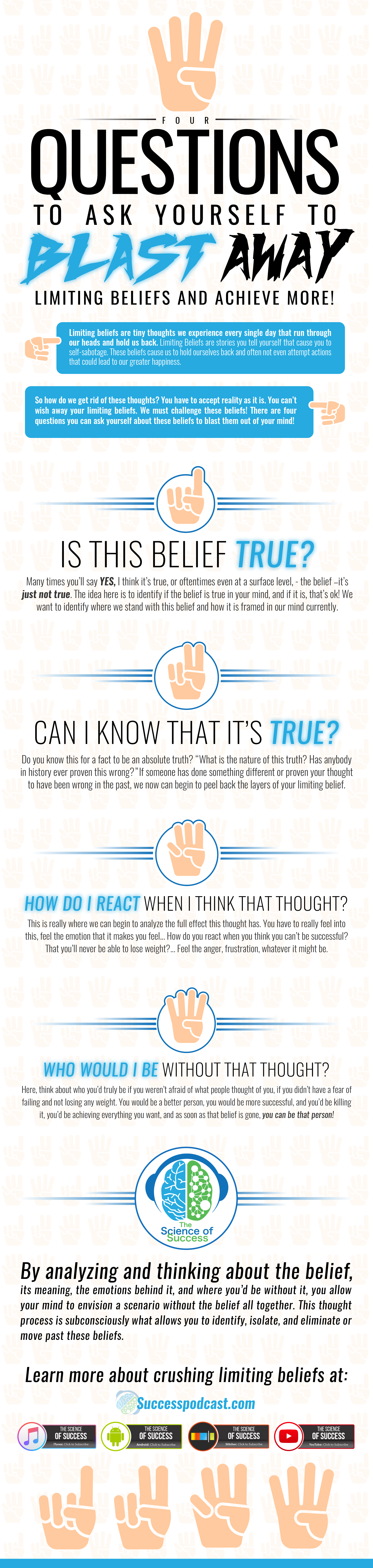
In this episode we discuss how you have multiple limiting beliefs that you have yet to discover that, if uncovered, could radically transform your life. We go deep into limiting beliefs, look at how random childhood experiences can shape your worldview for decades, discuss how your outer world is created by your inner world, examine how to reverse engineer bad behavior and much more with our guest Catherine Plano.
Catherine is the founder of the I Am Woman Project and an International Executive Coach with more than two decades of experience working with top companies, having impacted more than 100,000 lives and whose mission is to aid companies and individuals in becoming aware of their limitless potential and in using their extraordinary abilities to achieve their desired outcomes. Catherine is also a certified Life Coach and a certified Master Trainer of NLP. Catherine focuses on changing lives daily through her coaching and motivation speaking. She has also just recently released her new book Getting to the Heart of the Matter: The No-Nonsense Guide to Professional & Personal Transformation.
We discuss:
How simple, innocuous things in our environment plant seeds that can dramatically change of our lives
How we give meaning to situations without fully understanding them
How your parents programmed many of your behaviors
How limiting beliefs get planted into your mind from childhood
How your memories can be completely false
How your outer world is a reflect of your inner world
Why your thoughts become self fulfilling prophecies
Why 95% of your behaviors are not “who" you are, they are “learned behaviors"programmed by your environment
And Much More!
If you feel like something is holding you back, but you can’t figure out what it is - Listen to this episode!




Thank you so much for listening!
Please SUBSCRIBE and LEAVE US A REVIEW on iTunes! (Click here for instructions on how to do that!).
SHOW NOTES, LINKS, & RESEARCH
[Book] The Super Mental Training Book by Robert K. Stevenson (see here).
[Book] The Biology of Belief by Bruce H. Lipton (see here).
[Book] Evolve Your Brain by Joe Dispenza (see here).
[SOS Episode] How You Can Memorize a Shuffled Deck of Cards in Under A Minute - The Science Behind Memory (see here).
[SOS Episode] Limiting Beliefs (see here).
Catherine Plano (see here).
Rise & Thrive Course (see here).
EPISODE TRANSCRIPT
Today we have another great guest on the show, Catherine Plano. Catherine is the founder of the I AM WOMAN project and an international executive coach with more than two decades of experience working with top companies, having impacted more than 100,000 lives, and whose mission is to aid companies and individuals in becoming aware of their limitless potential and in using their extraordinary abilities to achieve their desired outcomes. Catherine is also a certified life coach and a certified master practitioner of NLP. Catherine focuses on changing lives daily through her coaching and motivational speaking. Catherine, welcome to the Science of Success.

Catherine:	Thank you very much. Thank you for a great introduction. Thank you, Matt.

Matt:	Well, we’re super excited to have you on here today.

Catherine:	I’m super excited.

Matt:	That’s awesome. And you’re coming in all the way from Australia, is that right?

Catherine:	That’s correct. In Melbourne.

Matt:	Great. Well, to get started, kind of tell me a little bit about your background and sort of share your story with our listeners.

Catherine:	Sure. My background goes way, way back -- maybe about 25, 30 years ago. I really got into the whole spiritual side of things, the energy. I was doing a lot of that kind of work, which, back then--say, 25 years ago--was probably looked upon as a bit woo woo. But, you know, what I did -- I actually used to have my own center, and what had happened is I had an epiphany one day. It was, you know, all these people coming in and very dependent on me, and I was thinking, this is not how you empower people! People have those abilities and those resources themselves. I just need to show them how they can tap into that. So, that’s when everything changed for me. I got into coaching neurolinguistics, neuroscience, and brain science, and hence why I’m here today -- to help people, empower them, and transform them.

Matt:	That’s fascinating. So, I’d love to kind of dive right in to some of the meat. Tell me about the concept. And we’ve talked a little bit about this in previous episodes of the podcast, but tell me a little bit about the concept of limiting beliefs -- you know, kind of what they are, how to identify them, and maybe even digging into how to combat them.

Catherine:	Oh, I love this one. Limiting beliefs. I think, limiting beliefs, we all have them, and because they’re unconscious, sometimes they’re hard to identify because we live them out and we play them out every single day. You know, 95% of the time we play them out. And so for an example, a limiting belief might be--and this comes up a lot in my clients--is the value of money, for example. So, if you grew up... And I know with my family, we... I was born in France. We came to Australia; started a family in a new country; didn’t know how to speak the language. You know, obviously money, all of that stuff. So, we saw our parents argue over money, and I’m sure lots of people see their parents argue over money. So, as we grow up and we see this happen in our environment and we see that it causes conflict... Or it could be as simple as, you know, your parent might say “Money doesn’t grow on trees,” or “This is too expensive! Why do you have to buy this brand?” So, we start having these beliefs that money creates arguments or money creates conflict. So, as you can see, these are learned behaviors. They’re not really our own beliefs. It’s the meaning we have given a situation without really understanding it. And so how this plays out when we get older is... For example, this is one of mine that I had to hack into -- was that I believed that I had to work really hard to make money because that’s how I saw my parents. They worked really hard to make money. And, you know, you’re working crazy hours and still chasing your tail. Or it could be as simple as when you do have money coming your way, you give it away because in your unconscious mind, you believe that money creates arguments or conflict, so "I don’t want any part of that." So, and you find that quite often people are saying "You know, I work really hard. I mean, what is it? I'm not making the money." And so we deep dive into those limiting beliefs. And how we find them out, it could be as simple as, you know, I ask them, like, “What beliefs do you see in yourself that come from your parents?”, for example. Or “What beliefs do you see in yourself that come from an authority figure?” And this is a great way because we are... You know, can’t blame our parents. They did the best they could with the information they had at the time. But there is this thing called parent programming. And even I know when I was growing up, I used to say, “There is no way I’m anything like my mum!” And over Christmas, I spent almost three weeks away with my mum. I am so much like my mum. So, limiting beliefs come from our past.

Matt:	I think you said something really, really important, which is the idea that sort of simple, innocuous things that happened almost in the background of our childhoods can plant these seeds that can dramatically change huge portions of our lives.

Catherine:	Absolutely. And, you know, I think, too, it’s a matter of being more conscious in our mind and being the observer of our thought. And when I get this belief--it might be a silly belief--I just go, where does this belief come from and what does it really mean? Just by probing myself with a couple of questions, I’m actually activating the prefrontal cortex, which is that thinking part of the brain. And if you want to create change, this is what you need to do all the time, which takes practice. I nowhere near have perfected it, but I am still practicing it daily.

Matt:	And that’s so funny because, you know, I’m somebody that... I’ve been kind of digging into the concept and trying to understand how to uncover and remove limiting beliefs for a number of years. And still, to this day, I have a list of probably 20 or 30 limiting beliefs that I’ve uncovered in the last, you know, let’s call it two or three months that I’m still working through. And so, at least for me, personally, it’s been a journey where you never really find or remove all of them, but you just have to constantly kind of cultivate the awareness of, you know, what’s that thought that just crept into my mind? And, hey, that seems like a limiting belief, and that could be something that’s holding me back or preventing me from achieving what I want to achieve.

Catherine:	Absolutely, because sometimes they do. They have consequences. Certain limiting beliefs do carry consequences. If I hang onto this belief for as long as I live, what are the consequences? Just even asking that question, you know. And I think that, too, it's... I call it "diffuse my beliefs". When they come up, I’m looking at it. I exhaust myself by saying “What else could it mean? What else could this mean? What else could this mean?” until I run out of different meanings. And it removes the boundaries of a limiting belief as well by just finding different meanings to it.

Matt:	So, would you say sort of asking against and again “What could this mean?”, is that a method for diffusing limiting beliefs or is that a method for kind of breaking them down?

Catherine:	I think both. I think that unpacking it, so what else could this mean is you’re unpacking your limiting belief. You’re bringing light to it, and I think then you’ll actually break it down because then you’ll realize how a) it’s not yours. It may be a really silly one, and it could be something that happened a long time ago that you gave it a particular meaning that serves you no purpose any longer, won’t serve a purpose any longer.

Matt:	I think that’s a really important distinction, is that it’s not yours, right? It’s something that came from the environment. It's something that came from maybe a parent or somebody that you looked up to, or even a time before you can even remember, and it was planted in there by potentially sort of a random occurrence in your life.

Catherine:	Absolutely, and I call them “learned memories”. They pop up every now and then. Yes, when there’s little triggers or a stimulus in our environment that triggers us back to that memory, that’s when it comes up.

Matt:	That’s a great phrase. And it’s funny, kind of circling back to the idea of, specifically, limiting beliefs around money. We had Vishen Lakhiani on the podcast previously--who’s sort of a teacher of meditation and an entrepreneur--and he tells a story about how he struggled for years to make money with his company, and found out he had this sort of core limiting belief about teaching people -- that you always had to struggle as a teacher, financially. And when he finally uncovered that, his company radically transformed within 18 months.

Catherine:	It’s amazing, isn’t it? And that's the same with me, that realization that I had to work hard to make money. As soon as... And it was a matter of tweaking the word. It was just working smarter. And it just changed. Just the fact that I said, "I've got to work smarter to make my money, not harder," everything started changing. New ideas came into mind and I became more savvy with the things that I was doing and I pulled everything online. It just changed everything.

Matt:	And so, when you’re talking about limiting beliefs, you mentioned kind of the idea of parental programming. What are some of the other sources of limiting beliefs or some of the other ways that limiting beliefs can kind of seep into your mind?

Catherine:	Oh, God, it could be so many things. From some of your experiences. It could be as we were growing up. We all go through a development phase, and the first phase is the imprinting phase, right up to the age of seven. So, anything that happened in your environment then, whether it was something you saw on TV; a book you read; stuff that happened at school; stuff that friends said to you; whatever that may be, it could be...you’re just downloading that information into your mind. It’s like downloading software into the computer. And then when you move into another phase from the age of seven to 14, this is called your muddling phase. And this is where we try to identify "Who am I?" and we seek externally of ourselves as to who do we aspire to be? So, this is the time when we start. I know back in my days, Duran Duran was quite big, with the big funky hairdos and the frilly shirts. And, you know, it’s really about who do I want to be and who do I aspire to be? And then it’s those people around you that have an impact in some way, shape, or form. So, these beliefs not just come from your parents; they come from our environment. They come from people that you looked up to or you aspired to be. They come from... It could be a TV show or a superhero that you were in love with at the age of ten. These beliefs come from all over the place -- very much from environment.

Matt:	So, to make this kind of concrete and to drill this home for people that are listening--and I think this is really important because it’s easy to talk about limiting beliefs in the abstract--but would you say that it’s a fair statement that every person listening to this episode right now has multiple limiting beliefs that they have yet to discover, that if they were to uncover them could have a radical impact on their lives?

Catherine:	Absolutely. Absolutely. And from an energy perspective, I look at it this way: As soon as you get to the source of your limiting belief, it’s almost like... I don’t know if you’ve ever heard of Gestalt Theory, but if you have a look at a pearl necklace, for example, and if you go back to that core or that root cause of that limiting belief, and you, with your adult eyes or with your understanding of and all the knowledge you have today, when you go back to that core belief and you actually give it a different meaning, it’s almost like pulling that bead away and you’re allowing all of these pearls to just fall apart. So, it’s like a domino effect. As soon as... It’s like you take that limiting, you pluck it out of your timeline of your memory--because we all have memories and they’re all in a timeline format--it just changes everything. It changes how you not just think, but how you behave and how you act.

Matt:	That makes me think of two things. One, on the subject of memory, we’ve actually done a previous episode all about kind of digging into memory and what it means and what memories are. And one of the things we talked about is the idea that your memories can literally be false, and every single time you drag a memory back up, every single time you think about something, you’re reconstructing that memory and putting it back, and you’re changing it and tweaking it and modifying it to where literally what you remember... And we read from a study where a number of neuroscientists literally say, point blank, that what you remember could be completely false about something that’s happened in your life.

Catherine:	So true! Very true. Because it’s... You know, you have all this knowledge now. So, you know, for me, if I was to go back to a time when I was seven, when I first came to Australia, I have fond memories of what that was like. But obviously every time I go back to that memory, I might add more color; I might add more story to it; I might add more feeling to it. It can change it completely. And you hear this, you know... And I hear this even amongst my friends and my partner and so forth, you know. You might hear a story over dinner with your friends, for example, and it just always changes slightly. Have you ever experienced that? Like, the story just...

Matt:	Yeah, definitely.

Catherine:	...gets better and more funnier. That’s what a memory is. People just add to it all the time. So, when you’re trying to connect with the actual root cause of that memory, it’s altered so many times depending on how many times you’ve plucked it out and revisited that memory.

Matt:	And touching back on one of the things you said a moment ago -- the idea of kind of the pearls falling off of the string. The analogy that I’ve always loved is--and I love analogies about water and how water flow and energy flow and all of that relates--but the idea of water flowing through a hose. Basically, if you imagine a limiting belief as basically a kink or a bend in the hose, and every time you...if you have multiple bends, every time you break one bend, the water flow gets stronger and stronger and stronger. So, if you take more and more of these kinks out, take more and more of these bends out of the hose, the energy flow gets more concentrated, more focused, and gets even stronger every time.

Catherine:	Oh, I love your analogy. That's perfect. That's a perfect way of saying it. Because, you know, limiting beliefs are like little blocks and they sometimes stop us doing the very thing we want to do. So, it’s perfect what you’re saying because it’s exactly what you’re saying -- the kink in the hose or the block. And as soon as you remove those, everything just flows smoothly.

Matt:	And it’s really funny, even kind of tangentially related. For example, if your environment is really messy and you just spend a little bit of time cleaning up your environment, those little, tiny things can snowball into more and more kind of a positive focus and positive energy throughout your day.

Catherine:	Yeah, I agree. I’m like that with everything around me, whether it’s my wardrobe or my office. It has to... I know a little bit about Feng shui, but, just intuitively, it has to feel right for my work to flow through. And when it’s not, I just...I might stand up and tidy things up again, and just the fact that I’ve done that, I feel like I’ve cleaned my space and I’m ready to work with it.

Matt:	So, shifting gears a little bit, I'd love to talk about the concept of visualization and how you can use visualization to achieve your goals and how you've used visualization in the past in some of the work that you’ve done.

Catherine:	I’m big on visualization and I think if you look at how we speak and if we were to speak the language of the unconscious mind--which is 95% who we are--it speaks the language of pictures. So, visualization, it's very much tied in with the vision boards as well. When you’re creating goals, I always encourage the people I work with to actually create a vision board. And it might be just a simple vision board, but just so that they see it. But it’s not just about seeing it; you have to have emotion attached to it. So, visualization, you’ve actually got to be associated in your visualization because the mind cannot tell the difference between what is real and what is not real. And so if you can actually see yourself as if in that moment, then your mind will believe it. And if you keep practicing it over and over again, you will create it or manifest it. And there’s this great book--it’s called The Super Mental Training Book--and there's lots of stories. There are hundreds of stories in there about, you know, different people using the technique of visualization. So, it talks about there’s a gentleman who was in jail for many years and he visualized playing golf, and he got out of prison and was a professional. There’s another story in there where there’s these Russian athletes and it was during the winter Olympics in something like 1986, and they did an experiment with visualization and they separated the athletes into four groups. The first group had to train physically 100%; the second group had to train physically 80% and visualize 20%; the third group was 50% physical and 50% visualization; and the last group had to visualize 80%, but 20% physical. And who do you think did the best?

Matt:	The group that visualized the most?

Catherine:	That’s correct, yep. The group that visualized the most. So it just explains to us that A. We’re tapping into that deeper part of our mind. And if we practice visualization, and it can be as simple as working on a goal, you know and I do this a lot with people with public speaking. Visualize yourself standing there on the public stage. Visualize the people in front of you. Have a really - get involved in your emotion, how your feeling, all of that stuff really build it. It’s almost like visualization is like starting with a blank canvas and then you’re painting it - adding color to it, adding sound to it, adding feelings to it. To make it come to life.

Matt:	And I think a really key point that you made is that you have to anchor the emotion to what you’re visualization.

Catherine:	Absolutely. The feeling is that they always say the feeling or emotion is the field to your thought. So if you want to create a strong visualization and you need to give it that drive so that to make it - to manifest, you need to have as much emotion as possible.

Matt:	So, for somebody who’s listening now, how could they sort of as a simple first step start practicing some form of visualization?

Catherine:	I think the best way is to understand first what you want to visualize. So plan first. What is it that I want to visualize? And it could be as simple as you might aspire to be a certain way. It could be public speaking is another one. It could be that you want to achieve a great relationship for example. As long as you know what it is you want to visualize to manifest. That’s the first thing - plan it. Then I would ask you to do is obviously - what kind of picture do you - what kind of emotions do you want to bring out in this visualization? So for example, if it was public speaking, it’d obviously be confidence. And if it was something to do with bringing or manifesting a relationship, it would be love. So, really, one strong emotion and focus on that. And you can suck on other emotions. And then what I would do is then start your visualization. You’re very clear about what you want to do, and you know why you want to do it, and then the how is you’re painting a picture. So, I would then spend my time almost visualizing my picture. So I would visualize, for example, public speaking, I would visualize the room, I would visualize the audience, I would visualize what the stage would look like. I would visualize myself walking onto the stage. I would stand there and listen to what’s going on around me, what do I see, what do I feel, really connect with it. And then what I would do is I would associated - I would be as if I was looking through my own eyes. And I would stack those emotions on you know, I’m feeling confident, I’m feeling proud, I’m feeling happy. I feel inspired. Just keep feeling those. Then once you’re done with your visualization, move away, dissociate it from yourself. And you know, I even like to you know if I like to add a bit of specific time to when I want to achieve my visualization. So, for example, if I want to say I want to be in a relationship in six month time. I would have a date. So what I would do is once I’ve created this massive visualization, when I stand away, I actually have it - you can visualize whatever you like, but I like to visualize it as in sitting, my visualization, in that balloon, going forward in time to that date, and a balloon pops and drops into that time. And so what I do is every time I keep doing that, I’m reinforcing my visualization but also I’m giving it a specific time to when I want it to manifest.

Matt:	And so for somebody that maybe, and I mean I’ve done a lot of work on positive visualization, and sometimes I feel like I struggle with making images feel real, or being able to tap into them or kind of feel them fully. What’s a way to kind of breakthrough that or if you’re struggling with visualizing the image, what would you recommend doing?

Catherine:	I have had some people say “well I can’t visualize.” I believe, this is my belief, that everyone can visualize. And I think that if you say you can’t, you’re just not allowing that to flow through. Then I say, find some pictures on the internet that are inspiring for you to manifest, whatever that might be. So, if it’s public speaking, find someone that you really look up to. What is it that you want to create? So create like a mini-vision board, so that when you are actually physically manifesting your visualization, and then what I would do is have it - you’re sitting in front of it, then I would look at it, stare into it, and you can connect with it that way once again. You can - What am I hearing? - Close your eyes as if now. What am I seeing? What am I feeling? All of that stuff. So you can do it that way as well if you feel you can’t paint that visualization in that mind.

Matt:	Got it. So, another concept I wanted to talk about is the notion of the outer-world versus the inner-world. That’s something I’ve heard you talk about before. Can you share that idea?

Catherine:	Yeah. I always talk about it. I always say that our outer-world is a reflection of our inner-world. And it’s the way that we perceive things for example. So if I hear people saying they’re not happy with their work environment, they’re not happy with their relationship, they’re not happy with blah blah blah, whatever that may be. Then that gives me a hint that there’s something going on inside of them. So, you know, our outer-world is a reflection of what’s going on inside. So if we want to change our environment, then we need to change inside. And inside meaning our inner-world. How we’re thinking. How we’re seeing things. What are our perceptions? What are we projecting with our perceptions? What are interpretations of the environment? So, it’s, to me, we are everything around us we reflect because of what’s going on in our inner-world.

Matt:	That’s fascinating. Can you give me maybe an example from some of the people you’ve worked with or some things you’ve experience and how you’ve kind of seen that take place?

Catherine:	You might say—and I actually have had this actually happen—I was boarding as a mediator for two women, two executives, they were at heads with one another and neither of them were going to leave because both of them had a really good job, cushy job, great money, and they loved their job. Just couldn’t stand one another. So, really, the thing that was going on was one particular lady that I worked with. I said to her, “You know, all I’m asking you to do is find one positive thing towards this person.” And she’s like “No. There’s no way I could find anything positive about this person.” And this took us about three weeks. So I said “Okay. Let’s nip this in the bud. And let’s really chunk this all the way. Let’s have a look. You’re both women. Yes. You’re both mothers. Yes.  Now let’s have a look at that. When you’re at home with your children, how do you behave? Are you the same person as you are at work?” She goes “Oh no, of course not! When I’m at home I’m on the ground with my children, I’m playing with their toys, spend some quality time with them before they have dinner and go to bed.” And I said - “Do you think there’s a possibility that this lady does the same thing in her own environment?” She went “Oh, yes.” I said “Okay, just focus on that. That one thing, just focus on that one thing that she is a mother.” So, for her, unconsciously, she was seeing this woman as being whatever that label she wants to call it. And therefore she was behaving that way, and was getting those results. The moment she changed the way she was seeing that women, started seeing this woman as a mother, nine days later, I got a phone call. She said, “You know what? She’s actually really good with numbers.” So basically what was starting to happen, and this is why I say shifts do happen, it’s a shift of mindset. She started seeing this woman in a positive light, and therefore what was happening is she was behaving differently because she was seeing her in a different light, and getting those results. They are now really good friends. So that’s an example of what the whole outer-world, inner-world stuff. So, she changed her inner-world the way she was seeing or thinking about this person, and therefore changed her outer-world.

Matt:	So, in many ways, our thoughts and our beliefs are self-fulfilling prophecies in the sense that the way we feel or react to someone actually may be creating the exact kind of belief or feeling that we have about them.

Catherine:	Absolutely. We are the creator of our inner-environment. We are the creator of our domain. And I know sometimes it’s really hard for people to accept that, because it’s like, “No way! I haven’t created this bad relationship! No way! I haven’t created this horrible boss!” It’s - if you want to believe that, it’s fine. Anyone can believe anything they want to believe. But I believe that I do create these things. And you know when things happen in my environment, it’s so much more empowering for me to go “How did I create this? And how did I manifest this?” Rather than blame. That way I know I can work with it.

Matt:	I think that’s so important, to take responsibility for our environment in the world around you, as opposed to just being a victim.

Catherine:	Absolutely. Accountability is key. Absolutely.

Matt:	Another thing that I’ve heard you talk about that I really enjoyed was the idea of - and this ties into what we’ve been talking about - the idea of reverse engineering that behavior. Can you talk a little bit about that?

Catherine:	Yes, absolutely. So, we are not our behavior. And I love this one because quite often, especially in working with lots of corporates, the talk about - they get you to come in and they say “this person has bad behavior, we need to change this behavior.” If we’re looking at the whole mindset and our behaviors it’s 95% of our behaviors is actually not who are, they’re learned behaviors. We are a byproduct of our past experience, parenting programming, environment, other people’s fees, limiting beliefs, decisions - you name it. And quite often, these behaviors have no purpose and actually sabotage the things that we want. So, as long as we understand the behavior is not the person, we can work with that. The behavior is the meaning they have given a situation. So, for example, if I have a look at the difference between attitude and behavior, the attitude is the way that we think, and the behavior - so once we think a certain way or go through the whole process to maybe help understand it, if we have an event happen in our environment, we think of it a certain way, we might see it a certain way, and what happens is we create what we call an internal representation. A picture of that event. And in that, what happens then, we create a state. Which is our emotions or feelings. This plays out in our physiology, which is our behavior. So, a lot of the times if we want to reverse engineer our behavior, it’s about going back and understanding what is this person thinking about this environment, or this event, or this person? To change the thinking and therefore change the way they see it, change the way they feel about it, and the behaviors will be completely different. So, the behavior is the meaning of the communication or situation at hand. And we can change that by being more conscious - and it takes 21 days - now there’s neuroscience that says it takes 21 days to create neural pathways and we can actually, and neuroplasticity is change our brain. So, if we say, just for the next 21 days, I’m going to be conscious of my thoughts. We can change our behavior.

Matt:	And for listeners who are curious about digging in more to the science of neuroplasticity, we’ve previously had Dr. Rick Hanson, the author of a number of books about that, but specifically kind of digs in to sort of happiness and productivity and everything else, so that’s a great episode to check out if you want to dig in more to that science. But, Catherine, for the people who are listening here, is there one piece of homework or something simple you would ask them to do?

Catherine:	I think that - I always say that we can reinvent ourselves. That’s the exciting part. It’s like - what do you want to create for yourself? Life isn’t about finding yourself, it’s about creating yourself. So, I think that piece of a big piece. Just, I think it - it doesn’t mean like, it doesn’t have to be reinvent the whole self, it could be tweaking. But I think to be more conscious is the thing. Because if we’re looking at - and you hear about it all the time, that we only use 10% of our brains. Well neuroscience says it’s actually 5% of our conscious brain. Which means that 95% are learned behaviors, past, parenting program - all of those things that some way, shape, or form, stop us from doing those very things that we want. So when we talk about even unconscious bias - the things we really want and desire, are they the things we need? Are they things really are going to line up with where we want to go? When we’re talking about that 5%, that conscious mind, when we want to manifest and create new things. We need to start - really - stop to think what we’re thinking about. Think about it, how often do we do it? Never. Well. I’m not saying never. But it’s a practice, you have to practice it. Even 5 minutes a day, just sit there with your thoughts. “What was I thinking today? What was I feeling like today?

Matt:	I think cultivating that awareness is such an important step.

Catherine:	Absolutely. I believe that too.

Matt:	So, for somebody who wants to kind of dig in, do some more research about some of the things we’ve talked about today, what would you recommend as other books or resources for them to check out?

Catherine:	Ugh, geez, so many books. I love, The Biology of Belief with Dr. Bruce Lipton. I love also Dr. Joe DeSpencer, he talks about how you can change your brain. There’s so many great authors, but those are the two that come to mind.

Matt:	Awesome, we’ll put links to both of those notes in the show notes. Catherine, where can people find you online?

Catherine:	Sure. They can find me under CatherinePlano.com And you can have a look at that, or I Am Woman project is the project that I work on and we’ve also just launched Rise and Thrive which is all online. So basically as I was saying, I’ve become more savvy - working smarter is putting things online. So, I have this mission of helping as many people as I can to empower themselves and the planet, and so I’ve put all my work online, which is a 12-week online course for 19.95 a week. Which, when you think about it, I don’t know what it’s like in your side of the world. But in Australia, they charge anything from 300-500 dollars an hour for coaching. And not everyone’s got that kind of money. So I’ve put these programs online for teenagers and leaders as well to work through some of the stuff we’ve been talking about.

Matt:	Great, well, Catherine, thank you so much for being a guest on the show. I know the listeners are going to get a lot out of this interview.

Catherine:	Thank you so much, Matt, for having me. It’s been an amazing time, thank you.
How to Master the Superpower that Builds All Other Powers with Dr. Rick Hanson

In this episode – we go deep on mastering the superpower that underpins all other powers, how your brain’s automatic survival mechanism tilts you towards unhappiness, growing the mental resources to deal with the biggest challenges of your life, and down the rabbit hole of exploring the idea of the self, ego, and much more with Dr. Rick Hanson. This was one of the most profound conversations we have had on this podcast.
Dr. Hanson is a psychologist, Senior Fellow of the Greater Good Science Center at UC Berkeley, and New York Times best-selling author. His books include Hardwiring Happiness, Buddha’s Brain, Just One Thing, and Mother Nurture. He’s also the Founder of the Wellspring Institute for Neuroscience and Contemplative Wisdom, he’s been an invited speaker at NASA, Oxford, Stanford, Harvard, and other major universities.
We discuss:
-How to master the SUPERPOWER that BUILDS ALL OTHER POWERS
-How to grow the mental resources inside yourself to deal with the biggest challenges in your life
-We reverse engineer the olympic athletes of the mind to learn their secrets
-We discuss how your thoughts change the physical structure of your brain
-How your brains 5 core survival strategies create suffering in your life
-How reality is continually constructed by the underlying hardware of the brain
-How to disengage from stress and suffering
-How to let go of attachment to your ego
-How to stop being defensive and taking things personally
-Why your “self” doesn't have an independent existence outside of the totality of the universe
-And MUCH more!
If you want to wire your brain to be happier - you can’t miss this episode!




Thank you so much for listening!
Please SUBSCRIBE and LEAVE US A REVIEW on iTunes! (Click here for instructions how to do that!).
SHOW NOTES, LINKS, & RESEARCH
[Book] Buddha’s Brain by Rick Hanson (see here).
[Book] Hardwiring Happiness by Rick Hanson (see here).
[Poem] Late Fragment by Raymond Carver (see here).
[Book] The Dhammapada by Eknath Easwaran (see here).
Rick Hanson’s Website (see here).
Foundations of Wellbeing Website (see here).
EPISODE TRANSCRIPT
Matt:	Today, we have another incredible guest on the show, Dr. Rick Hanson. Rick is a psychologist, senior fellow The Greater Good Science Center at UC Berkley, and a New York Times bestselling author. His books include Hardwiring Happiness, Buddha's Brain, Just One Thing, and Mother Nature. He's also the founder of the Wellspring Institute for Neuroscience and Contemplative Wisdom. He's been an invited speaker at NASA, Oxford, Stanford, Harvard, and many other major universities. Rick, welcome to The Science of Success.

Rick:	Matt, it's a pleasure to be here. Thank you.

Matt:	Well, we're very excited to have you on today. So, to kind of kick things off, tell the audience a little bit about your background and how you kind of became fascinated with the connection between neuroscience, psychology, and some of the Eastern religions like Buddhism.

Rick:	Well, I think what got me into it... So, I'm a psychologist and I've been around the block for a while, so I got interested in this stuff actually in the beginning of the '70s, and it just seemed to me logical, I guess, that if you've worked at the intersection of brain science, psychology, and the great contemplative traditions of the world, where those three circles overlap had to be where the coolest stuff was, right? You know, you understand the hardware of the brain, then you're tapping into 100-plus years of good research on psychology, and then you're bringing to bear thousands of years of people doing really hardcore practice training their minds, really exploring the upper reaches of human potential. And just to finish here, it's like if you... I've done a lot of rock climbing, and if I want to get better at rock climbing, I want to watch people who are better than me, right? So, I want to kind of tune in to what are those people doing who are moving like human geckos over the cliffs, and then internalize that, at least my next step in their direction. Well, in the same way, the people who have really explored what it is to be deeply resilient, happy, peaceful, and loving, even in really tough conditions, those are the great contemplative traditions of the world. So, I do a lot of reverse engineering. I try to imagine plausibly what could be the underlying neuropsychological foundations of people who are deeply strong, happy, successful, creative, and so forth, and then work backwards to how can I use the mind alone, no medication, no surgery, the mind alone, to stimulate and therefore strengthen those circuits in the brain, building up muscles, in effect, inside yourself that then you can draw upon everywhere you go, because even though it's certainly good to improve the external environment and improve your own body, you know, those tend to change a lot. But you take your mind with you wherever you are, and by being committed to skillful, self-directed neuroplasticity, I call it, you have an amazing capacity, no matter how tough your life is or what the past has been, to actually build inner resources inside yourself for the future.

Matt:	And you touched on something, which is a phrase or a word that people often kind of use interchangeably, which is mind and brain. But you make a really important distinction between the two of those. Can you share that?

Rick:	Sure. If you think about it, so we're all having experiences, right? You know, squirrels are having experiences. I think lizards are having experiences. I know my cat is having experiences. I'm having experiences. You're having experiences. We're hearing, tasting, touching, and smelling, thinking, remembering, and so forth. That realm of experience, if you look at it, is immaterial. You cannot hold a sound. You cannot measure a piece of information. Well, so, we live in this world of phenomenology, if you will. It's a virtual reality, and it is continually constructed by the underlying hardware of the brain embedded in the nervous system, embedded in the whole body, embedded in life altogether. So, the point is that when we use a word like "mind" or "mental" or "cognition" or "psyche" or similar kinds of words, they all refer to the realm of immaterial information processing in the nervous system. And that might sound kind of weird to think about, but that's actually the real bottom line. The function of the nervous system is to represent information, including very basic signals like a sound landing on your eardrum, a cascade of changes proliferated through your nervous system, carrying the information of the sound of a car honking or a bell ringing or a baby crying or, you know, your lover murmuring in your ear, whatever it might be. And so, we have then two process happening simultaneously, and this has practical implications. We have mental activity unfolding; conscious experience, which is inherently intangible; and then we have very tangible cushy, molecular, neurotransmitter-based synaptic neural circuitry-based process underlying that flow of immaterial experience. So, the two are going together. There might be supernatural or transcendental factors at work. Personally, I think there is spooky stuff outside the natural frame of science. But that's it. Just inside the natural frame of science, there's an utterly tight correlation, a co-relating, a co-arising of mental and neural activity, and the practical takeaway of that is by shifting or altering what you pay attention to and then what you do with what you're resting your attention upon. By doing that, you can deliberately use mental activity to stimulating the underlying neural activity in various skillful ways we'll probably get into, so that you can grow and internalize more inside yourself, more confidence, more commitment to exercise, more understanding of other people, more skills with other people, more healing from your last--fill in the blank--job, relationship, childhood. You really can't do that from the inside out, which I think is extremely important for just ordinary coping, healing, and wellbeing, but also in terms of adapting to a future that is very dynamic, very changing, very uncertain in which we need to deal with all kinds of new things. Being able to maximize your learning curve from the inside out, through everyday life experiences, is the superpower, in effect, that builds all other powers. And by drawing upon that superpower through learning how to learn... And when I mean "learn", I really refer to social, emotional, motivational, attitudinal, even spiritual kinds of learning, learning how to learn those good things, not just learning your multiplication tables. If you've learned how to learn, that's your superpower, because then you can learn how to learn anything that matters to you.

Matt:	And you touched on this, but dig a little deeper into the idea that what happens in your mind can actually change the physical structure of your brain.

Rick:	Yeah. It's because neural activity is required for mental activity, and repeated patterns of neural activity change neural structure and function. You know, the classic saying from the Canadian psychologist Donald Hebb is, "Neurons that fire together wire together." And on non-human animals, you know, just acknowledging the ethical issues in that territory -- that said, research on non-human animals that can be extremely invasive has really drilled down literally to the molecular or epigenetic processes, which are also molecular, going on inside individual neurons, all the way up to large scale structures. And then related human studies have shown that repeated patterns of thought or feeling, for better or worse... And one of the things you know about my work is that I have really explored the implications of what scientists call the negativity bias of the brain, the ways that, as I put it, it's like Velcro for the bad but Teflon for the good. We have a brain that's designed to be changed by the experiences flowing through it, especially negative experiences, especially especially when we were young. So, the point being, or kind of the takeaway, is that research has shown that if people more positively, let's say, practice mindfulness routinely or tune into their bodies routinely or do some kind of practice that helps them become happier or more compassionate or more loving or more self-compassionate, then, let's say eight weeks after some program and that, you can see changes in the brain down at the cellular, even synaptic level with MRIs and so forth. And, if people do things over the long haul, for better or worse, you can see major structural changes. Like, literally, people who meditate routinely tend to have measurably thicker cortex, the outer layer of the brain, in regions that regulate attention or help people become self-aware of themselves. It makes sense, you know. You work that muscle, it gets bigger, it gets stronger, and because it's bigger and stronger, making the analogy here for building up tissue and circuitry and functionality in your brain, you then become more able to do various important things like remain mindful, even when the oatmeal's flying all around you. And there are many examples of this, what's called experience-dependent neuroplasticity, including funny things like London taxicab drivers who, at the end of their training, memorizing those spaghetti swirl streets, have a measurably thicker cortex in parts of the brain--in this case, the hippocampus--that are involved in visual-spatial memory. So, they're working the function of some part of the brain, building up structure there. So, a lot of people, it's really jaw-dropping to appreciate that, to update a traditional term, your mind takes this shape from it routinely rests upon. And people can just feel this in their everyday life. Are you ruminating about what's irritating, what worries you, how you feel hurt or let down, or are you really caught up in a feeling of stressful driven-ness? You know, gotta get all this stuff done, tense and uptight? Or, is your moment to moment experience much more dominated by feelings of calm strength, feeling already connected to other people, already fundamentally contented, even as you dream big dreams and aspire without attachment, I put it, or feel, even though you're grappling with challenges and even threats, that deep in your core, you're not being touched by this stuff that's happening. You know, where is your attention resting, and how deeply can you take into yourself those beneficial experiences, knowing that your brain is designed to fast-track irritating, stressful, hurtful, anxiety-provoking experiences, deep into your neural structure? I mean, that's the negativity bias of the brain. That's the Velcro for the bad of the brain. And one of the, finishing up here, things that I really work on, and people can check out my freely-offered resources on my website, rickhanson.net, one of the things I’m really interested in is helping people, number one, learn how to learn, right? That's the superpower. And then apply that superpower to growing those particular inner strengths, those psychological resources, mental resources inside themselves that will help them deal with whatever they've got to deal with. Maybe they're trying to really rise in their job. Maybe they're really trying to find out what do they need to develop inside themselves to be happier in their intimate relationships or more successful there. What do they need to grow inside themselves to compensate for feelings of hurt or mistreatment from their childhood or past as an adult, let's say? If you think right now, listening to this, what, if it were more present in your mind routinely, would really help you these days? What would help you be more effective, happier, more healed, more able to contribute to other people? And then, you know, I use my methods for helping people grow that particular muscle, as it were, inside their nervous system, that then they can draw upon any way they want.

Matt:	I love that description, and I think that... I love the phrase "Neurons that fire together wire together". It gives people a very concrete and kind of simple way to understand that in a very physical, biological, real sense, your thoughts shape and change your brain.

Rick:	Yeah, that's right. And don't underestimate. I mean, a lot of the major research is on how chronic stress changes the brain, right? Or depressed mood or irritation or holding onto grievance with other people or feeling helpless or defeated. You know, we're very designed to be very affected neurologically by those kinds of experiences. And, to be clear, nothing here is about denying what's bad or rose-colored glasses as a way to look at the world or positive thinking. I don't believe in positive thinking. I believe in realistic thinking. I want to see everything. But, you know, honestly, even though I'm a little bit of a touchy-feely kind of guy as a longtime therapist, I'm kind of tough as nails. I really feel like, number one, life is often challenging, and the whole fundamental thing is help is probably not coming from the outside very often, you know. We've got to deal from the inside out with our own life. And the question of it comes, how do you be self-reliant? How do you really autonomously develop inner strengths of various kinds to deal with your own real life? And then, second piece of hard-headedness in my part is about this negativity bias. It's really gutting that what matters most in life is learning, is growing, developing, healing, figuring stuff out and so forth. Because you can't do anything about the past. The only question is, are you growing, learning, developing, improving from this point going forward? And when you really, really kind of get from the inside out that it's on you, no one can make you learn, right? Only you, whoever you are--in this case, me, Rick Hanson--only oneself can help oneself learn from life's experiences. And we have a brain that's designed to cling to the negative or chase the positive, you know, or this sense of internal driven-ness and discontent, you know, is where we come from. And it's really profound to realize that in your day-to-day, five, ten times over the course of the day, ten, 20 seconds at a time, there will be opportunities to really register beneficial experiences and, therefore, heighten the encoding process and the consolidation process that converts in your body, converts that beneficial experience into some kind of lasting change of neural structure and function. And most people blow right by those moments. They waste them. I certainly have, you know. They're nice in the moment, you know. A feeling of accomplishment, let's say a work or hanging out in the lunch room, kicking back with people, nice sense of camaraderie, maybe, or you step outside and, you know, there's something that beautiful that catches your eye, or you remember someone who cares about you, or you feel caring yourself. Whatever it is, we're having these moments. But are they making any difference? Or are they flowing through the brain like water through a sieve, which is what routinely happens, while negative material gets caught in that sieve every time. And five, ten times a day, people have an opportunity to take into themselves, to accept the good that's potentially available here, take it into themselves. They have that opportunity multiple times a day, and one of the, for me, most practical, grounded in science, and positive things a person can do is to look for those five, ten moments a day, usually a dozen or two dozen seconds long at a time, not a big deal, but then use them. You know, bring a big spoon. Bring a vacuum cleaner. Suck them into yourself as a way to fill yourself up from the inside out. And that's a phenomenal opportunity to have, especially at a time when so many of us feel pushed around by external forces. At least inside our own heads, we're the boss, and there are things that we can do.

Matt:	So, going back to the idea of what creates this negativity bias, can you touch on how the brain's survival strategies kind of lead us to suffering?

Rick:	Yeah, starting with a practical example. You know, you're in a relationship, let's say. 19 things happen in a day, or 20 things happen in a day. 19 are positive, one's negative. What's the one you kind of think about as you're falling asleep? Or your boss gives you a performance review, right? Ten items of feedback. Nine are positive, one is room for improvement. What's the one you think about? It's that negative piece of information. So, you know, we all have a feeling for that from the inside out. You know, we're in a meeting, we make ten points, right, and nine of them are really good and one of them we use the word incorrectly. What's the one we obsess about as we're going down the elevator, you know, after that meeting? It's the negative thing. So, we're designed to do that. It's not personal. It's not a character flaw. We're designed to do that because negative experiences, over the 600 million year evolution of the nervous system, you know, negative experiences of predators or pain or natural hazards or aggression inside your band or between bands, those negative experiences usually had more urgency and impact for raw survival than positive experiences did of finding food or hanging out with your little rat family or your little monkey family or caveman family. They're nice, but they don't matter as much for our survival. So, we have a brain today that's designed to do five things. I'll just go through them fast. One: Scan for bad news. You can watch that in yourself. You're always kind of looking. What's the threat? What's the thing that I've got that I might lose? What's uneasy or unsettled in my relationships? Scan for threat. Second: When we find that threat, when we identify that one tile in the mosaic of reality or our experience, that one tile that's flashing yellow or orange or red, whoosh! The brain over-focuses down upon it, losing sight of the big picture, to deal with the immediate reality. Friend or foe, right? And then the third thing that happens: The brain's designed to overreact to negative stimuli. If you play sounds for people or pictures for people that are equally intense, equally loud or bright, et cetera, the brain reacts more to the negative content, because again, that's what we're designed to do. And then fourth: Now that we've scanned for bad news, over-focused upon it, and overreacted to it, whoosh! That whole package, number four, is fast-tracked into emotional memory. Never forget. Once burned, twice shy. Lots of examples of that. For example, in relationships, negative interactions are more memorable than positive ones. Thus, attack ads in politics, negative advertising, people remember bad information about others more than positive information or good information about others. It's really easy for people to be trained in helplessness. You need many, many counter experiences to feel like a hammer instead of a nail. So, that's the fourth thing that happens, that fast-tracking, new emotional memory, while positive experiences, which tend to predominate in the lives of most people--unfortunate exceptions, of course--those are nice. There's a quantity effect for positive experiences but a quality effect for negative ones. So, that's number four. And then last, number five: The brain is designed to be sensitized to the negative through the stress hormone cortisol that's released when we're super stressed, running for our lives from saber-toothed tigers. But also, cortisol's released when we're stuck in traffic late for a meeting, or trying to get something done and the emails keep landing in our inbox, or someone is giving us that weird look across a dinner table, or dissed us in some ways, or we're worried about something. Hormones are released like cortisol, and then cortisol goes up in the brain, sensitizes the alarm bell of the brain, the amygdala, so now we're more reactive to the negative, and cortisol overstimulates and gradual kills neurons in a nearby part of the brain, the hippocampus, that puts things in perspective, inhibits the amygdala, calms down the alarm bell--the hippocampus does--and the hippocampus also inhibits the hypothalamus, a nearby region of the brain, that calls for stress hormones. So, in effect, the hippocampus tells the hypothalamus, "Enough stress hormones already. We don't need any more of that stuff." Well, that creates a vicious cycle, because stress today, releasing cortisol, sensitizes the brain to the negative and weakens our capacity to bounce back to become resilient in the face of the negative, which makes us more prone to negative experiences tomorrow, which sensitizes us further and makes us even more vulnerable to negative experiences the day after tomorrow and the day after that, and so forth. And there's no comparable process of neurohormonal sensitization to the positive. We have to work more at it. And you can kind of watch those five things happening inside you.

	Now, the key, of course, is to be able to watch them, to be able to observe them, and help yourself on three things. One: observe it when it's happening and step back from the process of being upset, irritated, frazzled, anxious, hurt, or blue; two, disengage from that process as fast as you can. Don't suppress it. If you go negative on negative, you just have more negative. But the trick is to step back from it and quite putting fuel on that fire. Quit looping through that resentful case against other people. Quit looping through that self-critical pounding on yourself, in part internalized from maybe your childhood. Stop doing that. And then third, you know, relatively quickly, pull out of this negative crud storm and start looking for, okay, all that negative stuff is true. Whatever's true about it is true about it. And also what's true... What are the positive things that are also true in the world around me, inside of my own character, inside of my own heart, the positive opportunities in the next moment? What can I do about this situation? What can I recognize in the bigger picture? What can I be grateful for? How can I feel loved and loving, even no matter what has happened for me today at work? You know, and then turn to those beneficial things, which are usually enjoyable, and really, really take a minute. For me, that's just a way to practice multiple times a day, any single time you do those three things, you know. Observe the upset, step back from it, second, disengage from it and stop fueling it, and third, replace the negative that you're releasing with some positive alternative to it that's authentic and legitimate. You know, every single time you do that, you know, it might take 30 seconds or three minutes, usually, or less at a time, it's not going to change your life. But the gradual accumulation of those moments of practice a few times a day, a handful of times a day, day by day by day, rather than doing what is typical for people, which is just marinating in the acid bath, if you do what I'm describing a handful of times every day, you'll feel different at the end of that particular day and you'll feel really different at the end of a week, and definitely different at the end of months of this kind of practice.

Matt:	So, changing gears a little bit, but I think this ties into what you were just talking about, share with me the concept of these two wolves.

Rick:	Oh, sure. This is a metaphor borrowed from a Native American teaching story, and it really speaks to the importance of what we do each day. I think people tend to focus on macro stuff, giant, you know, winning the lottery, getting the big promotion, like the huge stuff. But most of what life's about is the little stuff. So, in this teaching story, a woman is asked toward the end of your life, grandmother, "How did you become so happy? What did you do? How did you become so successful, so loved, and so wise? What did you do?" She paused and reflected and she said, "You know, I think it's because when I was young like you, I realized that in my heart were two wolves -- one of love and one of hate. And then, most important of all, I realized that everything depended upon which one I fed each day." That's the story, you know, and it speaks, of course, to the presence of the capacity, or even inclination toward, metaphorically speaking, the wolf of hate. You know, resentment, envy, ill will, aggression, even war, right? And what it also speaks to, though, more generally important, is the power of little things. In other words, we're constantly feeding the brain, in effect, one experience or another, right? And the question is, where do we rest our attention? Because neurons that fire together, that wire together, are absolutely turbocharged for what is in the field of focused attention, you know, in the larger background of conscious experience. There's lots of information processing in the nervous system that's unconscious, outside of awareness by its very nature, such as, you know, the deep software, as it were, for moving your arm to reach and pick up a cup of coffee, bring it to your lips without spilling it instead of down again. You know, we have no direct access to that underlying sensory motor software, as it were. But there's not much learning that happens, not much change, not much development or healing or growth in terms of the information flows in the nervous system that are outside of awareness. But we're designed to learn, as other animals are designed, we're designed to learn from our experiences, especially the experiences we bring focused attention to. That's, in part, one reason why it's so important to get regulation over attention, you know, rather than letting others around us grab it and pull it one way or another, or letting our attention be controlled by our habits. You know, if you think about it, the primary puppet masters in our life live inside our ears, you know, right between our ears, live inside our head, and that's where we're being controlled, you know, dragging our attention in one direction or another, much of which is negative, in terms of negative preoccupation. So, instead, I think it's really important to disengage from feeding and fueling the wolves of hate or hurt or anxiety or irrational worry or feelings of inadequacy or woulda-coulda-shoulda, second-guessing oneself, Monday morning quarterback. You know, stop feeding those wolves. If you attack those wolves, you just feed them, right? It's not about attacking them or suppressing them. It's about just not feeding them anymore, or stopping feeding them when you catch yourself feeding them. And in particular, feed the wolf pack of love or the wolf pack of resilience, grit, determination, feelings of self-worth, happiness, well-being, feelings of meaning and purpose in life, you know, taking the big picture of life into account. At the end of the lifespan, as others have pointed out, very few people think to themselves, "Damn, I should have worked more hours", "Darn, I should have improved my quarterly metrics." You know, that's not what people are thinking in the last years of their life. They're thinking about the people they've loved and the people that have loved them and the contributions that they've made and the good times that they've had and the meaning that they've been able to cultivate inside themselves, the meaning of life, sense of fulfillment in life altogether. That's what really, really matters most. So, let's feed those wolves and let's also feed the factors inside ourselves, the psychological, mental resources inside ourselves that help us feed those wolves and help us, you know, accomplish big things, helping ourselves and our career and our personal life, and helping the larger world as a result.

Matt:	I think that's such an important statement, that it's not about attacking or suppressing necessarily the negative feelings or the wolf of hate, but it's about kind of... What would you say? Acknolwedging them or just accepting them?

Rick:	Yeah, that's right. That's that first thing I was saying of the three practices, you know. The first one is to be with what's there, but not identify with it -- in other words, not glued to the horror show on the movie screen, but popped back 20 rows, eating popcorn, sympathetically going "Whoa, that sucks!" But just that alone! Popping out of the movie, stepping back from it, observing it mindfully, being able to name it to yourself. "Wow, I'm so irritated right now. Wow, you know, I'm obsessing about this stupid little thing. Wow." You know, knowing for yourself what's really going on. That's critically important. And then stop fueling that fire, you know. It's not about fighting it or suppressing it. You gotta feel the feelings. You gotta experience the experience, you know, including the deeper, more vulnerable, often younger layers. But that's not enough. That's not enough. A lot of people overvalue just witnessing their experience, you know. They could give you a master's thesis on their neurosis, but they're as unhappy as ever. We also need to not fuel the negative and we just need to release it, and then, in particular, grow the positive. Yeah, I find that path to be one that I walk multiple times a day. Recognize that I'm irritated or contracted or driven or feeling "ugh", glum in some way; and then, second, not fueling it any further; and then, third, as appropriate and authentic, shifting, shifting into, turning toward the positive alternative, which is where I really want to sink my roots and make my home.

Matt:	Shifting the direction a little bit, Buddha's Brain...your book Buddha's Brain has an amazing and fascinating discussion of the concept of the self and whether it exists...

Rick:	Uh-huh. Going hardcore, Matt! This is good!

Matt:	[Laughs]

Rick:	You're not messing around here.

Matt:	Oh, definitely not. We like to dig deep on the Science of Success.

Rick:	Yeah.

Matt:	But, you know, kind of the concept of the self, whether it exists, and what its true nature is. I'd love to hear your thoughts on that.

Rick:	That's a profound topic, obviously, and one that philosophers, mystics, psychologists have been really preoccupied with. I'll just say that... Maybe I'll just offer sort of the short version because it's huge. You know what I mean?

Matt:	Yeah, absolutely.

Rick:	For me, the short version is to, first of all, like a lot of thorny topics, get real clear about what the words mean. What do we mean by that deceptively short and simple, four-letter and one-syllable word "self", right? And I think, basically, there are two meanings of it, and it's very important to draw this distinction. The first meaning is the person altogether. You're a person, Matt. I'm a person. We're distinct from each other, you know? You're... The totality of your body-mind over time -- that's the person. It exists. It's real. It has duties. It has rights. It has responsibilities. It has moral standing. We're persons. There's no question about that. The other way, though, that the word "self" is defined is, in effect, to refer to a kind of entity inside us; a somebody looking out through our eyes; the agent of actions and owner of experiences; the "eye" behind the eyes, right? And then the question really becomes... There's no question about what the person is and the fact that persons are separate from each other, they have continuity and so forth. But is there actually such a being inside us looking through the eyes? That's a deep question. And in ordinary life, in Western...predominantly Western culture, there's an ongoing assumption that, yeah, there really is that little homunculus inside, that little entity inside. And yet if you look really closely at it in your own experience, you'll never find the complete package of the presumed eye. You will find many experiences in which there is a presumption implicit in the experience or the litte movies running inside your mind, the little inner chatter, that there is such an entity inside. You'll find presumptions of that entity and you'll often encounter a kind of sense of an eye, a sense of a subject; an intact, unified, enduring, independently arising subject somewhere inside yourself. You have a sense of it, but the sense of it is really different from it itself, and if you look closely, you'll never find the complete package. And if you look at the brain, neurologically, well, you can find a lot of localization of function for many, many things, you know, like moving your left little finger or recognizing the face of a friend or being able to comprehend language or, in other regions, produce language. There's a lot of localization of function for all kinds of things. There's no localization of function for that...for an eye inside ourselves. It's widely distributed, the neuroprocessing that supports the sense of eye, and you can do different...give people different things to do inside MRIs. And, you know, there's a lot of research literature about this. The basis for the sense of self is widely distributed in the brain and, second, it's throughout parts of the brain that do all kinds of other things, too. In order words, there's nothing special about the sense of eye, even though we feel we're so special, right?

So, what's the practical takeaway from all this? It really helps you take life less personally and move out of a contracted sense of being an ego and defending yourself or trying to glorify yourself or, you know, hold on to the status of this "me" inside, this eye inside; and instead of being so attached to the eye inside or defensive about it, taking things personally, you know, ruminating about, oh, how could you do that to me? What do you think about me? Blah, blah, blah, blah, blah. And instead of doing that, just relax more, lighten up more, come into the fullness of your process as a person, person-ing over time, while, yeah, for sure, standing up for yourself, standing up for your person, yeah, taking responsibility as a person for your impact on others and inheriting the results of the stuff you did, good or bad, back in the day, yesterday or a year ago or when you were in college as a person, living with the results of your own actions as a person, sure. But meanwhile, you know... This is kind of summarized--I'll finish on this point--in a Southeast Aisan monk. It kind of makes more sense when you see it in writing, but you can get it just hearing it. He says, "Love yourself; just don't love your self." In other words, that's two words. And I think that summarizes a lot of teaching here. You know, stand up for yourself, but don't take life so personally.

Matt:	And one of my favorite concepts relating to the self that you discuss, and I know Alan Watts has talked tremendously about this concept as well, but it's the idea that the self does not have an independent existence.

Rick:	Yeah. Oh, yeah. Well, you know, if you think about it, everything inside ordinary reality arises due to causes. Now, maybe those causes can be traced back to arbitrary quantum-level processes in the first trillionth of a trillionth of a trillionth of a second of the Big Bang, right? Okay. But at that point, after the Big Bang-ed, you know, it's been causal and deterministic inside of ordinary reality ever since. So, you know, your body arises due to causes, and those causes are, you know, embedded in 600 million years of the evolution of the nervous system, embedded in another prior three billion years of life on this planet, you know, and in a universe that's about 13.7 billion years old.

So, the takeaway from that for some people can be a sense of despair. You know, like, there's no independence. Everything is interdependently arising. And yet what seems to happen... And this goes back to what I said in the very beginning about reverse engineering awakened mind or working backwards from very, very high levels of self-actualization and trying to understand what in the world is going on in the brain of somebody who's a peak performer at work and who also has a lot of inner peace, or is deeply realized in some remarkable sense. Enlightenment is more rare than an Olympic gold medal as best we can tell throughout history, certainly over the last hundred years, and yet it's clear that there are some people who really are enlightened. And they're different, but they still have bodies, right? They still have a reptilian nervous system...brain stem. What's going on in those brains?

So, my point about all this is that as people in their own movement down the path of awakening or personal growth over time... And definitely it's a report of people, ordinary human beings like us who are awakened or close to it, that as you come more and more into the felt recognition that your person-ing over time is a local ripple in a vast network of causes, you know. You are definitely... You, the person, are a unique wave in the middle of the Pacific Ocean to be sure, and yet what's happening in your life over your life span--you know, three score and ten years or hopefully even more than 70 years altogether--your local wave of livingness, Rick-ness over time, Matt-ness over time is just a local expression of a vast ocean of causes. And when people really get that in a felt way, it often starts intellectually. You realize, yeah, that is true.

But what's the feeling of it being true? As you come more and more into the feeling of it being true, you don't get despairing and depressed; you actually get kind of ecstatic, and it's really interesting. It's joyful and peaceful and you realize, wow, man, what's happening here locally is almost entirely outside of my control. I'm just doing the best I can in this moment of waving, right, of being a wave in the middle of the ocean; trying not to hurt other waves as best I can; trying to learn and grow from the currents moving through me in this moment; trying to help useful residues stick around; you know, keep some foamy lace, keep some seaweed that's really useful for me and this wave that I am in this moment. But what happens generally is people lighten up enormously. I certainly have. People start to feel when they relax this sense of being a brick somehow in life, you know, struggling with other bricks, [INAUDIBLE 00:43:12] as they go through their days, and instead realize, wow, we're all in this together. We're all waves in a vast ocean of causes. Yeah, I'm going to take care of my wave. Yeah, I want your wave to quit stealing my parking place or mistreating me in my relationship or my job. You know, there's a place for that. But when you start to hold on to this bigger picture... My expression is: Love the wave; be the ocean. You know, when you start experiencing more and more life as the whole tapestry of causes, as the whole ocean of causes, honestly, you get less stressed. You lighten up. You get less irritated with other people, and you start getting taken more and more profoundly into an underlying, unconditional inner peace. You're not... That's the observation, clearly, of people who have deepend in this form of practice over time, and it's clearly the case of people who are reporting back to us what it's like for them to feel completely identified with the ocean altogether while also recognizing that they have a body, they have a unique personhood and personal life, but it's embedded in the felt sense of being the whole ocean.

Matt:	That's so powerful and I really, really enjoy hearing that wisdom.

Rick:	That's great. Well, a little bit of it's my own. Most of it's not. Most of it is stuff I'm just passing along through me. But you're right. Maybe we're finishing up here, Matt, and I'll just say that I think that it's important to deal, obviously, with the needs, the demands, the ambitions of everyday life, the situations, the issues and so forth. Okay. But then the question becomes: Are we just treading water? Or are we using these experiences to learn and grow along the way? Are we exercising our superpower, as it were, of learning along the way? And, really, the super superpower is learning how to learn along the way. Are we applying those lessons as we go? And, really, along the way, treating yourself like you matter, you know. This life is rare and precious. As best most people know, this is the only life they're ever going to have. What's the line from Mary Oliver, the poet? Tell me, what shall you do with your own wild and precious life, right? And, you know, I think... Also, I was at a commencement recently and the dean was quoting from a poet who was quoted in the memorial service for a roommate of his in college who died young, and the poem comes from Raymond Carver, who also wrote detective stories, I learned. But anyway, I think the poem is very short. It goes: Did you get what you wanted from this life even so? I did. What was it? To call myself beloved, beloved on this Earth. That's an almost exact quote, and the opening question is so profound. Did you get what you wanted from this life even so? Right? And I think it's important to do that, to not just mark time, but to actually look for opportunities to feed yourself and grow yourself from the inside out along the way.

Matt:	Thank you for sharing that. That was amazing. And we'll include a link to that poem in the show notes as well.

Rick:	Oh, great. It's called... I think it's called "Late Fragment". Well, hey, maybe I can finish by quoting the Buddha or...

Matt:	Yeah, absolutely!

Rick:	...[INAUDIBLE 00:46:55] what the Buddha said, and it was very short and sweet. I think about this a lot and it's very central to our conversation about feeding the wolf of love and turning lots of ordinary, little experiences--you know, half a dozen of them or so over the course of the day--turning those into some kind of lasting value woven into the fabric of your nervous system. The quotation from the Buddha from the Dhammapada is: Think not lightly of good, saying, "It will not come to me." Drop by drop is the water pot filled. Likewise, the wise one, gathering it little by litte, fills oneself with good.

Matt:	That's awesome. As we wrap up, one last time, where can people find you online if they want to learn more, if they want to find out more about everything that you've written and all the things that you've shared?

Rick:	Sure, my pleasure. Yeah, rickhanson.net. That's S-O-N, rickhanson.net. It's just a big treasure chest, honestly, of tons of freely-offered resources of various kinds. Talks, videos, slide sets and workshops, both short and long that I've taught, links to really good scientific papers in the public domain that are kind of like greatest hits, tons and tons of practical stuff. Also, I do a program online that is offered for free to anyone with financial need. Obviously, of course, if people can afford it, I'd love for them to pay for it, but it's an online program called The Foundations of Wellbeing, that is really about the fundamentals of applying positive neuroplasticity, the superpower, the "how" of self-help, applying those to growing 12 key inner strengths inside you that you can draw upon every day, hardwired into your own nervous system. So, check it out. Rickhanson--S-O-N--.net. And particularly check out this program, The Foundations of Wellbeing, that anyone can do online from anywhere in the world.

Matt:	Well, Rick, this has been a fascinating interview, and I know personally, I've learned a ton, and I've really enjoyed hearing from you, so I just wanted to say thank you so much for being on the show.

Rick:	Matt, it's been a pleasure and an honor, and hopefully what we've talked about will be of some use to people.
How To Put Your Body In Relaxation Mode, Reduce Stress, and Develop Body Awareness with International Yoga Expert Tiffany Cruikshank

In this episode we explore the boundary where eastern and western medicine meet with international yoga expert Tiffany Cruikshank – we discuss how cultivating body awareness can put your nervous system in “Relaxation mode,” how meditation impacts your metabolism, the lessons Tiffany has learned from more than 25k patient visits, and how to jump in and start yoga TODAY as we demystify and examine some of the science behind the practices of Yoga!
Tiffany is an international yoga teacher who has been teaching for over 20 years, an author, health and wellness expert, the founder of Yoga Medicine, and she is internationally known for her focus on fusing the two worlds of eastern and western medicine together and apply it to the practice of yoga in an accessible and relevant way. We discuss:
How to put your body in "relaxation mode"
The science behind the parasympathetic nervous system (and why its so important)
How to cultivate a mind-body connection and develop body awareness
How to get started simply and easily with yoga today
The impact meditation has on your metabolism
The differences between yoga and meditation
The lessons Tiffany has learned in more than 25,000 patient visits
And more!
If Yoga has interested you and you don’t know where to start - or you just want to learn how to become more relaxed - listen to this episode!




Thank you so much for listening!
Please SUBSCRIBE and LEAVE US A REVIEW on iTunes! (Click here for instructions how to do that!).
SHOW NOTES, LINKS, & RESEARCH
Tiffany Cruikshank's page on YogaGlo (see here).
Tiffany Cruikshank's website, "Yoga Medicine" (see here).
[Book] Autobiography of a Yogi (Self-Realization Fellowship) by Paramahansa Yogananda (see here).
[Book] Yoga as Medicine: The Yogic Prescription for Health and Healing by Yoga Journal and Timothy McCall (see here).
[Science of Success Episode] Unleash The Power of Meditation (see here).
EPISODE TRANSCRIPT
Today we have another awesome guest on the show, Tiffany Crookshank. Tiffany’s an international Yoga teacher who has been teaching for over 20 years. An author, health and wellness expert, and the founder of Yoga Medicine. She’s also internationally known for her focus on fusing the two worlds of Eastern and Western medicine together, and applying it to the practice of Yoga in an accessible and relevant way.  Tiffany, welcome to The Science of Success.
Tiffany:	Thanks for having me, Matt.
Matt: 	Well, we’re super excited to have you on here. To kind of kick things off, I’m curious, tell me: How did you get started in the field of Yoga?
Tiffany:	I was actually really young. I was a little bit of trouble maker in my early teens and my parents sent me off to a wilderness rehab program, kind of to get me back into shape. It was a really empowering experience for me; learning how to survive, and there were herbalists out there that took me on plant walks and kind of taught me how to use the plants around me, and it kind of began my investigation into holistic health and really wanting to help others in health and wellness.
As soon as I got home I saw this little sign that said “Yoga” and a phone number. At the time there weren’t really any Yoga studios, and eventually I remembered, and I went. And, being an athlete- growing up and being really athletic- the physicality was really interesting to me, but there was always something kind of “more” that I don’t really know that I knew, or was really even conscious of at the time, but there was something really intriguing to me. And, as a fourteen-year-old girl at the time, it was these moments of also just being comfortable in my skin, but also being able to explore with my background.
And in healthcare, as well, is kind of this intermingling of how Yoga can also be really an adjunct to our healthcare.
Matt:	And, kind of dove-tailing off of that, tell me a little about how your unique blend of sort of Western science and Eastern medicine helps inform your study of Yoga.
Tiffany:	Once I got really interested in Yoga and herbal medicine, I quickly finished up my high school and started college at sixteen, and went off to college and did my premed in nutrition, and then went off to Chinese medicine school. I was really intrigued by how the art of Chinese medicine, and this kind of ideal balance and health; and did my Chinese medicine and then went off to do a specialty in sports medicine and orthopedics.
When I started seeing patients, one thing I noticed really quickly was that the people, the patients who came and saw me- I had many of them who were Yoga students as well- got better so much quicker than my patients who weren’t Yoga students. And so one day, finally, a light went off and I was like, “Well, maybe I should start giving some- what I called at the time- Yoga prescriptions to my patients who were not Yoga students”. And I did, and it was usually only one to three poses that they would do each day on their own for a few minutes, and found that their response was really great. Their response to my treatments improved and things seemed to be going a lot easier. So I… over time, over the past twelve years or so of running teacher trainings, I’ve slowly integrated that into what I do training other teachers.
One thing that I’ve always enjoyed as a healthcare practitioner, as well as a Yoga teacher, is for me what’s really important is people understanding how things work. We know now the power of the mind and how important it is in health and healing, and then being able to bring that into our work, whether as patients or students, just in this understanding in how East and West meet. How we can kind of look at this Eastern philosophy of Yoga, or Chinese medicine, in a Western mental context, and kind of bring in anatomy and physiology. Not only to make it more effective, potentially, but also really so that our students and patients are- or my students and patients at the time could really make sense of it. I really think that’s an important part of your body’s ability to integrate, and also respond to treatments.
Matt:	So, I’m a total novice about this. I’ve taken like one Yoga class in my entire life. What kind of differentiates Yoga from other forms of exercise?
Tiffany:	You know, I’d say the biggest thing is… especially now because Yoga’s changing and there’s so much that’s getting pulled into this modernized Yoga, which is great, but I think the big over-arching theme is this “mindfulness”. You know, that it’s not just calisthenics or cross training- which we do see a lot of cross training stuff in Yoga now, and Pilates and calisthenics- and it really is a mindfulness that’s over-arching it. There’s a purposeful awareness of the body and the breath. And, this kind of “orchestration” of how the mind and the body connect, and reconnecting that awareness in the body. And, as a healthcare practitioner, I think it’s really big part of using Yoga in the medical sci- kind of, communities, because it’s, for me, the foundation of working with patients. You know, it’s really difficult, as a healthcare provider, to work with people who have no body awareness. Right? To come in and be like, “I don’t know, my shoulder just hurts,” and not be able to answer any questions. One of the great things, if nothing more- and I think there’s a lot more to it than this- that Yoga just gives you this body awareness that I think is helpful both within your context of your relationship with your doctors, but also as kind of like an owner’s manual to your unique body. Whether that’s finding a diet that works for you, or finding an exercise protocol that works for you, or so many other things, you know? So that we can really notice, “What is this mindful awareness that is Yoga?” in some context, outside of our Yoga practice as well.
Matt:	Tell me more about the concept of body awareness.
Tiffany:	Yeah, I mean, it’s just a general phrase that we use to talk about really becoming intimate with the experience of sensations that happen under your skin. Which, really isn’t very different form meditation. I’m a huge fan of meditation, and I think meditation can be- it is a part of Yoga, it is a branch of Yoga as well, but it’s this ability to translate that into movement; into how we are in our world and our relationships; to be able to feel the sensations in my feet when I’m standing or hanging out in the grocery line; or to be able to feel this experience in maybe my back even, while I’m sitting at my desk. And, you know, body awareness to me also implies a lack of judgement. Yes, you know, obviously we want to be able to take these cues in Yoga and be able to move away from pain, and stay safe in our world and our lives, but there’s also this ability just to observe and to notice how these things influence us.
One of the pillars of Yoga philosophy is this ability to kind of… what we talk about is soften the fluctuations of the mind. These ups and downs. You know, the high points and the low points, so that we can find some place in the middle where we can really just be reflective and be able to notice. Whether that’s body sensations, or meditating, or playing with our family.
Matt:	So, meditation is something that I’m a huge advocate of, and we’ve had a number of episodes and guests in the past talk about meditation. One of the questions- or one of the things I’m really curious about- and you just touched on it is: How does Yoga sort of relate to meditation? And also, how is it different from meditation.
Tiffany:	Well, I think, first off, most people in the Yoga world would agree that meditation is a part of Yoga; is a type of Yoga. Though, now-a-days meditation can kind of live in its own world sometimes, as well. I don’t think you have to- many people think of Yoga as the Asanas, or the physical postures that we put our bodies into, but meditation is, to most people in the Yoga world, considered a branch of Yoga.
In really traditional Yoga, the way it’s been taught in the past, is that the first step is really learning the Asanas. These physical postures: downward facing dog, or upward facing dog, or triangle pose. With Yoga medicine we do a lot of training our teachers of how to apply this as more… not physical therapy per say, but more of a physical practice to be able to tune the body in a way that’s more therapeutic. The whole purpose of the Yoga then was to create this sense of body awareness, but also comfort in our bodies. Which, you know, is a constant fine-tuning process as our bodies change depending on the circumstances we put them in, but it allows us to kind of train the body to be able to sit. And, the next step would be the breathing practices. So, the breathing practices are made to train the nervous system so that eventually the final practice is meditation.
Traditionally the Asanas, the physical postures, are really kind of like… you could think of them like the gateway to mediation. Some traditionalists might say, “If you’re able to meditate and sit, great! Maybe you don’t need the physical postures. Maybe you don’t need the Yoga.” I think, in our modern world, that all of it has different important things. You know, this was back in a time when the purpose of Yoga was to become enlightened. I think there’s many translations of what that might mean in a modern day context as well, but I think the different branches of Yoga- the physical, the breathing, and the meditation- all provide us with very different things that all feed off of each other as well.
Matt:	And that reminds me of the book, Autobiography of a Yogi, which he kind of talks about the concept of Yoga, which was written many, many years ago and really today seems more like he’s talking about meditation than Yoga. I guess I’d never really conceived of it as that meditation’s essentially a type of Yoga. In which case, then I practice every day.
Tiffany:	Yeah, that’s an old school text. I mean, there’s some far out stuff in there. My first [00:13:03] was actually from the yogananda lineage, which is “Autobiography of a Yogi”, and I think a lot of it’s still very relevant as well, but it is looking at the meditation, and a lot of the older practices. The oldest practice of Yoga they can find really is around meditation. Before they started to see the Asanas- the physical postures- coming about.
Matt:	So, focusing a little bit on the Asana side of the equation, what are some of the health benefits that you see from people who practice Yoga on a regular basis?
Tiffany:	Well, I think in a modern context the physical practice is really relevant because… one big thing, I think many of us are sitting in desks for long periods, or maybe in cars, or maybe that’s carrying babies around, or kids around. We have very awkward scenarios that we do, and maybe your job is very different from that, but we have repetitive movements that we have to create, whether you’re an athlete or a desk worker, that have our bodies really changing to accommodate this. And you know, this experience in our body, the sensations, really change how we see the world around us. They change our perspective. They change how we both interact with ourselves as well as the people around us. So, I think just the physical postures themselves, if nothing more than to just feel more comfortable in your body, is a really important part of that.
We look at this ability to have balance of both elasticity of the soft tissues. The ability to be pliable and have the right amount of range of motion, but also strength in the tissues to stabilize and support the joints for the integrity of the long-term health of the joints. To me, I think Yoga for most people, because whether they’re an athlete or a desk worker, we have very repetitive movement that we do, or stationary postures that we take, that Yoga kind of challenges us to move in new ways. Which, when we look at it from a physical medicine standpoint is really important. That our bodies are moved and challenged and stretched and strengthened in different ways so that the deeper structures of the joint aren’t getting worn, or irritated, over time from constant movement in the same patterns. I think there’s a lot more to it, but I think that’s one big part of it for the physical practice.
Again, I’m sure as a meditator yourself, there’s this sense of when you can sit more comfortably, and a lot of the Yoga postures are focused around hip openings so that there’s this ability to sit comfortably so that you can meditate. So that you’re mind’s not constantly going, “Ah my back! My back! My back!” There’s these moments of just being able to sit comfortably.
Matt:	And I think that… going back to the idea of many people today are sort of knowledge workers, or desk workers, there’s a phrase that gets thrown around that “sitting is the new smoking”. So, it seems like Yoga may be a really beneficial tool to help your body recover from the fact that you’re sort of have these repeated stresses again and again of sort of sitting, typing, that kind of thing.
Tiffany:	Absolutely. One of the things we really love- I love to teach our teachers, and we really specialize in with Yoga medicine, is really fine-tuning it for the individual. So if there are physical injuries, or repetitive motions, or illnesses, that the practice really should be applied in a very different way for each person. That really not only helps with the physical therapy side of things, but also really this mind-body connection.
The breath, the nervous system, the ability to kind of retrain how the nervous system perceives both stimulus, as well as our awareness of ourselves in our bodies, and our awareness of ourselves in the world around us. And this regulation of parasympathetic tone, which is so- I mean, gosh we could talk another hour just on that- and how important that is in the Yoga, both in the effects we see so much in the research now in Yoga- a lot of it is really looking at how it affects the parasympathetic nervous system.  We know that the parasympathetic nervous system really has effects on this global system of the body, whether we’re talking organs, or muscles, or cognitive function. And, so we see pretty potent effects from that work as well.
Matt:	Dig in a little bit more about the concept of the parasympathetic nervous system. That’s not something that we’ve talked about before on the podcast, and I’m sure listeners would love to kind of understand that concept fundamentally. And also, maybe some of the research behind how that’s related to Yoga.
Tiffany:	Yeah, it’s actually something we’ve known for a long time, and many people probably have taken anatomy and physiology in college, or otherwise probably have learned about it at some point. These simple such systems of the nervous system. The autonomic nervous system is broken down into parasympathetic and sympathetic. It’s getting a lot more hype in the media, on the internet now, but this idea, the sympathetic is really more of the fight-or-flight, and the parasympathetic is this relaxation mode. What’s important though, is the fight-or-flight was really designed to get us out of trouble. When there was a bear coming we would run really quickly, or maybe in a modern day context lifting a car off of someone, potentially. These really serious significant situations where our body releases stress hormones to really help us respond to significant situations by putting more energy and blood in our muscles. By taking it out of the organs to really deal with this acute stressor. What that means though is that all of the other functions of the body are really put off for a while; they’re put on hold. So, it’s really helpful at the time, but when our bodies need to slow down and do things like digest our food, extract nutrients, sleep at night, heal, repair, detoxify. All these really important processes that happen inside the organs, inside the body that we don’t see, that we don’t really feel so much, need to happen in that parasympathetic mode, and do happen during that parasympathetic mode.
So, it’s an interesting conundrum, I think, because in our modern world we’re so focused on our to-do list, right? We all are. I am the same. We’ve got things we’re trying to accomplish each day, or maybe our goals even potentially for the year, or our lifetime. We’re constantly checking off what we’ve done, and it’s really difficult to check off- who puts on their to-do list, “Today I did nothing?”; “Today I just sat and relaxed”, but  the reality is that time when we slow down, that time when we’re relaxing a little bit more- whether that’s still doing a little bit of work on our computer or not- but those times when we can find that relaxation mode is when our bodies can actually take care of themselves and start to process, not only nourishment, but also elimination of waste or toxins in the body that you need to get rid of. So it’s a really malleable part of our bodies that happen internally that we don’t see, and so it’s hard to put a value on them. You know, it’s hard to say, “Gosh, I really need to spend more time just relaxing.” I think many of us are getting that now as we start to understand how important stress is, but when we look at the nervous system and this parasympathetic versus sympathetic, being able to relax is really important. I like to think of it like a light switch, it should be something where our bodies can flip back and forth just like flipping a light switch from going and doing and creating, which is also a very important mode- sympathetic mode is still also significant- but then we should be able to flip right back into parasympathetic. That’s where we often run into trouble is we lose what we call “parasympathetic tone”, which is just like a muscle in the body that needs to be built up through learning, and training, and really experiencing this relaxation mode over and over again so that our bodies can flip back and forth from our worktime day, to being able to sleep at night, to slowing down to eat, to slowing down during our day for those moments of relaxation where the body can really nourish itself. Just a simple Yoga practice can be great at that, it doesn’t really need to be anything fancy.
Matt:	So, Yoga is a potential tool that you can use to kind of build that parasympathetic muscle…
Tiffany:	Absolutely, and I think just having body awareness. It starts to tune the nervous system in to what’s happening inside of the body versus all of these external stimulus. Which is part of the traditional path of Yoga is to take your mind away from all these distracting stimulus to be able to draw it to one point so that whether you’re trying to focus on your work and improve cognitive function, you’re able to focus on the one thing at hand, or be able to relax and allow your body to digest. There’s this sense of pulling our body awareness into itself so that our bodies can focus on what’s important.
The body awareness within a Yoga practice of just being able to show up to Yoga class- whatever class that might be. Or, maybe you’re working with a teacher and lie on your back and go from- maybe you’ve gone from a long day at work and you lie on your back and all of a sudden you notice it: “Wow, I was really tense.” It’s not so much about having to relax, but part of it is just noticing those sensations, “Wow, I really hold a lot of tension here all day long.” Before the nervous system can change it has to notice that there’s something wrong. So, the body awareness is the foundation of that, and then learning what it feels like to relax; learning this parasympathetic response-this relaxation response- through even just gentle Yoga practices, restorative poses, yin practices, breathing practices. Meditation, obviously, is a part of retraining the parasympathetic nervous system. However, for people who are maybe more tense, or stressed out, or unable to relax, it can be much harder to start in meditation, for many people.
Matt:	So, that dovetails into another question I had about the different types of Yoga, and I’ve done a single bikram Yoga class before, for example. I’ve done one or two sort of regular Yoga classes. What are the different sorts of Yoga practices, and are there different benefits from the different types? Or, I guess, could you kind of go into that a little bit?
Tiffany:	Absolutely, I mean there’s a lot of difference from one style to another. There’s the more vigorous styles of “bikram” or “hot Yoga”, “vinyasa Yoga”, “power Yoga”, ashtanga Yoga, which are really more movement based, definitely more strength based and, and more active, I guess, then some of the other forms. Definitely within those they’re going to have different attributes. I’d say, for someone who’s looking for more active practice, who feels like movement is really helpful for them… I like to teach my teachers a brainy understanding of why and how to use things, but with my patients and my students, and my teachers as well, I think one thing is really important- of utmost importance- is that you recognize how your body feels both during and after these practices to know how to apply it.
So, if you go to an ashtanga or a vinyasa class, or one of these more vigorous classes; bikram class; and you feel really tired afterwards, it might be that your body really just needs something more mellow. People who need to move, who’ve got to let some energy out and need to exercise, often feel really invigorated after a really vigorous movement based practice. But, obviously there’s differences between teachers and levels, and each one of those. So, if you’re new to Yoga and you just want to start with it, find a place that offers some beginner’s classes to help you learn the proper alignment and form and things… and just trying one out to find one that you like.
There’s the other side of it, which is more the relaxation side of it, which is more mellow practices for people who need to destress, who need to relax, who need, in many ways, more of the parasympathetic stuff that we talked about. Restorative Yoga is one where you’re using a lot of props to support the body so that you can really relax and notice the breath; notice the sensations. Yin Yoga is a type of Yoga where poses are held for three to five minutes in order to really affect the connective tissue. Which is really great for range of motion; for people who are really tight. And then there’s pranayama practices that really focus on the breathing. And then all sorts of combinations in between there.
There’s many different styles. Iyengar’s a great one; Iyengar’s also very alignment based. Kind of more of a set system developed by a man named “Iyengar”, and is very alignment focused. Hatha Yoga is kind of a general term for really any of the Asana practices, but also can be used as a term for more moderately paced that have some movement, and also some relaxation and body awareness, which can be like a nice middle ground if you’re not sure where to begin. But, I really recommend that people sample out; not only teachers because every teachers going to be slightly different, as well as styles. And if you’re new, to try and find beginner friendly classes because it is helpful to get a little extra insight. There’s so many people practicing Yoga now days that the intermediate classes often skip over a lot of the beginning stuff assuming that people know that and have heard it. Then you ever really feel like you understand it. It’s nice to kind of understand what you’re doing first in a beginner class, or even just working one-on-one with a teacher for a little while, but there’s a lot of variation out there within those as well.
Matt:	And that’s something personally, I’ve felt a little bit of… almost “overwhelm” of being interested in Yoga, but also being like, “Well, I don’t know if this class, or that class, is the class I should take.” I’m curious, for someone who’s listening… or someone like me, even, who maybe wants to get started, but hasn’t really ever done it, what is the best first step for somebody to take?
Tiffany:	I would say just to be really simple. If you’re looking for something more active, I’d look for something that’s vinyasa based; that’s kind of a very big category of Yoga that you can find in most places. If you’re looking for something more mellow, looking for more restorative or yin. Then just searching Yoga in your area and reading the descriptions. I think you learn a lot from someone’s bio. The beauty of Yoga now days is in most places there’s a lot of options, so you can find a teacher who sounds interesting to you. But, it should be enjoyable to some extent, though it might be more difficult and challenging, whether that’s to relax or to,  in the more vigorous classes too; in a physical sense.
Find something that feels helpful to you, which is going to be very different from one person to another, and to kind of let your gut guide you on that one.
Matt:	In terms of other exercise styles; other types of exercise; would you say there’s certain things that maybe work well in conjunction with Yoga? Or certain things that you might want to gravitate towards?
Tiffany:	There’s a lot of different takes on that. I think, you know, I do a lot with athletes and training teachers to work with athletes. I think it’s – for any sport- can be a really great adjunct because most sports have repetitive motions, or injuries associated with them, and working through different ranges of motion, restoring range of motion, as well as working the smaller-maybe deeper-muscles that really help to stabilize a joint in a different way than they would in their sport-kind of like a cross training mentality- can be really helpful. We see a lot of help with Yoga as cross training for athletes.
You know, if you have a specific sport, especially if you’re high caliber athlete, or you have a really specific injury, I think you really should be working one-on-one with a teacher so that it can really be accommodated to your unique body. If you can find someone who can work with you one-on-one that’s always preferred, especially for specific things, but you get a lot out of a group class as well. Being able to just go through a general practice; that can be helpful too.
As far as specific exercise, I think it’s nice to find what you like. Something I really believe in as a healthcare provider is that I always encourage my patients to find something they enjoy. I think exercise is more valuable, in a health sense, if you can enjoy doing it. The benefits of it will be much more than if you’re one of those people that just feels like they’ve got to go pound the pavement for however any miles a day, and they feel like that’s just what they have to do to lose weight. But, there is some benefit from the enjoyment of something. Whatever that exercise might be.
Matt:	As an experienced Yoga instructor, when you see people starting out, what do you typically see people struggle the most with?
Tiffany:	I think the hardest thing is the unfamiliarity with it. Most people come and do Yoga class, and especially nowadays that Yoga has become so popular and common; most people, when they’re new, they go into Yoga class-and maybe even a beginner class-and they’re surrounded by people who know the words; they know the names; they’re comfortable. They have their Yoga clothes on and they’re comfortable. Someone who’s new might come in in shorts and a tee shirt and not really be able to move so well. It’s finding clothes that are comfortable to move around in, which doesn’t really necessarily have to be spandex, but something that’s comfortable for you to move around in. You know, it’s getting comfortable.
If it’s a vigorous class-sweating-not everyone loves sweating. And then most people who come to Yoga are a little bit tighter, and though it’s really not about being flexible, it’s kind of being okay with not being the best in the room, and not having to touch your toes. Not having to do the pose this perfect way, but being able to just kind of not worry about what the people are doing around you, and listen and tune in to your body, and breathe, and be in the experience rather than be distracted by all of the things around you. To just allow yourself to enjoy it as it is; to not have to be able to do the poses a certain way, but be able to really appreciate the experience for whatever that might be as a beginner. Whether that’s even just starting to understand what they’re saying and looking around and kind of figuring it out, and then getting more comfortable with it. That takes, for some people, a few classes, for some people, many classes. For most people, though, even just after one or two classes they’re starting to get the hang of it and feel more comfortable there.
Matt:	Tell me a little bit about the concept of Yoga medicine.
Tiffany:	For me, as a healthcare provider, I saw a really big gap. I really wanted to- I saw a lot of other healthcare providers wanting to provide Yoga to their patients. I think it’s a great adjunct to so much. I think our medical system is so overwhelmed by people with pain, in particular, but also ongoing care. People, even with a physical therapist, often only go for four to ten visits, and that’s a lot more than they go to their doctors or anyone else they see, potentially. Even as an acupuncturist, there’s something really great about having continuous care with people as a Yoga teacher, or sending them off to have continuous care with a Yoga teacher- with someone who can check in with them on knowing that Yoga is really great because our health is not an endpoint, it’s a constant state of fluctuation depending on the circumstances we’re in, our environment, our work, our families; emotionally. So it’s a nice kind of ability to have these tune-ups for our lives; for our health.
As a healthcare provider I saw the biggest missing link there was for people to be able to find Yoga teachers that they could refer to. In the Yoga world, it’s fantastic now, we have so many different types of Yoga and so many great things out there, but as a healthcare provider I’ve always wanted to send my patients to someone who could talk to them on a- in a Western sense. Who understood the anatomy and the physiology, and was going to be able to work with their unique body rather than- maybe as a doctor you might send someone to a Yoga teacher, they might end up going and chanting. Which could be great too, could be very helpful, but I think as a doctor you want to have some idea of who you’re sending them to.
My whole purpose with Yoga medicine was to create some kind of continuity; of reliability; for a resource for doctors to be able to refer their patients to; to work with them on an ongoing sense. Especially now that we have so much research around the effects of Yoga on the nervous system, on disease and illness and injuries, and the body in general. For me, the really big missing link was them being able to have a referral source.
So, on our website we’ve got our “find a teacher” site where people can go and type in their zip code, and it’s really transparent. They can see all the teachers around them; they can see exactly the training they’ve completed with us so that if they have a shoulder injury, or their patient has a shoulder injury, they can find a teacher who’s done the shoulder module. They can see exactly what they’ve studied and how much they’ve trained with us, and where they are, and how to get ahold of them. We’ve got over a thousand teachers on there, or so now, all over the world. So, o it’s a really great resource for people to connect with teachers more one-on-one. Which, in a medical sense, as a healthcare provider, it’s really difficult to be like, “Just go to a Yoga class”, because as you know now, from this talk so far, there’s a huge expanse of differentiation between different types of Yoga practices, and one might be really helpful for your patient, and one might be not helpful- it might even make things worse, potentially. I think for the most part Yoga’s going to help many people in a general sense, but when you have a significant injuries or illnesses, or high caliber athletes really wanting results and needing help, I think it’s really important to have someone you can work with one-on-one who also is really familiar with the body from both an Eastern and a Western perspective.
Matt:	Within your practice, what results- or maybe some specific examples, or stories, of things that you’ve seen- from prescribing people Yoga, for lack of a better term?
Tiffany:	I’ve used it for a lot of different things. Most of my specialty is in sports medicine, so most of what I’ve worked with has been injuries. I was at the Nike World Headquarters for six years or so and started their acupuncture program there, and taught Yoga there. So a lot of it has been with orthopedic injuries, physical injuries, but definitely seen people with long-term sleep problems; I’ve worked with people with fertility issues; athletes. I lived in New York for a while and saw all sorts of interesting celebrities and things. I would say 70% of my practice, though, is orthopedics. People with back pain is a big part. Anything from herniated discs, to chronic lower back pain that’s been undiagnosed; hip issues; surgical patients who have had a lot of surgeries and not been able to find any relief there. I’ve seen, I think, 25,000 or so patient visits over the past 12 years or so.
Matt:	Wow!
Tiffany:	Yeah. It’s been a big mix.
Matt:	You also touched on-a moment ago- the research, and some of the science behind the effects of Yoga on the body. I was wondering if you could share a few of the findings, or some of your favorite examples that you’ve seen…
Tiffany:	A lot of my current res- the work that I’ve been doing really looking at research lately has been really around meditation; because of my latest book on meditation. Really, to be honest, the research that we see around the actual physical practice is actually much less. Most of the research is around really simple things like breathing practices and meditation, and really its effects on anything from eating disorders, to people’s experience going through cancer protocols- really more of the side effects, to  eating disorders-bulimic, bulimia- anxiety, depression… there’s a lot of them.
I think recently I’ve been looking-and really interested in- a lot of the research around how meditation really affects our relationship, both to food and to metabolism. My book, “Meditate Your Weight”, is really about how meditation affects the metabolism, and not just the obvious one. I think the big part is looking at how it affects the nervous system for the parasympathetic mode. That stress response is a big part of the cortisol release, and really intimately influences the metabolism and how our bodies hold on to fat, or release fat, in the body. But also, a lot of the research that we’ve seen around people’s relationship to food and how we eat, and how we feed ourselves. Looking at research around people who have eating disorders like bulimia and their ability to do a really simple practice like meditation, where they’re just simply noticing, without judgement, without any desire to fix or change. Just starting to notice our natural tendencies. Research around people’s food choices and how having the regular meditation practice can really influence that.
There’s a lot around meditation. In fact, you’re probably familiar with it. I definitely would say there’s less around the physical practice, which is coming. We’re actually starting. We’ve just hired someone at Yoga Medicine from Brown University who is leading our own research branch within Yoga medicine where we’re running our own research experiments looking at more the physical practice of Yoga because that is definitely an area where research is lacking comparatively to meditation. I think it’s time for it to come of age.
Matt:	For listeners who are curious about meditation, we have done a very in depth episode on it in a podcast in the past so that’s definitely something to check out. We also had a great interview with a meditation teacher and entrepreneur, Vishen Lakhiani. So, if those are things that you’re interested in, I highly recommend checking both of those episodes out.
I’m also curious, Tiffany, tell me a little bit about how meditation impacts metabolism. That’s something I’m fascinated with.
Tiffany:	The first part was what I was just mentioning around the connection to the parasympathetic response, and the stress response, and the cortisol release. You would see a lot around the cortisol and insulin response, and how our holds on to fat. How it really tells our body how to process the food that we take in. There’s a big part of it around that simple response that I’ve already talked quite a bit around, the parasympathetic response, which is really tied into that stress response, and the cortisol, and the hormonal response of stress, in both an acute and a chronic sense. As we start to get into more of that stress response, which is the sympathetic response, the fight-or-flight mode that I talked about before, we see this release of cortisol, this release of insulin, and how our body then starts to hoard fat and hold onto fat. It has a very difficult time releasing fat. And by fat, I’m talking about adipose tissue, not to be confused with the fat that we eat, but also how we process the fat that we eat. So, by really teaching the body to kind of steer clear of that stress response; that chronic stress response. I found for myself- my first book was on optimal health, it was called “Optimal Health for a Vibrant Life” and it was really looking at Yoga and nutrition home remedies, and a lot of the things I’d used with my patients, and one thing I found afterwards-after working with people for a while with that- was that there was a pretty good segment of people who were seeming to really do all the right things. With the internet, and media now, we have so much access to eating well and exercising, but that weren’t really changing; that weren’t able to lose weight; weren’t able to feel healthy. I think, for me what I noticed was that a big part of it, in my experience was one, the stress- there was this common theme of stress in many of those people- with most of those people- and their ability of then to kind of slow down and relax and integrate this parasympathetic response.
The beauty of meditation for me is that it’s not just that. There’s this very physical, chemical component to it of looking at the regulation of the nervous system and the stress response, and cortisol and insulin, but what we’re looking at, really primarily, is not just that but really how we relate to food. How we nourish ourselves. This mindfulness that meditation allows us to really examine, “Why am I eating this?” You know, to even just to take a second before you sit down for a meal and notice how you feel. Notice what you need in your body. It sounds kind of esoteric and vague, but to be able to check in and notice, “Do I need to eat this plate of sugar or bread”, or whatever it might be? “Is this going to feel good?” “How do I feel after I eat?” Again, the key is really without judgement. They have actually done a lot of research around this ability to slow down and savor food, and feel more satisfied connected with a meditation practice, and helping us understand what real physical hunger and fullness feel like. Dealing with things like cravings; helping us just look at those cravings that come up and notice what it is our body is actually needing.
To me, meditation also really helps people- there’s so many diets out there, and it really helps people understand for themselves what’s really helping. This concept of eating the right diet is really more of a brainy mentality versus actually experiencing what feels best in my body, because there’s a diet that works for everyone. Knowing which one to choose can be a lot. So, really understanding not only that, but our relationship to food, our relationship to our body image; how we see ourselves. This concept pf people that have been really overweight for a long time, and lose weight. Maybe they had to shift to go through a doorway or move differently in their day, and they still move in those patterns. The counter side of that is people who can’t lose weight, who can’t wrap their head around this new concept of change; this concept of them in a different body weight. So, looking at our self-concept, how we see ourselves, what we expect of ourselves… and it’s very different than going through counseling- which is fantastic; I think very helpful; but it’s this common thread of being able to observe without judgement, without having to fix. Without even having to change, but being able to see how our habits- how they reflect on our bodies and our minds, and our spirit. To have the option to change if we want, or not, if it feels like it’s something we don’t want to change, or isn’t helpful. But, the option just to be able to observe.
I think there’s multiple layers to how meditation really influences us. Not only for our metabolism, but for health in general, which is always to me of the utmost importance. More important than anything is just: How do we feel better? How do we allow ourselves to be healthier and more functional, and more connected to the people around us?
Matt:	Really insightful, thank you so much for sharing that. I think that was an amazing description of not only the power of meditation, but also specifically in the context of health, and body image, and eating.
What would one piece of homework be that you would give to somebody listening to this episode?
Tiffany:	I think, with our understanding, we’ve talked a lot about the nervous system on this call. With our understanding of the nervous system that we’ve talked about- with the parasympathetic mode and the sympathetic- one of the most important things we start to learn now with this concept of neuroplasticity-which is simply the concept that the brain and the nervous system can change. We used to think that once they were created- the neural connections were created in the body that was it. Now we know that they can change, what’s really important to that, whether you’re practicing Yoga, or meditation, or just starting to be more mindful in your day, is that we do it really regularly. So, whether you find a Yoga pose that you like, or a meditation practice that you like, the small things that you do really regularly- meaning every day, even if that’s for three or five minutes a day- are going to be much more significant, much more powerful in whatever kind of change or transformation you’re looking for, or healing process you’re looking for, or health, will be much more impactful than the things that you do for long periods of time infrequently. So, whether it’s something really simple like lying on you back for a few minutes every evening when you get home from work, and just taking a few minutes to just breathe deeply. To maybe count inhale for four counts and exhale for four counts, and just take a moment to relax and allow your body to kind of slow down.  Maybe it’ll help with your sleep, or just your ability to relax, or how you feel in your body; or maybe that’s meditating. But, to find just a few minutes that you can tap into that a day will be much more helpful than just going to one Yoga class a week or a month. But, the Yoga class once a week or a month can be a great way for you to learn that process, as well. So, small things done regularly make a big impact. Finding something that you can daily is really helpful.
Matt:	And what are some other books and resources you’d recommend listeners check out who want to dig in and do some more homework about this topic?
Tiffany:	There’s one that’s a really great book called Yoga as Medicine, which is a great book. There’s an orthopedic doctor who talks about using Yoga for different remedies. There’s- gosh, there’s so many Yoga books, I’m not really sure even where to begin, but that’s probably a good one that comes to mind. One of the things I really like to reinforce with people is that there can be this barrier of feeling like you have to learn a lot, or know a lot, before you start things. I’m such a big fan of the “just do it”-not just cause I worked at Nike- like, jump in and start trying it and see what works for you. I wouldn’t say there’s any specific books that stand out. There’s so many now, I’d kind of go and kind of graze through the shelves and see what you like, but more importantly I would go and experience the classes and find something you like so that you get out of the brainy mentality and really into your body.
Matt:	It’s all about that body awareness.
Tiffany: 	Yeah, I think its key. We spend a lot of time at our computers, and in our brains, and I’m such a huge fan of books and reading- I’ve got so many- but, I think for many people in the modern day world, getting away from that and just getting into your body can be more helpful.
Matt:	Where can people find you online?
Tiffany:	All of my information is on justtheyogamedicine.com website. Most of our social media’s under Yoga Medicine as well. They can follow us on Instagram, or Facebook, or… mostly those two, I guess. On the Yoga Medicine website we’ve got a “find a teacher” tool there for patients, or students, or doctors, as a reference, and all sorts of information on there as well… articles and things for people.
Matt:	Awesome! Well, Tiffany, thank you so much for being a guest on the show, and I know listeners are going to have a ton of really informative takeaways about Yoga and meditation from this interview.
Tiffany:	Thank you, Matt. It was great to chat.
How a Judge Literally Rolling Dice Could Get You Double The Jail Time - The Anchoring Effect

In this episode we are going to talk about how random dice rolls can influence judges to give people longer jail sentences, how so-called experts are massively influenced by completely random numbers – even when they explicitly deny it – and how you can better understand this crazy phenomenon – the Anchoring Effect.
As Nobel Laureate Daniel Kahneman puts it in his book Thinking Fast and Slow:
"The main moral of priming research is that our thoughts and our behavior are influenced, much more than we know or want, by the environment of the moment."
Arbitrary numbers and anchors can have huge implications for your decisions without you even realizing it and this all operates at a subconscious level beyond your conscious experience.
This episode is going to focus on drilling down and understanding a specific cognitive bias – a mental model – to help you start building a toolkit of mental models that will enable you to better understand reality.
Anchoring bias – along with Priming and Framing, which we have covered in previous episodes – are all cognitive biases that you want to know, understand, and be aware of – so that you can add them to your mental toolbox and make better decisions.




Thank you so much for listening!
Please SUBSCRIBE and LEAVE US A REVIEW on iTunes! (Click here for instructions how to do that!).
SHOW NOTES, LINKS, & RESEARCH
The specific research studies we cite are located within the book Thinking Fast & Slow.
[Book] Thinking, Fast and Slow Paperback by Daniel Kahneman (see here).
[Book] Think Twice: Harnessing the Power of Counterintuition by Michael J. Mauboussin (see here).
[Science of Success Episode] How This Simple Change In Wording Made 50% of Doctors Choose a More Dangerous Medical Procedure (see here).
[Science of Success Episode] This Powerful Factor Controls Your Decisions And 86% of People Have No Idea It Exists (see here).
EPISODE TRANSCRIPT
In this episode, we’re going to drill down and understand a specific cognitive bias to help you start building a mental toolkit. Remember that concept we talked about in the interviews with Shane Parish of Farnham Street, and the author and global financial strategist Michael Knobison [?] Both of them are experts in human thinking and decision making, and they both shared the same concept, the same idea. That what we should focus on to become smarter, to build better minds and make better decisions it to build a toolkit of mental models. Of models of reality that we can use to understand ourselves, understand our thinking, and understand the world around us. If you want to dig around more in that concept, check out those two interviews. They’re great interviews - tons of great information in there. But today we’re going to focus on a specific mental model. A specific cognitive bias. The anchoring bias.

Along with priming and framing, which we’ve covered in previous episodes. These are all ways in which the environment can substantially shape your decision making at a subconscious level. It’s a cognitive bias that you want to be aware of to know, to understand, so that you can add it to your mental toolbox so that you can make better decisions and so that you don’t fall prey, like so many people do, to these dangerous cognitive biases.

I wanted to open up with a quote from the book Thinking Fast and Slow by Daniel Kahneman. We’ve cited this in a number of other episodes, it’s an amazing book, highly recommend getting into it. But, before you do, there’s other, better books to start with because it’s such a dense book. Amazing information in there. But we talked about in the priming episode some other books that are better to start with if you really want to kind of begin to get a grasp of psychology and how it controls and rules the world around us. Anyway, here’s the quote.

QUOTE: “The phenomenon we were studying is so common and so important in the everyday world that you should know its name. It is an anchoring effect. It occurs when people consider a particular value from an unknown quality, before estimating that quantity. What happens is one of the most reliable and robust results of experimental psychology. The estimates stay close to the number that people considered, hence the image of an anchor. If you were asked whether Ghandi was more than 114 years old when he died, you will end up with a much higher estimate of is age at death than you would if the anchoring question referred to his death at age 35.” End quote.

Let’s dig into that a little bit.

Anchoring is the phenomenon where totally random or arbitrary numbers can substantially impact our decision making. Can substantially change the values that we assign to things, and the numbers that we select. He cites the example of Gandhi. If you - and they conducted this research study. They asked people whether Gandhi was more than 114 years old when he died. They also asked people whether Gandhi was younger than age 35 when he died. If you ask that question, what happens - and you’re probably already doing this yourself. What happens is you take that number, which is called the anchor, and then you start adjusting back from that number to something that is more reasonable. We all know that Gandhi was not 114. We also know that he was older than 35 when he died. But people who start adjusting, and this is the crux of the anchoring bias, typically people will move away from the anchor until they get to a point of uncertainty. Until they get to a point or a place where they’re not sure if they should keep moving the anchor any further. The problem is - that’s where they stop. That’s where they kind of place their guess. But typically they don’t go far enough. So the anchor has a substantial impact on their guess, or on the number, or on the value they associate to this. And we’ll get into some real world implications of this.

To give you another illustration of the anchoring effect. Amos Tversky conducted a study where they had a rigged Wheel of Fortune. It would only ever either go to 10, or 65. Now, it had zero to 100 on there, but it was rigged to only ever stop at one of those two numbers. What they would do is stand in front of a small group of people, ask them to write down the number when the wheel stopped. Again, the number would either be 10 or 65. Then they asked them two specific questions. Is the percentage of African nations among UN members larger or smaller than the number you just wrote. The next question: What is your best guess of the percentage of African nations in the United Nations? Now, as they point out, spinning that Wheel of Fortune has no impact on the number of African nations in the United Nations, it provides no valuable information. But it had a substantial impact on respondents and how they felt and how they thought about the second question that they were asked. Specifically, the average estimate of those who saw the number 10, was the 25% of the United Nations were African Nations. However, those who saw the number 65 estimated that 45% of the United Nations were comprised with African Nations. The key point here is that this totally innocuous, totally random number, created a substantial difference in the way that people perceived and tried to understand this phenomenon. We’re going to look at some other examples of how the anchoring bias can dramatically shape our decisions.

But before we dig into that, I wanted to talk about a couple other features of the anchoring bias. A couple other ways to think about and understand how the anchoring bias functions. There’s a study conducted by Nick Epley and Tom Gilovich that found evidence that when they expose people to an anchor and have them shake their heads, they were less likely to have the anchor influence them. It was almost as if, at a subconscious level, they were rejecting the anchor. So they moved further away from the anchor and made better and more accurate decisions than either people who did nothing, or people who nodded their head in agreement which actually showed an enhance anchoring effect. But the more fascinating finding of the Epley and Gilovich study is that they confirmed that adjusting away from an anchor is an effortful process. It’s something that depletes our mental resources. And we’ve talked about this before. We’ve talked about willpower, we’ve talked about decision fatigue. And we go in-depth in that in our interview with Peter Shallard about success predictors. It’s a great episode if you haven’t listened to it. I would highly recommend listening to that episode because we really talk a lot about replenish willpower, how it works, how decision fatigue functions, and much more. But one of the fascinating things is that conscious adjustments away from an actor take willpower and take decision-making power. So, if we’re in a state of mental fatigue, we’re more likely to be influenced by anchors. They’re more likely to shape our decisions and make us make poor decisions.

The next fascinating thing about the anchoring bias is that it can actually be measured, unlike many psychological phenomenon, the anchoring bias because it deals with numbers, has a measurable effect and can often be quite literally, quantified. As Kahneman puts it, QUOTE: “Many psychological phenomena can be demonstrated experimentally. But few can actually be measured. The effect of anchors is an exception. Anchoring can be measured, and it is an impressively large effect.” End quote. And there’s a really good study demonstrates how they measure the anchoring effect, and it also shows us how even experts can be influenced substantially by anchors, and how anchors can influence us at a subconscious level, even when we’re not aware of them. Even to the point where experts will literally deny that the anchor had any impact on their decision making. And in an experience that was conducted with real estate agents. The agents were given an opportunity to assess the value of a house that was actually on the market. They visited the house and studied comprehensive amount of information that included an asking price. The trick here is that half of the agents saw an asking price that was substantially higher than the list price. The other half saw an asking price that was substantially lower. Each agent was asked to give an opinion about a reasonable buying price for the house, and the lowest possible price they’d be willing to sell the house if they were the owner. What they found out is, and again, anchoring is a measurable effect. Agents who were shown the low price, were 41% lower than the actual price of the house. Agents who had been shown a high price, were 41% higher. Again, this is average. So the average anchoring effect was 41%. The interesting thing is that agents who asked for the list price had any impact on their judgement. The vast majority of them took pride in their ability to ignore the list price and determine the value the home based on other factors.

So, not only was there a substantial anchoring effect for these experts, but they were consciously unaware of the impact that anchoring had on them. They then conducted a follow-up study with business school students where they did the same thing. The fascinating outcome was that business school students also had a 48% anchoring effect. The crazy thing is that the difference between how the anchor affected the experts, influenced their decisions by a 41% margin, versus total laymen who had a 48% difference. Those are pretty close together. The detailed expertise that these agents had was not enough to overcome the anchoring bias. The fact that they said it had no impact on their decision, despite the fact that a group of totally uneducated people about the real estate space specifically had almost the same margin of error as the real estate agents. The only difference between the two studies was that the business school students conceded the fact that the anchor price substantially impacted their decision making.

So, in many ways, expertise was more dangerous in this context because the business school students, knowing they were not experts, were willing to admit that the anchor had influenced their pricing. But the experts themselves were not willing to admit that. And it’s not even that they were trying to hide that fact. They were not consciously aware of the fact that the anchor had influenced them. That’s why anchoring can be so dangerous. It’s something that we’re often not aware of at a conscious level. It’s just like the priming effect. It’s just like the framing effect. These cognitive biases take place subconsciously. We have to try really hard - we have to focus in. We have to understand them deeply. We have to understand our own thinking and be aware of all of them so that we can catch ourselves, and so that we can stop having things like anchoring influence our decision making.

Another fascinating component of the anchoring bias is that totally random anchors can have a substantial impact on people’s perceptions. We talked about that when we talked about the number of African nations in the United Nations. But this is even more staggering. There’s a study about judges sentencing people. And I’m going to quote from Kahneman here, because he perfectly describes this experiment.

QUOTE: “The power of random anchors has been demonstrated in some unsettling ways. German judges with an average of more than 15 years of experience on the bench, first read a description of a women who had been caught shoplifting. Then, rolled a pair of dice that were loaded so every role resulted in either a three, or a nine. As soon as the dice came to a stop, the judges were asked whether they would sentence the woman to a term in prison greater or lesser in months than the exact number showing on the dice. Finally, the judges were instructed to specify the exact prison sentence they would give to the shoplifter. On average, those who rolled a nine said they would sentence her to eight months. Those who rolled a three, said they would sentence her to five months. The anchoring effect was 50%.”

Think about that. Judges with more than 15 years’ experience on average, were influenced by something as trivial as a dice role in determining how long somebody would be sent to prison. There’s a 50% anchoring effect on these highly trained, highly experiences experts. People who we think of as totally unbiased. And we’ve talked before about in a number of the “Weapons of Influence” episodes on the podcast about how other factors can substantially influence judges in their decision making. But it’s really scary sometimes when you think about the fact that our judicial system can be influenced by such random and arbitrary things. But it further underscores the importance of the anchoring effect, and understanding it. And really grasping it so that we can become better decision makers. So that we don’t fall prey to these same mistakes. Because in your life, when you see a random number, it can impact your decision. The date, the time, your social security number. All of these things can change your decision making. Can change the way you value things. Can change the way you make quantitative decisions. So it’s something we have to be very aware of. Something we have to constantly cultivate an awareness of so that we don’t fall prey to this. So that we don’t get trapped. So that we don’t make bad decisions.

Kahneman has a phenomenal quote about the anchoring bias that I think sums this up really nicely. This is from, again, Thinking Fast and Slow.

QUOTE: “The main goal of priming research is that our thoughts and our behavior are influenced much more than we know or want, by the environment of the moment. Many people find the priming results unbelievable because they do not correspond with subjective experience. Many others find the results upsetting. Because they threaten the subjective sense of agency autonomy. If the content of a screensaver on an irrelevant computer can affect your willingness to help strangers without your being aware of it. How free are you? Anchoring effects are threatening in a similar way. You’re always aware of the anchor and even pay attention to it. But you do not know how it guides and constrains your thinking. Because you cannot imagine how you would have thought if the anchor had been different or absent. However, you should assume that any number that is on the table has had an anchoring effect on you, and if the stakes are high you should mobilize your System Two combat the effect.” End quote.

He talks about a couple different things in there. One, he touched on priming, and I think - I wanted to loop priming back into this because if you haven’t listened yet to the priming episode, or the episode about framing. All three of these are environmental effects in ways your environment can massively shape your decision making at a subconscious level, even if you’re totally not aware of it. So, all of these effects are interrelated in many ways. And the ways that you combat them, the way you think about them, are all interrelated. He also mentioned a study that we haven’t talked about where a screensaver impacted people’s willingness to help strangers. That’s a study he talks about - digs into, in Thinking Fast and Slow.

Again, there’s a lot more research behind every single one of these topics. I tried to cherry-pick a few stark and powerful examples for you on the podcast to really drive the point home. But there’s dozens more research studies that share and show all of these findings. The last thing to touch on briefly, is he talks about system two. We’ve touched on this in some of the other episodes, but System One and System Two are two different descriptions for parts of your brain that Kahneman uses in the book, Thinking Fast and Slow. System Two is essentially your sort of willful processing power. Willful conscious attention. If you think about it, System One is how you read, how you process language, how you process images, and have emotional reactions. System Two is how you do things like long division. So, Kahneman digs much more deeply into both of those the book Thinking Fast and Slow, but suffice it to say, for the effects of this quote, mobilize your conscious attention. Become aware of it. That’s how you combat things like the anchoring effect. That’s how you combat things like the priming effect and the framing effect.

All three of these are very very influential phenomenon. Things that you want to be aware of, mental models that you want to have in your mental toolkit. So, whenever you see a number thrown out there, understand that that could be influencing your decision making, especially if you’re making quantitive decisions. This has a ton of implications, whether it’s buying a house, whether it’s in business negotiations, whether you’re talking about the value of something, buying a car. People will try to use the anchoring bias on you all the time in your life. And sometimes it’ll happen by accident, sometimes it’ll happen consciously. But it’s something you want to really press pause, think about, and be aware of.

On the flip-side, you can also harness anchoring to your benefit if you’re presenting something, you want to frame something in a certain way. Remember, the previous episode we talked a ton about how important simple turns of phrase are, in shaping the way that things are framed and shaping people’s emotional reactions and decisions in the way that things are phrased. So if you haven’t yet listened to the framing episode, I highly recommend checking that out. But if you want to influence people’s decision making, get people to make the decisions that you think are the best possible decisions, anchoring can be another tool in that toolbox that can help you shape those decisions in a more proactive and effective way.
How This Simple Change In Wording Made 50% of Doctors Choose a More Dangerous Medical Procedure

Do you think that your doctor makes their decisions based on data or on trivial factors such as how a sentence is worded?
Do you think that your decisions are typically rational and based on the facts?
In this episode we discuss how a twist of phrase made 50% of doctors choose a more dangerous medical procedure, what explains an 88% difference in organ donations in two similar countries, and how experts can make vastly different choices based on the same exact data as we explore the Framing Bias.
As Nobel Laureate Daniel Kahneman puts it in his book Thinking Fast and Slow:
"It is somewhat worrying that the officials who make decisions that affect everyone’s health can be swayed by such a superficial manipulation."
The way things are presented can have huge implications for your decisions without you even realizing it and this all operates at a subconscious level beyond your conscious experience.
Behavioral economist Richard Thaler explains it this way: “The false assumption is that almost all people, almost all of the time, make choices that are in their best interest."
This episode is going to focus on drilling down and understanding a specific cognitive bias – a mental model – to help you start building a toolkit of mental models that will enable you to better understand reality.
Framing bias – along with Priming, which we covered in the last episode, and Anchoring – which we will cover in a future episode – are all cognitive biases that you want to know, understand, and be aware of – so that you can add them to your mental toolbox.


Thank you so much for listening!
Please SUBSCRIBE and LEAVE US A REVIEW on iTunes! (Click here for instructions how to do that!).
SHOW NOTES, LINKS, & RESEARCH
The specific research studies we cite are located within the book Thinking Fast & Slow (Cancer Treatment, Asian Disease Problem, and Organ Donation Problem).
[Book] Nudge: Improving Decisions About Health, Wealth, and Happiness by Richard H. Thaler and Cass R. Sunstein (see here)
[Book] Think Twice: Harnessing the Power of Counterintuition by Michael J. Mauboussin (see here).
[Book] Thinking, Fast and Slow by Daniel Kahneman (see here).
EPISODE TRANSCRIPT
Today, we’re going to explore how the way things are presented can have huge implications for our decisions. Without us every realizing it. How a simple change of wording can dramatically influence multiple different medical outcomes. What accounts for an 82% difference in organ donation rates, and how much of this operates at a subconscious level beyond our conscious experience. This episode is going to focus on drilling down and understanding a specific cognitive bias. A mental model. To help you start building that mental toolkit that we’ve talked about in previous episodes. When we did the interview with Shane Parish, when we did the interview with Michael Mauboussin, both of those episodes dig down and drill in and explain the concept of making better decisions by building a toolkit of mental models. Of different ways of understanding the world. Ways of understanding reality. And if you want to drill down and get to the fundamentals of why you should build that toolkit, and how it’s important, I highly recommend checking out both of those interviews. The mental model that we’re going to focus on today is framing bias. Framing bias, along with priming which we covered in the last episode, and anchoring which we’re going to cover in the next episode. Are all cognitive biases that you want to know, understand, and be aware of, so that you can add them to your mental toolbox, so that you can be a more effective decision maker, and so that you can understand reality more effectively. I wanted to start out with a quote from the book Nudge by Richard Thaler. Great book, very focused on framing and describing framing and its implications.

QUOTE: “The false assumption is what almost all people, almost all the time, make choices that are in their best interest, or at the very least are better than the choices than would be made by someone else.” End quote.

One of the things we’re going to discover about the framing bias is that often, when we make choices, we think that we’re making choices based on logic, based on morality, based on rationality. But in many cases, the entire basis for why we made the decision is the frame. And by the frame, I mean the entire basis for the reason that we made that decision, is simply the way the question was worded. The framing effect, or the framing bias, is a cognitive bias in which people react to a particular chose in a different way, depending on how that choice is presented. There are three particular books that I really like that talk about framing, explain it and drill down into it. The first is Nudge by Thaler and Sunstein. And I quoted from Nudge a moment ago. The second is a book that we’ve talked about in the past, Thinking Fast and Slow by Daniel Kahneman. Again, that book is very dense, very technical, but also incredibly rich in information. Not the best starter book if you want to go down this path and learn about a lot of these topics, but unquestionably a book you must read if you ever want to have a deep understanding of how some of these biases work. Lastly, Think Twice  by Michael Mauboussin. Again, previous podcast guest, someone we’ve talked about. If you want to get a slice or a view of how Michael thinks about the world, definitely listen to the interview that we did with him. But Think Twice by Michael is an amazing book that really covers a number of different cognitive biases and especially drills down and explains very effectively the framing bias.

So, we’re going to look at a few different examples of how the framing bias can shape and impact our decision making. Or, shape an impact the decision making of people that we often consider experts. And remember in the podcast episode in the past we talked about the authority bias when we went through the “Weapons of Influence” series. The authority bias, many times we think that people in authority have a special view on the world. That they know more than we do, that they make better choices than we do. In reality, authority, many times, doesn’t matter. It doesn’t make that big of a difference. Authority gives us a sense of confidence, gives us a sense of certainty, but it’s often falsely placed confidence, falsely placed certainty. And you’ll see that in a number of these examples. Let’s drill into the first example.

The first example was a study conducted by Kahneman and Tvirksy in conjunction with Harvard Medical School. We’re talking about serious experts here. This study was a classic example of the concept of emotional framing. The participants in this study were physicians, so they’re not students. These were doctors, these were practicing physicians. They were given statistics about two different treatments for lung cancer. One option was surgery, the other option was radiation. The statistics that were given the five-year survival rate clearly favored surgery. But there was a little bit of a twist. Surgery is slightly riskier than radiation in the short-term. So, the actual statistics were that they one month survival rate for surgery is 90%. Or if you look at that another way, there’s 10% mortality in the first month of surgery. But going back to the data, thinking about, looking at the data. Remember, the data that the doctors were given clearly showed that surgery was the better option long-term, for all of the patients. The results, 84% of the physicians chose surgery as the option when they were told that the one-month survival rate for surgery was 90%. When the physicians were told instead that surgery has a 10% mortality rate in the first month - again, these are the same sides of the coin, right? One is 90% survival, obviously implies a 10% mortality rate. But the doctors were only told one of those two sentences. The doctors that were told not that survey had a 90% survival rate but rather that surgery has a 10% mortality rate in the first month, those doctors, only 50% of them chose surgery. A 34% difference in the outcome. Surgery was clearly the optimal procedure, clearly the best choice in all instances. But just a slight tweak of the frame, a slight tweak of the wording, resulted in the doctors in the second case, the doctors that were presented with the fact that surgery has a 10% mortality rate in the first month, 34% fewer of those doctors made the recommendation of surgery.

So, from 84% down to 50%. That’s a massive change in something that seems so obvious. Right? If there’s a 90% survival rate, clearly that means there’s a 10% mortality rate. But the way that our brains are wired, the way that the human mind is structured, is that presenting something, or as we would say - framing something - remember, we’re talking about the concept of framing. Framing something a different way, even though logically they’re equivalent, logically they’re exactly the same thing. But framing them in a different way, this procedure has a 90% survival rate, versus this procedure has a 10% mortality rate, you know - it even sounds better, it sounds safer. I’d rather have a procedure with a 90% survival rate. But they’re the same thing. And these doctors at the Harvard Medical School were influenced simply by that framing. Only 50% chose the optimal procedure when they were presented with that procedure only having a 10% mortality rate. Whereas, 84% chose the procedure when they were presented that it had 90% survival rate. As Kahneman says, QUOTE: “Medical training is evidently no defense against the power of framing.” Unquote. The scary implication here is that most of us passively accept the way that problems are framed, and therefore we don’t often have the opportunity to discover that our decisions and our preferences are what Kahneman and Tvirksy call frame-bound rather than reality-bound. I.e., the way the question is framed and presented, changes the way we feel about it. Changes the ultimate decision we make.

This is not the only example of framing having a major implication in the way that experts feel and think about life and death outcomes. Another example is what Kahneman and Tvirksy call the Asian disease problem. In this study, Kahneman and Tvirksy had respondents look at an imaginary disease outbreak which is expected to kill 600 people. They were proposed with two alternative solutions which were phrased slightly differently. And this gets into the concept of one of the poor tenants of something called prospect theory which we’ll talk about in detail in a future episode on the podcast. But it’s something that Kahneman and Tvirksy created and discovered and are in many ways one of the things they’re best known for. There’s a disease that threatens the lives of 600 people. The first frame, the first option that was presented, was a choice between A and B. In program A, 200 people’s lives will be saved. In program B, there’s a 1/3 probability that 600 people will be saved and a 2/3 probability that no one would be saved. Okay. So, program A guaranteed saving 200 lives. Program B, 1/3 chance of saving 200 lives, 2/3 chance of killing everybody. A substantial majority of a respondents chose program A. They chose this certainty of saving 200 lives. Now it’s important to note here that statistically, those outcomes are identical, right. The expected value is identical between the two. 200 is 1/3 of 600. So, really, we’re looking at do people prefer a safe choice? Or do people prefer the gamble, right?

And this will come into play when we look at the second frame. The second way that the same decision was proposed is that if program A is adopted, 400 people will die. If program B is adopted, there’s a 1/3 probability that nobody will die, and a 2/3 probability that 600 people will die. If you think about it, program A and program A are identical, and so are the consequence of program B and program B. In the second frame, a large majority of people chose to gamble. They chose program B, right. This ties back to the same concept, the same idea of framing. But it gets at something else. When people are faced with dangerous outcomes, they prefer the sure thing over the gamble when the outcome is a good outcome. I.e., this is also known as being risk adverse. That’s why people, when the frame is presented as saving 200 lives, or gambling to save 600, people prefer the sure thing. They’re risk averse, they want to just lock in the 200 lives they can save. However, when outcomes are negative, people are risk-seeking. They tend to reject the sure thing and accept the gamble. When the same exact question is phrased as option A, 400 people die, option B a 1/3 chance of saving 600 people or a 2/3 probability of all of them dying. People vastly prefer the gamble.

Previously, these same exact conclusions have been discovered in a number of different contexts, looking at money - looking at how people behave in the financial markets. This is tied to the concept of loss aversion, which we touched on in the interview with Michael Mauboussin. The fascinating thing about this, is this also demonstrates the same tendency takes place when we’re talking about health outcomes, when we’re talking about people’s lives. As Kahneman says, QUOTE: “It is somewhat waring that officials that make decisions that affect everyone’s health can be swayed by such a superficial manipulation, but we must get used to the idea that even important decisions are influenced, if not governed by system one.” End quote. Again, System One we talked about this in the last episode, but System One, this isn’t a perfect description, but roughly speaking, System One, think of it as your subconscious sort of rapid decision making mind. So the Asian Disease Problem is a great example of looking at how the same exact outcome can be framed in two separate ways. It almost seems silly talking about it, because logically it’s so obvious that if you save 200, the other 400 will die. Or even thinking about the experiment with the Harvard Medical School. Somebody has a 90% survival rate, it’s the exact same thing as a 10% mortality rate. But just explaining it in a different way. Changing the frame substantially changes the way that people act. And it’s a very important thing to remember and to consider that when people are facing good outcomes, they’d rather be risk-adverse. They’d rather lock in the sure thing, right, they’d rather save those 200 people. But when it’s framed as a negative outcome, even when it’s the same situation, when it’s framed as condemning 400 people to die, they prefer the gamble of trying to save everyone. So, in both of those scenarios, the situations were actually identically. But changing the frame changed the way a substantial majority of respondents selected the outcome that they preferred.

Now we’re going to look at another example. This one you may have heard of this. It’s a very often-sited, very common example, of how framing can have a substantial impact on another medical outcome.

A study that was originally published in 2003 looked at the rates of organ donation in a number of different countries. Countries that they tried to compare was demographically and culturally similar to see why they had these massive gaps. And the two they looked at specifically, they looked at comparing Austria and Germany. Two very cultural similar nations and they looked at comparing Sweden and Denmark. The organ donation rate in Austria is near almost 100%. But the organ donation in neighboring Germany was only at 12%. What factor could explain the 88% gap between those two outcomes? The 88% gap in organ donation rates in two countries that, by and large, are very similar. And the inhabitants of each country behave very similarly, live very similar lives, have very traditions, morals, standards, cultural practices etc. Similarly, Sweden had an 86% organ donation rate. Denmark’s? 4%. These massive gaps - and these are life-changing outcomes here. Imagine if you have an entire population of organ donors, versus a population where only 4% donate their organs. This is something that’s a life-and-death thing for many, many people. This is changing people’s lives, people who are looking for organ donations. The thing that was causing this was so, so simple. It was a framing effect. Again. These enormous differences are caused simply by the fact that in Austria and Sweden, the countries with extremely high organ donation rates, everyone is opted in to organ donating. And you have to - it’s very simple, all you have to do is check a box and say “I no longer want to be an organ donor.” Vice versa, in the countries Germany, Denmark, you have to opt in to being an organ donor. That’s it. That’s the only difference. A simple checkbox. Whether people are opted in by default to donating their organs or not.

As Kahneman puts it in Thinking Fast and Slow, QUOTE: “that is all. The single best predictor of whether or not people will donate their organs is the designation of the default option that will be adopted without having to check a box.” End quote.

It’s that simple. That’s the crazy thing about the framing bias. These totally obvious, totally transparent, if you think about them logically, situations, people make crazy decisions, or society makes vastly different decisions based on something as simple as taking two seconds to check a box. These outcomes have huge, dramatic changes for the societies that they’re in. Or, if you’re looking at or thinking about these medical outcomes. Simply the way that something is phrased can change the way somebody makes a decision that can impact their life therein materially. That’s why framing is so dangerous sometimes, because we often don’t understand how the frame is impacting the way we think about the problem. Here is another great quote where Kahneman really sums this up nicely, from Thinking Fast and Slow.

QUOTE: “Your moral feelings are attached to frames. To descriptions of reality, rather than to reality itself. The message about the nature of framing is stark. Framing should not be viewed as an intervention that masks or distorts and underlying preference. At least in this instance, and also in the problems of Asian Disease and in surgery versus radiation for lung cancer, there is no underlying presence that is masked or distorted by the frame. Our preferences are about framed problems and our moral intuitions are about descriptions, not about substance.” End quote.

That’s very important the way that’s he’s phrased that. Our moral intuitions are about descriptions, not about substance. The way we viscerally feel about the option of saving 200 lives versus condemning 400 people, despite the fact that they’re the same thing, our emotional, our moral preferences, are about the frames themselves as opposed to the underlying reality. Thinking about the ways this might impact our lives on a day-to-day basis. Thaler, in the book Nudge, has another great quote.

QUOTE: “The verses that seemingly small features of social institutions can have massive effects on people’s behavior. Nudges are everywhere, even if we do not see them. Choice architecture both good and bad is pervasive and unavoidable, and it greatly effects our decisions.”

He uses a few phrases in there that we haven’t touched on before. Nudges are what Thaler and Sunstein use in the book Nudge to describe some of these frames, to describe another thing he calls choice architectures. The interesting thing is you can structure choice architectures in your own life in a way that can make you better decisions. You can think about, and be consciously aware of the frame. The sooner you become aware of it, the sooner you boil it down to the logic behind it - you can see through the illusion of the frame. You can see through the false choices that the frame creates, and make much more and effective and better decisions. Similarly there are many, many ways that you can think about how can you frame things more effectively to achieve what you want to achieve? If you’re presenting information to people, if you’re trying to convince someone to do something. Think very carefully about how you have framed the situation because the frame itself, just the wording of the situation, can have a dramatic impact on how people will react to it on the decision that people will make, and on the way that they’re going to feel about making that decision.

Think back to the example of the Harvard Medical School. Just a simple twist of the phrase - I think this project has an 80% chance of making it, or there’s a 20% chance this project is going to end in failure. If you’re sending an e-mail to your boss, if you’re proposing something, if you’re pitching investors, if you’re teaching students. Whatever it may be, think very carefully about the frames that you're using, because the frames can have a serious impact on how people react and the decision they ultimately make down the road.
This Powerful Factor Controls Your Decisions And 86% of People Have No Idea It Exists

Do you think you’re in control of your thoughts and actions?
What if things totally out of your conscious experience of reality actually controlled your decisions?
What if random phenomenon – like the music you just heard, or the words on a billboard, changed the way you thought, moved, and the decisions you made?
The power of your subconscious mind is much greater than you realize.
As Nobel Laureate Daniel Kahneman puts it in his book Thinking Fast and Slow: “You cannot know this from conscious experience, of course, but you must accept the alien idea that your actions and your emotions can be primed by events of which you are not even aware.”
In this episode of the Science of Success Podcast we dig deep into the Priming Effect – the way that your environment can shape your decisions, actions, and thoughts without you ever even realizing it.
We discuss:
-The powerful factor shaping peoples decisions that 86% of people were totally unaware of
-What caused voters to care more than children’s parents about funding the school system
- How “like ripples on a pond” primed effects can shape and define our behavior in huge ways
-How the word Florida makes people behave like the elderly
-Another mental model to add to your tool-kit
-And much more!
Do you want to get smarter and make better decisions? Listen to this episode!



Thank you so much for listening!
Please SUBSCRIBE and LEAVE US A REVIEW on iTunes! (Click here for instructions how to do that!).
SHOW NOTES, LINKS, & RESEARCH
Automaticity of social behavior: Direct effects of trait construct and stereotype activation on action. (see here)
Contextual priming: Where people vote affects how they vote (see here)
The influence of in-store music on wine selections. (see here)
[Book] Thinking, Fast and Slow by Daniel Kahneman (see here)
[Science of Success Episode] The Psychology Behind Making Better Decisions with Global Financial Strategist Michael J. Mauboussin (see here)
[Science of Success Episode] How To Stop Living Your Life On Autopilot, Take Control, and Build a Toolbox of Mental Models to Understand Reality with Farnam Street’s Shane Parrish (see here)
EPISODE TRANSCRIPT
Today, we're going to explore how our environment can shape our decisions without us ever even realizing it, how a change of music can dramatically shift your buying preferences, how the smells around you can change your behavior, and how this all operates at a subconscious level beyond your conscious experience. This episode is going to focus on drilling down and understanding a specific cognitive bias, a mental model to help you start building the mental toolkit that we talked about in previous interviews with Shane Paris and with Michael Mauboussin. In both of those episodes, both of them are fantastic thinkers, experts in human decision making, and they both recommended building a toolkit of mental models so that we can better understand reality.

This episode is one of those tools that you're going to put in your toolkit. This episode focuses on the specific cognitive bias known as priming or the Priming Effect. Along with framing and anchoring, which we're going to cover in upcoming episodes of the podcast, priming is a strong, subconscious tendency where your environment can shape your decisions and shape your behavior without you ever being conscious of it happening. Priming is a phenomenon that can have a major impact on our actions, on the way that we perceive the world, on the things that we do, but many times, one of the things that people don't realize about priming is that it often takes place at a completely subconscious level, and I wanted to share a quote from Daniel Kahneman in his book, Thinking Fast and Slow, which I've recommended before in the podcast. Thinking Fast and Slow is a phenomenal book, very, very dense, very, very information-rich. If you're new to this topic, I would not recommend starting with Thinking Fast and Slow. I would say start with Influence by Robert Cialdini. Start with even some of our episodes. The entire Weapons of Influence series that we've done on the Science of Success is a great place to dig in. But I wanted to share this quote with you from Daniel Kahneman in Thinking Fast and Slow about priming.

Quote: "Primed ideas have some ability to prime other ideas, like ripples on a pond. Activation spreads through a small part of the vast network of associated ideas. The mapping of these ripples is now one of the most exciting pursuits in psychological research. Another major advance in our understanding of memory was the discovery that priming is not restricted to concepts and words. You cannot know this from conscious experience, of course, but you must accept the alien idea that your actions and your emotions can be primed by events of which you are not even aware." End quote. That last part is essential; the understanding that events of which you are consciously not even aware of can prime and change your behavior. It's one of the ways that your environment, the things around you that you can't control or that you don't control, can transform or shape or change your behavior, and we're going to look at a few different examples of that.

The first example is something that's known as the Florida Effect. This is a classic experimental psychology study. There's a psychologist named John Bargh, and they conducted an experiment at New York University. They took a group of 18- to 22-year-olds and they had them assemble four-word sentences from a set of five words. They split the students into two separate groups. One group was given neutral words -- just random words. You know, table, apple. Things that had no association exactly with what they were testing for. The other half of the group received words that were associated with the elderly. Words such as Florida, forgetful, bald, gray, wrinkle, et cetera. The key point is that at no point was the word "old" or the words "elderly" actually mentioned in this word scramble. What they did after that, they had the students finish conducting this exercise and then they had them walk down a hallway to another room, and this is actually where the experiment really took place. The students that had been given words that were indirectly associated with old age walked down the hallway 13% slower than the students who had been given neutral words. In the next room, they asked the students if they had noticed a common theme about the words. None of the respondents said that there was any commonality, anything connecting the words. So, they were consciously unaware of the impact of the words. Their subconscious picked up on the fact that these words were associated with the elderly. And, again, going back to the quote from Kahneman a moment ago, it's like ripples in a pond. The fact that these words like "Florida" or "wrinkle" were associated with old age -- what else is associated with old age? Walking slowly, moving slowly. At a completely subconscious level, these students walked 13% slower than their comparison group, simply because they had subconsciously been primed that words related to the elderly--again, the word "slow" was not used, the word "old", the word "elderly", those were not used; they were things like "Florida"--slowed their walking speed through an indirect association of something they were never conscious of.

The key thing that you want to understand and take away from the Florida Effect study is that they were consciously unaware, and that the thing that they were primed to do, to walk more slowly, was an indirect association of something that was never mentioned. So, again, priming effects can have a number of chain reactions, ideas connecting to other ideas like ripples in a pond, that can impact and change your behavior in a way which you're never conscious of.

Another example of the Priming Effect is in school voting patterns. In Arizona in the year 2000, they looked at a number of different propositions to increase school funding. What they found was that when they had the polling station located inside of a school, the voters were substantially more likely to vote in favor of the proposition increasing school funding. The funny thing about that: the effect of just locating the polling station inside of a school was greater than the differential between average voters and parents. So, the Priming Effect of just changing the surroundings of where people are voting, changing their environment, had a bigger influence on voters than whether or not they were parents in desire to vote in favor of a proposition -- increasing school funding.

Another great example is a study about music and music's subconscious influence on you. A 2007 study published in the journal Nature examined the impact of music on people's purchasing choices. Specifically, they set up an experiment in a wine store. They put bottles of French wine and bottles of German wine next to each other on a shelf. Over the next two weeks, they then alternated playing French music and German music. What they found in their experiment was that when French music was playing, French wines represented 77% of sales. When German music was playing, German wine represented 73% of sales. Now, that finding alone is pretty fascinating: the notion that just by playing a certain kind of music you can have that dramatic of a shift in consumer preference, that dramatic of an impact on people's buying behaviors. But the most fascinating finding of the music study was actually when asked about their purchase choices, what do you think people said? What do you think the customers said when they asked them, after they had purchased, "Did the music have an impact on your purchase decision?" 86% of people denied that the music had any influence over their purchase decision. 86%. Let that sink in for a second. Just like the Florida Effect, these priming effects take place at a subconscious level. Many of the people may not have even noticed what music was playing, but it clearly had a powerful impact. When French music was playing, 77% of the sales were French wine. When German music was playing, 73% of the sales were German wine. And yet when they were asked, 86% of people said that the music had no influence on their purchasing decisions.

The real takeaway from this: The environment can prime you to make certain decisions, can change the behavior of your body at a subconscious level, and, in almost every instance, you're totally unaware of it. We simply don't realize that it's happening. And the reason that it's so hard to understand this, the reason it's so hard to see these priming effects is because they take place at a subconscious level. It's not something that's part of our conscious experience. It's something that we don't see and understand every day. Our conscious experience is one of often the illusion of control, the illusion that we're making logical, rational choices, that the reason we do things is based in thoughtful decision-making, that we have control over our environment. The reality is that, oftentimes, our subconscious makes a decision that we're never consciously aware of, and we create justifications or reasons why we made that decision, or we're not even aware of it. In the example of the Florida Effect, the students, the participants, were not even conscious of the fact that they had been walking more slowly, and they were not even conscious of the fact that the words were associated with the elderly to begin with.

Priming effects can also take place or be triggered by a number of different phenomenon. Priming can be triggered by music, by smell, by sight, by words, by images. There's another experiment conducted in 2005, published in the journal Psychological Science, that explored the impact of smell and how smells can create priming effects. They exposed people to the scent of an all-purpose cleaner and had them eat a crumbly biscuit. What they discovered was that participants who had been exposed to the scent of the all-purpose cleaner were substantially less messy. The people who had been exposed to the all-purpose cleaner kept their area neater, tidied up more, and generally made less of a mess. Again, they were never consciously aware that they had even been exposed to this smell. It's something that subconsciously changed and impacted their behavior.

There are lots of influences throughout your life, things in your environment, things that happen to you, around you -- music, smells, images that impact your behavior, impact your thinking, impact your thoughts at a subconscious level. I wanted to share another quote from Daniel Kahneman's book Thinking Fast and Slow that sums this up very nicely.

Quote: "The results are not made up, nor are they statistical flukes. You have no choice but to accept that the major conclusions of these studies are true. More important, you must accept that they are true about you. You do not believe that these results apply to you because they correspond to nothing in your subjective experience, but your subjective experience consists largely of the story that your System 2 tells itself about what's going on. Priming phenomenon arise in System 1 and you have no conscious access to them." End quote.

And Kahneman uses some terminology there. He uses the phrase "System 1" and "System 2". That's a concept that he talks about and discusses throughout Thinking Fast and Slow. For the purposes of understanding this, essentially, System 1 is your subconscious processing power. It's the automatic subconscious portion of the mind that does things like read words, process images, hear sounds, make conclusions. System 2 is your conscious effort, that deliberate focus on something. System 2 is what you use when you want to do long division. System 2 is what you use when you're planning and thinking deeply. And he dives very deep into that topic in his book, and that's a subject in a rabbit hole for a future episode of the podcast. But, just putting that quote into context, the crazy part about priming effects is that you never experience them consciously. You don't have any memory or any examples of how priming has impacted your behavior, because it takes place at a subconscious level. But, as Kahneman notes, this impacts you. It impacts your behavior. It changes your decisions. It's cognitive bias that you have to be aware of and you have to understand, because once you understand it, you can start to leverage it and use it to shape your behavior in positive ways. You can start to combat it and start to be aware of it. Remember: Awareness is the first step to uncovering and understanding a lot of these cognitive biases.

And we've actually talked about the Priming Effect in previous episodes of the podcast. When we interviewed Scott Halford, the author of Activate Your Brain, he and Josh Davis, the author of Two Awesome Hours, in both of those podcast episodes we talked about ways to harness priming to your benefit. We talk about and dig into how you can leverage the priming effect, the power of music, the power of your environment, to become more productive, to become more creative, to become more effective, to accomplish whatever it is that you want to accomplish. So, it's very possible to harness the Priming Effect to your benefit, but you have to be aware of it first. You have to understand its influences. Both of those episodes are great episodes to go back to and listen to now that you're aware of priming, if you want to think about and understand ways to positively use the Priming Effect to change your behavior for the better.

On the flipside, being aware of the Priming Effect helps you combat your environment priming you, changing your behavior, changing your beliefs and actions without your conscious input and awareness. And, if you want to be more aware of priming effects, another amazing tool for doing that is meditation, which we've also talked about in a previous episode and we share a great framework for meditation that's simple and easy and you can implement tomorrow in 15 minutes.

That concludes our discussion of the Priming Effect. It's something that operates at a completely subconscious level, that often we're not aware of, but can have substantial impacts on our lives. It can change our behavior; it can change the way we think, feel, and act in the world; and it's something that you need to be aware of. It's one of those cognitive biases that you need to have on your list. It's one of those mental models--remember, we talked about that--that you want to have in your toolkit. In the episodes with Shane Parish and Michael Mauboussin, previous episodes of the podcast, both of them are phenomenal thinkers about how to make better decisions, and they both harped on the concept of building a toolbox of mental models so that you can more effectively understand reality. Both of those episodes are great if you haven't listened to them, and this episode is all about one of those specific tools: the Priming Effect, how to understand it, how to leverage it to your benefit, and how to be aware of it so that it doesn't trip you up and cause you to make bad decisions.
How to Get Rocket Fuel for Your Success, Bend Reality, and Achieve Happiness, With Vishen Lakhiani, Founder of Mindvalley

Learn to think like some of the greatest creative minds of our time - to question, challenge, and create new rules for your ideas of success, happiness, and much more with Vishen Lakhiani. Vishen shares incredible strategies to redefine your life and success on your own terms in this episode of The Science of Success.
Vishen is an entrepreneur, best-selling author and speaker. He is the founder and CEO of Mindvalley, a learning experience company serving three million students, subscribers and followers worldwide.
His book, The Code of The Extraordinary Mind, a New York and LA Times best seller, blends evolutionary biology and computational thinking, providing a new framework for identifying, questioning and redefining beliefs to understand and enhance the human self. The book also draws knowledge from the world's leading thinkers such as Elon Musk, Richard Branson, Peter Diamandis, Ken Wilber, Arianna Huffington and more.
If you’re looking for something to take yourself to the next level, break through barriers, and achieve your dreams, listen to this episode immediately.
Vishen and I discuss:
-How language shapes reality and controls your understanding of the world
-How to uncover the “bullshit rules” making you unhappy in life
-How to set “ends goals” instead of “means goals"
-How to cultivate “rocket fuel” for your success
-How to live a life of “Blissipline” (and why that’s important)
-How to set and accomplish huge goals without having you happiness anchored to them
-How to combat the fear that “I Am Not Enough"
-How to live life as though everything is rigged in your favor
-And Much More!




Thank you so much for listening!
Please SUBSCRIBE and LEAVE US A REVIEW on iTunes! (Click here for instructions how to do that!).
SHOW NOTES, LINKS, & RESEARCH


The Code of the Extraordinary Mind: 10 Unconventional Laws to Redefine Your Life and Succeed On Your Own Terms by Vishen Lakhiani (Amazon Link here).
Free Lessons From The Code of the Extraordinary Mind (see here).
If you want to learn more about discovering and breaking down Limiting Beliefs, listen to that episode below or click here.
EPISODE TRANSCRIPT
Today, we have another amazing guest on this show: Vishen Lakhiani. Vishen is an entrepreneur, bestselling author, and speaker. He's the founder and CEO of Mindvalley, a learning experience company that publishes ideas and teachings by the best authors in personal growth, health and fitness, spirituality, productivity, mindfulness, and more, serving three million students, subscribers, and followers worldwide. His book, The Code of the Extraordinary Mind, which is a New York Times and L.A. Times bestseller, blends evolutionary biology, computational thinking, and provides a new framework for identifying questioning and redefining beliefs to understand and enhance the human self. The book also draws on knowledge from the world's leading thinkers, such as Elon Musk, Richard Branson, Peter Diamandis, Ken Wilber, Arianna Huffington, and more. It's an incredible book. I recently read it. Huge fan. And I just wanted to say, Vishen, welcome to The Science of Success.

Vishen:	Thank you, Matt. I'm honored to be here.

Matt:	Well, we're super excited to have you on. I'm a huge fan of you, Mindvalley, the six-phase meditation, and love the new book, which I have sitting right here. So, you know, to kind of start out, I think most people are probably familiar with your background and who you are, so I wanted to dive right into the meat of some of the cool topics from the book that I really found fascinating.

Vishen:	Thanks good. I think that's a great idea. Let's dive straight into the meat.

Matt:	Let's do it. All right. So, tell me the story of the tribe that could not see the color blue, the sort of thing with the blue squares and the green squares. I found that totally fascinating.

Vishen:	So, in this book, I like to bring in information from a wide range of different media out there, right, and so one of the things I absolutely love listening to are podcasts. And there was a particular podcast. It was called Radiolab. It's a wonderful podcast. I recommend it highly. And Radiolab had an episode that spoke about the Himba tribe. The Himba tribe are a tribe in Namibia, and one thing that's unique about them is that they have 19 words for the color green but no word for the color blue. So, this Radiolab episode was exploring the idea that what language delineates, we can see. In other words, when you don't have a word for something, we cannot see it. It doesn't exist in our frame of reference. So, the speakers in that episode were citing a book that spoke about how when historians go back to ancient cultures, the ancient Chinese, the ancient Greeks, they find that there is no mention of the word blue. There's no mention of the color blue. Even in Homer's Iliad, he refers to the Aegean Sea as the wine dark sea. To us, it's not wine dark; it's blue. It's clearly blue. But they refer to it as the wine dark sea. Go back to ancient Chinese texts. No mention of the color blue. Red, green, yes, but no blue. And so, this Radiolab episode wanted to investigate, could it be that the word blue did not exist until just several thousand years ago and, prior to that, people couldn't see blue? So, again, to explore this theme, what language delineates, we can see, they went to Namibia and an anthropologist there studied the Himba tribe, and she showed them a series of squares, green squares, and one of these squares was clearly blue. The rest were all green. And she asked them, "Pick out the square that's different," and they could not. They really could not see the blue square. To any of us it's obvious. Then she tried a different experiment. She showed them a circle of squares. All of them were green, but one was a slightly different shade of green. Most of us cannot pick that out, but the Himba people, it was obvious. So, the question here is, what is it about language that gives us the ability to perceive certain things? Now, I used this in the book. I coined different words to allow people to see different structures in the world around them, in terms of how they're functioning in the world so that we can remove ourselves from structures that are no longer serving us. So, I used this analogy to coin the term the "culturescape". The culturescape is that tangled web of human rituals, beliefs, habits, that come together and define how we see the world. You see, we simultaneously exist in two worlds. There's a world, the physical world of absolute truth. This is a cup. It's white, and in it I have tea, which is hot. But then there's the world of relative truth. When you think of words such as happiness, success, meditation, religion, God, none of these things are absolute truth. Different cultures define them in different ways. And so, what I'm trying to teach people is to not place too much legitimacy on singular words, because so much of our communication in so many ways, we misunderstand ourselves. We get into dumb political arguments or fights because words mean different things to many people. And, at the same time, words and these constructs can shackle us, can hold us, confined to who we are. Think about the word "marriage", right? What exactly is it? From culture to culture, it's completely different, yet we have these ridiculous, pointless political fights over concepts such as gay marriage. So, I coined another word called "brule" to help us see the ridiculousness of all of this, and a brule is simply a bullshit rule. So, we live in a culturescape filled with brules, and when you can learn to identify which rules are lifting you up versus which rules are restricting you, you gain ability to free yourself from that tangled mess of useless constructs in the culturescape that keep so many people trapped in an ordinary life.

Matt:	I love the concept that language shapes reality, and I think that's something that you hear about sometimes in philosophy textbooks or whatever it might be, but the fact that there's this incredible research study that literally... You know, people can't see a color that, to us, is so obvious. It's amazing how we often really don't understand how language truly does underpin the way we perceive the world. And limiting beliefs is something I know you talk a lot about and we've talked about in previous episodes of the podcast, but I'd love to dig in specifically to one word that you created that I love and has actually helped me reshape my daily architecture in many ways, and that's the concept of blissipline. Can you talk a little bit about that?

Vishen:	Sure. Sure. So, blissipline is a word that has been used by many different people, including Reverend Michael Beckwith, Brian Johnson of PhilosophersNotes, so I wouldn't say I coined a word, but it's not in the English language yet and I thought it was a cool word. Blissipline's the discipline of daily bliss. It is the idea that the number one discipline you can have on a day-to-day basis is to put yourself in a state of bliss. Happiness, you see, science is now showing, happiness is rocket fuel towards your success. We grow up in a world where we're told to chase certain goals, that it's about the career ladder. And, again, all of these are just words. Really, what you want to seek are feelings. We chase words to get to feelings. We chase the nine to five. We chase the safe corporate job. We chase money. We chase being an entrepreneur, whatever the hell that means, because we're actually pursuing a feeling. Feelings of freedom, feelings of being happy with yourself, feelings of being able to contribute. Now, blissipline is simply the idea that, look, stop the chase. Get to the feeling first. And those feelings are typically feelings of bliss, of joy, of happiness, hence the word blissipline. Now, we can hack those feelings. You do not need, for example, to grow your salary 25% or to have 25% more sex to be 25% happier. Studies have shown that the simple practice of morning gratitude 30 days in a row, science says, will make you 25% happier. So, blissipline is looking at the simple mental hacks to get to the feelings that you want to get to for which more people are taking a really long, painful, brule-based thought. And that's what it's about. It's about understanding how to hack joy, bliss, happiness to get you there now.

Matt:	I think that's so important, and I'm curious. Obviously a daily gratitude practice is one tactic that listeners might be able to employ to integrate blissipline into their lives. What are some other examples or strategies that you implement?

Vishen:	Well, there's a whole ton, right. So, I invented something called the six-phase meditation. Okay, so when I was a kid, I loved computer games, probably like any one of our generation. And I used to play this game called Rings of Zilfin, where the hero, Reese, would travel to this horrible land filled with ogres and weird dinosaur-like creatures, and he had to gain certain skills to battle these creatures so that he could kill the evil lord and save the princess and free up the land. So, I was 14, so those kinds of things appealed to me. So, Reese had to up-level and, like many video games, he had to up-level his amount of gold, his amount of endurance, his amount of charisma, his amount of skill in archery. And life is often like that in a certain way. There are certain core areas in which we need to up-level. And I identified six, and I believe that if you can up-level yourself in these six areas, everything else you want in life starts coming to you really easily. So, I looked at these six areas and I found that there was a lot of research behind it. The first is connectedness. It's a feeling of connectedness or compassion with your family, but also beyond your family, beyond your tribe, with the world around you. It's an ability to have empathy for other people. When you build this connectedness, you move from nationalism to the idea of seeing the world as a unified whole. You see beyond race, beyond religion, beyond culture, and you realize that we are all human beings having human experiences in our own way. So, that first skill is connectedness. It creates a feeling of love and appreciation for the world around you. It's a really powerful feeling. So, I created a meditation called the six phase, where the first phase is about applying certain practices from Zen Buddhism to create feelings of compassion. Now, the second phase is happiness. It's bringing happiness into your life immediately. That is obviously. Gratitude, one of the biggest hacks for happiness. That third feeling, that third thing that we have to up-level, is actually forgiveness. A lot of people don't get this, but forgiveness improves your physical body. Studies now show that forgiveness can reduce back pain. Forgiveness can increase your vertical jump. Forgiveness can increase your insurance. It's insane that forgiveness does so many different things to your body. I've done experiments where I've seen that forgiveness can improve dramatically my alpha brainwave amplitude and brain coherence, which is a powerful skill that people get to with years and years and years and years of meditation, but you can do it with forgiveness much, much, much faster. So, forgiveness is that third thing, but it's not just forgiving other people. It's forgiving yourself from past shame, from past guilt, from past mistakes. It's a process of self-healing. Now, those three initial phases are all on the idea of bliss, on the idea of blissipline. I do this every morning. So, I woke up this morning. That was the first three things I did.

But then, while still in my meditation, I do an additional three things. You see, I believe we need a certain balance in life. You need to be happy now. We need to be fully immersed in the present. But that's not the entire thing. We do live in a world where we are encouraged to go out there, to build things, to be a success, and that's important, too. It's a game that we enjoy playing, and it's a game that pushes the human race forward. So, the next three things are about getting out of this passive state of meditation and actually using your mind to do things. And so, phase number four is about visualizing your life three years into the future. You could call this future vision, and I recommend exercises people can do. Phase number five is crafting your perfect day internally in your head before you start the day, and phase six is basically creating a sense of internal support. It's creating this sense of inner drive and stability where you know that whatever higher power you believe in or whatever inner mechanism you have is there to support you in your quest for the day. When you put all of these together, you have a really powerful meditation practice. A lot of entrepreneurs who say they cannot do meditation, a lot of people who say, "Oh, I'm too ADD to do meditation; I can't clear my mind," well, that's the wrong kind of meditation for you. This is designed, the six-phase is designed specifically for these kinds of people, and this is how I spend my time every single day.

Matt:	And longtime listeners of the podcast will know that I'm personally a huge fan of the six-phase, and I do it every day as well. I did it this morning.

Vishen:	Matt, sorry, I just want to say, the meditation is completely free. You can download the app Ombana--o-m-b-a-n-a--and the app, you can get it on Google Play or the Android store, the IOS app store, and on the app it comes with the meditation pre-loaded.

Matt:	Awesome. That's perfect. So anyway, what I was going to say is you touched on the idea of the balance between happiness in the now and setting goals or striving to achieve things in the future, and could you talk a little bit about something you mentioned in the book, the notion of the intention paradox? It's sort of, you know, how can we have goals in the future but also still be focused on just happiness in the present.

Vishen:	Well, it's because we accidentally mesh the two, don't we? We say we'll be happy when... I call it the "if-then" model of happiness. If I get this, I will be happy. If I get that, I will be happy. Problem is, if you are placing that condition for happiness on a future, as soon as you hit that future, what happens? You're not really happy. You're just thinking about the next future and the next future and the next future. Happiness always stays on the horizon. As you keep running towards the horizon, it just gets further and further and further away. That's what happens you have an if-then model of happiness: you never catch the horizon. And so, people waste all their time chasing things, thinking it's going to make them happy. That's why so many people wake up at the age of 40 one day going, "Holy shit, I can't imagine. How did I get my life to this level? I'm miserable." And that really is what you want to avoid.

Matt:	And that ties into the concept that you talk a lot about in the book, sort of the distinction between a means goal and an end goal.

Vishen:	Yeah. The way to really understand if you're chasing the right goal is to know the difference between a means goal and an end goal. Now, means goals are what the culturescape tell you that you have to chase. Means goals are often brules, okay. So, a means goal might be six pack abs. A means goal might be a job where I get to go to work every day and earn a living paycheck. A means goal might be marriage. A means goal might be "I need to lose five kg". A means goal might be "I need to get to a certain salary level". Problem is, many of these means goals we chase because society makes us believe it is important, and then when we get to the goal we realize we don't really have that feeling that we initially wanted. You see, you want to go from goals to feelings. The thing is to ask yourself, "If I got this goal, then what? If I got that goal, then what? If I got that goal, then what?" And you keep asking yourself this question, you start to arrive at what I call end goals. End goals are those things that your soul really, really, really craves. End goals are things that truly bring you happiness. You see, you want that six-pack abs? No. You want that six-pack abs so you can feel healthy. But there are better ways to do it. You don't want that nine to five job with a steady salary. No, you want security, and there are better ways to do it. You don't want to be an entrepreneur, because most entrepreneurs are facing anxiety, stressed out, and simply bought themselves a new nine to five job. What you want is freedom. So, when you aim for those feelings, when you identify what are those feelings that you crave, you start to understand that you can hack life to get you those feelings much, much faster. And when you do that, you don't fall into the means goals trap. Here's a classic example of the means goal trap. So many Americans decide that they want to become lawyers because it's one of the highest-paying professions when the average American kid graduates from college, yet... And so people spend all of this time getting student loans, studying hard, taking their LSAT, joining a firm, becoming a lawyer, but I used to work in the legal industry and studies show that 50% of lawyers are clinically depressed, especially female lawyers. 50% clinically depressed. And it's crazy people make this their goal, but a big reason is they were following the rules of the culturescape. They were chasing a means goal. Why did they become a lawyer? And I asked this to a couple of my friends who are lawyers and who had quit, and they became a lawyer because, really, what they were seeking was "I wanted a good income so I could have a good home, so I could raise a family, so I could be happy. I wanted to do something to contribute to the world." And the point is, don't follow what the herd tells you to do. Understand what is it that your soul craves and chase that. That is the end goal. It gets you off the hamster wheel. So, here's the thing. End goals fall into three buckets. The first bucket is experiences; the second bucket is growth; the third bucket is contribution. All end goals fall into these three buckets, so you start by identifying what are the experiences you want to have in the world. These are things such as waking up next to the man or woman I love, being able to backpack across Southeast Asia. Then you ask yourself, to have these experiences, who is the man or woman I need to be? And this might be, well, I need to be really fit. I want to speak this extra language. I want to be able to be confident in the way I carry myself. And this is good. Growth is a goal in itself. Now, the third bucket is, if I had those experiences, if I evolved to be this incredible man or woman, how can I give back to the world? And here you come up with your list of how you can contribute to your fellow man. Now, when you chase these three things--experiences, growth, and contribution--it is a much surer path to happiness. Experiences bring us happiness because they let us experience all the wonders of the world. Growth is one of the surest parts to happiness. As Tony Robbins said, as souls, we crave two things: growth and contribution. And that brings us to contribution. Contribution is, according to the Dalai Lama, you want to be happy? Make other people happy. Contribution is one of the quickest ways to hack your levels of happiness. So, when I teach people goal setting, I ask them to toss away the goal setting models of past generations and instead aim for experiences, growth, and contribution. This, I believe, is a much, much, much better path to a life that's wonderful, that's full of meaning, that actually gives you what your soul craves.

Matt:	And this kind of duality between present happiness and end goals and kind of blissipline, how does that tie into another concept you talk about, which is the idea of bending reality?

Vishen:	Ha. So, firstly, in the book I lay out ten different laws, right. Ten different laws that I think really help us advance in terms of our scale of human evolution, and bending reality is one of those laws. It's an understanding that our consciousness, to some degree, shapes what we experience. And that's what I mean by bending reality. There are certain people out there--I'm sure you've met people--who feel really lucky, who talk about coincidences and synchronicities entering their lives. I can't explain it, don't know how it works, but I believe it's real. And what I suggest in this book are a couple of models that help you get there, a couple of mental constructs that help you get there. And again. I'm not talking about that mumbo-jumbo stuff from The Secret, which I don't buy into. I'm talking about something quite different and a process that is quite different.

Matt:	You know, it's really funny. In our previous episode, actually, we had a neuroscientist on here and we were talking about how to create an upward spiral to escape from anxiety and depression, and he talked about the fact that beliefs shape reality and that truly, you know, your conscious experience can remap your brain, can change your neurochemistry and literally shape what happens in the world around you. And so, it's not mumbo-jumbo. It's not hokey. And for listeners that are skeptical, if you check out that episode, you'll hear a neuroscientist explain the process behind how and why this takes place.

Vishen:	Right. And what I say is, "Look. Is it the mystical law of attraction? Maybe. Is it our brains reticular activating system where our thoughts help our brain recognize objects in the world that help facilitate those thoughts? Maybe. But the fact is we don't have to know how it works to let it work for ourselves."

Matt:	That's totally true, and I think that dovetails a little bit with another concept, even maybe just a phrase that you kind of mention in the book which I love, which is the idea that live life as though everything is rigged in your favor.

Vishen:	Right. I love that model of functioning in the world.

Matt:	I think it fundamentally kind of shifts your perception and the way you experience events, and I think it's something Tony Robbins talks about, too, sort of the notion that shift your perception to think that everything in life is happening for you, the notion that I think you also use the phrase, or I maybe quote somebody, that the world sent you nothing but angels, right.

Vishen:	Right, right. That's Neale Donald Walsch who said that.

Matt:	Well, I'd love to talk a little bit about the concept of digging into a sort of... going back to brules and limiting beliefs, one of the most kind of damaging and insidious limiting beliefs that almost everyone suffers from is the belief that I am not enough, right. Can you talk a little bit about that?

Vishen:	Right. So, one of the interesting things... We were just talking about how our thoughts create our reality. That's not true. Your thoughts do not create your reality. Your thoughts are constantly changing and shifting. It is your beliefs that create your reality. People get this mixed up, and that's why...

Matt:	Very good point.

Vishen:	Yep, because your beliefs run your thoughts. If you believe you are not enough, you will have thoughts related to that thing. If you believe that you are smart, that you are intelligent, that you are powerful, you have thoughts that relate to that. Your beliefs shape your thoughts, which create and craft your reality. So, the idea here is how can we adjust our beliefs? How can we make sure that we have the right beliefs? And it's really a process called belief hacking. It's maybe a little bit too complex to explain in the short timeframe we have, but it's understanding that your beliefs, like hardware in a computer, are swappable. If you want your computer to function better, well, you can swap out an outdated hard drive and swap in a better hard drive. You can upgrade your monitor. You can change certain things about your computer. You can go from an old mouse to a more modern, sleek Apple magic mouse, too. Just like that, your beliefs are also swappable, and people don't get that. People cling to their beliefs and believe that their beliefs are them. They are not you. You feel that your religion is holding you back? You can swap that out. You feel that have a negative belief about a certain way of functioning in the world? You can swap that out. Now, I learned about this through a phenomenal teacher called Marissa Peer, who I mention in my book, and she's the hypnotherapist for many successful famous people, including the U.K. royal family, the who's who in Hollywood, and so on. I did this hypnotherapy session with Marissa once. She's also a Mindvalley author, so you can check her out on mindvalleyacademy.com. And I was trying to wonder, why is it that I had this big ed tech company, but I never seemed to have as much money as I wanted. And she regressed me into my past, and I had this memory of this school teacher whom I really, really, really adored. He was my favorite teacher. And I adored him, I loved his classes, at the age of 13 I wanted to be like him, but the thing is he was always broke. His wife had left him. He just led a really sad life. He was a great teacher but a sad life. And in that moment, while under hypnotic regression, the belief popped up. I was carrying the belief internally within me that said, "To be a great teacher, you have to suffer". And I realized that the belief had been holding me back, and so when I cleared that belief, so many things instantly shifted in my life. It was unbelievable how fast these shifts happen, but that's the thing about how our heads work. We carry with us beliefs that we do not know we're carrying with us. Think of this little circle. This is the amount of beliefs that you know you have. But this is the amount of beliefs, this giant circle over here, that you're carrying with you that you do not know you have, and life is that process of discovery where you discover these beliefs and you uninstall them as you go on. The six-phase is a great way to do it. As you meditate more, as you practice mindfulness, realizations come to you, and many of the realizations come in the form of new beliefs that push out outdated ones.

Matt:	And the thing is, everybody has these limiting beliefs, right. Even if you're not aware of them, even if you're listening and you think, oh, I don't have any beliefs holding me back, the reality is, just like that regression, that something that happened 15 years ago is still shaping and having a very material impact on your life. And for listeners who are curious or want to kind of dig into how to root out and uncover limiting beliefs, we have an earlier episode on The Science of Success where we kind of dig into the whole process of how to kind of uncover and break those down. But, you know, as we're wrapping up I'm curious: What is one piece of homework that you would give to somebody listening to this episode?

Vishen:	Sure. Well, what I'd say is go to mindvalley.com/extraordinary, and there you can sign up for a free course that takes you through many of these ideas. Now, if you buy the book, that's phenomenal, because the book helps you understand the free course and vice-versa, but if you don't buy the book because you can't afford the 13 bucks, just go and sign up for that anyway. Because in that course, I take you through a whole process of identifying your goals in different dimensions of your life, and to move past the rules into true end goals. And the process is really interesting.

Matt:	And for anybody out there listening, you know, personally I've read The Code of the Extraordinary Mind. I think it's an amazing book. I highly recommend everybody checking it out. I read it and literally--I'm not even joking--I changed my entire daily architecture. I was already doing the six-phase, but I added on some other kind of exercises and strategies that have already, in the few weeks that I've been implementing them, I've seen dramatic changes in my happiness, in my excitement, and it sounds kind of woo-woo but, you know, even in the way that the universe suddenly sort of... you know, things start to go your way. You start kind of experiencing luck and bending reality and shaping the outcomes around you. It's pretty amazing.

Vishen:	Thank you. That's really good. I'm glad that's working out for you.

Matt:	Absolutely. Well, Vishen, thank you so much for being on the Science of Success. We're so glad to have had you on.

Vishen:	Thanks. Likewise. I'm honored to be on your show. So, good luck there, Matt. Thank you so much.
How To Break Free From Depression & Anxiety By Changing Your Brain Chemistry with Neuroscientist Dr. Alex Korb

In this episode we discuss how you can battle depression and anxiety and break out of a vicious downward spiral by literally changing the chemistry of your brain using very simple and straightforward tactics that you can start applying right now.
If you've struggled with depression or anxiety, or you want to understand how we can reshape our brains with our actions, listen to this episode immediately!
Dr. Alex Korb is a neuroscientist at UCLA, is the author of The Upward Spiral: Using Neuroscience to Reverse the Course of Depression, One Small Change at a Time, and author of the Prefrontal Nudity Blog on Psychology Today.
Alex and I discuss:
How people get stuck in a loop of anxiety or depression
How to strengthen and grow new neurons to literally change the structure of your brain
Why nothing is wrong with your brain when you get stuck in a loop of depression or anxiety
How the same action can have an entirely different impact on your brain at a different time
How your own choices and actions change your brain in real time
The difference between depression and anxiety
How 10 mins of exercise can dramatically change your brain chemistry (and the study that shows it)
How your actions can determine your perception and shape your reality
The Neuroscience behind “The Secret” and why it really works
And much more!
Learn more about Alex at http://alexkorbphd.com/ and his blog https://www.psychologytoday.com/blog/prefrontal-nudity.




Thank you so much for listening!
Please SUBSCRIBE and LEAVE US A REVIEW on iTunes! (Click here for instructions how to do that!).
SHOW NOTES, LINKS, & RESEARCH
[Book] The Upward Spiral: Using Neuroscience to Reverse the Course of Depression, One Small Change at a Time by Alex Korb (see here).
EPISODE TRANSCRIPT
Today we’ve got another awesome guest on the show, Dr. Alex Korb. Alex is a neuroscientist at UCLA, and the author of The Upward Spiral: Using Neuroscience to Reverse the Course of Depression, One Small Change at a Time. He’s also the author of Pre-Frontal Nudity, a blog on Psychology Today. Alex, welcome to the Science of Success.

Dr. Korb:	Great to be here, thanks for having me.

Matt:	We’re super excited to have you on. To kind of kick things off, tell us a little bit about your background, and how specifically you got kind of fascinated with people who struggle with depression and anxiety.

Dr. Korb:	Well, I’ve always been interested in Neuroscience. I majored in neuroscience at Brown as an undergrad, and perhaps that originally came from my own examination of myself wondering why I was very emotional sometimes, or why I could be productive at sometimes and found it very difficult to get things done at other times. That probably drove my initial interest in neuroscience. Then I started working at UCLA at the brain mapping center and saw a lot of the great work they were doing there, and that really expanded my interested into neuroscience. At the same time, I was coaching the UCLA women’s ultimate Frisbee team on the side. I really enjoyed that, trying to figure out how to motivate people and unlock their peak potential. Unfortunately, one of the girls that I coached suffered from major depression and had been depressed for three years ever since she was in middle school I think. She was a freshman at the time. And, so, she went through a lot of attempts to get better. She was in therapy, she was on medication, she was getting the best treatment. At the beginning of the sophomore year she ended up committing suicide. And it was extremely tragic, but that really led me to try and want to understand what exactly is happening in the brain in someone with depression that could lead them down that path. So, I decided to pursue a degree in neuroscience, get my PhD at UCLA, and try to figure out what's happening in the brain in depression and what we can do about it.

Matt:	Wow. That’s - that definitely hits home. So one of the things you talk about, one of the kind of key components of Upward Spiral is the idea that somebody with depression and somebody with anxiety, can literally remap and sort of change the neurochemistry of their brain. One of the underpinnings of that is kind of the idea of neuroplasticity. Can you talk a little bit about that?

Dr. Korb:	Yeah. Well, your brain is constantly being reshaped by the actions that you take and the environment around you, and the degree to which it’s being reshaped varies from time to time. As you’re growing up, it’s very what we would call plastic. Meaning plastic in the sense that something that is easily shaped, or molded. And that process continues as you get older, although a lot of aspects settle and harden and become more rigid. That’s why you say “You can’t teach an old dog new tricks”, but it turns out, the brain is continuing to grow and be reshaped throughout your life. So, through key changes or even unintentional changes in the activities you do or the interactions you have, or the environment that surrounds you, can cause changes in the regions and the chemicals that contribute to either happiness or depression.

Matt:	So, can you describe how someone can sort of get stuck in a loop of anxiety or depression?

Dr. Korb:	Yeah. Well, it can happen in a bunch of different ways. Like, asking that question is similar to saying “how do traffic jams start?” Anxiety and depression happen in the brain because the brain is a complex dynamic system, like traffic flowing down a busy set of freeways. Now, that analogy I like to use because there’s no one cause for depression. There are many causes that can interact with each other. And that also exposes - there’s no really one big solution, though oftentimes we would like there to be. There are often many small solutions. So, if all you know that someone is depressed, that doesn’t necessarily tell you how they got there, OR what the path forward is. Just says, if you know that there is a traffic jam, that doesn’t tell you how to solve the traffic jam. Because one traffic jam could be caused primarily by weather, whereas another traffic jam could be caused primarily by an accident. So we know the key thing to keep in mind is - what are the forces that are shaping this traffic jam, this pattern of cars being stuck in this certain ways. And what are the different ways to influence the system and get it out of there? In depression or anxiety, it’s this dynamic system of the brain is stuck in this sort of particular pattern of activity and reactivity that it can’t quite get out of. And there’s a whole bunch of different reasons for why it could get stuck, and it’s a whole bunch of small little life changes or medical approaches that we can enact in order to break up that pattern and get people better.

Matt:	And in the book you use this amazing analogy which is kind of like - essentially describing how a microphone can get caught with feedback and it just gets loud and louder and louder. Can you elaborate on that idea?

Dr. Korb:	Yeah, well, when I was talking about the brain getting stuck in this pattern of activity and reactivity, that’s sort of abstract. And sometimes the traffic analogy works well with people, particularly if they live in place like LA where they have a lot of experience with things like that. But the microphone and speaker analogy because it simplifies it to one simple circuit. So, your brain is composed of dozens and more of circuits that control each aspect of your life. You have a circuit that's devoted to decision-making, and planning, and habits, and every other aspect of your life. Hundreds of different circuits that are often overlapping. Now, if you look at any individual circuit, that’s sort of like a microphone and a speaker that are connected to each other. Because circuits in the brain are dynamic and they have feedback with each other. And we can look at the microphone and speaker and say “oh those are each different independent components”, but when you put them and connect them together, they create this feedback circuit. And if the microphone is oriented in just a particular way, or the speaker is turned up a little too loudly, then just even a soft whisper or a slight tap of the microphone could create this screeching feedback. And that’s important to understand, because a lot of times when people find out I study depression they ask me “ugh, so what’s wrong with the brain and depression?” or they're depressed and they ask me “What’s wrong with my brain?” they want to know what’s wrong. And I don’t think that’s quite the right way to think about it. Because if you look at the analogy of the microphone and a speaker, yes, you’re getting this output, this screeching feedback that’s terrible and undesirable and nobody wanted that intentionally. But there’s nothing wrong with the microphone. There’s nothing wrong with the speaker. Both are working exactly as they're supposed to. It’s just in the dynamic interaction, the elements of that circuit, that it gets caught in this runaway activity. And we might, even though it’s a terrible outcome that’s hard to bare, the solution could be starting with very small changes of moving, reorienting the microphone just a little bit. Or turning down the volume, just a tad on the speaker. And this big problem suddenly disappears.

Matt:	You describe the brain as a complex, adaptive system. Which basically, you know, one of the concepts you mention in Upwards Spiral is the idea that the same stimulus can actually have a  completely different effect on the brain, based on sort of the kind of mental state, and the kind of place that you’re in. Can you talk a little bit about that?

Dr. Korb:	Yeah. It’s relayed to you - this notion of “you can’t step in the same river twice”. All of the actions that you take are causing different changes in the brain, and as you’re moving forward in your life, your brain is constantly shifting and adapting to the previous choices that you made and your current life circumstances. So, a good example is thinking about how setbacks or frustrations can affect us differently at different times in our lives, for a whole number of reasons. That could be including the environment that surrounds you, or the goals that you’re working towards, or the support, the social support that you have. So, for example, if you make a mistake or fail a test in college, where you still have a clear path towards graduation or and you still are living with a bunch of your friends. Then, maybe that wouldn’t have quite the same effect as if you made a big mistake at work when you are in your late 20s, and living by yourself. Because how your brain reacts to that failure is different as your brain chemistry changes with age, it can be different based on you social relationships, the environment around you, the different habits that you’ve continued to develop or strengthen over the time that you’ve been living. So, just because something wasn’t enough to push you into depression early on, doesn't mean that it couldn’t be the reason now, or the primary reason because the reasons are always complex. And similarly, just because you are depressed, one attempt at a solution didn’t work the first time, doesn’t mean it won’t work at another time. And here’s where the analogy to traffic works well. Something that could be used to ease traffic such as a traffic light, or something. Might be very effective, sometimes actually slows people down. But it wouldn't be effective at other times during the day when there are too many cars or things like that. I don't know if that made any sense.

Matt:	That makes a lot of sense. Basically the idea that, you know, if you’re struggling - for example. Someone who’s struggling now with depression or anxiety, that just because something hasn’t worked in the past, it may actually be effective now because the brain is so complex and constantly changing that the stimulus might have a completely different effect. It took, to use the traffic analogy, basically the same idea is if you take a route at some time in the day, it might take you five minutes to get somewhere. And if you take it at the wrong time of the day it might take you half an hour.

Dr. Korb:	Yes. That’s definitely true. And the thing that’s different from traffic, which makes it even more dynamic, is the fact that your own choices and actions change the actual activity in those brain circuits. So, just because something didn’t work the first time, well, when you do it the second time, the actions you made the first time already had an effect on the brain, so the context in which you’re attempting at the second time, is a totally different context where those brain circuits are now being activated for a second time. Instead of for the first time. And so, that might be enough to be the difference.

Matt:	So, for listeners who might not kind of grasp the difference, can you explain the difference between depression and anxiety?

Dr. Korb:	Yeah, well, depression and anxiety are very related in terms of their neurocircuitry, but they can have very different effects and appear very differently, and they’re very different syndromes even though they oftentimes occur together. What’s a more common question is I think what people wonder what the difference is between depression and just general sadness, or what the difference is between anxiety and just normal worrying. And it’s not just a matter of degree, because I think a lot of times people think of depression as just being really sad all the time, or anxiety as just worrying a lot. But they both involve a lot more symptoms than that. And I really focus on depression a lot, and it’s, I think it’s even more complex than most people grasp. And so that’s why I like to explain things from that perspective. For example, a lot of times people with depression don’t necessarily feel sad all the time. They can often have an emptiness where emotion should be. They feel like nothing is enjoyable, they don’t have any energy, they have trouble sleeping, often anxiety is a symptom, things feel like they lack meaning and oftentimes it appears like it’s not worth living. And it’s very difficult to understand from the outside because you could look at someone’s life and think “Oh! They have so much going on in their life, what do they have to be depressed about?” But really, the problem with depression is that it robs the brain, it robs the person of their ability to connect or feel a close connection with the people around them, or to enjoy the things that maybe they used to enjoy. And this symptom of anxiety which is often included in depression is a terrible disorder, even when it’s experienced on its own because it’s a lot more than just simple worrying. In fact, worrying and anxiety, they’re sort of related concepts, but worry is thinking about problems, whereas anxiety is much more feeling them. Anxiety is like a trigger of the brain’s fear response, and it includes a lot of physical symptoms that people don’t quite realize. For example, a racing heart, or a queasy stomach, or tense muscles. A lot of times people have these feelings of anxiety, but they’re not even consciously aware that that’s what they’re feeling.

Matt:	One of the things you talk about related to that, is kind of the idea that sometimes you can be worried about something or a number of things, but that worry is sort of a surface-level symptom of a much deeper anxiety that may be about something completely different. And that’s something that personally, I found or when I’m feeling really stressed out, when I’m feeling really worried. I’ll often kind of pull back and ask myself ”what’s really stressing me out, what’s really the cause of this anxiety?” and sometimes you have to go to very core fundamental things in your life that are happening as opposed to sort of that surface level thing that it seems like “Oh, I’m stressed out about X”, When really it’s something much deeper that maybe happened, even months ago that you’ve never really dealt with.

Dr. Korb:	Right, yeah. I’ve actually experienced this early on in my life. And perhaps it’s useful that my mom is a psychiatrist so she sort of pointed these things out. Not in any mean way. But I realized that I had a lot of stomachaches as a kid, particularly when I was in line at an amusement park for like a scary rollercoaster. My older brother would be like “Ha, you’re scared of going on this rollercoaster?!” and I’m like, “No, I’m not scared! I have a stomachache, I have to go to the bathroom.” I didn’t see a connection between the two. And at another point, when I was learning long division, I just started crying because I couldn’t get it. I just didn’t understand why I couldn’t get it. My mom asked if I was feeling overwhelmed. And it was a strange situation because it didn’t make sense to me why I was crying because I wasn’t sad about anything. I just couldn’t get this mathematical concept. And usually, math had been quite easy for me. And when she asked if I was feeling frustrated or overwhelmed. It took her asking that to have me actually look inside myself and ask myself, “Oh! How am I feeling?” and that’s a very important skill. And I started to realize, “OH! Yes, because I can’t quite grasp this concept, that’s what’s making me upset. It’s not this math problem per-se, it’s this larger problem.” I didn’t fully realize that at the time, but it wasn’t that particular math problem that was making me upset, it was the larger concept of feeling competent in - I was taking a more advanced math class, and feeling like I was able to succeed at it. And you know, that’s an example from childhood, but we have these things going on all the time. For example, you might be worrying about one aspect of a party. I use this example in my book of - for example, when you go through a wedding. Sometimes you obsess over the invitations and all these different aspects of the wedding. But what you’re really worried about at heart, is the social approval of your friends, and they’re about much deeper issues, or any worries that you express about the wedding ceremony per-se, may be reflections of a deeper anxiety that you have about the relationship with the person you’re getting married. So, just because our mind focuses on one aspect of, and thinking “oh this is the problem”, oftentimes that is because dealing with the deeper problem, or acknowledging the deeper problem is more difficult. And so we prefer to focus on these superficial aspects that are actually stand-ins for the deeper problem.

Matt:	And that’s something that really hit home for me. In the last six months or so I actually lost both of my remaining grandparents. I found myself struggling and experiencing huge amounts of anxiety with these that were totally normal, totally kind of not an issue for me at all before that. And it really took me a little while to kind of figure out, “Hey this is something that, maybe I haven’t really dealt with, that I need to really think about and kind of go back and drill down a little bit more on.” And so that really resonated with me and hit home deeply, and was the most poignant parts of Upward Spiral.

Dr. Korb:	Thank you, yeah. I think a lot of times when certain events happen like that, then we find ourselves at work and we’re trying to finish a report that we’ve done quarterly for the last five years, and just can’t quite seem to finish it or having a lot more difficulties - we realize “oh! Once I finish this, then I’ll have to deal with whether I’m going to get that promotion, and am I really at a job that I value because my grandparents worked at the same job that they valued for all this time”, we don’t like dealing with thinking about those deeper issues but when we, ignoring them doesn’t necessarily make them go away. It just means that we can’t appropriately deal with them.

Matt:	Absolutely, yeah. It’s like burying your head in the sand isn’t going to fix the problem.

Dr. Korb:	Right.

Matt:	We actually have a whole previous episode we did about kind of accepting reality and sort of, you know, really kind of being present and mindful and accepting the way things are. So, for listeners who might be struggling with that, that’d be a good episode to go back and potentially check out.

Dr. Korb:	Yeah. And what’s interesting is the very act of introspection, of just asking yourself how you feel and trying to figure out what it is that’s really bothering you. That can actually help reduce its emotional impact. There’s a great study, neuro-imaging study, on people where they were shown emotional pictures and you’re brain has an automatic emotional response when it sees different emotional pictures. But if they ask the people “Name the emotion that you’re seeing”, or “Name the emotion that you’re feeling”, that simple act of introspection actually decreases the brain’s emotional response.

Matt:	That’s fascinating. And I think that’s a great segue into some of the strategies for kind of breaking out of that cycle. For somebody that is sort of trapped in a situation of depression or anxiety and they feel like there’s no way out. What are some of the things that you would recommend? I know there’s obviously a broad list that you talk about in Upwards Spiral, but maybe as an initial starting point, or an initial step to sort of make the first shift, or kind of get that upwards spiral started to where they can kind of slowly pull themselves out of it.

Dr. Korb:	Well, one of the first things is to recognize that there’s nothing quote-unquote “wrong” with you. A lot of times when people feel stuck in depression or anxiety they spend all this mental effort, chastising themselves for that they’re- or they feel like they can’t address it because there’s something wrong with them, or wrong with their brain. And it’s really just simply recognizing that, now you have different regions of your brain that are supposed to feel anxious, or they’re supposed to make you question your decisions and be indecisive. Those regions are working exactly as they’re supposed to, just as with the microphone and the speaker analogy. Or, there are regions of our brain that are supposed to notice your mistakes and we just need to tweak the activity in those regions a little bit, or change your environment a little bit to tone it down, but there’s nothing inherently wrong with having any of those traits on an individual level or there’s nothing wrong with your brain. And the second thing to realize is that, through intentional action, through - making small life changes in the actions you take, or  the interactions you have or the environment around you. You can actually start to shape and change the activity and chemistry in the brain - in the very brain regions that are contributing to you being stuck. And the number of life changes that you can make fall into a whole bunch of different categories. And I’m happy to expand on any of them. But they include small things like, just exercising more, going for a little walk outside because not only does the exercise help, the sunlight absorbed through your skin has benefits, the sunlight absorbed through your eyes has different benefits on a different pathway. Changing some of your habits around sleep can help make it even more restful. Reaching out to people close to you, or even talking to strangers, or getting a massage. These are all small little life changes that have measurable effects in the brain and they can start to change the dynamics i.e., turn down the volume of the speaker of that particular circuit a little bit and push you towards more positive emotions, and feeling more in control.

Matt:	So let’s drill down a little bit. One of the first things you recommend is exercise. And I’d love to kind of share with the listeners how exercise can both change your neurochemistry and produce more BDNF, I forget what that stands for but I’m sure you know

Dr. Korb:	Neurotropic factor.

Matt:	Exactly. So tell us a little bit about that and drill into how exercise can literally change the chemistry of your brain to wire you to be happier.

Dr. Korb:	Yeah, well, I’ll start with BDNF since you brought it up. That is a chemical that is sort of like steroids are for your muscles. It helps strengthen and grow new neurons. In a particularly vulnerable part of the brain called the hippocampus which is important in forming new memories, and it’s also part of the emotional circuity of the brain. If you have depression, that can actually start to decrease cell production and kill neurons in the hippocampus. But if you take anti-depressant medication it can increase this chemical BDNF which helps strengthen neurons, keeps them from dying, and grows new neurons. And it turns out that exercise has a lot of the same effects as anti-depressant medication specifically on BDNF because it can actually start to grow new neurons in this key emotional circuit.

Matt:	Some of the other neurochemicals that it helps produce are things like norepinephrine, and endorphins, etc. Talk a little bit about why those are important and how those can be mutually reinforcing in terms of improving your brain strength.

Dr. Korb:	yeah, so, the three main neurotransmitter systems targeted by anti-depressant medications are serotonin, norepinephrine, and dopamine. And exercise can modulate the activity in all three of those neurotransmitter systems. It can increase the production of serotonin which helps improve willpower and managing your emotions and connecting your present actions to future goals and rewards. The norepinephrine system can help manage stress and help focus. And the dopamine system helps with habits and overriding bad habits and maintaining good habits, and it also is important in a certain spark of joy in life; the enjoyment that you get from eating a chocolate bar, or giving someone a hug. Well, the hug has a lot of other neurochemical effects as well, but, anything - anything that’s naturally pleasing releases dopamine in the brain, which is what makes it rewarding, such as eating or sex, or things like that. Exercise can modulate the dopamine system as well. In fact, a great example of that they took a study of smokers. And one of the reasons smoking is so addicting is because it activates that dopamine system. But they took people who are smokers, they didn’t let them smoke for a day, so they’re really on edge, really wanted that cigarette. One group exercised on a stationary bike for just ten minutes. And then they scanned their brain and see how their brains responded to pictures of cigarettes. And the people who hadn’t exercised had a much bigger drive in their brain for wanting that cigarette. They had a much bigger dopamine response. Whereas the people who had just exercised, that exercised had provided some more dopamine, it modulated the dopamine response so that they didn’t crave the cigarette quite as much.

Matt:	So, just ten minutes of stationary bike was able to kind of create some of those changes. So when you talk about exercise, it’s not necessarily going out and running four or five miles. This is something that, you know, can be relatively easy to implement in your life.

Dr. Korb:	As I say to a lot of people. The exercise that you do is infinitely more valuable to you than the exercise that you don’t do. And it doesn’t always take a lot because it’s really compared to - well what were you doing in the first place? If you’re feeling depressed and you’re just laying on the couch all day and someone says “Ok! Well run a 5K!” That’s not really going to seem possible. And if that means then you’re not going to do anything, then you’re not going to be able to start to turn things around. So, it really depends on where you are. If you’re just sitting around not doing anything, well, just standing up and walking outside, or walking around the block, that’s going to put you off in a better position than doing nothing at all. And that small amount of exercise will start to put your brain in a better position to make better choices, or it makes it easier to exercise more. That’s why I call my book The Upward Spiral, because these small little life changes, these small little actions, cause changes in the brain which make further positive life changes more possible.

Matt:	That’s great. And one of the other topics you talk a lot about is the idea of making decisions, and how making decisions can create sort of some other “upward spirals” and change your neurochemistry. I love the example that you used of - it’s more about making a good decision than making the best decision. This is something that I’ve insistently been trying to teach my wife. I’m sure she doesn’t want to hear that on the podcast. But can you,

Dr. Korb:	You should try writing a book about neuroscience then trying to teach your wife every chapter of it. That doesn’t go over as well either.

Matt:	Oh I’m sure, I’m sure there was a lot of struggles there.

Dr. Korb:	I’d say “You should just read chapter 7 again!”

Matt:	yeah, exactly. Well, can you talk a little bit about how decision making can change neurochemistry and specifically why it’s important to sort of settle for a good decision quote-unquote?

Dr. Korb:	Well, that has a lot of different aspects to it. One, this notion of trying to pick the best decision causes problems because oftentimes there isn’t a best decision, or you certainly don’t have enough information given where you are right now to be able to decide what that best decision is. And so, we can often feel paralyzed because we don’t actually move forward in any direction, and when you’re given - when you’re not actually moving in a direction, moving in ANY direction feels equally plausible and we can just sit there and do nothing and then gain no more information and therefore we’re not accomplishing anything. Whereas if you just start to move in a particular direction, for example, there’s a study on people who couldn’t decide what job they wanted. What career path they wanted to take, and that can feel very overwhelming. If they just started to research any job, that reduced their anxiety and make it easier for them to move forward. And it didn’t have to be the job that they ended up wanting to take. They just had to start - pick something to start reading about, and then that would give more guidance and more information because now they could say either “oh yes!” from learning about it, “I think that’s a better decision, so I’m going to keep moving in that direction”, or from learning about it, “I realize, eh, that’s the wrong way, I’m going to do something else.” But moving in one direction realizing it’s the wrong thing and coming back to where you started, that is much better for you than sitting there and doing nothing at all. The other aspect of your question that’s important for people to realize is that having a goal, and making one small step or intention towards that goal actually changes the way your brain perceives the world, and is going to start creating opportunities for your brain to just notice solutions all on its own. And that can maybe sound abstract, but think of the feature on your camera that maybe highlights faces when you hold it up to a group of people. It knows that you’re trying to take pictures of faces, so it puts a little box around the faces and it focuses on them. And your brain has that same capability to focus on the parts of your environment, or the parts of your life that are actually important to you and ignore all the rest of the irrelevant details. But in order for your brain to rely on your brain’s automatic processing to do that, you just have to create an intention or a goal and take one little step in that direction, and then that - you start to get the benefits of that brain circuitry.

	So the study that’s related to that that’s really interesting, I think, is they asked a group of people to get ready to either point or grab a certain figure, they’re going to show them. Then when they flash an image up on the screen of things that were either easier to point to or to grab, the activity in their visual cortex was actually different based on what their intended action was. Now, the visual cortex, that’s a very low-level thing. That’s the kind of thing that you would think - oh, that should just automatically process the image of whatever is coming in. But based on your intentional and the goals of these people were setting out, the region of their brain that controlled the goals are actually increasing the game sort of in the visual cortex to look for things that were relevant to the goal that they were doing. So, once you start having this idea, once you commit to a particular goal or moving down a certain path and having a specific intention, then these lower level unconscious parts of your brain will start changing your perception of the world to help accomplishing, to make accomplishing that goal easier.

Matt:	So one of the things you mentioned is taking that small step, and you talk about a little bit in the book the idea that following through is a critical component and actually has a different impact on your neurochemistry than just sort of deciding you’re going to do something.

Dr. Korb:	Yeah, actions speak louder than words. Your brain knows and interprets your goals based on your thoughts, but also on your actions. I experience this myself the first time I signed up for online dating. When I was in my early 20s I felt like “Ah, I don’t have — there’s no one to meet, I can’t get a date with anyone” So I signed up for online dating, and I immediately started going on more dates. But the interesting thing was that the dates that I was going on, wasn’t necessarily through the online dating. But through the act of signing up for the website and paying the money, I sent a signal to myself saying that, “yes, this is something I’m actually interested in”, and that starts to change your perception of the world, and awareness, and the parts of your brain that sees opportunities in everyday situations. On the bus, I would see, make smile with the girl sitting next to me. Then I’d strike up a conversation, and by taking a certain action down the path and committing myself at least somewhat down this path of “oh yes, I’m actually going to try to meet someone”, I was starting to see possibilities in everyday life. And the actual truth is that those possibilities had already been there, but since I hadn’t made a concerted action and to tell myself that “yes, this is, I want to try to meet someone, this is something that’s important to me”, then I’d been missing all of the signs that were around me all along.

Matt:	I think that’s so important, it’s one of the reasons that visualization is such a powerful tool as well.

Dr. Korb:	And yeah, the problem is it can sound very hokey, I think a lot of that sounds like “The Secret”. Like you send your thoughts out to the university and you change what comes back. But your prefrontal context is responsible for goal-directed actions. And another deeper region, the anterior cingulate cortex, sits as sort of the intersection between your prefrontal cortex and your emotional brain regions. And one of its jobs is to notice goal-relevant stimuli in the world. So, if you don’t have a particular goal, your brain has to spend most of its time ignoring most of the stimuli around in the world, because there’s a million more things than you can ever consciously process. But, if you have a particular goal, then those two brain regions are communicating with each other so the they know, “okay what are the kinds of things I should be looking for”, so when something happens in the world that is close to something that could benefit you, then - boom - the anterior cingulate fires and brings your attention to it, saying “oh this is important, we should pay attention to this”, and by creating those goals and intentions, and moving down that path in a particular path, we’re giving our brain the opportunity to be able to focus on these parts of the world that are important to us. We can’t naturally change the world, per-se, but we can start to change our perception of it and that’s just as important. You can think of the police chief - he can give orders to the lower level officers on patrol, like, ignore drug dealers and start focusing on speeding tickets. And boom, the number of speeding tickets is going to increase. There were just as many people speeding before, but the police department wasn’t paying as much attention to them. And that’s the way a lot of these perceptual systems in the brain work. Your pre-frontal cortex is that police chief that can give the orders to the lower level officers to say “Okay, this is the things that we want to pay attention to, and go out there and look for them.”

Matt:	So, everybody who’s listening out there, you heard it from the neuroscientist. That what you perceive in reality can change based on what you tell yourself, and the beliefs that you put into your mind, right? That’s actually something we did a previous episode on as well. About the reality of perception and how literally the world and your world can shift. It’s kind of the same idea that like you said, it sort of sounds like “The Secret”, but the reality is actually rooted in neuroscience, and it’s rooted in the way that your brain is structured.

Dr. Korb:	Yeah, and I think, though, starting to take action - even if it’s a small action. Shows that you’re actually committed to that idea as real. Rather than just - you can’t completely change your perception of the world simply by thinking about it. But by taking action as if this thing were true or to show yourself that this is the goal that you are pursuing, then that’s sending feedback to your brain that “oh yes, actually I do believe this is true!” and that’s going to start to have a bigger effect because your thoughts are one thing, and your actions are another thing, and those ideally should be able to support each other. But if you’re trying to have one thought but your actions don’t reflect the thought that you’re having, then they’re going to compete with each other, and you’re not necessarily going to get the same benefit. To continue, very simple actions in your body, in your posture, can have effects on your feelings and your thoughts. You could tell yourself that you’re happy and everything is fine. But if you’re have an anxious facial expression and a sad withdrawn posture, and you’re sitting on your couch not doing anything. Then your brain isn’t going to fully believe those thoughts. Whereas if you tell yourself that everything is fine and you sit up straight and relax your face and you put on a little hint of a smile, take a deep breath and go outside, well then those actions are feeding into those thoughts and those are going to support each other and actually start to make you believe yourself.

Matt:	I think that’s incredible piece of advice and wisdom, and something that everybody listening should really take to heart. Changing gears slightly, and something that I’m incredibly passionate about - something that I frequently advocate, is the power of gratitude. I know that’s something you talk about in the book, can you expand on that a little bit, and maybe share some of the research about why gratitude is so powerful?

Dr. Korb:	Yeah. Gratitude can actually help improve the quality of your sleep, for example. And that’s a big one because I have a whole chapter in my book on sleep and how important it is, and so many people say to me “Yeah yeah I know, I should get more sleep, I don’t have time for that, give me something else that I can do that doesn’t take up more time.” And the important thing to understand there is - if you just take a couple of minutes before you go to sleep and just write a journal of the things you’re happy for that day, or maybe the things that you’re excited for tomorrow, the things in your life that you’re grateful for, it actually improves the quality of your sleep and makes it more restful, even if you can’t necessarily get more sleep. And focusing on the positive parts of your life can actually, and particularly happy memories, can actually increase the production of serotonin in key regions of the brain such as the anterior cingulate cortex that I mentioned before, which sits at the intersection of the sort of rational and emotional brain. And serotonin as I said before is one of the key system targeted by anti-depressant medications. So, thinking happy memories can actually boost that system. And there are other studies, there was one study that looked at people who underwent psychotherapy. If prior to their psychotherapy they wrote a “thank you” letter to someone they’d been meaning to thank but hadn’t gotten around to yet, then the therapy was actually more effective and there were regions of the brain that had included this anterior cingulate cortex that had changes many weeks later, even from this small act of gratitude.

Matt:	That’s amazing. And I know there’s a few other studies too that just demonstrate the incredible power of gratitude.

Dr. Korb:	And part of it is because your brain only has a limited ability to focus on things. There’s - the world is so complex that you have to filter out 99% of the things that are floating around you bombarding you every day. And intentional act of gratitude is important, because it tells yourself, it tells your brain that, “Yes, I want to focus more on the things that make me happy”, because evolution didn’t necessarily - wasn’t designed to make you happy. It was designed to make you live and have sex and reproduce. That’s what got us here in the first place. But now that we’re here and we have consciousness, most of us realize that “Oh I actually prefer to be happier”, so evolution didn’t actually design your brain to be the happiest it could be, but through intentional action you can start to shift your perception towards focusing on more positive aspects and therefore increase your happiness.

Matt:	Can you elaborate a little bit on the concept of biofeedback? What it is, how it’s important in combating depression and anxiety?

Dr. Korb:	Yeah. Biofeedback is simply the idea that the brain changes it’s activity based on what the body is doing. So, I referenced it before, I just didn’t use that name. There’s, for example, when you are feeling anxious, you may have fast breathing, and tense muscles, and a racing heart, if you can slow down your breathing, and stretch out your muscles, then your breathing will not only slow down but deep breathing can also slow down your heart as well. Then that will send different signals back to the brain. We often think of emotion as a one way street, “oh I have this anxiety, and that’s why I’m having all these sensations in my body” such as the breathing, muscle tension, and so forth, but your brain is constantly monitoring your body for how it should feel. So, yes, maybe you felt anxiety, or you had a worried thought or whatever that triggered this anxiety and that caused these bodily symptoms. But now those bodily symptoms are feeding back and making you feel more anxious. And if you can disrupt that feedback cycle by decreasing the body’s anxious response, then you can make yourself feel calmer. Now, it won't necessarily eliminate all of the anxiety, but it’ll keep you from making it worse. And that’s why deep breathing can be so powerful if you’re feeling depressed if sad, if you’re having withdrawn posture and stooped over posture, that can be a feedback signal to your brain saying “oh yes, I’m feeling sad”, or if you have a worried facial expression. You can improve your posture, sit up straight, open your chest to the world, take a deep breath and smile, then that’s going to be sending different signals back to the brain where it’s going to think “oh! Maybe things aren’t quite so bad, because the body is behaving as if I’m happy.”

Matt:	So, for listeners out there that might be struggling with depressions or anxiety, or maybe even listeners who aren’t. What would be one piece of homework that you would give them?

Dr. Korb:	I think one of the simplest things that I recommend is just going for a walk in the morning, ideally with a friend. That captures a lot of aspects of the upwards spiral including sunlight at the right time, and exercise, and making a habit, and possibly some social inputs as well. And that’s just a very small change that most people feel capable of making. Other simple changes include, the act of introspection. Just, momentarily throughout the day, checking in with yourself and noticing how you’re feeling. Not necessarily making a judgment about it that it’s good or bad, just saying “oh, okay, this is where I’m at”, and that act of introspection can help you feel - can help reduce the emotional impact of your emotions. And, lastly, I would say be present. Whatever you’re doing, just do that at 100%. Pay attention to the things you’re doing, and don’t pay attention to the things you’re not doing. And that - the introspection that I mentioned previously is actually related to that. Because if you’re feeling anxious or if you’re feeling sad, that’s part of who you are at that moment. And being present includes recognizing “Oh, I’m feeling anxious, okay, I’m going to continue to work on this, or focus on that, even though I’m anxious.”

Matt:	Where can people find you online for people that want to learn more or do some more research about this?

Dr. Korb:	I have a website, AlexKorbPhD.com. I’m including a lot of my blog articles and I offer personal coaching and consultations for people who are interested learning how - more about the brain, or how better to apply it to their life.

Matt:	Well, for anybody out there who’s listening that struggles with depression or anxiety, I highly recommend checking out The Upward Spiral. There’s so many different tactics and strategies in the book, we only barely scratched the surface. And we could talk for hours and hours about all the different things that you can do that are often very simple, very easy steps to take to kind of break out of that vicious cycle, break out of that downward spiral and, you know, get into an upward spiral. So, Alex, thank you so much for being a guest on the show. This has been some great feedback and conversation and I really appreciate having you on here.

Dr. Korb:	Thanks, it was great to be here and hopefully we reached some people that could use it.
The Psychology Behind Making Better Decisions with Global Financial Strategist Michael J. Mauboussin

Do you want to improve your decision-making a build a better mental toolkit? In this episode we explore the psychology behind making better decisions with Michael J. Mauboussin.
Michael is the Head of Global Financial Strategies at Credit Suisse. He is the author of three books, including More Than You Know: Finding Financial Wisdom in Unconventional Places, named in the The 100 Best Business Books of All Time. Michael also serves as an adjunct professor of finance at Columbia Business School.
We discuss the following topics:
The interconnectedness of knowledge across many different disciplines
How to switch to the “outside view” to make better predictions and decisions
How to improve your results without being any smarter or better trained
A fascinating psychology study that demonstrates how we deceive ourselves
The biggest biases that cause investors to make bad decisions (and how to combat them)
Why the right tools aren’t enough to make you a successful investor
Concrete steps to start down the path of better decision-making
How to understand the difference between luck and skill in complex fields like business, investing, and entrepreneurship
How to become “numerate” and understand the physics and mathematics of misjudgment
What statistical base-rates are and how they can improve your decisions
How reversion to the mean really works and why you’ve been misunderstanding it
The power of checklists and other decision-making tools
And much more!


Thank you so much for listening!
Please SUBSCRIBE and LEAVE US A REVIEW on iTunes! (Click here for instructions how to do that!).
SHOW NOTES, LINKS, & RESEARCH
[Book] Peak: Secrets from the New Science of Expertise by Anders Ericsson (see here).
[Book] Tales from Both Sides of the Brain: A Life in Neuroscience by Michael S. Gazzaniga (see here).
[Book] A Curious Mind: The Secret to a Bigger Life by Brian Grazer and Charles Fishman (see here).
Michael Mauboussin Articles on Value Walk (see here)
EPISODE TRANSCRIPT
Today we have another awesome guest on the show: Michael Mauboussin. Michael is the head of Global Financial Strategies at Credit Suisse. He is one of my favorite authors and the author of three books, including, More Than You Know: Finding Financial Wisdom in Unconventional Places, which was named one of the 100 best business books of all time. Michael also serves as an adjunct professor of finance at Columbia Business School and is an expert in decision making, behavioral psychology, and all of those fields applied to the financial markets, especially. Michael, welcome to The Science of Success.

Michael:	Thanks, Matt. Great to be with you today.

Matt:	We are super excited to have you on here. So, to kind of kick things off and get started, tell us a little bit about... For listeners who might not be familiar with some of your books, tell us a little bit about your background, and how did you become so fascinated with the psychological aspects of human decision making, specifically within the context of investing, which you're obviously an expert at, but also, you know, even more broadly.

Michael:	You know, Matt, I think part of it is you mention my association with Columbia Business School, and I started teaching there in the early 1990s and I was thinking a lot about what I was talking about with the students, effectively giving them tools to try to make them successful investors, and sort of had this growing feeling that what made for great investing had less to do with the tools--you know, accounting and financial statement analysis and valuation, although those things are obviously really important--and much more to do with decision making and temperament, especially under stressful situations. So, probably in the mid-1990s, I started to just open up my reading quite a bit. A lot more science, a lot more in the world of psychology, and sort of being exposed to this world as a lightning bolt of recognition that probably what makes for great... not just great investors, but really great in any field, is awareness of a lot of these psychological factors that improves the quality of decision. So, it sort of changed my whole tenor, recognizing that a lot of things we teach, for example, in business schools or actually any kind of school, are just the ante to the game, but the real success has to do with this whole other field of decision making. So, that was sort of my epiphany, was that recognition of where value comes from. The other thing I'll just mention is I was reading widely... You know, I was one of those  guys who was... You know, I'd read something and I'd be like, oh, here's a connection to this, or here's a connection to that, and just sort of this recognition that we live in an extremely rich world, and that there are a lot of interesting connections between different things that may not be superficially obvious but that I think could really make... that could be some really fascinating connections, and I think really helpful connections to allow people to think about the world more effectively.

Matt:	And that's essentially the concept of the idea of multi-disciplinary thinking, that Charlie Munger is a huge proponent of, and I know you're a huge proponent of, and something actually we touched on a little bit with one of our previous guests, Shane Parrish of Farnam Street. Can you explain a little bit more about, and maybe even provide some examples of, how different disciplines can impact each other or how maybe psychology can underpin finance, or something like that?

Michael:	Yeah, absolutely. The way I like to think about this is that it's like a toolbox, the metaphor of a toolbox, right. You might have the best hammer or the best screwdriver of anybody, but what you really want to do when you're thinking about the world is to have the right tool to apply to the right problem. And so, I think the Munger approach... And I do. I give huge credit for my thinking to Charlie Munger, who I think is the most articulate. I'd also mention another book, which many of your listeners may be aware of, by E.O. Wilson called Consilience, and these ideas that many of the vexing problems in our worlds are at the intersection of disciplines and we need a sort of full toolbox to try to tackle them. So, to me, this is the way to think about the world. The other thing I'll just say is another quick comment, is that we've made huge strides in science over the last, let's say, 400, 500 years through reductionism, which is to say basically breaking things down into its fundamental components, and it's been extraordinary, and I think a lot of the things we take for granted in life, advancements, are the result of that amazing work. But I think increasingly, we're bumping into areas where we're dealing with systems that are complex, where reductionism really doesn't work, where, in a very real sense, the whole is greater than the sum of the parts. And that requires a very different way of thinking about the world. Now, if you think about academia in general, you get paid for specialization. You get paid for being narrow. But a lot of the problems in the world are kind of going the opposite direction, where it's important to think about things from different perspectives. So, one example I would give you, and I think is also a very powerful mental model in and of itself, and for me was another big eye-opening moment, is just thinking about markets as complex, adaptive systems. The stock market, right. So, if you say to an academic or a really traditional economist, "How should we think about how people behave?" they'll typically say, "Well, we've got these models of agents who are rational and they understand their different... They have information that comes in and they understand their preferences and they have utility functions, and then they make decisions on the basis of this. You know, we've known for a long time that empirically, that's not how the world works. So, if you try to extrapolate that into a model of markets, it just doesn't fit the facts all that well. Complex adaptive systems, by contrast, come at the world as thinking about the interaction of heterogeneous parts or agents, right, and you can think about other examples like ants in an ant colony, right? Absolutely fascinating, because the colony itself is almost an organism. It has a life cycle and is sometimes aggressive, sometimes passive, but every individual ant is really basically clueless. They're sort of bumbling little agents within this total. So, I think that's a much, much richer way... And by the way, your consciousness, for example, neurons in your brain, you can think about example after example, people that live in New York City are components of a complex system. And when we take that sort of set of tools and that way of thinking to the world of markets, it just opens up, again, new ways of thinking about things gives you good reason to understand why markets are generally hard to beat, but it also gives you some insight as to why markets go periodically haywire. So, to me, this whole mental models thing is just a really, really powerful way to think about the world. Now, let's talk about the pros and cons. The pros is, I think, that if you do understand big concepts from various disciplines, gives you a huge leg up in life. The con is it requires constant--basically--reading and thinking and learning. So, if you're going to get into this world, it ends up being sort of a commitment to perpetual learning. Now, that's not everybody's cup of tea, but if it is, I just think it's a really fun, exciting, and I think ultimately a great way to find success.

Matt:	I love the idea that the traditional education or business school or whatever it might be is sort of the ante to get into the game, but if you really want to win, if you really want to compete at the highest level, you need to have a much richer and much deeper toolkit to really understand reality.

Michael:	Yeah, and I really think that's the case. The other thing I'll just say is that's certainly true. I also think that there are gaps now in our education. Especially, for example, in high school and college students. I'll give you one example, and I don't mean... This is sort of a negative example, but I don't mean to be too negative. One of my sons went to a really terrific high school and they decided to develop a leadership center for the kids, which is great, right. So, they were working on things communication, cultural awareness, a lot of things you would say are really important. But what struck me as fascinating about it is there was actually no segment or module on decision making or on psychology. So, I went to the guy that ran the program and I said, "This is really interesting, because at the end of the day, our future leaders are really people that need to be equipped in understanding how to make decisions, understanding being [INAUDIBLE 00:10:39], or understanding the scientific method and what science tells us. These are actually very essential elements in the future, and we're just basically not teaching those things. So, that, to me, is another area that we should be spending... And by the way, I'm about to go back to one of my college reunions, and when I went to college, the kinds of things, the decision making courses--they're now much more common--didn't exist at all. So, if you're someone of my age and you're in your forties or fifties, chances are you didn't have any access to it in school. So, there's more of it now, but certainly not enough of it, in my opinion. So, yeah, I think you have to supplement a lot of what your curriculum has been in order to become a more well-rounded individual.

Matt:	So, if you're somebody that's listening to this podcast, what are some easy steps or maybe some first steps they could take on the path towards starting to build this toolkit or starting to maybe understand human decision making more effectively, or make better decisions?

Michael:	Yeah, Matt, and I think that you know my answer, which is probably to start, whether you can read or certainly listen to audiobooks or something, but there are a handful of books that'll probably get you off and running. One book that I always loved, and I'm sure you're fan of as well, is Bob Cialdini's book Influence: The Psychology of Persuasion. It's an easy book to read. It's got six big models about how you could influence people and their decision making, or you can also see or reflect how those things influence you and your decision making. So, that's a great starting point. Another great one, of course, is Danny Kahneman's book, Thinking, Fast and Slow. It's probably a little bit more of a challenge, but so rich in terms of its content. So, that would be another thing I would say, is people reading that and just really, I mean, the degree to which you're willing to wade into the, for example, the psychology literature is fantastic. So, that's one set of things. The second set of things is if you have an appetite to do so, it's really great to try to hang out with people who are different than you. And that might be if you're a finance person, hang out with artists or people who are into literature. You know, there was a very famous essay many years ago about the two cultures, sort of the literary culture and the scientific culture, and the argument was these cultures really didn't meld with one another, and I think those people who really tried to reach out, to understand different points of view, have diverse thoughts, I think that really just forces you into being actively open-minded about the world and, I think, really gives you a leg up in a lot of circumstances. So, I don't know if that's a gentle entry in, but probably the first thing I would say is to start to read some of these things and think about, be introspective about how they're influencing you or how your decision making processes work, and then just make an effort to reach out to people who are different. You know, is Brian Grazer the guy who wrote a book on creativity recently? Do you know that book?

Matt:	I do not.

Michael:	The Hollywood guy. So, the Hollywood guy.

Matt:	We'll put it in the show notes.

Michael:	[Laughs] Yeah, exactly. So, we'll track down the exact book, but I think it's just called Creativity. And he had this sort of extraordinary story, which I absolutely love, and he said he just made a point, is when he read an article... He's a pretty famous producer now, but he'd read an article about somebody, he would just say, "I want to meet that person," and he would call them up out of nowhere and say, "I'd love to have a cup of coffee with you. Can we make that happen?" And he'd reach out to people where it'd take six months, 12 months, 18 months to schedule something, but he was just reaching, going all over the place. One week he'd be talking to a lead athlete. Next week he'd be talking to an astronaut. Then he'd be talking to a Navy SEAL. Then he'd talk to a police commissioner. I mean, this incredible, fascinating array of people, and he just made it part of what he was about, and I think he argues that really helped stoke his own personal creativity and mindset.

Matt:	That's fascinating. And that makes me think of two kind of quick notes for people who are listening. One is we actually did a whole... We did a six part series called Weapons of Influence where we basically... On the podcast, where we basically broke down each of the major pillars of influence and kind of dove deep into the research studies and the findings behind it. So, for people who want to kind of take that first step that Michael's recommending, that's a great way to get started. And the other thing, briefly, we also did a really cool episode recently on creativity, so, to kind of drill into some of this neuroscience behind that and how to spark your own creativity, for people who are listening.

Michael:	Super cool. Super cool.

Matt:	So, one of the things you touched on briefly was the idea of being numerate, and another way that I think Peter Bevelin called that in the book Seeking Wisdom is the physics and mathematics of misjudgment, and I know Munger did an amazing job in his speech about human misjudgment, kind of nailing all the different psychological factors. But two of the things I think that you've done an incredible job of really studying and explaining, Michael, are the concept of base rates and the concept of reversion to the mean, and I'd love to drill into talking about both of those, and I know there's a lot to unpack in each one of those, but in a way that we could kind of explain them to a layperson that's never heard of either of those concepts why they're important and what they are.

Michael:	Yeah. So, great. Great question. The base rate, it really comes from the work of Kahneman and Tversky, so Danny Kahneman, Amos Tversky. They were examining how people... Well, actually, the ideas precede that by many decades, but they sort of codified this to some degree. And the idea is that there are two ways of making forecasts of the world, what they called the inside versus the outside view. So, the inside view--and Matt, this is how you and I typically operate, right. You know, if I give you a problem, you give me a problem, our classic way to solve it is to gather a bunch of information, right, combine it with our own inputs, and then project into the future, right. So, if you go to a college student and you say, "Hey, when will you be done with your term paper?" they sort of think about what their calendar looks like, how hard the paper is, and so forth, and they make some sort of projection. So, that's the natural way to think. The outside view, by contrast, we're calling the base rates, says, you know what? I'm going to think about my problem as an instance of a larger reference class. Basically, in plain words, I'm going to ask the question, what happened when other people were in this situation? Right, and it's a very unnatural way to think for two reasons. Number one is you have to leave aside your own information, this cherished information that you have, and second is you have to find and ultimately appeal to this base rate. So, for example, in our term paper example, instead of saying, "Hey, when will you finish your term paper?" and the student thinking about their own schedule and the difficulty of the paper, you basically ask a question of all the students who had a term paper due a certain day, when did they actually complete it? It's a very different question, and it turns out that what we see in the decision making literature is the introduction of base rates actually massively sharpens the quality of forecasts. So, we've applied it very specifically, for example, in the world of business to things like sales growth rates for companies. So, you might say, you know, hey, here's a company that has 10 billion dollars in sales. What's the sales growth rate going to be for the next three years or five years or ten years? So, you could model it. Again, bottom up. Sort of say, "Here's what they do. Here's how many new units they'll sell," and so forth. Or you can ask the question of companies of that same size over time, "What's the distribution of growth rate?" So, they're not mutually exclusive. Both of them go together, but that's the idea of base rates. And so, once you start to think about base rates, you start to see them, they're basically everywhere. But certainly realms like sports, realms like business, we have really good data on base rates and I think they can be really, really helpful. Reversion to the mean is another concept that is really important, and I think very, actually, quite tricky. So, reversion to the mean formally says that outcomes that are far from average will be followed by outcomes with an expected value closer to the average. So, the classic example of that is heights of people, right. Heights of fathers and sons, for example, specifically. So, what we know is that very tall fathers have tall sons, but the heights of the sons are closer to the average of all the sons. And likewise, short fathers have short sons, but again, the heights of the sons are closer to the average. So, there's sort of a squishing back toward the middle. So, that's an effect that happens, right, and it's just a statistical artifact. By the way, on the height thing, for instance, that sort of has to be true, if you think about it for a second, because otherwise there'd be people walking around who are 20 feet tall and two feet tall. That doesn't happen, right. So, here's an interesting way to think about the reversion to the mean, how powerful the force will be. So, if the correlation from one event to the next event is basically zero, then you should expect very, very rapid reversion to the mean. Let me give you one really concrete example from the markets. It turns out if you look at the standard [INAUDIBLE 00:19:52]500s. They're the most popular index in the U.S., and you look at the results from year to year. So, you take on X axis t=0, like what it did last year, and then on the Y axis, t plus one, what it does in the subsequent year, and you plot that going back to the 1920s. The correlation is basically zero. In other words, what happened last year tells you absolutely nothing about what's going to happen the subsequent year. So, as a result, the best estimate of what's going to happen next is some measure of the average, right. Reversion to the mean. And so, your best estimate for the market is basically the historical average. On the other extreme, if the correlation is perfect, very high, you expect no reversion to the mean at all. So, Matt, if you and I ran a sprint against Usain Bolt, he's going to win, right. And when we run again, he's going to win again. It's going to be perfectly correlated that he's going to win every single time, and there is no reversion to the mean. So, how we finished in prior races or how he finished in prior races doesn't really make a difference. He's going to win every single time. So, this idea of reversion to the mean, you can think about how correlated outcomes are over time. That also gives you an idea of how rapidly that idea of reversion to the mean takes effect. So, super powerful, super important, and often really overlooked. Even people who do this for a living--for example, sports executives--somehow get tripped up and don't fully take into account reversion to the mean.

Matt:	And one of the things that I really struggled with, and I've read your chapters, and a bunch of Kahneman's stuff over and over again. I've read your chapters in The Success Equation five or six times, trying to really drill that concept into my head as the relationship between correlation and reversion to the mean. And also, you know, kind of going back to the simplest example is flipping a coin, and when people think about reversion to the mean, sometimes if a coin comes up heads four times in a row, people think, oh, I'm due a tails, right. But that's actually a completely incorrect way to think about and really understand how reversion to the mean actually functions.

Michael:	Yeah, exactly, and I think that... Look, one of the reasons it's so challenging is because we have intuitions about how all this stuff works, but if we want to be slightly more formal, exactly what you said. So, when correlations are low, reversion to the mean is very, very powerful, and that's my stock market example. When correlation is very high, reversion to the mean is not a powerful force. In other words, what had happened before is, for the most part, a pretty good estimate of what's going to happen next. And yeah, no. By the way, that little heuristic, that's one of our tools in our toolbox. That's a mental model. It's an incredibly powerful mental model and, remarkably, very few people get it. The other thing, you know, Kahneman talks about this, but one of the other reasons that reversion to the mean is difficult is because our minds are wired to seek causality. If I give you an effect, some sort of an outcome, your mind is going to try to come up with a cause to explain it. And reversion to the mean is a concept that really has no cause and effect. And I'll give you an example that I always find to be fascinating. It turns out I mentioned before that the heights of fathers and sons, tall fathers have tall sons, but the heights are closer to the average of all the sons. But it turns out, and this is somewhat counter-intuitive, that if you plot the heights of the sons, it turns out very tall sons have tall fathers, but the heights of the fathers are closer to the average of all the fathers. And we know that sons don't cause father's, right. So, it gives you pause. You sort of say... So, in other words, the reversion to the mean has no arrow of time, and the notion of causality really doesn't apply. It's just it applies any time you have two series that are not perfectly correlated with one another. And by the way, the heights of fathers and sons, the correlation's almost exactly .5. So, in other words, if you're six inches above average, the best estimate of your son's height would be three inches above average, half the distance between your height and the height of everybody else. So interesting, right. So, I applaud you for going back to the concept. I did the same thing many, many times, going back to it, and there are some other people besides Kahneman who talked about it effectively. I just think it's a really hard concept to get your head wrapped around and it also is worthy of a lot of study.

Matt:	I think the trickiest part is the very counter-intuitive notion that there's no cause and effect. That's what people think that it means, that there's some kind of cause that it's going to happen, cause something to happen, when in reality there's no arrow of time, there's no causality at all.

Michael:	Yeah. So, I would say, Matt, to be a little bit more careful about it, it doesn't mean the causality isn't part of it. It just doesn't require causality, right.

Matt:	Yeah, that's definitely a better way to say it.

Michael:	So, the example I give that also... Well, I'll give you a quick story on this. I was presenting to... it was actually an academic conference, and it was on behavioral strategy. Super interesting. So, these are professors of strategy, corporate strategy, who have a behavioral bend. Super interesting topic. So, I was doing a presentation a little bit on luck and skill stuff, and I showed them a very classic, well-known picture where, if you take, say, 100--I'm just making this up--take 100 companies and you rank them in quintiles, so from top to bottom, and then you follow those cohorts, the highest returns on capital I'd say specifically to lowest returns on capital, and you follow those cohorts over time. What you'll see is the high return on capital returns go down and the low ones go up, which is exactly what reversion to the mean would indicate. So, I show that slide, and everyone's sort of, you know, amening and hi-fiving, and they all get that, right. But then I flip the data and I started with 2014 and I went backwards. So, I went from 2014 back to 2005. And again, what you do is you rank the companies on 2014 return on capital, again, highest to lowest, and then you follow those cohorts back in time. And what you find is the same picture.

Matt:	That's wow.

Michael:	So, it's clear for example that competition... So, you say, why would returns on capital go down over time? And the classic answer in economics is competition, right. So, if you're earning very high returns, maybe I'll come in and try to take part of your business away. That makes total sense. But clearly, competition can't work backward, right. So, it's the same idea that it's flummoxing, right, because competition is such a satisfactory answer as to why returns go down, but it doesn't really explain what we're after. Only partially explains what we're after. It's a really interesting point.

Matt:	And I think that the mind invents the reasons why it's happening. Often it's just a statistical artifact.

Michael:	Yeah. And that's the work... And that's another thing I would recommend. I find this to be almost infinitely fascinating, but the work by Michael Gazzaniga, who is famous for his work on split brain patients, so these are people that have suffered typically epilepsy and, to address these severe seizures, they sever the corpus callosum, the bundle of nerves between the two hemispheres of the brain. And what that opened up for Gazzaniga, Roger Sperry before him, was this opportunity to study modularity in the brain, and what Gazzaniga found was in the left hemisphere, where our language resides for most people, that there's a module they've now dubbed the interpreter, and the primary job of the interpreter is to find causes for every effect. So, it's a sort of cause and effect closing machine. And to your point, often in life, cause and effect are clear. You throw the rock at the window and it smashes. That's cause and effect, right. But the point is that if there's randomness, there's luck, going back to your coin tossing example, there's some sort of stochastic process, your mind is just going to make up a cause. It's fabricated, right, because it wants to close the cause and effect loop, and what Gazzaniga was able to show so brilliantly and so poignantly is that, with these experiments with these split brain patients, they could really isolate where this is happening and come up with these really fascinating results. And Gazzaniga wrote a book last year and he makes this point where... quite powerful, where he sort of makes this claim where he thinks that that module, that cause and effect connection, is the thing that distinguishes humans from other species most fundamentally, which is really interesting if it's true. So, I think that's a really important thing to keep in mind, too, is that our minds are constantly closing the cause and effect loops and it's not above any of us. We all do it and we just have to be very, very mindful of the stories that we're telling ourselves, because sometimes they're true and sometimes they're not.

Matt:	And I don't know the specifics of those studies, but essentially, what they were doing, they had them open a door or something, right, and then the other hemisphere of the brain would invent a reason why they had done it or something, right?

Michael:	Yeah, totally. Exactly. So, I mean, there are lots of different examples. They would show pictures or whatever it is, but one simple example, yeah, would be something just like that. They would flash some words to the left visual field, where it goes to the right hemisphere. Something that'll say, the patient sitting down will say "Stand up." So, the left visual hemisphere sees it. Right hemisphere connects. The patient stands up. So, it's interesting. Of course, the left hemisphere, the person knows that they're standing up. They have no access to that cue, but now the researcher will say, you know, "Patient, why are you standing up?" And the research is almost humorous. It's because these people would fabricate these sort of elaborate, crazy stories. You know, my left knee is sore and I want a stretch, or something like that, right. They would fabricate something that would sort of hold the whole thing together. But obviously, it was completely contrived. So, again, you get these chuckles as you see these things that these people are saying, but the more serious and fundamental point is that we're all doing it all the time and we're just not mindful of it. So, this is just shining a spotlight on something that we're all doing all the time. So, it's a really hard thing to do, but it's discipline to say, am I fabricating a narrative here or is this a luck-laden activity or a luck-laden field? Am I simply just capturing luck here and I'm making up a story to try to make for a cohesive world?

Matt:	I think that's the critical point, is that just because... It's happening in the research, but the reality is it's happening every single day to everyone who's listened to this podcast, and both of us.

Michael:	Precisely. Absolutely.

Matt:	Well, I think that's a good segue into the idea of cognitive biases, and I know that's something you're very knowledgeable about. What are some of the most insidious or even some of the most common cognitive biases that you see people suffering from? And maybe specifically in the context of investing, or even broadly?

Michael:	Yeah. So, there are really two things that I would mention in investing. There are many more. One of them, which is extremely difficult to sidestep, is confirmation bias. This is this idea that even if you struggle to make a decision--let's say buy an investment, buy a stock or what have you--even if you sort of struggle to come to that conclusion, once you've made a decision, we all have a natural tendency to seek information that confirms out point of view and to dismiss or disavow or discount disconfirming points of view. And one of the things we've learned, you know, certainly, and I think a lot of what we've been seeing in computer science the last 25 or 30 years has been strongly reinforcing, is this idea of updating information as new information comes in. So, it's a Bayes' theorem. So, you have a prior... you have a point of view of how the world works. New information comes in and, really, if you're doing your job properly, you should be updating your view, updating your prior, given this new information. And, unfortunately, the confirmation bias is this sort of huge brick wall that prevents new information from finding its way into your mind or finding its way into your decision making. So, that's the first one that's a really big one. The second one is probably overconfidence, and this is very trivial to demonstrate if you get a group of people. People tend to be very overconfident about topics that are a little bit away from their own bailiwick. So, if I give you questions that you know a lot about, you'll do fine, but things that are just a little bit on the margin from that, you'll tend to be overconfident. And the way that tends to manifest in an investing setting, for sure, is people tend to project ranges of outcomes that are too narrow. In other words, they think they understand the future better than they actually do, and they fail to consider possibilities, whether they're really good possibilities or really bad possibilities, and that's, I think, the more pernicious component of overconfidence. So, those are two that come to mind, but boy, you know, things like... We could go on and on. Loss aversion. So, we suffer losses more than we enjoy comparable-sized gains. That's a really big one that looms large in a lot of our decisions. So, there's a long list of them, but those two probably, confirmation bias and overconfidence, are probably the one-two that I would list first.

Matt:	And what do you think are some ways that people can combat each of those?

Michael:	So, confirmation bias is just really, the key is to be as open-minded as possible. Jonathan Baron at University of Pennsylvania's got this beautiful phrase. He called it actively open-minded, and this idea of really, truly trying to be as open as you can to new information or new input. And the second thing, I think it's very few people are going to be formal about doing something like Bayes' theorem, but understanding behind Bayes' theorem, which is, you have a point of view. New information comes in. Are you revising your view, both directionally the correct amount and the magnitude of the correct amount? So, those would be some ways to try to do that. Overconfidence, the key is to just... and we can go back to our discussion a few moments ago about Bayes rates, is just to continue to compel yourself to think about alternatives, right. I'll give you one example that's a very simple one. I joke with my students at Columbia Business School, often when there are stock recommendations, you know, you see someone on CNBC or something, or they recommend a stock for purchase, they'll often say, "Well, the upside is 30% and the downside is 10%." Something like that, so it sounds like three to one. Pretty good, right? But if you think about, just statistically for a moment, the standard deviation of the stock market, right, so how fat the bell shape is of the distribution of returns. It's about 20% standard deviation in the last 85 years or so. So, that's a diverse five portfolio, of course. So, the standard deviation of an individual stock is going to be higher than that. Let me just pick 30% just to make the numbers easy. So, the average stock, let's say roughly speaking, would be up about 10%, mean return, average, with a 30 standard deviation. So, just translate that into statistics. That would say that about 68% of the time, it's going to be between up 40%, right, 10% mean plus 30 standard deviation, to down 20%. So, 10% mean minus 30%. So, 40 to -20. So, I just joked about this 10 to 30 percent upside, 10% down. You know, just one standard deviation is wider than most analysts are willing to accept, and certainly going on two standard deviations, it's vastly wider. So, imposing this discipline on yourself to understand what the underlying distributions look like and to recognize, try to think about having ranges of the future that are wide enough. And then there are other techniques, which we could talk about, and I think you probably have covered some of these in some of your prior podcasts, but things like pre-mortems. So, these sort of structured ways to get people to think about different points of view are also some nice techniques to allow to do that.

Matt:	You know, we actually use pre-mortems in our business, but it's not something that I've talked about at all on the podcast. I'd love for you to kind of extrapolate on that concept.

Michael:	Sure. I mean, so most people know about post-mortems, right? So, in other words, the patient has died or something adverse has happened to the patient and we sit around as a medical community and say, given the facts that we had at the time and our technology, what could we or should we have done differently to get to a better outcome? And we're also very familiar with scenario forecasting. So, we sit here in the present. We peer into the future and say, "Here are the possibilities we should consider as we make a decision." A pre-mortem, as you've already gathered from the name, is a very different exercise. It actually effectively launches yourself into the future and you look back to the present. So, now it's June, for example, 2017 and we look back to today, June 2016. This was developed by a social psychologist named Gary Klein, and so, just to give props to him, he's the guy that developed this. And so, we can tie together two ideas here. So, here's the classic way to do this. You say, "Let's sit down. We'll meet in our conference room." I suspect this is what you guys do in your business. And you say, "We're going to think about making a particular decision." Let's say it's an investment decision or a business decision to expand or what have you. And what we're going to imagine, then, each of us, is that this decision turned out to be a fiasco. Total disaster. We're all embarrassed about it. But now it's June 2017, so it's a year from now. So, each of us is going to write a little narrative, write a little 200-word essay about why this decision turned south. And it's very important to do it independently, and it's very important to do it from the point of view of the future looking back to today, right. So, you might say, and then you combine the different inputs, and it turns out that that exercise tends to generate substantially more alternatives or scenarios than simply standing in the present looking to the future. And by the way, is that consistent, Matt, with your own experience in your own company?

Matt:	Oh, yeah. Absolutely.

Michael:	Yeah. And so, let's tie this back to the idea of the interpreter. You might say, "Well, hey, I'm looking at scenarios. I'm thinking about this already. Why is a pre-mortem adding value?" And the answer, I believe, is by launching yourself into the future, assuming that this particular outcome has occurred, what that does is it wakes up your interpreter, right. This little module in your brain, you've now given it a fact and you're saying, "Hey, interpreter, why did this go bad?" And the interpreter's like, "I'm up to this task," and starts generating particular causes for it, right? So, in a sense, your scenario planning, standing in the present, future, the thing isn't done. So, you're not really thinking about causes in a very rich sense. And the second, the pre-mortem, you're basically recruiting your interpreter, in a sense, to help you understand scenarios more richly. Isn't that cool? So, I think that's part of the psychological reason why pre-mortems, I think, can be more effective than simply scenarios. And, you know, my experience is very consistent with yours, that organizations that have adopted, embraced pre-mortems tend to report that they have much richer discussions, much more heated debates, and ultimately probably make better decisions as a consequence of going through the exercise.

Matt:	Another related concept that we've used a number of times is something from the military called a Red Team. Have you ever heard of that?

Michael:	Yep, absolutely. So, we wrote a piece about decision making, and we talked about different things. So, we talk about Red Team, Blue Team very specifically. And, you know, you may have mentioned this before, but red team typically is attacker, blue team is defender. I think today, one of the good... it's from military strategy, of course, but today, one great example, very relevant example is cybersecurity. So, you might say, "Hey, chief technology officer, are we protected from cyber-threats?" And he or she may say yes, but you might hire a hacker to be your red team, so to challenge yourself to see where your vulnerabilities lie. And so, red team... And, by the way, this was my prior job. If we had a particular investment that wasn't working out well or a thesis that didn't seem to be unfolding, we actually would do this, that you'd assign some people to go off and develop the counter case, the devil's advocate case. You'd have people defending the point of view of the firm and we just let people sit across from each other at a conference room, and everybody else would be judge and jury and we'd let them go at it, which was great. I'll tell you the one thing that I learned. A couple of things that I would just add onto that. One is that in Red Team, Blue Team, I think it's really important to distinguish between facts and opinion, and I think a lot of our discussions in general, by the way, we tend to not distinguish as carefully as we should or could between facts and opinion. So, this is a really interesting exercise I'd recommend all the listeners to do, if they have a few minutes, is to pull out an article. For example, something you either really agree with or something you really disagree with, right. So, something that's really polarizing for you. And then take two different color highlighters, say blue and yellow, and with one color, highlight what you would deem to be facts and then another color what you would deem to be opinion, and then simply step back from the document, and whether you agree with it or disagree with it, try to have a balanced assessment as to whether you're being persuaded or not persuaded by fact or opinion. That's super cool. The second thing I'll mention, which was a new thing for me, is that Adam Grant's a great professor at University of Pennsylvania, and he wrote a book called The Originals. I don't know if you guys talked about that. There's some stuff on creativity in there, as well.

Matt:	Have not.

Michael:	But Adam talked about Red Team, Blue Team, and he actually made a point that I didn't appreciate fully until I read it. And he said, "If you're assigning red team responsibility in your organization, what you want to find is someone who really doesn't believe in the thesis." You don't want to just say, "Hey, can you be the devil's advocate?" You want someone who actually doesn't believe in the thesis, someone who really is the devil's advocate, and he just says that enriches the dialogue greatly, versus having someone that's sort of an innocent bystander, grab them by the collar and say, "Go tell us why you're against this." So, that was another little wrinkle that I just learned about, which I think could add a little value in the process.

Matt:	And another tool that I know you're a big advocate of our checklists. Can you talk a little bit about that, how important they are and how they can improve decision making?

Michael:	Yeah, absolutely. You know, I was really inspired, and I think many others, originally, by Atul Gawande's article in The New Yorker, which ended up being a book, The Checklist Manifesto. But the protagonist of that original New Yorker article, and to a large degree, the book, is a guy named Peter Pronovost, who's a doctor at Johns Hopkins. And, actually, we had a conference a number of years ago where he invited Pronovost to come in. And the story's nothing less than astounding, where Pronovost basically... And by the way, he had lost his father to a medical error, so it was very real and very personal for him. Where Pronovost basically introduced a very simple five-step checklist for putting tubes in, intravenous tubes, and found that they could massively reduce infection rates, saved lots and lots of lies, and I think Gawande in the book argues that Pronovost may have saved more lives in the United States than any other person in the last ten years or so. So, this sort of informs us that... By the way, doctors, if you ask them what they need to do before putting a tube in, they know what to do. It's not like their lack of knowledge. It's really a lack of execution. And so, I think the point that Gawande makes in the book that I think is so powerful is that in every field where this has been studied, be it aviation, medicine, construction, a faithful... First of all, coming up with a good checklist and a faithful use of the checklist has led to better results, and this is without making the underlying users any smarter or any better trained. So, it's just hewing to the process more accurately, which is really fascinating. So, I think a lot about this in the context of investing. Now, investing is a little bit of art and a little bit of science, and I think where the checklists really do apply very effectively is in a lot of the process-oriented stuff. So, how to do certain types of calculations. Basically, it's sort of the fundamental components of investing analysis. Now, the art part comes into some other elements of interpretation, but I would just say if you have components of whatever job you do, and I think almost all of us do have components that are somewhat algorithmic, where consistency and accuracy are really, really helpful, you should be thinking about, if you're not doing it already, developing and applying checklists. Gawande's book is fantastic. Pronovost, by the way, himself, wrote a book about this topic, and maybe the last thing I'll say that came out of Pronovost's book, which I think is very important, is that he said one of the keys to checklists succeeding is actually gathering and analyzing data. In other words, being scientific about this, not sort of just a nice idea of having a checklist, and I think that was one of the keys to Pronovost's original wild success as a Johns Hopkins, was not just that they developed a proper checklist but they figured out ways to get the doctors to use it, and then they really kept track of it and gave the doctors feedback. And so, this idea of data collection and feedback is also a really, really key element to this whole thing.

Matt:	Changing directions a little bit, I'd love to dig into some of the stuff you talked about in The Success Equation, kind of untangling luck from skill and the concept of the luck-skill continuum. One of the tools or mental models that you use to describe that phenomenon was the two jars model, which I found to be extremely helpful. I'd love for you to kind of explain that a little bit.

Michael:	Sure. So, you know, and by the way, luck, skill, the whole topic of The Success Equation, it had been sort of lurking in the shadows for me for many, many years. I played sports in college and high school and a sports fan. Clearly a big deal in the world of investing, and also if you look at corporate performance, it's almost everywhere you look, this idea of luck was sort of there, but hard to pin down. And I read Fooled by Randomness by Nassim Taleb in 2001. That certainly got me thinking more about that, and I think Taleb does an incredibly effective job in that book of sort of underscoring the role of luck, but didn't really do much to help us quantify a lot of this. So, the cornerstone of the book, as you point out, is called the luck-skill continuum, and the way to think about this is that you just draw a line and on the far left you put activities that are pure luck, right. So, roulette wheels or lotteries, where really, there's no skill whatsoever. And on the far right, you might put pure skill activities. And things like maybe... a lot of things. Pure skill, but running races, or chess is probably over there. And then, just thinking about arraying activities between those two extremes. So, where does a basketball game fit on that? Where does bowling? Whatever it is, right. So, that in and of itself, the methodological approaches to trying to do that was really, really interesting. But, as I got into this, as you point out, I was trying to think about conceptualized the so-called two jar model. So, the idea is that your outcome for whatever activity is going to be the result of drawing a number from a jar filled with numbers for skill, and then drawing a number from a jar that's got luck. Right, so you're going to pull two numbers out, add them together, and that'll be your outcome. Now, if you're on the pure luck side of the continuum, for example, you'll have a luck distribution. You can envision it as a bell-shaped distribution, is fine. And your skill jar is filled with zeroes, right. So, only luck will make a different. If it's on the pure skill side, you know, you have a skill distribution and you're drawing zeroes from luck, so only skill matters, but almost everything in life is sort of these two rich distributions colliding with one another. And the question is, how much is each contributing? So, I just think that's... And by the way, one of the really nice things about the two jar model is it allows us to understand to some degree things like reversion to the mean, which we spoke about before. It allows us to appreciate the fact that great outliers--for example, streaks in sports of consecutive hits in a baseball game or consecutive shots made by a basketball player--are always, and almost by definition, going to combine great skill and great luck. Because, if you think about it for a second, that has to be true, right. Not all skillful players have the streaks in sports, but all the streaks are held by skillful players, right, because skill is the prerequisite and luck comes on top. So, to me, it's just a very, very vibrant way to think about a lot of things in life, and the key point of The Success Equation is not just thinking about these topics, but hopefully providing some people with some ways to think about the concrete, how they have to deal with the world differently concretely, as a consequence of understanding the role of luck.

Matt:	And one of the things that I'm really fascinated with is the concept of deliberate practice, and you touch on that and how it relates to and applies more specifically in skill-dominated systems. But I'm curious, you know, how would you think about applying something like deliberate practice, or maybe the core lessons behind deliberate practice, to a field like investing or business or entrepreneurship?

Michael:	Yeah. Super interesting. And so, deliberate... I don't know if you've... There's a brand new book by Anders Eriksson called Peak, on this...

Matt:	I have not heard of it. I'll have to read that.

Michael:	Okay, yeah. Check it out. So, Anders Eriksson just wrote a book called Peak, just as it sounds, which I just read a couple of weeks ago. So, that is his... you know, talking about deliberate practice, just to reiterate for all the listeners, deliberate practice is this idea of practicing that is at the cusp of your ability, so a little bit at or right beyond your ability, often where you have a teacher or coach, someone who can give you instruction, and you're getting quality feedback. So, you're proving at the cusp of your skill level. So, as he points out, a lot of us practice things, or we do things that's like we practice. We do things over and over, or even we practice but we don't really satisfy the requirements of deliberate practice. It's usually not beyond our or at the edge of our capability. We often don't have coaches. We often don't get the quality feedback. And, as Eriksson expresses it, deliberate practice is not a whole lot of fun, right. It's actually very tiring, because you're constantly pressing yourself. So, I wrote a piece about this actual topic of deliberate practice and 10,000 hours back in 2004. It came before Gladwell's book and so forth, and I've struggled since that moment of writing that piece about what deliberate practice means. What is this idea of working beyond our boundaries and getting feedback and so forth? So, I don't know that there's a perfectly good example of that, so maybe I can make two points. One is what I argued in The Success Equation, is skill improvement or skill development through deliberate practice is absolutely valid in fields where your output is an accurate reflection of your skill. So, what kinds of things would that be true? It would be, you know, music, if you're a musician. Athletics, it would be true. Chess playing, it would be true. So, there's certain fields where the output is an accurate indicator. There's very little luck that's filtering out the outcomes, right. So, that's where deliberate practice really is good. As you slide over to the luck side of the continuum, what happens is the connection between your skill and the outcome is colored greatly by luck. So, for the example I gave Matt that's a trivial one is, if you're a blackjack player and you enjoy playing blackjack and you go to Atlantic City, you may play properly with standard strategy and lose badly for a few hands, or you may play very foolishly and win for a few hands, right? So, this connection between your skill and the outcome are broken. And when that's the case, what I argue is you should focus almost exclusively on process. And process, it's got elements of deliberate practice, but process is going to have three components, as I would argue for it. One is an analytical component. That is both trying to find situations where you have an advantage and also how do you bet, given your advantage. I'm going to call the second component behavioral, and this covers a lot of what we've been talking about today, but are you aware of managing and mitigating the behavioral biases that we all fall prey to? And the third I'm going to call organizational, which is we all work for companies or parts of organizations or parts of teams. None of them are perfect. Agency cost can be a very big deal. What are we all doing collectively to minimize those organizational drags, right. So, to me, it becomes very process-oriented, and I think if you look at the elite performers, whether it is in sports betting or even sports team management or investing, you get a very common thread, that those folks are almost always and almost exclusively focused on process in the faith, the full faith that a good process leads to good outcomes over time.

Matt:	I think that's great advice and that's something that I've struggled with a lot, is kind of how to reconcile that or how to deal with the challenge of getting whether it's accurate feedback or whatever else it might be in systems where there's a very fuzzy relationship between skill and outcome.

Michael:	Exactly.

Matt:	So, you've touched on this a little bit, but if you had to kind of distill it, what would one piece of homework be that you would give to the listeners of this episode?

Michael:	Read. [Laughs] Read is probably the main thing, is to... And I actually say that I think working with people like you or following people like you is a great place to help curate some of this stuff, but I think it probably helps to have some thoughtful people. Shane Parrish, you mentioned, was fantastic.

Matt:	He's great.

Michael:	And Shane's another guy who can help you curate that stuff. But I think starting to just...making sure that you commit a substantial percent of your day to learning, continual learning, and, again, being diverse in what you're reading and thinking about; and forcing yourself, compelling yourself to have the stance of being actively open-minded, so making sure that you're considering different points of view, you're exposing yourself to different types of people. So, that maybe not. That's maybe a tall order, but, to me, that would be the first thing I would say. And, you know, I do find a lot of people struggle to find time--or at least they perceive they struggle to find time--to read, and the main thing I would just say is that life is about tradeoffs. So, the question is: Are there things that you're doing today in your moment to moment that you could trade off, that you could do less of, that would allow you to do more reading? Because I do think the return on investment is really, really... The return on time and the return on investment is really high for reading.

Matt:	You know, there's a really funny study that Zig Ziglar talks about in some of his old speeches. And I think the study was in the '50s or '60s, but they basically looked at...they looked at a factory and they started with everybody from the factory workers up to the line managers, up to the office managers, up to the president, and they looked at how many hours a week they each spent watching TV. And there was sort of a relationship where, you know, it's like the factory worker spent 20 hours a week watching TV, all the way up to where the president spent half an hour a week watching TV or something. So, that's a great point, is that there's always a way to find time to read if you make it a priority.

Michael:	That's right. Exactly. And I love that. And, again, it's maybe not everybody's cup of tea, but for people who are probably listening to this, it is going to be something that they'll find interesting and I would just jump in. And I would also encourage... Especially for young people it's a great thing to get going on. When you can work it into your habits when you're young, it's just a huge leg up through the years, for sure.

Matt:	I mean, obviously you're a very active reader. Do you have any kind of methodology that you use to keep track of all of your kind of book notes or to keep...to sort of categorize everything that you've read and all the knowledge that you've accumulated?

Michael:	[Laughs] So, Matt, I wish I had a good answer to this question. The answer is no, not so much. But I guess I...

Matt:	I struggle with that, too. That's why I'm asking -- for myself, in this case.

Michael:	[Laughs] But I benefit from a couple things, which are sort of offshoots of the way my career works. So, I have the fortune of being able to write a fair bit for my job and not just book stuff or just day-to-day stuff, and so that allows me to weave in a lot of the stuff that I read and implement it, and I think teaching and writing are two really powerful mechanisms to help consolidate thinking and consolidate ideas. So, that helps a lot. And, beyond that, it's just... Now, a lot of it is cumulative, right? So, it's just trying to make sure that whatever I'm reading clicks into place. I mentioned this Anders Ericsson book and, you know, I've been reading about... I think I have probably a half dozen books or more on expertise. Many of them were edited by Anders Ericsson. So, that was just adding onto something that I had a little bit of a foundation in. So, yeah, there's not much method to my madness, but I'm not sure that... Yeah, I'm not sure... I think just jumping in is probably the first and foremost thing to do.

Matt:	Where can people find you and some of your works online?

Michael:	So, probably the easiest thing to do is go to michaelmauboussin.com. So, that's a website that mostly highlights the books that you mentioned at the outset. The Success Equation, our skill lookbook, also has its own website, which is success-equation.com. Success-equation.com is also kind of fun because there are some interesting little simulations that you can play around with, including the two jar model you talked about. There's also some fun stuff on the Colonel Blotto game, which is a game theory model, and a little mind reader algorithm. So, there are some fun things to do there as well. And then it's harder... My professional writing is difficult to get access to through formal channels, but if you've got some fingers in Google, you can tend to find a lot of the stuff on there. So, I would just google it. [Laughs]

Matt:	And I think valuewalk.com has a great list of a lot of your...a lot of your pieces.

Michael:	Yeah. So, ValueWalk's a good example. Yeah, exactly. And Hurricane Capital's done a great job. So, a couple of these sites, those guys do a nice job of recapturing a lot of the stuff we do.

Matt:	Well, Michael, thank you so much for being on The Science of Success. It's been great to have you and it's been an enlightening conversation.

Michael:	Matt, it's been my pleasure the whole time, so thank you for having me.
How To Stop Living Your Life On Autopilot, Take Control, and Build a Toolbox of Mental Models to Understand Reality with Farnam Street’s Shane Parrish

Do you feel like your life is on auto-pilot? Do you want to take control and build a better and deeper understanding of reality? In this episode we discuss mental models, cognitive biases, go deep on decision-making and how to improve and build a smarter decision-making framework and we look at a number of key mental models that you can add to your mental toolbox.
If you want to dramatically improve your decision making with a few short steps - listen to this episode!
Shane Parrish is the founder and author of the Farnam Street blog, which has been featured in Forbes, The Wall Street Journal, The Financial Times, and much more, its one of my personal favorite blogs and an incredible resource dedicated to making you smarter every day by mastering the best of what other’s have already figured out.
We discuss the following topics:
-Why you should focus on mastering things that change slowly or don’t change at all
-Why reading “pop” books and news doesn’t make you smarter
-How to pattern interrupt yourself when you get focused on the wrong things
-What “mental models” are and how you can use them to your advantage
-Why you should focus on your “circle of competence"
-How to reduce your blindspots and make better decisions
-Simple steps you can take right now to improve your decision-making
-How to think about the world like Charlie Munger
-How you can avoid becoming “a man with a hammer"
-Why you should focus on avoiding stupidity instead of trying to be smart
-Why its so important that you should keep a decision journal (how to do it)
-And much more!
Learn more and visit Shane at https://www.farnamstreetblog.com/




Thank you so much for listening!
Please SUBSCRIBE and LEAVE US A REVIEW on iTunes! (Click here for instructions how to do that!).
EPISODE TRANSCRIPT
Shane Parrish is the founder and author of the Farnam Street blog, which has been featured in Forbes, the Wall Street Journal, the Financial Times, and much more. It's one of my personal favorite blogs and an incredible resource dedicated to making you smarter every day by mastering the best of what others have already figured out. Shane, welcome to The Science of Success.

Shane:	Thanks for having me, Matt. I'm excited to be on.

Matt:	We're super excited to have you on here. So, for listeners who might not be familiar, tell us a little bit about what is Farnam Street and what do you talk about on the blog.

Shane:	Oh, there's so many ways to describe it, but a friend of mine put it best when they said it was an online intellectual hub for people who are rediscovering their curiosity and want to be better, in a non-self help-y way, but want to be better at solving problems, removing blind spots, exploring life. I think that about encapsulates the blog. We talk about everything from art and philosophy to the science of decision making to what it means to live a meaningful life to what it means to be a good friend, and how you can go about doing that and how you can learn from other people, and not only learn from other people but learn from their mistakes. I'm very open about some of the mistakes that I've made about being a good friend, and some of the decisions I've made have factored into how we think about decision making. So, I think that it's just an online intellectual resource for people who are consistently looking to gain an edge over somebody else.

Matt:	And how did you initially become interested in this subject?

Shane:	Oh, it started back with my MBA, and it wasn't really anything that I thought would turn into what it has become today. Originally, when I started my MBA, I was focused on doing my homework and passing and all of this stuff and getting good grades, and all of a sudden it became pretty apparent to me that a lot of the schools—and I won't mention names—have become check cashing institutes, where somebody, usually a corporate sponsor, sponsors an employees to go get an MBA, and the schools have a large incentive to allow those people to get MBAs. So, what happens in between is almost irrelevant, as long as those people get MBAs and the school gets a big check. The learning became secondary, and so I took it upon myself originally to start learning on my own, and then this is the manifestation of that. Like I said, it was never intended to be what it is today. It's a lot of luck, a lot of happenstance, a passionate group of 80,000 readers, and it's kind of taken off from there.

Matt:	So, kind of the tagline of the subheading for the blog is Mastering the Best of What Other People Have Figured out.

Shane:	Yeah. I mean, I'm not smart enough to figure out everything myself, so how do we learn? We learn a lot through reading. We learn a lot through experience. But there's only so many things that I can experience in life, so I want to try to learn from mistakes of others, the epiphanies of others, the insights of others, and that'll give me kind of a cumulative advantage over a long period of time, in terms of the knowledge that I can accumulate and how I apply that to problems.

Matt:	You know, that's an interesting... When you say cumulative knowledge, I've heard an analogy before that it's almost like compound interest. You know, when you start to read, you kind of build this knowledge base and this framework that you can continually sort of layer knew knowledge into. It's like, someone can't just read two or three books that you read recently and catch up to where you were before.

Shane:	Yeah, definitely, and it depends on what you're learning and what you're reading, right? I mean, all of that factors in. There's almost a half life to knowledge, and you want to learn if you're going to apply yourself, and you have an opportunity cost to your time. You want to start learning things that either change slowly over time or don't change at all. Unless you're in a niche field where you have to keep up with the latest neuroscience or research in a particular field, it makes more sense to apply yourself broadly to things that change slowly over time, and then use those tools to reduce your blind spots when making decisions, when connecting new things for creativity and innovation and solving problems, and then also for how to live a meaningful life.

Matt:	That's a great point. The idea of mastering or focusing on things that change slowly or don't change at all. What would you say are some kind of types of knowledge that would fall into that category?

Shane:	Well, I mean, if you look back in history, we have this big bucket of time, right? We have psychology, which everybody thinks is this great knowledge to have, but it's fairly recent that we've discovered these heuristics and biases. But physics has been around for a long time and chemistry's been around for a long time, and these laws don't change much over time. I mean, our heuristics and biases are important to understand, but you also want to merge them with other ideas. And I think that where people go astray is when you go to the bookstore and you pick up the bestselling book, and we have every incentive to pick up... I call them pop psychology books, but the pop psychology book of the day, because we feel educated, we feel like we're learning something, we feel like we're moving forward, and it's on a subject that's usually topical, that's in the news, and then what happens inevitably over time is those books disappear and the study either gets disproven or there's contrary evidence. It doesn't end up being knowledge, so you end up spending your time, whether you believe it or not, you spend your time entertaining yourself. And I think it's great to entertain yourself. You just need to be aware of when you're reading for entertainment, when you're reading for knowledge, when you're reading for information, and the way that you approach those subjects should differ. And your goals, in terms of how you get better throughout your career or what you want to do is also... will lead you to different sources of information.

Matt:	I love the idea of focusing on kind of going back to the hard sciences, and that's something that someone who I know you're a big fan of and I'm a big fan of, Charlie Munger, talks about a lot. Kind of, you know, focusing or thinking about biology, physics, really those core fundamentals, and then branching out more and more into kind of the things that are built on top of that.

Shane:	Yeah. Munger is the source of a lot of inspiration for me, in terms of just the way that he approaches problems, and when you think about the world, it is multi-disciplinary. So, if you don't understand the big ideas from other disciplines, how can you synthesize reality? How can you remove your blind spots and how can you gain an edge or make better decisions that other people miss if you don't understand those big ideas from different disciplines? And these ideas are understood at different levels and you hone them over time. It's not something that you just conceptually grab. You write a chapter on physics one night and you understand gravity. It's something that you develop over a long period of time, and you hone those ideas. And I think that when you encounter new information, you start mapping it to what you already know, and this is where Munger's concept of the latticework of mental models comes in, where you start saying, "Oh..." You start seeing people make decision making errors and you can say, oh, that's confirmation bias, oh, that's anchoring bias. That's great. It gives you insight. But those are heuristics. Those are great. But it also gives you insight into, oh, well, they're operating outside their circle of competence. I'm operating in a complex adapted system. There's supply and demand effects here, and then when you kind of go through this mental list of models that you have in your head from other disciplines, including ecology, investing business, heuristics in terms of psychology and mathematics, statistics, chemistry, physics, you can usually gather in your mind mentally the variables that will control the situation. Right? Momentum is an incredible variable that people underestimate a lot of the time. That's a concept from physics. Statistics, in terms of sample size and distribution and mean and medium, and understanding the difference between those things enables you to make better decisions, and it enables you... More importantly, it enables you to reduce your blind spots, which I guess, in the end, is how we make better decisions. We all have a certain aperture onto the world, and that aperture is not a 360 degree, almost holographic view of what the problem is. But by reducing our blind spots, we come to a more complete knowledge of the situation, and that knowledge enables us to make better decisions, avoid stupidity, which is also an important outcome, and then go forward.

Matt:	So, backing up slightly, can you kind of define or dig in a little bit more on the concept of mental models? It's something that we've mentioned briefly on the podcast, but some listeners may not be familiar with it.

Shane:	So, in my mind, I mean, there's two types of mental models. There's the psychological mental models, which are how we deceive ourselves, and those would be kind of like the heuristics that are popular today. There's availability. There's confirmation bias. There's anchoring bias, hindsight, overconfidence, and so on and so forth. And then there's kind of like the time simulations, and these are also heuristics, which are important to understand in some senses, right, where there's gravity. If I drop a pen, I know what's going to happen, but I'm simulating time. So, understanding that and understanding feedback loops and redundancies and margin of safety and the prisoner's dilemma and understanding how these things play out over time enables us to fast forward through time and see the most probably outcome when we're making a decision. Doesn't mean it's a guaranteed outcome. I mean, there are some things that are pretty guaranteed, like gravity, but it gives us a better aperture into the problem that we're trying to solve and also enables us to recognize intuitively that there's other outcomes that are maybe less probably but still possible.

Matt:	So, can you think of an example of applying some of these mental models in a challenge or problem that you've faced recently?

Shane:	Well, one of the mental models that we use a lot if circle of competence, and circle of competence enables you to, just knowing where you're competent and where you incompetent enables you to make a better decision. I'll give you a kind of high level overview of how that works. If you're accurate in your circle of competence and you keep, say, a decision journal or something like that, you'll be able to hone that over time and you'll be like, well, when this type of decision comes up, like an investment decision in an airline company, I have a really high batting average. I would say that's within my circle of competence. But we all can't sit back like Charlie Munger or Warren Buffet and basically for the fat pitch that's within our circle of competence. Most of us have this pragmatic reality where we have to make decisions outside of our circle of competence. But if you recognize that you're outside of your circle of competence, you approach the decision in a different way. What I mean by that is now you start, instead of becoming overconfident, you start recognizing that other people's opinions may be valuable. Instead of thinking that you have all the information, you start seeking disconfirming evidence to the belief that you hold because you know you're not operating within the circle of competence. So, just a knowledge of a circle of competence and where you make good decisions and where that boundary is enables you to proceed in an area outside of your circle of competence and still make better decisions than you would have otherwise.

Matt:	And in that example, circle of competence is essentially one quote-unquote "mental model" in the toolbox, right? The goal is essentially to build a toolbox of tens, if not hundreds, of potential models that you have kind of deeply internalized in a way that it's almost intuitive, so that when you encounter a problem, you can naturally kind of pluck the four or five most appropriate models for understanding that particular situation.

Shane:	So, I think about it like you're a craftsman, right, and you show up to the job, and if you have a hammer, there's a limited set of problems you can solve. There's a limited amount of creativity that you can have with raw materials. The more tools you have, and the tools and the knowledge industry happen to be sometimes mental models, and sometimes they're very niche, you don't always need to be a broad, generalist thinker. Oftentimes, the most rewarding professions, like neurosurgery or lawyers, tend to be very niche in terms of how they think about the world and the problems that they try to solve. The rest of us have to operate in a lot of ambiguity in the sense of, we're solving problems that may not be as narrowly defined. We may not be in such a niche where we studied it for 15 or 16 years and we have to get on this treadmill to kind of keep up with it, but we're solving general business problems, and then the problem becomes how do you solve those problems better? How do I become better at my job? How do I become more valuable as an employee, as a knowledge worker? And I think the answer to that is acquiring more tools to solve different problems, but, more importantly, by solving different problems, you're often avoiding different problems. We teach a course on productivity, and one of the biggest sources of productivity that really not a lot of people think about and is very counter-intuitive is that the best way to be more productive is actually to make better decisions, because when you think about how most of us spend our days, we're spending so much time just fixing mistakes and solving problems that we've created by rushing our decisions, by not thinking about them, by not doing something that we could have done to change the outcome. So, the best way to get free time is to make better initial decisions. And when you think about that, it makes a lot of sense, but most people don't frame it that way. So, if you want to start making better decisions, one of the best ways to go about that is to understand the problem, and one of the best ways to understand the problem and understand reality is to be able to synthesize it. You want to be able to look at the problem from a three dimensional point of view. And if reality isn't multi-disciplinary, then I don't know what it is.

Matt:	And when you say reality is multi-disciplinary, can you elaborate on that so that listeners who might not be as familiar with Munger and his conception of worldly wisdom know what you're talking about?

Shane:	Yeah. I think you can't just look at one background. Like, if you have a psychology degree, the world isn't only psychology, right? It's also physics. It's also ma. It's biology. All of these things factor into most of the problems that we look at, and our goal, as a decision maker in an organization, not only do we want to make more effective decisions, we want to recognize when we're making decisions outside of our circle of competence, or that multiple disciplines might factor into. Psychology's great in terms of corporate decision making, but it may underplay supply and demand. It may underplay switching costs. If you don't have a grasp of these concepts and you don't have an intuitive mature about how to handle them or how to structure them in your mind, then you become what Munger says is the one-legged man in an ass-kicking contest. You're handicapped in life. And then people will run circles around you, and that may be fine and that may not be fine, and that all depends on your makeup and what you kind of want to achieve and how you want to live your life.

Matt:	And I think in many ways, economics is a field that's often criticized for failing to understand or take into account the implications of other disciplines, with the example I know... I think there's a psychology book where they talk about the difference between econs and people, where it's what an economist would say how someone would behave and how they actually behave in the real world.

Shane:	Yeah. I don't think I know enough about the discipline of economics on that level to comment on what the economists think. I think there are economists out there who think in a very multi-disciplinary manner. Greg Mankiw from Harvard, I think, would be one of those people who think that way, and Munger has pointed out that his textbook thinks about economic problems in a multi-disciplinary way. I think his criticism was he doesn't actually point out that he's thinking about them in a multi-disciplinary way, and I think there's a lot of lessons that the rest of us, especially those of us who operate in mid- to large-sized corporations, can learn from business, about the time value of money and investment returns and marginal costs, and most importantly, probably, opportunity costs, which is a lesson that all of us can learn in the sense of you life one life and you can trade time for money and that's fine, and you can also trade money for time, and Buffet has a great quote where he said the rich... I forget the exact words, but the rich are always trading money for time, whereas the poor are trading time for money. And when we think about that, that comes down to opportunity cost, and most of us... Say, for example, you live in the suburbs or you live somewhere where you have a long commute. Most of us view that as a cheaper way to live. But do we factor in—and the important question is, do you think about—the time it takes to commute? Do you think about the two, maybe the two and a half hours a day you're spending in the car, and how do you value that time? And when you start factoring that in, it kind of changes the dynamics of what you're thinking about in terms of cost and value. Example would be reading. If you're reading something, you're not reading something else. So, if you're reading Gawker, whatever, Buzzfeed... I don't even follow most of the media today, but if you're reading the latest news, that's great. It's keeping you up to date on current events but it means you're not reading something that's enduring that doesn't change. So, there is an opportunity cost to everything we do. If you go to lunch with a friend, maybe you value that a lot, which I do, personally, and if you sit and do nothing but read the newspaper, you value that, and it becomes just knowing what's valuable to you and knowing how it helps you achieve the goals that you're trying to achieve or how it entertains you or gives you some sort of down time, which is also an important cost. But there is an opportunity cost to everything, and I think people underestimate how important that concept is to grasp, right. While you're watching Netflix, you're not doing something else. And if somebody else is doing something else that makes them better, more valuable, or more knowledgeable, eventually, over time, you're going to lose the edge that you have. And I think that's important to realize.

Matt:	I definitely have the same sort of perspective about most news, most current events. I barely read any sort of news sources. Mostly what I read are blogs like Farnam Street or things that really talk much more deeply about, to use the phrase that you use, things that don't change over time, right? You know, you can fill your head with a bunch of news. Six months later, most of that stuff is irrelevant. Whereas if you fill your head with these mental models...

Shane:	When you think about how we consume information, most people—and I'm generalizing here—are consuming articles, like ten ways to get promoted at work or whatever the clickbait headline of the day is. And what's really funny is I've talked to some of my friends who are like this, and they love it. They do it for entertainment. That's great. But they're often, like, "You know what's really interesting is I click on the same article two days in a row and it's just got a different headline, but I don't really recognize that I'm reading the same article until the last paragraph, when something kind of jumps out at me." So, they're going through these 800 to 1,500 word articles and they're not actually remembering that they read it yesterday. So, what are they doing? I mean, that's just a form of entertainment at that point. And then anybody who's promising the world is not going to deliver that. There's now four steps you can take to guarantee your employment. There's no six ways to negotiate with your boss to get a raise. I mean, there's tips and there's tricks and there's probability involved, in terms of, well, if you employ this, and I know one person who teaches about how to get a raise at work, and one of the main factors that he's giving people is the courage to ask for a raise. But he's not actually giving them a tool that they develop, right? He's basically saying you need to ask for a raise, and a lot of them get a raise when they go and ask for a raise. And that's fine, but what is he teaching them, long-term? Maybe it's self-sufficiency and maybe it's that I can ask for things I want. We want to teach people things that don't change over time that apply to a wide variety of problems, from everything from innovation to decision making. I mean, we factor into corporate mergers and acquisitions. We can set it in SEC filings. There's a whole bunch of stuff that we want Farnam Street to be, but it really boils down to giving you more tools that you can use over a year, over two years, over three years that enable you to be better at whatever it is you want to be better at, and part of that is just recognizing when you're reading things for entertainment or information and when you're reading things for knowledge, and when you're reading things for knowledge, you want to slow down. When you're reading things for entertainment, you might want to speed up. But it's not to say that one is better than the other. I don't think we're making that decision for people. We're just giving them an alternative.

Matt:	You know, it's funny you mentioned the story about somebody reading the same article and not realizing it. One of the things that we talk a lot about on the podcast and that I'm a big fan of is meditation, and it may not be for everyone, but one of the beautiful things about meditation is that it kind of gives you that inner dialogue to sort of check your thoughts and be like, hey, what's happening, right? So, if you start... Sometimes I'll get sucked into a loop of reading a bunch of stuff on Reddit or something like that, and then my mind will kick and be like, what are you doing? Pull out of this dopamine loop. And I'll pull out and be like, all right, I gotta stop doing that.

Shane:	Yeah, but that comes back to a feedback loop, which is also an important concept from engineering, right. So, the mental model is that you've created this either intentional or unintentional feedback loop that enables you when you go astray or do something you're not wanting to be doing to just check in and be present, right? We all make decisions. It's whether we make them consciously or unconsciously, and a lot of us just spend that time, I would say, unconsciously, which is fine. But you've enabled yourself to kind of be like, oh, is this how I want to spend my time? And that feedback loop enables you to make different decisions about consuming information. It might mean that you go back to Reddit and you start reading more, and it might mean that you're like, what the hell am I doing? I want to do something else and I want to spend my time differently. But just that in and of itself, that feedback loop, that mechanism to kind of switch from unconscious to conscious is one of the most incredibly valuable things you can have. And I would say meditation probably is the foundation for much of what I do. I don't meditate every day, but I do meditate on a regular basis, and it enables me to structure my time better and it enables me to clear my mind and have moments in my mind that are device-free, that are quiet, that are calm, that are soothing, and it's made me respond to situations in a different manner than I would have in the past, where I might have made more anxiety or stress about a certain situation. Now it's enabled me, I would say, to become more stoic about it and just accept the world for the way that it is, instead of pushing back against things that I think are unfair or unjust and just accepting that that's the way it is, and that is unproductive energy and my mind would get clouded with some of the stuff like that, before I started meditating, before I started yoga, and now it's become a lot more clear in terms of the path that works for me.

Matt:	It's funny that you mentioned stoicism, because we have a whole episode about the idea of accepting reality. The same concept of, it doesn't matter if it's fair, it doesn't matter if it's just. It's all about accept things the way they are so that you can move beyond them.

Shane:	Yeah. I mean, Joseph Tussman has this amazing quote, and I think it becomes about this. He says, "What the pupil must learn if he learns anything at all is that the world will do most of the work for you, provided you cooperate with it by identifying how it really works and then aligning with those realities. If we do not let the world teach us, it teaches us a lesson." And I think that's one of the most profound things I've come across in a long time, and I think that enables us to think about, am I confronting the world or am I accepting it? And if I'm accepting how it works, that's a bit of a feedback loop into checking what I think and checking my approach to life, and that feedback loop over a long period of time should compound and enable us to better align with reality. It's not something like... You don't go to bed Thursday night and wake up Friday morning and be like, I'm going to align myself with the world. You just start opening your eyes to how the world really works, how it operates, the different outcomes, and understanding that outcomes are not necessarily guaranteed and they're a function of probability, and we all have periods of bad luck, and then you enable that over time to slowly learn to roll with the punches.

Matt:	It's amazing that once you've kind of gone down the road of internalizing and really starting to understand many of these different mental models, it's almost like, you know, I'm thinking about... I was in a meeting last week in kind of a sales meeting, and it's amazing how I can just immediately see it's like they're using this bias and they're doing this thing, and it's like you start to kind of build this framework where you can subconsciously just capture that stuff.

Shane:	Yeah, totally. And I mean, the flip side to that is biases are biases for a reason. I mean, they work most of the time. They're heuristics because they work 99% of the time. Our goal is to kind of recognize when they're leading us astray, which is why there's frameworks for decision making that enable you to just check and balance that. One of the questions that you should ask yourself is where am I leading myself astray, where am I... I'd be fooling myself. And that's when you kind of check your biases and your heuristics yourself and start thinking about, oh, well, it's a really small sample size. Should I be basing a $500 million merger on two years of track record from this other person? And then just enabling those questions usually generates a better outcome, but not always, right. I mean, you really have to think about this stuff. And when you think about how we structure our days, how we structure our time, most people don't take the time to make good decisions. And what I mean by that is they're not making a conscious choice to make bad decisions. So, just setting themselves up for failure. Think about the... Generalizing again. Think about the modern office worker. They work... Let's say for the sake of argument, they work nine to five. They show up. They've got to drop off the kids first. It's a hectic morning. They get in a little later than they want. It's 8:35. They open up their email. They have a nine o'clock meeting but they've got to go through 30 emails before then, because some people have shown up earlier and they've redirected their time, and then they realize that it's 8:55 and they have a nine o'clock meeting, and they're supposed to make a decision on something, so they pull up the document that's the briefing on the decision they're supposed to make, and they have five minutes. So, what do they do? They read the executive summary and they go to the meeting and they base their decision on the executive summary, which most times will work. It's another kind of heuristic, right? But often it leads us astray, because we don't do the work behind the scenes to understand the decision to understand the dynamics of the problem, to understand things. So, one of the other ways that you can increase productivity, and I guess it leads into making better decisions, is to schedule time to think about the decision. I mean, that's very counter-intuitive. We mention it in our productivity course, which is bewaymoreproductive.com, but it's incredible to me the amount of people who show up to work and just let email dictate their day. And they rely on, I guess, their wits or their spur of the moment judgment to make decisions. And, you know, 90% of the time that's going to work for you, but the 10% of the time it doesn't work for you is going to consume most of your time going forward.

Matt:	So, for somebody who's listening right now, what would you say are some concrete things they might be able to do to kind of immediately start improving their ability to make smarter decisions?

Shane:	Well, I think one of the things that you can do is, if you're unsure of the path forward, is to invert the problem, right. And to invert the problem means think about what you want to avoid and if you're avoiding those outcomes, you've already come to a better conclusion than you would probably otherwise have. But that's not the best way to make better decisions. I mean, the best way to make decisions is really to understand the problem and understand the dynamics, and part of that is recognizing when you're operating within your circle of competence and when you're not. And if you're the head of an organization, then it's understanding how people learn from each other. You might have... Say you have 100 people in your organization. Somebody's got a circle of competence in X. Somebody's got a circle of competence in Y. Often, the way that we facilitate decision making is in a way that X doesn't learn from Y and Y doesn't learn from X. But eventually, X or Y quits and retires and then the other has to make a decision. But they haven't learned. Even though they worked with the same person for ten or 15 years, they haven't actually learned how they structure decisions, how they think about the variables that govern the decision, what the range of outcomes could be, and how to hone that attention. This becomes really fascinating to me, because I know a lot of investors who, you know, they read everything about a company, which I get. I mean, it makes a lot of sense. But when you really know the variables that you're looking for, you're able to filter the information a lot quicker. When you understand the situation, you know, they could put out 6,000 pages of press releases and documents a year. You don't necessarily need to read every word of it. What you want to look for is, do the variables that I know; what are they; what are they saying; are they indicating that we're on the right track; if yes, all things are probably good. And yeah, you want to see disconfirming evidence. Most of us consume media. This is another interesting and possibly important point about how we consume media. We consume things that tend to reaffirm what we already think instead of consuming things that disconfirm what we think, and if you go back to Charles Darwin, he wasn't... He had this amazing discovery, which is probably some degree of luck and some degree of him being able to disprove himself. So, one of the tools or tricks that he had in his toolkit was, every time something disagreed with him, instead of glossing over it, he paid attention to it. And think about the way that we consume media today. We don't consume media like Charles Darwin. We consume media like, oh, well, if I'm a pro-Trump supporter I'm going to read pro-Trump articles. If I'm a pro-Hillary supporter, I tend to be inundated with pro-Hillary articles or anti-Trump articles, which is really just reinforcing my view. What we really want to do is slow down and come across things that, oh, well, I thought these five variables matter, but this person's saying a different variable matters. Why does that matter? Does it conflict with my view of the world? How does it conflict? Are they right? And then kind of dropping our assumption that we know what's best or dropping the feel-good nature of the media we consume, which is, I agree with you. And, I mean, that feels great. We get probably a dopamine rush from that. We're not alone. Everybody agrees with us. But at the end of the day, as a knowledge worker, you're paid to be right. So, it's not about paid to be feel good. It's paid to be, when am I wrong, recognizing you're wrong, and there's a lot to be said out of scrambling out of problems, right, and recognizing that you're right early and taking course correction, instead of waiting till it's too late.

Matt:	So, how would somebody listening to this start acquiring a lot of these different tools and mental models?

Shane:	Reading Farnam Street would be a great example of how to go about it, but I mean, most people go back to reality. Most people aren't going to set aside an hour a day and start going through physics textbooks. They're not going to set aside an hour a day of going through biology textbooks. And most people don't have the time, with kids and family and work, to set aside time to learn on a regular basis, consistent basis. So, the way that you go about it is becoming more open-minded, and one of the ways to become more open-minded is just to read things that disagree with you, and not read them in a critical sense of, oh, that's hogwash, but read them in a sense of, oh, that kind of makes sense. Right? I really want to take a different approach, or, oh, I was wrong, and admitting you're wrong. And you don't have to admit to the world you're wrong, but admitting to yourself you're wrong is a big step in terms of getting better at recognizing the keys to the world. And then recognizing how you consume media. Are you consuming it for opinion? Which I think a lot of people do, right. We want to show up at the water cooler, and we live in a culture where you have to have an opinion on every subject, otherwise you're ignorant and uninformed, which is just ridiculous when you think about it. But in that culture, what it creates is this environment where we read these op-eds, or we read this headline, and that becomes our opinion. We haven't read the article. We haven't thought critically about it. We haven't spent the time doing the work, and yet we formed an opinion on it. And I think that that is contrary to the approach that we want to take, where maybe the way to consume most of the mass media we get is for information. I'm not going to let somebody else do the thinking for me, but they can provide me with the statistics that I need to form my own opinion, or they can provide me a structure for an argument that I will then refute or think about critically, but not one that I will regurgitate without having thought about it. It's okay to say I don't know. And then if you really want a fun exercise and you work in an organization of, I would say, more than ten people, I mean, just keep a tally pad in the last page of your notebook about how many times people say, "I don't know." I mean, I've consulted with organizations big and small, and it almost never comes up. There's almost nobody who's ever said, I have no idea. And that can vary between, "How do you think IBM's doing in their cloud computing space?" to "How do we design this part better?" Everybody has an answer to everything, and once you recognize that, you're like, that's not possible. How can that be the case? There's no way you can understand all of these different things. And then when you recognize that in yourself, it enables you to be more open-minded about other people's opinions, but it's important to probe them. Why are they thinking that? What variables matter to them? Why do those variables matter to them? What would cause them to change their mind? And then when you start thinking about it from another person's point of view, it inevitably creeps into your point of view, and then you start thinking about, what would cause me to change my mind? Why do I think what I do? Where does that information come from that I think this? Is it a headline I read on Twitter? Do I really want to base a decision on that? Do I really want to state an opinion on that? And I think that when you start thinking at that level and that, that enables you to move forward in a way that you're more conscious about what you're consuming, how you're consuming it, and the types of decisions and models that you're adding to your life.

Matt:	Going back to the comment you made about how few people say "I don't know", I think it's something that Munger touches on, kind of the idea... It ties in many ways to overconfidence bias. But the fact that often the most wise or the smartest people are the ones who typically are like, "I don't know," and the least informed, most over-confident person is the one who barges in with a very concrete opinion about XYZ.

Shane:	Yeah, but when you think about how that manifests itself in an organization, often the organizational psychology is the one that promotes the person who has an opinion and is right, versus... It's not because they're right because they've thought about it necessarily. I mean, they could be right just based on odds. They could be right for the wrong reasons. And the person who says, "I don't know," gets left behind. What I mean by that is saying "I don't know" is an important trait to recognizing and understanding knowledge. That doesn't necessarily make it an important trait to getting promoted, and I think when people start distinguishing, you know, I want to be smarter because I just want to understand the world better and I think that's going to help me live a better life, and that, in and of itself, should, over a long period of time, obviously, aggregate into disproportionate rewards in terms of what you value. Maybe that's promotion. Maybe it's level. Maybe it's quality of life, spending time with your family. And maybe it's other things, and that's fine, and everybody has their own kind of utility value associated with all of this stuff. The flip side is the person who goes in, and let's say it's a coin toss and just says heads four times in a row. Well, they're going to be wrong a lot, but they'll also be right every now and then, and if they get promoted because they're right but for the wrong reasons, you can kind of accept that and it doesn't become this, oh, they're better than I am. It becomes, oh, well, that's just luck, right. They're right for the wrong reasons. That'll eventually catch up to them. And then you also need a feedback loop. Like, when am I right for the wrong reasons and how do I learn from that? And it's that learning and that feedback loop that enables you to compound over time, and most people aren't conscious about learning. They're not conscious about their decisions. They're not conscious about their feedback loop that they employ, so they're not actually getting better at what they're doing. And when you think about driving, driving would be a perfect example. We learn how to drive when we're, you know... It's 16 in Canada. We learn how to drive when we're 16. We probably stopped getting better at driving for all effective purposes when we're, like, 19. And then we spend all this time driving but we're not practicing. We're not getting the feedback we need to be better. We're just kind of recognizing the cues that we've already learned. And I think we do that with decision making. We do it with organizations. We do it with new jobs. We spend maybe the first year, we're getting better at our new job, we're learning about different things, and then all of a sudden we kind of get the hang of it and we stop getting better. We stop the compounding. And when you stop the compounding, that's a really bad thing. What you want to constantly be doing is, like, how can we get better, and challenging yourself. And one of the ways to do that is decision journals and to seek outside feedback. It's to ask people how you can be doing better. It's to ask people to coach you, right. Like, a lot of people have mentors in organizations. How do you think about this? What should I be thinking about? What are the variables that I should be thinking about? How do I structure this? How do I approach this problem? And if you're really open to it and you're not just asking to kind of be a kiss-ass or something like that, then that enables you to get better over time.

Matt:	There's so many questions I want to ask after that. One of the things that comes to mind immediately, talking about the concept of being right for the wrong reasons, I'm a very avid poker player, and one of the biggest lessons that poker taught me was the difference between winning a hand because you made the right decision or losing a hand even though you made the right decision, and kind of what I think often in poker is called positive expected value thinking, in terms of make the right decision based on the math and then whatever the outcome is, it's irrelevant at that point.

Shane:	Yeah. It's not always going to work for you, but you also need to be able to tally that, right, to check your view of the world. So, if you think I made the right decision but I lost and I should have won 80% of the time, you need some sort of feedback that you're not making that same decision and losing all of the time, right. You need some sort of check-in balance that, yeah, 80% of the time I do win when I make that decision. So, yes, it's a good decision, and not just that you have this comfort in, oh, this is what I believe and it was just bad luck. So, you need to actually go a little bit deeper than kind of thinking that way, and poker would be a great example where the odds are pretty well-known and you can go through that structure, but most of the world isn't as structured. It's not as refined as that. So, it becomes more of a, like, where was I off, where was I wrong, and that becomes a very humbling exercise for people, and that humbling-ness is what often creates... or what often leads them to stop the feedback loop, because there's no CEO who wants to admit that he was right for the wrong reasons or she was right for the wrong reasons. But internally, you need that check-in balance in terms of getting better over time, so that you can calibrate yourself, calibrate your circle of competence, and calibrate your decisions and better understand how the world works. It's the only way I know of to improve your ability to make decisions.

Matt:	So, going back to the driving example that you used earlier, one of the things that I'm fascinated with and I know you've talked about is the concept of deliberate practice and how you can drive for thousands of hours and never improve versus if you sort of concentrate and do deliberate practice, you can grow and achieve and become better.

Shane:	Yeah. I mean, deliberate practice is so important, right. It's about getting better at little things and seeking feedback that's usually immediate, in terms of how you're getting better. One of the best ways to do that—I mean, again, I'll apply it generically to people who work in an organization—is don't just send the report your boss asked you for, but seek feedback and specific feedback, and kind of corner them and be like, "Hey, where could I have done better? Where did I do wrong?" And if they can't give you that feedback, then you're never going to get better at the job that you're in, and if you can get that feedback, it doesn't necessarily make you better at your job, but it makes you better in your boss's eyes. So, it's also filtering that feedback and going, oh, this is what he or she wants versus how I think the world works, but you also want to calibrate that. Why does he or she want that? How do I get better at doing what I'm doing every day? How do I get better at sending emails? I mean, how many of us, just for an example, send an email to schedule an event or a meeting with somebody or a coffee, and we need 30 emails to do that, and we need 30 emails all the time to do that. Why is that? Well, part of the reason is we don't do something simple like, "Hey, here's some proposed dates. Do any of these work for you?" in the first message. Usually, that reduces the number of emails that you need to do that. Well, that's a great feedback mechanism, in terms of getting better. And if you deliberately try different things when you're proposing something that you do commonly throughout the day, like, ten or 20 times, then you can start to get feedback on what works and what doesn't work, and you're almost kind of AB testing things. It's like, it's almost [INAUDIBLE 00:45:58], right. Like, here's my best idea today, but does this other idea work? Does it change my understanding of how people will respond to this? Does it enable me to get to the outcome I want quicker and better and in a win-win way? And, if yes, then let's adopt that. And if not, then I can revert to my old one.

Matt:	I think feedback is such an important idea, and one of the ways that people often get tripped up—and, I mean, again, this loops back into a lot of the different cognitive biases—is ego, right, and kind of denying reality or getting caught up in their egos.

Shane:	Oh, man. Yeah. I mean, we all have egos. That's incredibly important to recognize. I mean, I don't know a person in the world who doesn't have some sort of ego, especially wrapped up in their opinion on a controversial subject. Adapting to that reality is incredibly important, and recognizing sometimes it serves you and sometimes it doesn't, and it's the same as mental models, right. Sometimes they work and they serve you and they enable you to make better decisions, and sometimes they're wrong, but often we're just coding things into our head that, oh, well, when this happens, do this. But we're not actually saying, well, here are the reasons this happened. Do they exist in this situation? So, applying that mental model won't necessarily work. Ego can become this incredible enemy of seeking wisdom, and I don't have any good ideas, I guess, for how to avoid that from creeping in. I mean, I know people who are naturally very egotistical. I know people who are very naturally the averse to that, but they both have egos. And they're both sensitive in different ways and they both approach the world in different ways. And I think part of it is, if I was forced to comment on it, would be understanding where you are and meeting the world at that place, and then understanding where you want to be and recognizing the path towards that. And ego can be something as small as, I need to give other people on my team a voice, and I'm not always right, and part of that comes back to calibration and feedback loops, and that helps check your ego and helps humble you, in a way, and part of that comes back to saying, sometimes I do need to be the egotistical leader, and by egotistical I mean not that you think you're right, but projecting confidence, and by projecting a path forward. In uncertainty, people will naturally gravitate towards people who take risks, who seem to know what to do, and your job is to not only grasp those risks and those situations and those opportunities and move forward and galvanize your team and kind of push forward, but it's to recognize that you may be wrong. Even if you're not projecting that, it's to recognize that maybe it's wrong, but here's how I will know I'm wrong and here's how I will course correct if I am wrong. You don't necessarily have to tell your team that, but you have to recognize it internally if you want to be the best version of yourself.

Matt:	So, one of the tools you touched on earlier was the idea of a decision journal. Can you explain that a little bit and sort of demonstrate or talk about how maybe you use that, or how someone listening could potentially use a decision journal to help improve their decision making?

Shane:	Most people make decisions and they don't get better at making those decisions, and so when you think of an organization, you think about how they're going to go about making decisions. They'll make the same decisions. They'll make them by committee. Nobody's learning from anybody else. Nobody's really accountable for the decision, and nobody's getting better, right. So, you end up reaping... And when people think about, well, why do we keep making the same mistake over and over again? That would be one of the reasons. Nobody wants to be humbled, right. So, nobody really wants to keep an accurate decision journal, and by decision journal... We have a conference called Rethink Decision Making, and we talk about this extensively in there. But what you really want to catalogue, and we've created physical decision journals for participants at our conferences, what we go through is individual decisions. So, you can either share them or not, but what you really want to do is start calibrating yourself, and you want to talk about the situation or context of the decision, the problem that you're facing, or what about it is different. Why is it a problem? The variables that you think will govern the situation. So, there's never one. There's usually multiple. The complications or complexity as you see it, why do you have to think about this? What are the factors that you're considering today as you're making the decisions? You want to talk about the alternatives that were considered and why you didn't choose them, right. There's never one path, and I mean, we've kind of nailed into this view of, oh, you know, the corporate PowerPoint presentation. I can't tell you the amount of boardrooms I've been in where it's like you have these three options or these two options, and it becomes a false duality. I mean, there's way more options than that. We just narrowed them down for simplicity. We need to recognize that that simplicity isn't always what we want, and we do want to dive into these other options. And then you want to kind of explain to yourself the range of outcomes that you see possible in the situation. And the reason that you want to do that is often you're going to have an outcome that is something that you don't see. And you want to assign a probability to those outcomes so that you can start to hone your ability to understand yourself, where you make your decisions, where you make bad decisions, and what type of probability you assigned to the different outcomes. Then you want to talk about what you expect to happen. Like, what is the most probably event, or maybe not the most probable, but there's an intervening factor that you think will lead to a different outcome. But you really want to talk about the reasoning behind it. So, you want to get into your own kind of self-dialogue about why you think this would happen, when you think it'll happen, and the variables, again, tying it back to the variables that you think will govern the situation. And then you also want to keep track of things like the time of day you're making the decision, and the mood you're in when you're making the decision, because you're not always going to be happy and you'll probably recognize that most people make better decisions when they're in a certain type of mood, and that mood might vary by the person. But what I've learned through implementing decision journals at various organizations and with hundreds of people is that the time of day often affects the quality of decision that you're making. We tend to... Again, generalizing, but we tend to make better decisions in the morning than in the afternoon, right, and you can use that for decision theory or depletion of cognitive resources or whatever. We tend to be more mentally alert at the front of the day than at the back of the day, so one of the ways that you can take advantage of that is to structure decisions at the beginning of the day, not the end of the day. That simple fact alone will enable you to make an incremental improvement to the quality of decisions that you're doing. And then importantly, it's not about just keeping track of this. You want to review it, right? You want to go back in six months and be like, how did this decision play out? How did I think it was going to play out? How did it actually play out? And what can I learn from this? Do I need to calibrate myself differently? Did I think I was within my circle of competence and clearly I'm not because something way outside of the probability that I expected happened, or do I think that I'm reasonably right but now I can learn or hone my understanding of this situation differently? And when you think about that on an individual level, you start learning a lot, right. You don't want to use vague or ambiguous wording. You don't want to talk in abstractions. You really want to use concrete wording that you can't deceive yourself with later. You don't want to talk about strategies. You want to be specific about what strategy. You want to be specific about what variables. Because that enables you to learn. But when you think about it, learning on an individual basis is great, but the real value to a corporation is when a CEO or a vice president or somebody high up in the organization enables organizational learning, so that I'm not only learning from myself, now I'm learning from you. If I had access to your decision journal, now all of a sudden I don't necessarily need to make the decisions you're making, but if I had to, I bet you it would be a better decision than if I didn't have access to your thoughts and the variables that you thought, and knowing the outcomes that you achieved with those thoughts. And that will enable us slowly, over time, to make better decisions. Now, better decisions alone aren't enough. The world is always changing, so we need to make better decisions on a relative and absolute basis, but we also need to make slightly better decisions than our competition, and if we can do that and we can do it over a long period of time, well, then eventually we're going to own the industry.

Matt:	I love the concept of handicapping all the probabilities and then coming back and reviewing how accurate was my prediction that this was a 20% likelihood, this was an 80% likelihood.

Shane:	Oh, yeah. That where most people stop doing it, though, right? So, they'll get an outcome. If they get an outcome they thought would happen, and then at, like, 5% of the time, and it's a decision they've made repeatedly over the last six months, like, say, buying a stock, for example. They'll give up, right. Or, if they get outcomes that they didn't expect, they'll give up. Or, if they get the answer right for the wrong reasons, they'll give up. And by give up, I mean they just stop keeping a decision journal, because it becomes humiliating. And when you think about decisions in corporations, one of my favorite things to do when I'm in a corporation and consulting or helping them is to listen to the people involved in the situation and how everything is always right, right? And how they predicted it. You know, if I work with you for a year, I can quickly figure out that you didn't predict that for the right reasons. You got lucky. And then, just understanding when people are right for the right reasons and when people are right for the wrong reasons, and when people have bad outcomes but they're for the right process, that enables you to surround yourself with people who can challenge you, who will help you make better decisions over a long period of time, and those are the people you really want to work for, right?

Matt:	So, changing gears a little bit, what's one kind of piece of homework that you would give to our listeners?

Shane:	Oh, become self-reflection, right. One thing that I work with people a lot on is just take stock of your day. And I don't mean, you know, a typical Saturday or something. I mean, how do you spend your day? How are you matching your energy to the task? Are you reading newspapers in the morning and matching your best time of the day to a task that may be a low value add for you? Newspapers aren't something to avoid. I mean, everybody works in a different industry. They have different constraints. But if reading the newspaper at 6:00 p.m is going to not make a difference, then reading the newspaper at 7:00 a.m., I would advocate that you maybe need to think about why am I reading it at 7:00 a.m. Is that a habit? What is the most productive use of my time at 7:00 a.m. in the morning? I want to be thinking about something deep, something strategic. I want big chunks of time in terms of how I approach that problem. And I think that that enables you to switch out of automatic mode and it enables you to switch into something conscious, and I don't care about what choices people make. Within reason, obviously. I mean, if they're conscious about those choices. But we usually get into this autopilot and that's how we live our lives, and then we wake up at the end and we recognize that, you know, maybe that wasn't the best approach, or maybe that wasn't the approach that I wanted personally, and those are the decisions where we want to take a different path. Being conscious about those decisions and inserting a moment in the day on a regular basis where you just do five minutes of self-reflection. You can call it meditation. You can call it whatever you want. You can go sit on the toilet, but what you really want to do is just think about, like, what did I do today? What could have been better about today? Where did I waste my time? How do I waste less time in the future? Where could I have been more productive? Where should I have invested more of my time, my thinking energy? And then being aware of how these things interact over a long period of time, so also taking that and thinking about, well, I spent my time on X today. Why was I dealing with X? Not, like, how did I deal with X? And what is the path forward? But why is X an issue? Is it because I made a poor decision in the past? Why did I make a poor decision in the past? Does my environment play a role in that? And start asking yourself questions like that. And then just being open to the response about it. I mean, it's not a dialogue with a friend. You don't have to admit you were wrong to anybody else. You just want to be open to yourself in getting better over time so you're spending less time doing stuff like that, more time doing what you want to do. I don't know if that helps.

Matt:	No, that's great. That's super helpful. And I think everybody could take five minutes at the end of their day and kind of reflect on what to place and why.

Shane:	Yeah, but nobody does that. Well, I don't mean nobody, but very few people do that on their own volition, and the people that I've helped start it, we do it in an organized and structured way. They almost always continue, and they say it's one of the most helpful things they've ever done.

Matt:	What are some books or other resources that you'd recommend for people who want to kind of follow up or dig down on some of the topics we've talked about today?

Shane:	I think Peter Bevelin's book Seeking Wisdom is amazing.

Matt:	One of my favorite books of all time, by the way. Seeking Wisdom.

Shane:	Yeah. Porcelli's Almanac. I mean, we want to get less out of this... and, I mean, I fall into this trap on occasion. Less out of this, I need to read more, and what we want is more about what am I reading and do I understand it and is it worth reading to a level of understanding. I mean, I've met so many people who tell me that they've read Seeking Wisdom or Porcelli's Almanac, but then they do things that would definitely contravene the wisdom in those books. So, reading and understanding are two different things, and we want to apply ourselves to understanding. And if you just read the same book, you know, the people who say... And, I mean, I was one of them back in 2013. I think I read... Or 2014, it was. I read 150 books. I must have started 300. But at the end, I mean, one of the biggest lessons, one of the biggest failings I had, one of the biggest lessons I learned, and this is almost like a big secret, right, is that it's not the number of books you read. I could have read five books over the course of the year and actually improved myself more than reading those 152, because you start losing... When your goal is to read more books, you start losing track of what it is that matters and the understanding that matters and where does that come from. And then reading Porcelli's Almanac, that's not a book you read once and you kind of chuck on a shelf. And reading Seeking Wisdom, you don't read it once and then be like, oh, I got it. It's something that you read, you digest, you try to apply, you read again, you digest, you try to apply. And then through that, you hone your understanding of those ideas, and then you start consuming other information. And you map it and you translate it in your mind to the ideas that you've learned, the structure that you've decided to go for. And I think that, aside from that, I mean, I've moved almost materially to older books. We do a lot fewer newer books than we ever used to, a lot more of the books that have been around a long period of time, because that's usually an indication that they contain some sort of wisdom that's enduring, or they hit on some point that helps us hone our understanding of a topic that is still relevant. Less about the bestsellers, less about the Gawkers, less about the "What is the trend of the day?", more about what changes slowly over time, more about what am I really interested in, more about do I understand my circle of competence, how can I improve that? I think that that is all individual based. There's no ten books I can give everybody to read and they'll walk away satisfied. It's kind of a [INAUDIBLE 01:02:14], right. If you like white wine and I offer a red, that doesn't make a good [INAUDIBLE 01:02:20]. It's all individual-based and customized to you and what you're trying to achieve and where you are.

Matt:	I think... I mean, Seeking Wisdom is probably one of the best books I've ever read, and my copy, I think every single page has multiple notes, underlines, highlights. You know, somebody could probably spend a year just digesting that book, or more, easily.

Shane:	Oh, totally. I have friend who reread that on a regular basis. You know, honestly, I would say that's a large portion of their success, is that not only do they reread it, but they understand it and they understand the dynamics at play, and then they apply it to life and they become incredibly successful by doing that.

Matt:	Well, where can people find you online?

Shane:	So, we're at farnhamstreetblog.com. F-A-R-N-A-M Streetblog.com. We do three to four posts a week, covering everything from art and history all the way to philosophy and psychology, and I'm also on Twitter, which is @FarnamStreet. @ F-A-R-N-A-M-S-T-R-E-E-T, and we're on Facebook as well. Or, you can just Google Shane Parrish and Farnam Street crops up as, I think, the number one link on that. And that would be a great way for you to follow along with what we're doing and build your toolkit over time. I would encourage you that if you see an article and you're like, oh, well, I don't agree with this, or I don't want to learn about art, that you give it a week or two. I can't tell you the number of times I've had people go, you know, "A friend of mine sent me your link and I read it for a day and I was like, oh my God, what is this, and then I read it for a week and I was like, oh, this is really interesting, and then I read it for a month and I'm like, oh, I'm addicted to this. I can't actually get away from it. I've started going back and reading all their old posts." Because the topic of the day is not necessarily... I mean, our approach is to give you a broad range of solutions, or tools, if you will, so that you can build better products or solve different problems. Inevitably, we're going to come across something that you don't agree with or that you think is useless, or something you already know. And often, we contradict ourselves, right, and part of that is getting the reader to do the work of understanding that contradiction, and we're not giving you... We're giving you 90% of the solution. We want you to do the 10% on your own. And that 10% is where most of the value comes from, because if I give it to you, you don't actually understand it. It doesn't become part of your life. By you doing the work, then it becomes embedded in what you're doing and how you're approaching things.

Matt:	Well, Shane, this has been a great interview, and I really want to say thank you very much for being on here, and I know the listeners are going to love a lot of the stuff that we talked about today.

Shane:	Thanks, Matt. Really appreciate it. I'm looking forward to it.
Are You Oblivious to the Secret Game Being Played Around You? with Art of Charm Host Jordan Harbinger

You may be oblivious to the secret relationship rules around you - and in this episode with Art of Charm host Jordan Harbinger we dig into what you can do to avoid the biggest mistakes and pitfalls when building relationships with influential people, looking at many different examples and stories.
If you want to take your relationships to the next level - listen to this episode!
Jordan is the co-founder and host of The Art of Charm - one of the top 50 podcasts on iTunes with more than two million downloads per month, he was named by Forbes as one of the 50 best relationship builders anywhere, and Inc Magazine called him the "Charlie Rose of Podcasting.”
We discuss the following topics:
-How you might be oblivious to the secret game being played around you
-The major networking mistakes you’re making
-How to build relationships with influential people
-How you might be sabotaging your relationships
-Why you should focus on providing value to others first
-How to create a scalable way to provide value to your network
-The “double-opt in” tactic
-Why it's a bad idea to ask “how can I help you?"
-And much more!



Thank you so much for listening!
Please SUBSCRIBE and LEAVE US A REVIEW on iTunes! (Click here for instructions how to do that!).
EPISODE TRANSCRIPT
Today we have another incredible guest on the show, Jordan Harbinger. Jordan is the co-founder and host of the Art of Charm, one of the top 50 podcasts on iTunes with more than two million downloads per month. He was named by Forbes as one of the 50 best relationship builders anywhere. Ink Magazine called him the Charlie Rose of podcasting. And he's been kidnapped not once but twice while traveling overseas through a war zone. Jordan, welcome to The Science of Success.

Jordan:	Hey. Thanks for having me on, man. I appreciate it.

Matt:	Well, we're super excited to have you on here.

Jordan:	Yeah. I mean, for me, I rarely get a chance to discuss a lot of these topics. I mean, people... Don't get me wrong, I get invited a lot, but it's hard to find shows where I actually can make a little bit of a difference, and I know you have an audience, so I'm excited to take part.

Matt:	So, tell me a little bit about your background and how you became interested in the field of relationship development.

Jordan:	Sure. So, I used to be an attorney on Wall Street, and I got hired by this guy named Dave, who's one of the major partners at this big firm. And I thought, hey, we're lawyers. We bill hours in six minute increments, and Dave was never in the office, and a lot of the other partners were. So, one day he took me out for coffee because H.R. kind of made him do that, and it was really interesting. He told me, "Ask me anything," because he was banging away on his Blackberry, and for me, I thought, all right, this is my chance to really dig in, and he thought I was going to ask him about real estate finance and all that good stuff, but instead I said, "Look. How come we're supposed to bill hours but you're never in the office?" And he kind of put down his Blackberry, and this point I think I'm probably getting fired in front of all these people at this crappy Starbucks in an office building. He said, "Well, look, I bring in a lot of the deals. I have a lot of relationships that the firm needs, and so I am able to kind of write my own ticket on that," and that changed the way that I look at work forever, because for me, I was getting outworked by a lot of people in this firm, simply because there were people there who left their families in India or Russia to take this job, and no matter how much you think you've got the idea that you want to get ahead, you're probably never going to be as hungry as somebody like that. And, in addition, there were really brilliant people there, and as you know, it's hard to make yourself smarter and it's hard to feign interest in a topic that you don't care about. So, there were people that were just somehow passionate about real estate finance and these kinds of deals. So, for me, I thought, I'm never going to be able to motivate like these folks and work as much as these folks, despite good work ethic and habits. And so, I found this sort of secret, hidden path--third path, I should say--to the top, and I had previously thought, okay, you work your way to the top, put in your time, and then you get introduced along the way to all these high level people and you start hanging out and throwing each other deals, and it turns out it kind of happens the other way around. You make the connections first very consciously, or you can wait for it to happen, and for many people it simply never does. And, if you actively, proactively go after this, you're going to have a much easier time, because Dave was indispensible. I mean, he was a dude from Brooklyn with a tan, so he knew something other people did not, and that was that you can write your own ticket. If people need you, of course, you become more valuable. And the way to do that is to not just be another drone working 2,000 hour years, billing 2,000 hour years, working God knows how many hours to get that in your billing docket, but being able to create those relationships and maintain those relationships that get the company work at the firm deals. That's the key, and most people can't do it, because people are willing to work hard. It's a matter of putting in hours. People are willing to study the material. It's a matter of motivation. But developing relationships is a whole different skill set that's a lot harder for a lot of bookish people, and so it makes it harder for people like that, often for people like that to make these connections. So, I figured I had a really good competitive advantage, and I just learned about it right in the beginning of my career, whereas at the Art of Charm, what I'm finding now, since we've been teaching this skill set for the better part of a decade, most people find out they need this skill set somewhere where they're hitting middle to upper management, and they go, oh, wait a minute. I'm not getting promoted because I don't have the connections. I'm not making the connections that other people are making. I'm not getting it done. And that was really interesting for me, because I thought, okay, well, everybody knows this skill set. Everybody knows how to do this. At some point they learn it along the way. But, as I told you, I figured this out early enough, and now I see the guys coming through the AOC boot camp, and some of them are 50 and they're like, "Look, I'm never going to be a partner unless I get this handled. It's just never going to happen."

Matt:	That's a fascinating story. So, what do you think some of the things... Like, why do people struggle with... whether you call it networking or relationship building or whatever it might be?

Jordan:	I think a lot of people don't want to do it, and I don't blame them, because it can be really awful and annoying. And I think also, a lot of people don't have the aptitude for it. It doesn't mean they can't learn it. It just means that it hasn't come by them naturally. Especially smart, high performers. A lot of them deprioritized social skills for their whole life, and then they get in the working world and they're thinking, ha, I win, all you jocks! I'm the guy who knows how to program the computer. I'm the guy who knows how to work the machinery. I'm the guy who worked his butt off in law school or medical school, but then you get to the point where the soft skills matter a lot more. And you go, uh, okay, and then you try to learn it or you try to think about learning it, but the fact is you can't just pack in a lifetime of social skills in a couple of weeks of book reading. So, this is a skill set that's learned in a completely different way than people are used to, and it takes an entirely different path than most of hte people who got to where they are now are used to. There's a book called... I think it's called What Got You Here Won't Get You There. Have you ever heard of this?

Matt:	Yeah.

Jordan:	And that's a perfect analogy or a perfect way of describing what this phenomenon looks like, because what got you into the Wall Street firm is not necessarily going to get you to the top. What got you into the top medical school or to whatever medical school, it's not necessarily what's going to get you to become chief of surgery. It's two totally different skill sets, and I used to, when I was younger, I would meet guys occasionally who were like, oh, chief of surgery, U of M hospital, and I'm thinking, this guy's like this pretty cool, outgoing, charismatic dude. You must learn how to do that at some point before you become chief of surgery. And the truth is, that guy was probably always outgoing and charismatic and magnetic, and he went to medical school, and then he got promoted way up the ladder because he was a leader and he was able to forge alliances. Most of us, we never learn this stuff, and that's what holds us back eventually. And a lot of folks right now might even be going, well, I don't know about that. If you are ignorant of this, willfully or otherwise, you're simply voluntarily becoming oblivious to the secret game being played around you, and that's what a lot of professionals find out really late in the game.

Matt:	That's great advice. So, I can already hear somebody listening to this saying, "Oh, I'm not that kind of person." Do you think that this is a learnable skill set? Is it trainable?

Jordan:	I know it's trainable, yeah. It absolutely is very trainable, and I know that because I do it every single week at the Art of Charm, and we've seen some results of it. It's not just like, oh, I tell people I can teach them this stuff. I mean, we teach this to not only AOC clients that come in who are in college or in a regular profession, but we've had intelligence agents come through from various countries. We've had special forces come through from the United States and from special air service and other countries in the Commonwealth, and in the five eyes, if you will. We've had a lot of people come in who are already very high performing and we've had people come in who are in need of a little bit of scraping off some of the rust, and we see everybody go back with major, major results. Of course, you can't necessarily get 100% with everybody, but the people who come in and actually want to learn and are willing to do the work after they come in as well as the prep work we give before have huge shifts. The only time we ever see where it's like, ugh, that didn't work out so well for them, is when people come in, they haven't done the prep work, and they're simply not willing to do the follow up, and they kind of expected a magic pill that was going to happen over the five days they were here, and that's unrealistic. So, those people's results are obviously not as good.

Matt:	Changing gears a little bit, one of the things you talk about is the idea of giving value first instead of having sort of a transactional mindset when you think about relationships. Can you extrapolate on that a little bit?

Jordan:	Sure. I think most people--and reasonably so, understandably so--focus on what they can get from other people, and that's why you see a lot of the common networking mistakes, and these mistakes include things like... and we can go over these in depth, as well. Actually, you know, let me back up a little bit. We can illustrate this concept by using networking mistakes, but I want to sort of define it a little better. A lot of people look at what they can get out of an interaction instead of what they can give, and that's reasonable because we're, at the end of the day, trying to survive or thrive or grow our own business or whatever. We're looking out for ourselves, completely, totally human and very rational process of thought. And you end up making a lot of serious mistakes with networking because you fail to think about how this looks from other people's perspectives and you fail to, as another book title states, you fail to dig the well before you're thirsty. So, that leads us to the first mistake or sin of networking, which is not digging the well before you're thirsty. I know a ton of people early on in the Art of Charm, the history of the company, who made the mistake--now retrospectively big mistake--of doing things like... Well, here's a great example, and I won't throw this person under the bus by using their name, but I originally started the show in 2007 and nobody knew what a podcast was, and I didn't really know how to promote things online. I mean, that wasn't something I was good at. I didn't understand how it worked. And so I would text friends and I would post things on people's Facebook walls, like, "Hey, I started this new show. Let me know what you think." And I got a lot of semi-negative feedback from friends, not about the show itself but people saying, "Hey, I haven't talked to you in, like, three months and then you just randomly post this thing on my wall. I wasn't sure if it was spam." And I'm like, "Sorry. I'm in law school and I was working on this side project. Yeah, I do feel bad. I do think about you wand wonder about you," and stuff like that, and they're like, "Oh, cool. Yeah. Let me have a listen to your show and I'll let you know what I think." So, we had a lot of that in the beginning, and I sort of learned that lesson really early on. Like, oh yeah, duh. I'm being really selfish here. But where it really hit me, and where I really started to notice it, wasn't the candid feedback from friends, but when other people did it to me, and I remember reaching out and asking this guy who was my friend, "Hey, would you be interviewed on my podcast? It's really going to be super helpful and I know you like to help people out, or at least I hope you'd like to help people out, and you wrote this book on..." I don't know. It was something to do with sex, I think it was, back in the time, and I thought it would be cool and fun and controversial, and he texted back, "Lose my number. Don't ask me for crap again." And I was like, what the hell? And so, I emailed him an apology and I was like, "Hey, sorry about that," and he was like, "You know, this is something that I get paid for." And I was like, "Oh, wait a minute. I didn't go out of line by asking you to do this. You're just an a-hole who thinks you should be compensated for every time you fart, and that's ridiculous. You should be thankful for the opportunity to speak to an audience." I mean, this is a person who would give lectures to rooms with 12 guys in it. Now, I'm offering... At that time we were new, probably only a few hundred people listening to the show, but when have you ever packed a room with that many people? Never. But, you know, to reply with, like, "Lose my number," that was just a ridiculous... Well, fast forward a few years later. His PR people emailed me a request for him to come on the show, because a lot of people had heard of us and we were... At that point, we had really snowballed into something in our little niche, which, at the time, was dating-focused. And I found the conversation. You know iTunes and iPhones, they just keep everything frigging forever? I just did a search for his name and I did a screenshot, and I wrote, "Here's why I will not have him on the show." And his PR person was like, "Oh my gosh. I don't blame you." And this is a person who works for him, right, who's just like, "I got nothing. If you reconsider, that would be great. Maybe he was stressed out." And I was like, "No, I emailed him about this. He had plenty of time to cool down. And then he replied that he needed to be paid for it." And I go, "So, how much is he..." and I didn't even consider this for real, but I said, "How much is he willing to pay to be on the show?" And the PR person was like, "Let me get back to you." And he did offer to pay to be on the show, and I said, "Nah, we're worth a little bit more than that." I can't remember what it was. He would have had to offer me, like, the price of a car to get on the show at that point. And, you know, looking back, it was kind of a petty thing to do. This was probably six, seven years ago now that I did that. It was a little bit petty and I wouldn't respond in that same way, but I will tell you what. I don't care how enlightened someone is. If you act that way towards them, they're going to probably want to do that. They just might not have done it. I did this when I was probably 27, right. Now I'm 36, so I'd like to think I'm a little bit more mature. But I will tell you that even though I went through and did it back then, there's a lot of people who would think about doing it and would instead just say, "You know what? I'm going to pass for now," or something along those lines. And the reason is, look, you've got to dig your well before you're thirsty. This isn't just about him blowing us off in a rude way earlier. Perhaps a better example are the people that launch a book, and this is something we're all familiar with as thought leaders now, whether you've written a book or whether you're a show host like you are now, Matt, you know those people that launch a book. You haven't heard from this schmo in your years. You've never heard from this person, and then they reach out personally or their PR person reaches out and it's like, "Hey, saw your show on the top of iTunes. Would love to get schmopity-schmope on your show now that her book is launching in September," and you're thinking, who the hell are you and why? What's in it for me? I emailed so-and-so a long time ago and they never replied, or I've never heard of this person. Why are they suddenly reaching out? I mean, I get that they're doing a launch. PR is a fact of life. It's a real thing. But there's not that much value in me having the same guest as 87,000 other freaking podcasts, and this person never reached out to me before. So, the reason I'm doing your show and I'm spending an hour with you is, and I know you've got a great platform that you've just told me about five seconds before we started recording, but I did it because we have mutual connections and you and I had had an exchange before, an email, which was, and I looked at it just recently after I asked you how we knew each other before, oh yeah, this person. This is Matt. Okay, got it. Now all is well, right, because you didn't just email me out of freaking nowhere and go, "Hey, can I have you on my podcast? It's new."

Matt:	Yeah.

Jordan:	We had a previous connection, and, had I said no, I know from watching interactions with you and other mutual friends that you wouldn't be like, "Jordan's such a dick. I'm going to treat him like crap now." You know, it was like, "Oh, I'm just reaching out in order to get something. There's no outcome dependency on this." And that leads to the second networking mistake. So, first of all, that's what we call dig the well before you're thirsty. You have to be out there helping people get what they want, helping people out, creating relationships before there's an agenda on the table, otherwise the default thought that I have is, what do you want from me? whenever you reach out. And that's what I have, no matter what, and that's what most people have. So, if you reach out and I say, "What can I do to help you?" and you go, "Actually, nothing right now, but I saw that you were looking for guests for your show and I happened to be friends with so-and-so. Are they interesting to you?" If I'm like, wow, okay, that's cool. So your whole agenda for this email is to help me? And then later on, you know, maybe you'll need something but maybe not, but it doesn't matter because we're not even talking about that right now? That's digging the well before you're thirsty. But it leads to the second networking mistake, which is keeping score. So, what a lot of people do is they do this weird tit for tat, and there's kind of a fine line here when it comes to dig you well before you're thirsty and don't keep score, and we can get into that in a second, but a lot of people, they do the following: "Hey, Jordan. I would love to introduce you to Tom Cruise. It would be great if he were on your show." And then I go, "Cool. You know him?" "Well, know, but my friend's friend's cousin's friend's uncle's buddy does, so let me see if that can happen. And then you try and it doesn't pan out, and then I go, oh well, and you go, "Well, now that I've got you here, can I ask you to come speak at my event for free?" Or even more likely, "Hey, look, I've got this thing that you don't really want," and you cold email it to me. "Here's a copy of a book." Great. And then, you know, "Can you come on and do this other thing for me?" And then I start to realize, since the proximity of the give and the ask is so close together, I start to think, oh, I get it. Matt--to put you in the devil's seat--Matt only gave me that introduction because he wanted me to do something in return. And that's the first nuance of keeping score, and it leaves a really sour taste in someone's mouth. Like, suppose after this interview, you're like... And people do this to me all the time, Matt, and it's super annoying. They'll say, "Hey, can I have you on the show?" And I go, "Okay, cool. Yeah, why not?" And then right after we're done, probably haven't even flicked off the record switch yet, they go, "So, just let me know. When should I come on your show? I'd love to talk about my skincare line," or whatever, and I'm thinking, "Oh, I get it. I get it. You had me on your show not because there's value in this for your audience, but because you wanted some sort of BS give so that you could then come on my platform, so now I get to look and feel like crap when I say no. And I have since become a little bit inoculated to that, where I now just say, "Yeah, I don't really see that as a fit, but you can talk to my producer, who I've specifically delegated the task of viciously vetting any hosts that come on the show. So, even if you, at the end of this, did say, 'Hey, look, I've got this thing. I think it would be great for Art of Charm,' I would say, 'Great. Here's a pitch form that you can everyone else uses and my producer gets it and he will reply in three months with a yes or a no and then go from there, and that's a beautiful thing, but I've literally had to build that around myself because of the frequency with which this happens, and I get why people do it. Because it seems logical, right? Like, instead of just asking for what we want, which seems really one-sided, we decide to do some sort of give, but the give isn't real. It's kind of a bait and switch. Even if it's a great give, like, look, you know, my friend has a lake house you can use in Tahoe, and I show up and then afterwards they go, "Hey, can I come on your show?" That's kind of unfair, right, because I do owe you one, but I don't owe you a big chunk of my business, or I don't owe you 100,000 people's time, which is the audience of the Art of Charm. I don't owe you their time, right. I don't think it's a fit, so you're literally asking me to waste all of their time and my time and resources doing that. That's not really a fair trade, because it's a covert contract. You're waiting for me to accept what I think is a favor, and then you bait and switch and go, "Just kidding! It's a trade." And now I have to deal with that on my end, and that's sort of the first part of keeping score. Does that make sense?

Matt:	Yeah, that makes a lot of sense. The concept of using an intermediary to say no is something that I use even with a virtual assistant to schedule my meetings. So, she has ruthless parameters about when I'll meet and what I'll meet on, and I'm just like, "Great, thanks for connecting. She's going to book a meeting." And then, you know, she always... She's the bad guy in that situation.

Jordan:	You know, it's funny, because I had to use the same thing. I had to actually undo that with... I think you rescheduled this time for whatever. It was probably...

Matt:	I did.

Jordan:	And Jenny goes, "Matt Bodnar has to reschedule." And I remember this now very clearly. I said, "Oh. Can you make sure it's not, like, four months down the line?" Because the default parameter is, if somebody reschedules and it's not for a great reason or I don't know them or whatever, they just go to the absolute back of the line. And that line is now really long, because it's not like, oh, I'm just so busy. It's just that I devote such a small amount of time to doing things like this generally, and I said, "No, no, no. Just let him pick something and move stuff around, as long as it's not another appointment." And she did that, as far as I understand, or at least made that available to you somehow.

Matt:	Yeah. No, it was super smooth, and honestly, the reason I rescheduled is I had an epic case of food poisoning and I couldn't even get out of bed.

Jordan:	She said something like... Because I remember being like, "Why?" and she said, oh, well, you know... I think she told me that you weren't feeling well and I thought, okay, that's probably real. I don't remember exactly now what it was, but I remember making sure that happened. But look, had you been anyone else, I would have simply said, "Sure. Whatever." And there are people that I talked to recently. Last week I talked to somebody, and I remember thinking, like, this guy's name sounds so familiar. They scheduled it in January. And I thought, holy cow, that's ridiculous. But it's fine for me, because otherwise, when I didn't have these parameters in place, there was one week where I did 20 hours of other people's shows.

Matt:	That's incredible. That's crazy.

Jordan:	It sounds great when you're trying to promote something, but when it's literally just there's no filter for whose crap you're doing, because you're on a PR... I was just like, I will do any show. This is probably two years ago, three years ago now, because I wanted to see what the effect would be. The effect was I lost a lot of time doing shows that had nine people listening, but I got a lot of practice being interviewed. That was not good ROI over the long term. But anyway, going back to the keeping score thing, that's the first part of keeping score. The second part of keeping score is on the other end of the equation, which is people hoard their connections, and what it means... It looks a little something like this. There's a woman that I knew from a long ago and I helped her out with a bunch of different things, and then, as it turned out, she knew somebody that I really wanted to interview, and I can't even remember who it was now. It's probably not that big of a deal compared to where we are now, but back then I was like, this is such-and-such person! It was some Hollywood person, like an actor. I thought, this is going to be super cool. I'm just going to ask Kathleen for this introduction and it should be a no-brainer. I mean, I've helped her a lot. And on the one hand, I was keeping score. So, I said to her, "Hey, Kathleen. I would love to be introduced to so-and-so." And she said, "Sorry. I'm eventually going to have to use that connection for something myself one day." And so, looking back, we both made a mistake, because I was annoyed with her for not making that intro, but that's because I was keeping score. I thought, I've helped you so much. Why aren't you going to help me? And her reason for not doing it was also really bad, because your network is like a muscle. It atrophies when you don't use it, and when you work it out well, when you make good intros, it strengthens that connection. If I introduced you, Matt, to a bunch of really awesome guests, you're going to be like, "That's awesome. Thanks, Jordan. I really appreciate it." Of course, if I introduce you to a bunch of junk food guests that waste your time and have nothing to offer, that connection between you and I sours a little bit, because you're not mad at me. You just think I have crap judgment and introductions and you won't take them anymore. Now, with Kathleen, she was being stingy because she thought, well, I don't want to email this person because if I do, they might eventually not want to take my email anymore, which is a ridiculous thought. That's not how relationships work, generally. You're not asking that person for a favor. You're having them meet somebody who's got mutual value. It's completely different, right? So, we were both keeping score, and that didn't work. I learned the lesson, though, and decided not to be mad when people wouldn't do things, and I still help them anyway, up to a point at which I think I'm being used, which is actually very rare. And she kept doing that. I remember years later, there were other things that I had asked her to help out with or introductions to be made, and this is somebody who I thought was my friend, and it was always, "Well, I don't know. I have to think about it, because I might want to ask them for the..." And it was always like this farfetched idea, and eventually she lost her position in Hollywood, and I would imagine that it had a lot to do with the fact that she wasn't developing relationships properly, because that town is all about relationships. So, if you're hoarding everybody that you come across and you're not strengthening that network, well, if you treat everybody like I got treated, then yeah, there's a lot of people who won't want to deal with you anymore. And so, she eventually had to move back home to the Midwest, which sucks. And a lot of people do this keeping score thing. They do it a whole lot. And again, it creates covert contracts, right, where, "Well, hey, Matt. I'm going to introduce you to a bunch of guests," and then I do that and you're like, "Hey, if I can ever help with anything..." and I'm like, "Funny you should ask. I'd love to bring my family to your lake house in Lake Tahoe." And you're thinking, uh, wow. I really don't want to do that, because I don't know you that well, or I don't want your dumb kids in my swimming pool, or whatever. But now you feel like you have to say yes. If you say no, right, which is normal in other relationships, the question is, if I'm not keeping score, I just think, that's fine. Totally reasonable. But if I'm keeping score, I get angry at you, right. Secretly, usually. Because few of us have... We know when we're doing this. Few of us have the audacity to go, "But I introduced you to this guy and that guy and that woman and this other person. How dare you say no to my totally unrelated request?" That's when you know you're keeping score. So, the way to tell if you're doing this, if you're not really that self-aware with it yet, is if you do a lot to help other people and they don't help you, how much do you care? Do you just think, oh, that's kind of strange they wouldn't do it but they must have their reasons? Or do you think, that son of a bitch. I've done so much for him. Because if it's that, you're keeping score and you should stop doing that right away.

Matt:	That's great advice, and I think a lot of people fall prey to keeping score, even sometimes at a subconscious level.

Jordan:	It usually happens subconsciously. Most of us aren't like... Actually, I shouldn't say that. A lot of people are subconscious with it, but you're right. There's a lot of people who have designs that sound like, all right, here's my plan. I'm going to help Matt get a bunch of guests and then I'm going to ask him for a bunch of his products for free, and he'll probably say yes because I hooked him up. That's a good plan. And, you know, I get it, kind of, and it sounds okay on its face. Like, we're just making a trade. But the problem is, one, you end up with that resentment on both sides of the equation, and two, I don't want the... you really don't want the calculation in your head to be "Should I help this person, because what will I get in return?" Because you cannot plan for this. Actually, I have a really good example of this, if you still have time for another nail in this coffin of keeping score.

Matt:	Let's hear it.

Jordan:	So, when I first moved to L.A., I had a toothache. I just got one out of the blue. Never had one before and I was like, ugh, this is... I don't know if you ever had a toothache. It's the worst frigging pain ever. It's annoying. It's inside your freaking brain, you know. It's awful and invasive, and so I kept calling dentists, like, "Can you see me tomorrow? I got a toothache." "Well, actually, we're booked." "Oh, we don't take new patients." "Well, yeah, but we're super uber far away and you don't have a car yet because you moved here yesterday and it's going to be a $90,000 cab ride and we'll see you between 1:00 p.m. and 7:00 p.m. So, all these dentists kept saying, "Go to the ER." And I thought, there's no frigging way I'm doing that. They're just going to tie a string to it and slam the door. That's not going to work. And so, I posted on Facebook in desperation, "Look, I have a toothache. I'm in this part of L.A. Does anybody have a dentist they can recommend? And some guy I don't even know, because I have my settings set to public, he said, "Yeah. My aunt's a dentist and she works in XYZ neighborhood. Is that close to you?" "Yes, it is." He goes, "Yeah. Let me know. What's your phone number? I'll call and I'll ask her for a favor," and I was like, "This may or may not work," gave my info. He called me back right away and said, "Look. She's going to see you tomorrow at eight. Is that cool? It's pretty early. She's got a full docket. She's just going to show up early and help you." And I thought, that's amazing. Yeah, I love you right now. I could kiss you. So, I went there, got my tooth fixed, got a fair price for it, and wrote the guy back, "Hey, look. Anything that I can ever do to help you, just let me know. This was huge for me." And it would be really convenient if that guy needed something from me that I could actually provide, and it didn't happen that way. What happened was he said, "I've got a graphic design portfolio. I know you've got a website and stuff. Please keep me in mind for any jobs." That's not how it shook out, but what happened was I said, "Yeah, sure, I'll keep my ear to the ground," which, you know, I'm not going to go looking for jobs for him, but I will keep my ear to the ground. It was an unrelated thing. He wasn't keeping score. He just thought, well, sure, since you're asking. At least, that's the way it came across, and so I didn't feel super obligated to help him with this totally random thing, but I thought, he's a great guy. I would love to help him if I could. Four days later, I get an email from someone that says, "Who does your website? Mine needs redoing and I can't find anybody to do it." I emailed that guy and said, "Look, I know you're graphic design and not web design, but do you think you can help this person?" And he said, "Actually, I can totally do web design. I just don't like it as much as graphic design." So, he ended up with what later turned out and evolved into an $80,000 a year full-time job managing a portfolio of websites, and he got that because he gave me a connection to his aunt, who was a dentist in L.A. Now, you can't plan for that. You can't plan to hook up somebody with a dentist that doesn't even run a company in which you're looking for work and you're not even sure if you're looking for work in that area, and then magically find a job four days later. You can't plan for that, but if you're keeping score, if you're agenda is, I'm helping people that can give me things that I want, he would have missed that opportunity, right. It wasn't even remotely on the horizon. It wasn't on the radar at all. It happened through chance, and the reason that the chance ever happened at all was because he helped me without expecting anything theoretically in return, and I gave him something in return that I didn't even realize was going to be exactly what he wanted. But if you're keeping score, that's completely off the table. There's no way you can plan for it, and therefore you would say, "I could help him, but I don't really feel like it," and then that's the end of the transaction, because it's transactional instead of being relationship based.

Matt:	Yeah. There are so many examples that I can think of in my own life of people that I've connected to each other that somehow ended up... You know, somebody gets a job offer, finds a new career, or whatever it might be. But you can never foresee that ahead of time.

Jordan:	Think about how most people meet their wife. It's very rarely like, "Well, I was at this one dating event where we were talking with other single people and she happened to be a match." That happens more now because of the internet, but back in the day, look at anybody who's your parents age, and even our age, the vast majority of people, they still meet people through their circle of friends. They're not going out with their friends every day like, "Hey, Melissa. Can you introduce me to all the single females that you think might be available to me?" That doesn't happen. You just go out with your friends and one day Melissa brings her cousin and you guys hit it off. You don't do that, you don't go out with Melissa merely because she always has... And maybe you do have this female friend, but you're not going out with her, chances are, because she has attractive friends that one day you might be able to meet and get married to. That's pretty fricking rare, right. You don't really plan for that. And yet, we do that all the time in our personal lives, but man, try doing it for business. It's like people have never heard this concept before. And I understand it. I had to learn it myself the hard way.

Matt:	So, changing gears again, are there any other networking mistakes that people should avoid?

Jordan:	Man, there are tons, but I think keeping score and not digging the well before you're thirsty are really the two sort of top that I see. There are other mistakes that I see. Being very transactional, as I hinted at before, instead of being relationship-based where things have to be tit for tat, which does dovetail into keeping score, or where people really often only think about what's in it for me and they don't actually... they're not looking at the other side of the equation. You've heard always be closing, right? ABC, always be closing. What we say at Art of Charm is always be giving, ABG. Not quite the same ring to it, but a better message in my opinion. What that means is always be looking for ways to help other people without worrying about what you're going to get in return, and when you constantly make that the practice instead of angling on how to get things from other people, you inevitably end up getting things back because of, one, the law of reciprocity, which is a real psychological concept, a la Cialdini. And two, the idea is, look, if I keep helping people get what they want, even if some people become more takers, the people who are giving all of that help, they tend to be happier, they tend to make relationships better, and also, it's very scalable, right. Because a lot of times... Well, here's a third/fourth networking mistake: thinking you're the one that has to deliver the product. And what I mean by product is you're the one that has to help everyone. For example, the guy who gave me the dentist in L.A., he didn't get hired by Art of Charm as a graphic designer. I merely made an introduction to someone else. So, if you're thinking, oh, well, I can't get anything from this person, or I can't help this person, if you're looking at ABG, right, and you're thinking, ugh, I can't help Matt because I don't know any good guests for his podcast, and that's what he's looking for, hypothetically. I can't really help him, so I guess I won't really try. It doesn't matter. You might know someone else who can provide that service and is looking to provide that service, whether for free or it's their job. So, if I say something along the lines of, "Man, you know, my house is such a dump. It's such a bachelor pad..." It's not. I live with my girlfriend, but hypothetically, and somebody goes, "Oh, man, I wish I could help Jordan but I'm not a decorator and I don't really know any good cleaners and I don't really have any good artist... I'm not an artist, so I can't help him out." Well, you're out of luck, and even if you are that person, you have to then do it yourself. Very time consuming. It's going to be very tough to help more than a couple of people every month, right, because you got ish to do. You got life. But if we're looking at it in a scalable way, you might say, "Oh. I know a great cleaning service if that's of use to you. I got a great interior decorator that might be able to provide something really cool for your studio. My friend is an artist." You make those intros via email and then we do the rest. You just helped me out in three ways in 13 minutes. All you did was connect people inside your own network, and a lot of people don't think about it like that. They think, hmm, well, if I can't help them directly, I'm out of luck. That's a problem, because even if you have a really great skill set like, oh, you're a marketer, you can help pretty much anybody. Well, that's great, but here's the problem: it's not scalable. It is scalable if you continually connect people in your network with each other, because as you do that, your network grows and those relationships grow. So, instead of you owing one to the guy who helped you out, those two people who you connected to each other, now they feel reciprocal value towards you, and so, you end up being able to really connect a lot of different strings on the web together, and those people all have good will towards you. You can do that every day. You can make introductions every single day. You can make ten every single day if you have the time. And so, what we recommend people do is, look, start out doing one a week, and actually, eventually, people start finding it hard to only do one a week. They end up doing three a week because stuff just keeps falling to them as they become known as the guy who knows everybody, guy or girl who knows everybody, and that's a great place to be because it takes you 30 seconds to think, "Ah, you need a new website? I know a great guy for that. Oh, you need a new marketer? I know a great guy for that. Oh, you know what? This thing on your site is broken? I actually have a guy who runs a product. Just came out, nobody knows about it. It fixes this problem for entrepreneurs. Do you want an introduction and free trial?" I mean, that stuff happens to me all the time now, but it took years to build it up. I never could've seen that coming, though. I just kind of gave this an experimental try, and I recommend that everybody listening do the same.

Matt:	Yeah. Introducing people is such an easy way to provide value. And, you know, when I sit down with somebody new that I've never met, I usually leave with a list of five or six people that I want to introduce them to.

Jordan:	One caveat/technique before we wrap here is when you're making introductions or when you're going to, do what's called the double opt-in. I don't know if you've heard this before or talked about it. We talk about it a lot at Art of Charm, especially when we teach networking. The double opt-in is you might have that list of 10 or 20 and you're like, I got to introduce Matt to Jonathan! That would be such a great match! Well, you need to ask Jonathan first and I want to reach back out to Matt--you--and ask, "Hey, would you be open to meeting this guy Jonathan? He does x, y, and z," because of three or four small reasons, a few of which I'll explain here. One, you might already know each other. I don't know about you, but, for me, I feel like people look kind of dumb when they introduce me to somebody that I already know and they just didn't ask me. And I realize it's an innocent mistake, but it's kind of a dumb, awkward situation that's super avoidable.

Matt:	Yeah.

Jordan:	I guess I should... Maybe I'm judgy, but I feel like it's kind of a silly thing. It would be like if you and I were standing near each other at a party and someone comes up and goes, "Hey, Matt. This is Jordan." You're like, "Yeah, I know. We're eating right now, together, at the same table." But in the virtual world, you can't really tell that. So, it's just kind of a time waster for all three parties when you do something like that. And then I have to, what, reply and be like, "Hey, Matt! What's up, dude?" The other reason is that what if you don't like me, right? What if you get introduced to me or to Jonathan... Whatever. I just blew the analogy of the story. What if you get introduced to me and I'm like, oh, yeah, great. Another [INAUDIBLE 00:40:58] to Matt! And you're like, oh, frah, Jordan again? Oh, I was so avoiding this guy. I've avoided him for three years. I've successfully avoided him for three years and now suddenly Mitchell over here decides you should meet Jordan. Great. Now I got... And I'm all, "Hey, Matt, when are we going to do your show again?" or whatever annoying thing that I did that caused you not to like me in the first place. Now you've got to play that off again, and I've got to get...and I might even get offended by that. Like, oh, you introduced me to Matt and he didn't reply, or you introduced me to Matt and it wasn't fruitful. You look bad either way doing that because now I'm annoyed that I got introduced and nothing came out of it, and you're annoyed because you had to sort of bat me away yet again or humor me or whatever because of that person's unauthorized, unsolicited introduction. So, those are two really good reasons not to do that. And the third reason is just what if I'm really busy right now? Or there's some other reason why now's not a good time? And this happens to me a lot, much more than the first two, because I don't mind most people and it's usually not a big deal, but a lot of times people do the following: "Hey, Jordan! Was just talking with my friend Alex and he'd be a great fit for Art of Charm. Alex, Jordan is cc'd on this email." And then Alex replies 13 seconds later: "Thanks, buddy! Hey, Jordan, great to meet you. Really love what you're doing of The Art of Charm. Here's my ebook that's published on Amazon. I have no audience and I wrote it in two days and didn't spell check, but here it is. Let me know when to book your show!" And now I have to go, "Yeah, right now we've got a pretty full roster," and insert excuse here about why I can't book somebody, and it goes back to why I have an entire production staff whose job it is to go, "Hey, Alex. Looked at your big. Not a great fit for what we're doing. Good luck in the future!" and all this other stuff. But now I look kind of like a jerk because I had to go through that funnel, and Alex goes, "Thanks for the useless introduction," right? So, there's a lot of really fine points that can...and little barbs that can completely be filed off and avoided if you just ask me and you just ask the other person. You'll find out if we know each other; you'll find out if one of us doesn't like each other; you'll find out if the timing is good or not. And there are other reasons, too, but most people never bother doing this even though it takes about 30 extra seconds to send an email to each one of us: "Hey, would you be interested in an intro to this person?" And the only time it gets tricky is when one person says yes and the other person says no, but it's lucky when that happens before you make the introduction because now the monkey isn't on my back to say, hey, now's not a good time. If I reply no to the intro that you were going to make with somebody else, all you need to do is then say, "No problem. I got it," and then you reply to the other person who you offered an intro. And either you can ask the person who you think is most likely to say no first--that's a good one--but barring that, you can also say, "Hey, reached out to Jordan. He's slammed right now, but I'll circle back in a few months." And then you just let it go. And the other person might follow up in a few months, and you can try to repeat the process or you can even be honest and say, "Jordan doesn't want any new intros right now. He's a really busy guy. But we can try again later, maybe (smiley face)." That's completely understandable. If anybody gets angry with you for that, they're being unreasonable, in my opinion. So, the double opt-in is huge. It's key. It shows you know what you're doing. If I see the double opt-in, I'm so much more likely to trust your taste in the future simply because it's sort of that little kind of, like, wink and a nudge, that you get what...the value of my time and you get the value of the other person's time; and you also understand that you're doing us a favor and you're willing to take on the burden of kind of making...facilitating it, rather than just "I want to look good by making an introduction!" and then you take a steaming pile on the living room floor and then run away, which is what a non-double opt-in intro can look like when things go bad.

Matt:	Yeah. The double opt-in is a critical tool, for sure. Circling back to something you said earlier--the idea of kind of building scalable relationships--one of the things, personally, that I struggle with is: How do you keep up and kind of manage so many different relationships in a way that you can still be authentic and not have it be sort of too robotic and kind of automated?

Jordan:	Yeah. So, a lot of people ask me this question, or something along the lines of: Hey, how do I systemize a lot of this so that I remember to keep up with people? Like, after this interview--I'll be perfectly honest--there's a really good chance we won't talk again or see each other unless one of us randomly comes across something, until we have one of the hangouts for a group that we're in, right, or some online interaction. It's unlikely that I'll be sitting around one Sunday or that you'll be sitting around one Sunday and you're like, "I'm just going to send Jordan a quick text and see what's up." It's just... There's too much stuff going on. And, also, it's not that necessary, in my opinion, and I find that people at our level... You know, I'm friends with a lot of different I guess you'd call them online influencers -- guys like Tucker Max, for example. And maybe he's not the epitome of manners that we want to mention on a show like this, but, frankly, him and I talk pretty regularly, but usually it's when one of us has a question for the other person, a request, or something like that. And I don't think less of him or our interactions because there's always an agenda on one side or the other because it's not a negative agenda, right? It's not like, "I want to get this thing from him, but I don't want him to know." It's like, "Hey, Jordan. Can you introduce me to this person?" Or, "Do you have any ideas about how this might work? Because you're good at this." And I might say, "Hey, Tucker. Can you introduce me to this author? I emailed him and I didn't get a reply." It's fine. It's okay to do that. I don't really want a lot of small talk, generally. Don't get me wrong: If I go to an event and Tucker's there, I'll sit next to him for three meals in a row and chat. It's cool. I enjoy that. But that's what that's for. I don't need to use email and phone and all those other things like that. It's actually just... It's not required to keep that friendship going. It's just not. And so I do use automation tools, like the CRM that I have. I recommend things like Contactually for people who really have a problem keeping in touch. But, honestly, I don't love the idea of automating everything because then it gets to be a little sticky, where you start to see these patterns the more you use these tools where it's like, yeah, so-and-so's quarterly check-in. "Hey, let me know if there's anything I can do for you!" "Okay, I will. I know that your CRM software sent this out and you didn't even know. I know that you programmed this eight months ago when we first spoke." You know, and it's less authentic and, quite frankly, I don't remember ever replying to anything like that. And it's almost like a waste of time to say, "Hey, I'm good right now, but thanks." It's just... It's not useful. And so I prefer just the much more organic approach, and I don't mind if somebody pops out of the woodwork and says, "Jordan, it's been a really long time. We haven't spoken. I was thinking about you the other day because my friend started a podcast and I was wondering if there was a resource that you recommend." I don't have a problem with that. I'd much rather that than that person checks in every three months just to say what's up, unless we're actually really close, personal friends and we have some other bond. You know what I mean? I just don't require that kind of maintenance, and I know some people do, but I'm not one of those people and I don't know a lot of online influencers that are hurt that I don't tweet at them or email them regularly just to say hi. It just... It doesn't make sense. If I find something of value... Here's my guideline. If I find something of value for that person, I will say, "Hey, Clay. Random thing here, but I just thought of you." Or if someone on a social media outlet says, "How do I do this thing?" and I think, oh, I know the guy for that, I'll tag them in it. That's fine. I'm offering a value. I'm not just posting on their Facebook wall, "What's up, buddy? Haven't heard from you in a while!" It's just not that valuable, and if you're doing it for business, just do it when there's something in it for the other person. Don't do it just to "just pinging you to touch base!" I don't know why that's a little bit irritating, but I think it's the... I don't think it's one occasion; I think it's the frequency with which it happens and the scale in which it happens. Guys like Tim Ferriss, for example -- can you imagine how many people just ping him out of nowhere, that he's never met in his whole life and they're just like, "Just wanted to say what's up. Good work"?

Matt:	[Chuckles] Yeah, that's so true.

Jordan:	And it's cool. Don't get me wrong; I love when people say, "Hey, I love the show. Just wanted to drop you a note and let you know you changed my life." That's different than "Hey! Let me know if I can ever do anything for you!" Because I'm like, who are you? Why would... I don't know what you can do. I'm not going to think of something that you can do. You know, offer me something and I'll do the same for you. But if you're just reaching out for general "let me know if I can ever help with anything", it's like, well, I guess. [Scoffs] Sure. But I'm not going to take action on that.

Matt:	Yeah. That makes a lot of sense.

Jordan:	Like, if the next time you and I talk is in eight months and you say, "Hey, look. I wonder if you could recommend some other guests for my show," I will not be annoyed by that. It's fine if that's the next time you and I have contact, right. It's not going to be a big deal. I'm not going to think, oh, this guy doesn't reach out all year? He forgot my anniversary, and yet here he is, wanting an introduction? I mean, it's completely legitimate to do things that way, in my opinion. It probably sounds a little bit contra to dig your well before you're thirsty, but, as far as I'm concerned, we've already established some value here, so it's fine. And I think a lot of people get obsessed with "I want to make everybody think that we're really personal friends so that when I do need something, it's not weird," but that's not what you're doing. It's inauthentic. You're just sending me an automated thing so that I think we're personal friends so that then you can ask me for something later. It's still keeping score, but it's just kind of painted with this nice veneer of BS on it. I think that's why I find it irritating. Does that make sense?

Matt:	Yeah, it makes a lot of sense. I mean, you're such an expert in this field that it's great to hear your insights into what a lot of people might consider kind of a common practice.

Jordan:	It is. And don't get me wrong. Look, if your practice is to say happy birthday to people on Facebook to see if they're still alive, that's totally fine and that's totally legitimate. But I think the one thing that irritates me is just when it's fake and it's for the purposes of "maintaining the relationship", but, really, you're not behind it. It's just a system. If you think of me randomly and go, "Hey, dude, I saw this hilarious, random meme that reminded me of you because of that random conversation we had two years ago," there's a little bit of value there because there's a laugh in there or something. It's not just "Hey! How are you? Please reply to me and spend time when you get a chance so that I can not read it, so that we seem like friends." It's just... That happens so often that when it starts to happen with hundreds of people, you start to see those people in a separate category as you would genuine folks.

Matt:	Yeah. Well, wrapping up, what would one piece of homework be that you would give our listeners?

Jordan:	For me, I think, start introducing people in your network to each other. And if you don't know what kind of network you have, make a list of everybody that you met at the most recent event and start reaching out to them; thank them for being cool or whatever; say that you're glad to have met them; find out what they might need so you can keep your ear to the ground or what they're working on; and start introducing them to each other. If you know somebody who's new in town, introduce that person to your friggin' barber. Tell them about good restaurants in the area. I mean, these are... There's not a lot of rocket science here. It's just a matter of finding out where you can be valuable, and the answer is not asking them how you can be valuable because the reply to that is: I don't know, but thanks for the offer, because you're putting the monkey on their back. So, start looking and figuring out for yourself where you can be valuable to other people and start giving it without solicitation.

Matt:	That's a great piece of advice. One of the things that I always...that kind of annoys me is when people are like, "Oh, what can I do? What can I help you with?" You know what I mean? It's like...

Jordan:	Yeah, because the answer is: I don't friggin' know what you can do and it's not my job to go to your website, figure out what you're good at, request that of you, and then you go, "Meh." Oh, gosh. Here's something... I'm sorry. We're, like, ranting away on your show, but here's a perfect illustration of that point. I got an email from somebody who was like, "Hey, I would love to intern for Art of Charm. What positions do you have open?" And I said, "We don't have anything open. What do you have in mind to do?" And he sent me this outline of "Here's this project I'd like to do. I'd love to be able to read books and then write reviews about them." And I said, "Sure, you can send those along, and if they're great we'll publish them." And he goes, "Well, no, I'd need you to fly me out there and give me room and board and pay me for this."

Jordan:	And he goes, "Well, no, I'd need you to fly me out there and give me room and board and pay me for this." And I'm thinking, nah, I don't really need that, because that's a ridiculous request. First of all, I can hire anybody to do this bit of content, which, by the way, doesn't fit into any marketing plan that I have. You thought of it and emailed it to me. And I gave them another chance because they were ex-military, which usually those guys know better, but I gave them another chance and I said, "Here's what I actually need done." And he goes, "Nah, I feel like that would be a waste of my time. Let me know if you reconsider my project."

Matt:	Wow.

Jordan:	And I was like, "Are you kidding me? I'm not hiring you. I'm so double, triple not hiring you now. You don't want to do the work that I send you. You only want to do the work that you want to do, which I told you was not that valuable, and then not only do you insist on that, but you insist on doing it at absolutely ridiculous terms that are completely unreasonable." And it was just like, people do this all the time because they're not thinking about it, and I guarantee you that guy's having trouble finding employment. I would imagine there's just no way that you can write anybody and talk to them like that and expect a good result. And you're putting the monkey on someone else's back if you ask how you can help them. It sounds kind on its face, but you're doing exactly what that guy did, which is, "Read my mind and find something that I will want to do to help you, and then maybe I'll do it." That's not my job. I hire people when I need stuff done and I hire the best. So, if you've got an idea, not only should you present that idea to me, but you should present that idea, do a massive outline of what it'll look like, and ideally, if I reply with a yes, you should reply with the first couple of steps done and they should be just home runs. That's how you get hired at a company that hires high performers. You've got to kill it. Because otherwise, why am I trying to figure out how you can do your job that I don't even know exists yet? That's ridiculous. Yet people do that all the time.

Matt:	Well, Jordan, thank you very much. This has been a fascinating conversation about networking mistakes and pitfalls, and I'm sure the listeners have learned a tremendous amount about things that you shouldn't do and some great stories about why you shouldn't necessarily pursue a lot of networking strategies that people might think are the right path forward, or think that they're chugging along and doing the right thing when really they could be completely self-sabotaging their networking efforts.

Jordan:	Totally. Yeah. Thank you very much for the opportunity.

Matt:	Well, thanks for being on The Science of Success.
Why Everything You Know About Time Management is Wrong with Best Selling Author Rory Vaden

In this episode - we dig into the truth about time management, uncover the reason that most time management thinking is wrong, and learn how we can give ourselves permission to multiply our time with our guest Rory Vaden.
If you feel like you never have enough time and your todo-list just keeps growing, listen to this episode!
Rory is the best-selling author of Take The Stairs and Procrastinate On Purpose, an award winning entrepreneur and business leader, a self discipline strategist, and co-founder of Southwestern Consulting.
We discuss the following topics:
-Why everything you’ve heard about time management is wrong
-The one calculation that changes everything in your time managemnet
-How to do things today to create more time tomorrow
-How to tell people “no” in a kind way
-How to create "compound interest" for your time
-How to overcome the fear of delegation
-How to overcome the emotional barriers preventing you from multiplying your time
-Why time is NOT money
-And more!


Thank you so much for listening!
Please SUBSCRIBE and LEAVE US A REVIEW on iTunes! (Click here for instructions how to do that!).
EPISODE TRANSCRIPT
This episode, we have another incredible guest on the show, Rory Vaden. Rory is the bestselling author of Take the Stairs and Procrastinate on Purpose, an award-winning entrepreneur and business leader, a self-disciplined strategist, co-founder of Southwestern Consulting and—bonus points—a Nashvillian.

Rory:	Boom!

Matt:	Rory, welcome to The Science of Success.

Rory:	Hey, thanks, Matt. It's good to be here.

Matt:	We're very excited to have you on. So, Rory, tell us a little bit about your background and how you became fascinated with self-discipline and self-improvement.

Rory:	Yeah. Well, I grew up around... A lot of my story I talk about I was raised by a single mom who sold Mary Kay cosmetics. So, I grew up around success and sales and leadership principles, and it means I know more about makeup than I do about cars. So, I kind of had that exposure when I was little, and then when I was in college, I worked for a company called Southwestern Advantage and ran my own business selling educational children's reference books, 14 hours a day, six days a week on straight commission, paying all my expenses all the way through college door-to-door. Did that for five summers and made about a quarter million dollars in the five summers in college and graduate school doing that, and then entered into the world of business and entrepreneurship, and then started Southwest Consulting. Actually, I did a thing called the World Championship of Public Speaking for Toastmasters, and that launched my speaking career, and then started Southwestern Consulting with some business partners. Just had our ten year anniversary, and we started with four of us and we now have 115 team members that make everything happen. Moved to Nashville six years ago and dreamed one day of being on The Science of Success podcast with Matt Bodnar, and here we are!

Matt:	Nice. Well, that's awesome. That's an amazing story. That's quite a few reference books to sell door-to-door.

Rory:	Yeah. Yeah, well, it was, and it was amazing training, and that's really where I got exposed to a lot of the principles of success and self-discipline and just really what it takes to make a business successful, and I'm very grateful for that opportunity, and I'm actually speaking tonight at an event where there will be several hundred students who are about to go sell. It's the new class of this summer's students and I'm going to go talk to them a little bit, so it'll be fun.

Matt:	That's awesome. Well, one of the things that I'm a huge fan of, and I know you've talked a lot about, is sort of the distinction between effectiveness and efficiency. Can you tell us a little bit about... A lot of people might think those are kind of the same thing. What's the difference and why is that difference important?

Rory:	Well, actually, yeah. So, efficiency, as I think Dr. Stephen Covey said, is doing things right. Effectiveness is doing the right things. And Procrastinating on Purpose, the first sentence of the book says "Everything you know about time management is wrong." And one of the things that we challenge... Effectiveness is kind of around the idea of prioritizing and focusing first on what matters most, but what we have found in recent years is there's this emergence of a new type of thinker that we call a multiplier, and multipliers don't care so much about efficiency or effectiveness as they do about efficacy, and efficacy is different. Because if efficiency is doing things right, effectiveness is doing the right things, efficacy is simply about producing results. And multipliers don't even care so much... It's not so much about the right way or the wrong way. It's about what is the way that produces results, and that is what they really care about. So, it's not about quantity of time or even quality of activity. It's simply about what produces the maximum result, and that word is efficacy.

Matt:	Fascinating. So, when you say that everything we know about time management is wrong, could you extrapolate on that a little bit more?

Rory:	Yeah. So, there's two major differences that we have discovered, and Southwestern Consulting, so what we do is one-on-one coaching, and we have about 1,600 active clients right now that we work with one-on-one, you know, talk through the daily challenges of their lives, and helping them get to the next level, particularly in sales, sales leadership, and time management. There's two major differences in the way that multipliers think, compared to everybody else. The first one is that... I was actually with my business partner on a Saturday morning, and he has this... at the time, this little two and a half-year-old girl, baby girl named Haven, and we were having an International Leaders Planning Retreat, and it was like a big meeting day, and so we're leaving Dustin's house early in the morning or whatever, and Haven comes running down the hallway and she runs and she grabs ahold of Dustin's leg, and she looks at him and she says, "Daddy, where are we going?" And he looks at her and says, "Oh, you know, I'm sorry, baby Haven. Daddy actually has to go to work today." And her eyes well up with tears and she says, "No work today, Daddy. Please no work." And, in that moment, Matt, I realized two things. The first is that I'm not ready for children quite just yet. [Laughs] But the second one is that everything I had ever been taught about time management was all tips and tricks, tools and technology, calendars and checklists. It was all logical. But looking at Haven in that moment, I realized that today, time management is no longer just logical. Today, time management is emotional, and our feelings of guilt and fear and worry and anxiety and our desire to feel successful and valued, important, those things actually dictate what we actually spend our time doing, as much as anything in our email list or in our to-do list or on our calendar, and yet most of us have never had any formal training on managing those emotions, and most of us aren't even cognitive or consciously aware that emotions are driving our decision making. And so, that's the first major difference, is that today, time management isn't just logical. It's emotional, and Procrastinating on Purpose is really the first book that focuses on that emotional aspect of managing your time.

Matt:	I think that's critically important, and we've talked a lot on the podcast about looking at limiting beliefs and fears and that kind of stuff. What are some of the big fears that hold people back from being able to multiply their time?

Rory:	Yeah. Well, the subtitle of the book is actually The Five Permissions to Multiply Your Time. It very easily could have been called The Five Fears that Prevent People from Multiplying Their Time. And there's more than five, but one example is guilt. The first of the five strategies is in the focus funnel, which is the framework for the book, is eliminate. And we call it the permission to ignore. It's giving yourself the permission to develop the confidence to say no to things, because most of us try to go through life never saying no, and I was one of those people. I like to say yes. I'm a people pleaser. I want to make everybody happy. Until one of the multipliers said, "Rory, that is the stupidest thing I have ever heard," and I was like, "Okay, jerkface." But they explained and they said, "You have to realize that you're always saying no to something. Any time you say yes to one thing, you are simultaneously saying no to an infinite number of others," and that was a huge breakthrough for me. That's something that we call the significance calculation, which is the second major difference, and we can talk about that in a minute. But the fear is the fear of missing out or feeling guilty, and so we get asked to do things and we pressure ourselves, or we allow other people to pressure us into doing them when we don't really want to do them but we feel like we have to or we should, or we're afraid of missing out. And so, that fear causes us to take on things and accept things and overcommit in a way that has a negative long-term impact, both on our emotional stability and our psychology, as well as our productivity and our ability to get results.

Matt:	And I think that's something that, personally, I definitely struggle with, is, you know, when to say no and how to say no. What are some ways that you can say no to people in a way that you're not being rude to them or disrespectful or disruptive? Or is that just a fear that you just have to get over and be confident in your ability to say no to things?

Rory:	Yeah. Well, mostly it's a fear. Mostly we associate telling people no with being mean and we don't want to be mean, so half of the battle there is the realization that you can say no but still be nice. And so, you make a game out of it. We do it. We try to make a game out of being the nicest no that anybody ever got. A big part of what I do these days is I speak, and over the years, my speaking fee has gone up pretty dramatically, and so now we get people who are... you know, it's just awesome, because they'll come to us. They invite us to come speak but maybe they don't have the budget to afford it, so we only have a certain number of dates that we can take to be out-speaking, and so we can't take all of them, and if we have to tell somebody no, we put together a little care package. You know, it's like, thank you so much for the compliment of requesting us. Sorry it's not able to work. Here's some things... We put quote books in there and some magnets and some different things, and then we always try to point them in the direction of, "If you were looking for a message like me, here's maybe some other speakers that you should check out that you might like, and they might still help you accomplish that objective." So, you know, it can be that, or it can just simply be with language. One of the phrases that I love, and I don't know when I started using it, is just, "Thank you so much for the compliment of asking me." It's flattering to be asked. I want to able to say yes to you. Unfortunately I have a stack of previous commitments that are not going to allow me to do this with the appropriate level of focus and dedication it really deserves, so for that reason I'm going to have to decline, but I really wish you the best and here's a couple ideas. Or, you know, we try to always give people some resource or direction to the extent that we can for whatever their next step might be. But it's not so much about the tactical part of it as it is the mental realization that you can say no and still be nice.

Matt:	That was great. I think that's a very, very good way to phrase it, and that's something I think I'll definitely be using. I think that there's a lot of advice out there, too, that you should say yes to everything and take every meeting and blah blah blah, and I think that on the road to success, there's a flipping point where you switch from needing to say yes to everything needing to say no to more and more and more things so that you can really focus in on the highest value, biggest impact things.

Rory:	Yeah. It absolutely is. It's very often a case of what got you here won't get you there. It's an example, though, of how everything about time management is wrong, because we hear that very thing, right, that you have to be saying yes, you have to be out there always taking on everything, and, according to multipliers, what's more important than having a to-do list in the next generation is having a not-to-do list. So, it's having clear clarity about the things that you do not do, and that becomes more important, because as you become more and more successful, as your star rises, whether that's inside of an organization or inside of an industry or just kind of in general with public popularity and influence, more and more opportunities come your way and you have to be really clear about the things that make sense and the things that don't, which ties in to multiplying time. For us, we actually have created a scoring system, basically, or a new way of thinking that helps people evaluate what tasks they should do and they shouldn't do, based on a calculation we called the significance calculation.

Matt:	So, tell me a little bit more. What is the significance calculation?

Rory:	Yeah. So, it's based upon the history of time management theory, and early time management thought, which we call era one thinking, was very one-dimensional. It was all about efficiency. It was managing your time by doing things faster. Well, then a book came out called Seven Habits of Highly Effective People. Amazing book written by the brilliant late Dr. Stephen Covey, and he changed the world. The book sold 25 million copies and it was just a game-changer, and Dr. Covey introduced era two time management thinking, which is prioritizing your time. And he taught us, rather than just trying to do things quickly, is that you should focus first on what matters most, and you should prioritize certain activities, and he created this two-dimensional scoring system that he called the Time Management Matrix. Well, in the Time Management Matrix, the Y axis was importance and the X axis was urgency, and importance... you used those two criteria to help you score and you realized not all tasks are created equal. And it was so powerful. It was huge for all of us, because it helped you realize that, hey, item number seven on your to-do list should actually be bumped up to number one, and that concept is really powerful. The limitation of that, as the world has evolved, and a lot of people don't realize this. That book was written in 1989.

Matt:	Wow.

Rory:	Think about how different the world was in 1989.

Matt:	Seriously.

Rory:	Right. I mean, there's no cell phones, no internet, no Google, no Facebook, no social media, none of that. None of the stuff that we have today. Well, you can't solve today's time management problems using yesterday's time management thinking. The next level of results always requires the next level of thinking, and so, what we noticed is that these multipliers, these top one-percenters, these ultra-performers, that we call them in Take the Stairs, which was our first book. Their thinking has evolved to something where they include the significance calculation. And while importance is how much does something matter, and urgency is how soon does something matter, significance is how long is this going to matter. In other words, how is this going to play out over time? And the significance calculation changes everything. Absent the significance calculation, we tend to live in a world of urgency. Significance is the natural counterbalancing force to urgency, and what I mean by urgency as a practical example is most of us live with a 24-hour paradigm. Most of us wake up and we say, what's the most important thing I have to do today? But that is not the question that multipliers ask. Multipliers, when you make the significance calculation, you break free of that one day, 24-hour paradigm, and they instead are thinking about tomorrow and the next day and the next day. So, while most people ask the question,
"What's the most important thing I can do today?" multipliers are asking the question, "How can I use my time in a way today that creates more time tomorrow? What are the things I can do right now to create more time or more results in the future?" And, based on that question, they choose a different set of tasks than most people would. Again, let me give you a practical example of this, Matt. So, if I ask the average person off the street, I say, "Hey, do you have two hours open in your calendar today where you could set up online bill pay?" People would be like, "No. Are you kidding? I don't have two hours open in my calendar. I don't remember the last time in my life when I had two hours open in my calendar." So, they would say, "No, I don't have time to do that. I have more important..." They would say, right, "I have more important things to do." Well, a multiplier would look at that and go, well, wait a minute. If I spend two hours today setting up online bill pay, and I don't really have the two hours. Of course, there's other things I could be doing with that two hours. But, if I take two hours and I set up online bill pay and that saves me 30 minutes every month from paying my bills, then that means in just four months' time, I will have broken even on that investment and every month thereafter I will be getting something that we introduce, a concept in the book, called ROTI, which is return on time invested. So, every month for the rest of your life, you're getting this ROTI. It's creating time in the future that you wouldn't otherwise have. I mentioned there's five permissions in the book. The first is eliminate. The second one is kind of related to what we're talking about here, which is automate the permission to invest. And what we realize is that automation is to your time exactly what compounding interest is to your money. So, just like compounding interest takes money and turns it into more money, automation takes time and it turns it into more time. None of us have time to set up a better system today. None of us have time to create a better technology. None of us have time to migrate over to completely different software than we've been using. It's never convenient to do that. But the people who have explosive growth are the ones who are constantly doing that. Not constantly, but they're regularly evolving in that fashion because they know that those things create more time in the future. So, the way that rich people think about money is almost exactly the same way that multipliers think about time.

Matt:	I love that analogy and the comparison to compound interest. Compound interest is such a powerful phenomenon and it really translates into a way of thinking about, you know, if you apply the same principle to your time, you'll be able to multiply it.

Rory:	Yeah. Absolutely. And it's a new way of thinking, and you have to give yourself permission, because if you don't give yourself the permission to invest the time and the money to set up that system, you will always fall victim to whatever's latest and loudest. You will always be victim to the urgent, and there's a term that we coined in the Take the Stairs book that really captures this, and it's part of what really popularized our work in the media, was this phrase that we call priority dilution. And so, priority dilution is the new procrastination, because priority dilution, even though it has nothing to do with being lazy or apathetic or disengaged like classic or traditional procrastination, it's the same net result as a procrastinator, which is that we leave the office at the end of the day with our most significant priorities left unchecked, not because we're lazy but because we allow our attention to shift to less important but perhaps more urgent tasks. We're constantly fighting fires, and the result is we only have linear growth for the company versus exponential growth. Multipliers are the people who make that significance calculation. They're willing to take the hit in the short term, the same way that wealthy person is going, "You know what? I'm not going to buy a new car this year. I'm instead going to invest that money, and ten years from now I'll buy a car that's ten times as nice." It's the exact same mode of thinking. It's just that instead of about money, it's about time. And what Procrastinating on Purpose does, you know, I think the idea isn't really novel. It's just the power is bringing it into your consciousness and having a nomenclature and semantics and a visual, which we use this thing called the focus funnel, to codify the way that this thinking happens, because even multipliers themselves do most of this on an unconscious level. They don't know they're doing it. What we do, because we're around them all the time, and I interview them on my podcast—I do a weekly podcast also and I share the stage with a lot of these authors and thinkers and amazing people or whatever—is I started to realize there's these certain patterns that were shared. So, we put that together in a book and that's making a big impact.

Matt:	So, you've mentioned the five permissions, and we've talked about a couple of them already. What are the others?

Rory:	Well, yeah. That's a lot to get into in a short period of time.

Matt:	Fair enough.

Rory:	And, in fact, if you go to procrastinateonpurpose.com, you can watch a free webinar. It's a one-hour webinar and it's completely free, and it walks you through the entire framework. It shows you the visual of the focus funnel, explains how these multipliers think. But basically, at the top of the funnel, if you have all your tasks coming in, the first question is, "Can this be eliminated?", which is the permission to ignore. If it can't be eliminated, then it drops down into the middle of the focus funnel, which is automate, the permission to invest. So, can this be automated? If it can't be automated, then it drops down to the bottom of the funnel, which is, "Can this be delegated?" And delegation is a really core focus because, at that point, you know a task must be done. The question is, must it be done by you? And if it can be done by somebody else, then you should have them do it. The problem is that most of us... Like, if you asked the average small business owner, you say, "Hey, are there tasks that you're doing every day that you could train someone else to do?" Most people would say, "Well, yeah, of course there are." And you say, "Well, why haven't you trained them to do it?" And they'd say... well, one or two things. They would say, "I either don't have the time to do it, like, it's just faster for me to do it myself," or, "They won't be able to do it as well as I can." Again, those are actual emotional rationalizations that we make in a split decision, like an instant. And if you actually break those down and you look, so let's look at the one about... You know, it's faster for me to do it myself. And one of the things, Matt, that we encourage and we try to teach our coaching clients is what we call the 30x role. So, the 30x role suggests that you should spend 30 times the amount of time it takes you to do a task once on training someone else to do that task for you. So, let's just say you have a task that takes five minutes, as an example. The 30x rule suggests, then, that you should spend 150 minutes... So, 30 times five. 150 minutes training someone how to do the task. And this is where I lose people sometimes, because they go, "Rory, that is so stupid. Why would I spend 150 minutes—that's two and a half hours—training somebody to do a task that I could just do myself in five minutes?" Well, the answer is, it never makes sense to do that unless you make the significance calculation. In a world of urgency, in a 24-hour paradigm, it never makes sense to trade two and a half hours for five minutes. It just doesn't. However, if you make a significance calculation and you look at this over just one year worth of time, you'll realize that if you spend five minutes a day on the task, well, if there's 250 working days in just one year, then over the course of one year, you're going to spend 1,250 minutes on that task. So, now the question is a little bit different. The question isn't, "Should I spend 150 minutes to save five?" It's, "Should I spend 150 minutes to save 1,250?" Well, the answer is just as obvious, but it's the complete opposite of what you originally thought. The only thing that has changed is your perspective, what we call the significance calculation. And if you were to evaluate that investment of time the way that you would evaluate a financial investment, so now I'm investing 150 minutes, I'm saving 1,250, so really, that's a net gain of 1,100 because I have to spend the 150 training, so the net gain is 1,100. So, I invested 150 minutes. The net gain was 1,100. If you divide 150 into 1,100, that's a 733% ROTI, return on time invested. And we think the next generation of cost savings for companies is not going to be about saving money. It's going to be about saving time, because people say time is money. Time is not money. Time is worth way more than money is. So, when you look at delegating, most of us don't have time to train someone to do it for us, right? Because we're living in a world of urgency. Well, multipliers go, "Well, I don't care how urgent it is. I'm going to take the time to train this person to do this right, and then I'll never have to worry about it again," and that longer calculation changes everything. So, what it really comes down to with delegate is not that you don't have time to do it. What it comes down to is the more emotional thing, you don't think they'll be able to do it as well as you can. Again, though, if you make the significance calculation, you realize that might be true once. Like, the first time they do it, yeah, it's not going to be as well you could do it. Maybe the second time, maybe the third time, maybe the fifth time, maybe the hundredth time, but at some point in the future, they're going to be able to master that task just like you were, and they'll probably be able to do it even better because they're going to have a higher level of specialization and focus, because they're not pulled in as many directions as you are. So, delegation. The third permission is the permission of imperfect. You have to give yourself permission to say, "Yeah, this is going to be a little bit messed up for a while, for a short term, but the value in the long term is worth it," and it's the significance calculation that provides the foundation and the basis for being willing to accept that short-term permission of imperfect.

Matt:	That's so critical. I see so many people struggle with an inability to delegate, primarily because of a fear tied to they're not going to be able to do it as well as I can.

Rory:	Yeah, and that's an emotional thing. Like, it's a perfectionism fear. Like, it won't be good enough. That is emotion at the subconscious level dictating you that you're going to do it. And not only dictating you, but trapping you. It's trapping you into doing that all the time, which means that you're restricting your ability to grow individually, and certainly to grow your organization or whatever your cause is, because you're imprisoned, you're handicapped by this idea that you have to do everything. And if you're talking about entrepreneurs, until an entrepreneur gets past that thought that I have to do everything, they're going to inhibit the growth and the possibility and the potential for everyone around them.

Matt:	So, what is one piece of homework that you would give our listeners to kind of implement some of these ideas into their lives?

Rory:	Well, so, there's two things. So, first of all, I would say don't be silly. Like, give yourself permission to spend an hour and watch. Go to procrastinateonpurpose.com and watch this and get the education. We're making it available for free for people, so go and do that. That one hour will have a return, I am sure, of thousands, if not tens of thousands of your time. But the other practical thing to do is, okay... The whole premise here—make sure that we're clear—is very simple. You multiply time by giving yourself the emotional permission to spend time on things today that give you more time tomorrow. That's the whole premise. So, what I would say is, make a list, because you probably have had these ideas kicking around in your head. You're like, yeah, you know what, I probably should reorganize that thing, or we probably need to update this software, or we really need a tool that does this, or this process needs to be improved. You know, we should really create a series of talking points for that customer service issue. I really should hire a person to do this. I find that I'm doing this one thing over and over and over again. And that's a great place to look, by the way, is things that you keep doing over and over and over again. Make a list of those things and ask yourself, okay, what are the things that I could do today that would create more time tomorrow? How can I eliminate, automate, delegate, and then there's two other permissions, which you can get into in the webinar. And just develop clarity around those things, and that's half the battle is just bringing it into your consciousness, the power of this idea.

Matt:	Well, Rory, this has been fascinating, and I'm sure the listeners are going to have some very actionable insights here, especially if they check out that webinar. That will let them multiply their time. So, I wanted to say thank you very much for being on The Science of Success and sharing all of these insights.

Rory:	Oh, yeah. It's my pleasure, Matt. Thank you so much for having me and remember, success is never owned. Success is only rented, and the rent is due every day.
How You Are Sabotaging Yourself By Setting The Wrong Goals - And What To Do About It - With Emmy Winner & Bestselling Author Scott Halford

In this episode we dive into how to activate your brain, create and sustain momentum to make your goals a reality, how goals can often be self-sabotaging, and the neurochemistry behind how and why all of this happens with our guest Scott Halford.
If you are feeling stuck or want to make progress on a goal but can’t figure out why you’re not – listen to this episode!
Scott is an Emmy Award winning writer and producer, acclaimed public speaker, and the author of Activate Your Brain. Scott is also a long-time educator of Fortune 500 executive teams on topics including achievement psychology, brain-based behavioral science, and more.
We cover some incredible topics including:
How long term goals can self sabotage by triggering a “disgust” response in your brain (and what to do about it)
The ways to “erase” cortisol and other stress inducing neurochemicals
How to create momentum towards your goals and put yourself in an achievement state
Simple strategies to “activate” your brain
The “three brains” inside your head and what each of them is responsible for
The truth about multi-tasking and why its impossible
And Much More!



Thank you so much for listening!
Please SUBSCRIBE and LEAVE US A REVIEW on iTunes! (Click here for instructions how to do that!).
EPISODE TRANSCRIPT
Welcome back to The Science of Success. Today, we have an exciting new guest on the show, Scott Halford. Scott is an Emmy Award-winning writer and producer, acclaimed public speaker, and author of Activate Your Brain: How Understanding Your Brain Can Improve your Work and your Life. Scott is also a long time educator of Fortune 500 executive teams on topics including achievement psychology, brain-based behavioral science, emotional intelligence, and the principles of influence. Scott, welcome to The Science of Success.

Scott:	Thanks, Matt. Great to be here.

Matt:	Well, we're excited to have you on.

Scott:	I'm thrilled. You guys do all this psychology stuff. It's pretty interesting, huh?

Matt:	Absolutely. So, to start out, Scott, tell me a little bit about how did you kind of get into this field and start doing some research and kind of talking and writing about neuroscience and psychology?

Scott:	Yeah, I think I've been interested in what makes people tick for a long, long time. Never from a disease state, but mostly from an achievement state, which is a very different kind of path, and when I was in television... I had a TV career, as you intimated in my introduction. When I was in television, I had the opportunity to do a number of different documentaries on a number of different topics, and met some people in really very, very difficult and trying situations, all the way from people on death row for capital punishment to people who were burned on 90% of their bodies and lived and just the kind of trauma and drama that ensued after that and the kind of life that they had to deal with. And, you know, just meeting them, following them, understanding their plights, really just kind of always resonated with me, and as I got into the corporate world, I really wanted to kind of apply some of the lessons that I learned and to really help them to understand, you know, what is it... We know a lot about what makes people not work well. We even have a huge diagnostic manual on it called the DSM, that tells us all about the mental normalities, but we don't have that much out there that is actually published and rigorous and specific about achievement states. And so, I just got really interested in it and worked in corporations with executives and began just speaking a lot about it, writing a lot about it, and that brings me to kind of where I am.

Matt:	So, when you say achievement state, what does that mean?

Scott:	Well, so, when you look at... For instance, let's go back to disease states. When you look at paranoid schizophrenia or any kind of neuroticism or any other kind of psychopathology, you're typically trying to bring people to homeostasis, or normal. You're trying to fix something that they have that doesn't fit into the typical nomenclature of an average, normal human being, because of either brain chemistry or brain architecture that's gone wrong or, sometimes, substance abuse and physical and emotional abuse that creates that. So, there's all that work around that, and the achievement state is, if you're taking someone who's basically got kind of a normal profile, what is it that they can do to be exceptional, to push themselves, to drive harder than the typical person would, to stick with things longer than the typical person would, and to achieve kind of extraordinary results by the habits that they create and the kind of thinking that they have and the way that they go about paying attention to the world.

Matt:	Fascinating. So, is that sort of the same thing as positive psychology, or is there a difference there?

Scott:	Yeah. So, positive psychology, for sure, is a big piece of it. I actually did a semester of the Authentic Happiness with Martin Seligman, who is considered the father of positive psychology, now offers the master's in applied positive psychology at the University of Pennsylvania. And yet, you know, what they're really looking at are things like happiness and things like flourishing and really taking a look at the things that allow us to have a higher sense of wellbeing and applying it to counseling, applying it to coaching, applying it to just everyday kind of work. It's the same. I'm really interested in achievement states through the lens of the brain. So, I love being able to see it proven through science, and to see that gives it teeth. A lot of the executives I worked with, as well as I do a lot of physician leadership programs, and these doctors and highly analytical and cynical executives, quite frankly, they'll listen to it and they'll understand the emotional intelligence. They'll understand that's an important thing. I get that. I read that. It makes sense that it's important. But they're kind of like, well, it's really secondary to my business acumen or my understanding of financial spreadsheets, and so on and so forth. So, it doesn't always feel like they have teeth because there's no data. Well, neuroscience gives it data, and all of a sudden they can see it in the brain. They can see that their ability to make decisions is impaired by their stressors. They can see that their ability to interact with people in a positive light that actually brings out positive outcomes is predicated on how they manage themselves on a moment-by-moment basis throughout the day, and that you can actually see that in the brain. So, there are a variety of other examples. So, that's where I just get very switched on about the whole thing, is to be able to say, you know, take that cynical person and kind of show them a picture of what's happening in the neuroarchitecture and, with the endocrinology in the brain, the hormones, and say to them, "There's your data. There's the teeth. This is not soft skills. These are the hardest skills you will ever learn." The softer skills are business acumen and financial acumen. You can learn that in a book. You can go through a course, semester, go through an MBA in two years and get all that done and then go out there and experience it, but understanding humans is a lifelong process that has so many variables that we'll never, ever achieve that state. We'll just always be on the journey of it.

Matt:	That's such a great point. One of the things that set me on that journey many years ago was a speech by Charlie Munger. I don't know if you're familiar with him or not.

Scott:	Mm-mm.

Matt:	But he has this amazing speech. He's Warren Buffet's business partner.

Scott:	Oh, yeah, yeah, yeah. Okay, yep.

Matt:	And he's a fascinating guy. He has this incredible speech called... I forget how many exactly, but it's like the 21 standard causes of human misjudgment, and he basically goes through all these things that cause people's decision making to go haywire. And that kind of got me on this rabbit hole of digging into all these different pieces of the puzzle.

Scott:	Fantastic. So, why did you... Why are you so interested in it?

Matt:	Like I said, I mean, I think it started with that speech and I really just wanted to figure out, you know, what drives people to make decisions, and I think in many ways, and I get a lot of listeners, actually, who send me questions sometimes that kind of fall into this category. I think a lot of people's interest in psychology, understanding humans, understanding decision making, all of that sort of stems from initially almost like a very naive place of, you know, I want to figure out how I can influence someone to do what I want, right. It's like, I want A plus B equals them doing what I want them to do, basically.

Scott:	Right, right.

Matt:	And once you kind of get into it, you know... I mean, I started in that place. There's nothing wrong with being in that framework or that kind of thinking about things that way, but once you actually dig into it, there's so many more layers deeper than that, and you really have to kind of start understanding the building blocks and the fundamentals and how those fit together, and then once you understand a lot of that and you really start to build that deeper framework, then these sort of surface level tactical applications of everything from "Why am I making a bad decision?" to "What is this other person making this particular decision and what are the factors going into that and how can I potentially influence them in a more positive way?" Those sort of flow naturally from a deeper understanding of it.

Scott:	Mhm. Yeah. And the variables become really difficult, not to understand but to maneuver around, and so when people have relatively good principles that work, they can work most of the time. Where the A plus B equals C falls apart is that A has a variable, B has a variable, and then the environment affects C as well, and so mood affects it, the timing of the day, positive or negative effect, what you ate, you know, prior decisions, the environment, so many different things. And so, I get that a lot from executives. Just tell me, what's the one line that will get everybody to do what I want them to do?" Like, wow. If it was that easy, I'd be out of business, but it's not that easy. And so, I think that it's so incredibly cool to be able to think about it from a not only personal perspective, but in helping other people. And for me, a lot of people will think because I teach it that I have all my stuff together, and nothing could be further from the truth. I just teach it. And again, we're all on that journey as unfinished human beings trying to figure out how do we go about in the world with high well-being, being effective, feeling successful, feeling meaningful, all of those things that allow us to be who we are. And I think the other thing, too, is that at our very basest, I think a lot of people are interested in psychology because they want to understand their own, number one, and I think when we look at our species, again, through brain architecture, we have brain architecture that allows us to contemplate about ourselves and reflect on how we fit in with the person sitting across from us. So, if you'd go to an airport and you sit around and you're not buried in your iPhone or other device and you just watch people, you watch people watching people. Not very many other species are as interested in each other as we are, because we have so many variables. And so, that's why people watching is so incredibly fascinating, because we can be stunned by each other every single day throughout the day, and I think that that's kind of at the crux of it all, in terms of why people are interested. We inherently should be interested in our own species.

Matt:	You know, one of the things that it took me a little while to realize was that understanding your own decision making and why that can go haywire, why that can go wrong, and understanding other people's decision making, are essentially two sides of the same coin. And so, once you kind of dig into either one of those, you really start to get to those core principles.

Scott:	Yeah. Yeah. I agree. And I think that, you know, we become better when we watch other people, and it's typically not in a book. You know, none of this is... It's all written about. We all ponder it, but no one's ever pronounced the truth just yet. I think that we do our best when we are aware, and not just of ourselves but of other people, and I meet countless executive after executive. And I mostly work in corporations, and I meet countless person after person who can't figure out why all the bad stuff in their life keeps happening, but when I ask them deeper questions and they come to a realization that they're just not looking up. They're not paying attention to the people sitting across from them. They're not interacting, and then understanding their own impact in that relationship. They don't question it. They don't take responsibility for their piece in it. They just kind of have a sense that something went wrong. Huh, what did they do wrong out there, you know? So, the successful ones are looking up and they're watching and they're interacting.

Matt:	That makes a lot of sense. So, kind of changing gears slightly, one of the core concepts that you talk about in Activate Your Brain is the idea of activation. What does it mean to activate, and how does that tie into kind of what we were just discussing?

Scott:	Well, so, from a neurophysiological standpoint, you can actually see activation in the brain. It's what we look at when we're looking at PET scans and we're looking at fMRIs, which is a functional magnetic resonance image. Allows us to look in your brain as things activate while you're doing something. And when we activate, in the book when we're looking at activation, we're talking, really literally, about activating momentum around doing what it is that you want to do that pushes you toward more what you believe to be your own successful state and your own state of wellbeing. And activation is a place in the brain. It's in the medial orbital frontal cortex, so in the middle. So, if you put your finger in the middle of your forehead and just to the left of that middle, you're on that left side of the medial orbital frontal cortex, orbital meaning around your eye, and right under there is a place that, when it activates by you doing something, and typically it has to do with something that you've accomplished... You know, like you just got something done on your to-do list and you cross it off. When you do the crossing off, that literally activates that left medial orbital frontal cortex. We'll just call it LMOFC for short. It activates it, and what it does is it energizes the reward systems in the brain, and the reward systems include a neurotransmitter called dopamine, and dopamine makes you feel like you want to do something again and makes you feel excited and gives you pleasure, and it says, "Do it again, do it again, do it again." So, when you activate, activation preceeds motivation. Motivation is a psychological construct that really looks into and determines on why are... Really, the why. Why do you want to do something? And looks at desire. We all have those things that we don't desire to do but we have to do, and we have to be the one to do them. And we don't ever get motivation around them, and so what we have to do is activate around them. You just do it. You just begin. Start small but start now is a mantra throughout the book. And once you start and you get that one little cross off, you go again. I mean, we've all had that, where we're like, oh, you know. You're looking at your emails and you've got in your inbox, even though you've looked at them, you just haven't cleaned it out. I have this going on right now. I've got 3,000 emails that they're all dealt with, but it really needs to be cleaned out. And you go, okay, I'm going to spend some time. I'll just do a few. Well, once you start doing it and you start kind of checking off, either mentally or physically, around it, and you activate around it, pretty soon you've cleaned out the whole thing. You've done it with your office. You've cleaned your house, right. We've all done that.

Matt:	That's totally true.

Scott:	Yeah. That's the activation. You know, and to be certain, the activation portion of the brain is also implicated in addiction at all, because it's within the same neurotransmitter and receptors as addiction does. But it's a great message to understand. That's the achievement side, is that you can become addicted to positive things. So, that's what that's all about, and really, it's the dance between that right side, which is on the orbital frontal cortex on the right side, is your no button. The left side's your go button. The no and the go. And the right side says, you know, when you wake up in the morning and you're supposed to go work out and you lay there and you think, oh, no, I just want to sleep, and the sleep wins, the no button won. And so, that's the part that keeps you on the couch. But, as with the left side being both positive and negative, having the positive attributes, the right side does, too. So, the right side, says, "No, stay on the couch," but it also says, "Don't eat that food. Don't go and gamble again." So, it's the dance between that left and right side that actually help us to navigate and negotiate our conscience, our guilt, our morals, our values, our ethics and beliefs. And that drives our behavior and really allows us to achieve what we want to achieve in the world, and that dance back and forth is what we're really looking at.

Matt:	That's fascinating. It reminds me of, I think, Josh Waitzkin. I don't know if you're familiar with him, but he's a world champion martial artist, a national chess champion who's now kind of a performance coach, but he talks about the idea of unkinking your energy flow, and it's kind of like a hose that has a bunch of kinks in it, and you know every time you move one kink, the flow through the hose gets stronger and stronger and stronger. And it's the same thing. You know, when you activate one thing, then that sort of cascades into multiple different activations of doing and executing all kinds of different things. You know, you start with your one email and then you've cleaned your inbox, cleaned your office, et cetera.

Scott:	Yeah. I 100% agree with that, and that would be exactly what our goal is. Because when you look at drivers, you know, Hertzberg studied drivers in the 1960s when he created hygiene therapy. I don't know if you know about that, but... Hygiene theory, rather, not therapy. Hygiene theory basically says that the things that demotivate us are not the same things that motivate us, so the things that demotivate us are pay, the environment, fairness, that kind of thing. Well, when all those are taken care of, if you feel like you are being paid well enough, it's not consider a motivator. So, it will demotivate you if you're not paid well enough but, once you're paid well enough, it's not the motivator. The things that drive you to motivate are things like achievement, personal growth, the job itself, earn recognition, so on, so forth. And really kind of unkinking, to your point, unkinking to get to those places and making sure that those demotivator things are taken care of, are really kind of what it's all about and really important, and I think that when people pick up my book, or any other kind of book like that, what they're really looking for are the tactics and the ways to get out of the way of themselves and to unkink and to... You know, most people are looking for an easy kind of way to go. I think success is never easy. It's always rewarding, but you have to make sacrifices. You've got to get up early. You have to work harder than you typically might want to. But, you know, when you look at a pathway that says, "All right, so what do I do to kind of feel excited about doing this hard stuff?" part of it is just the awareness of, number one, what it is that you're going after, number two, what's in your way. Those are the kinks. And number three, having the gumption to get rid of them, and actually, not only get rid of them but to create things that keep you activated, keep you excited, keep that energy going and making sure that you stay on that achievement side, as opposed to falling back into what Hertzberg would call the maintenance side, which is the demotivators. So, you know, again, it's not a destination. It's just always the journey. That's what you will do for the rest of your life if you want to be successful.

Matt:	So, I'm sure it's a lengthy and complex answer, but how would you say people should go about keeping themselves activated, or even starting, kind of jump-starting, activation?

Scott:	Well, you know, it really kind of boils down to a couple of things. First off, really kind of beginning to live under the adage, getting away from the old, you know, do more with less. What a crappy adage that was. I mean, what a bad theory. And we're discovering now how bad it was. In the '80s, '90s, even... you know, some organizations still live with it. Do more with less, right. Why should I multitask? We know that actually is such a bad idea. It's not only a bad idea, we physiologically cannot do it, number one. Number two, we also know that it degrades the gray matter of your brain over time, so it's hard on your head. But we know that people do better when they do fewer things. They just pick fewer things. They do them better. And so, first off, it's figuring out what you want and not having... You know, you can have anything you want. You just can't have it all right now. And the thing that people get really overwhelmed with is when they put too much on their plate. I know I do. I've done that several times where I just get too much on my plate, got to accomplish things around them, and now what I'm just doing is just maintaining them, just getting them done, not having enjoyment going toward them. So, if I have something I really want to go toward and I figure out what those are, two or three things, and I'm going toward them, I don't become overwhelmed. I can activate around them and I can start small but start now. Just start, you know, doing a little bit around each one and allowing the activation momentum to kind of take over and just rely on myself to push myself. I also think we all need people who help us be accountable, whether it's a coach or a mentor or a good friend, significant order, who, when you say, "All right, so I want to accomplish this and I need you to help make sure that I'm sticking to my goal here, and so I want you to hold up the mirror every once in a while and say, 'Hey, you know, you said you wanted to...' da-da-da-da, 'but you just didn't do this this time. You said you wanted to lose weight, but look at that big old triple-decker cheeseburger in your mouth.'" Whatever it is, right, that we have somebody who we're willing to listen to, to kind of hold us on the path. You know, my philosophy... And I don't have any data around this, but I do have a lot of experience. I've been in my... I've had my company, Complete Intelligence, for 26 years. I've watched people for a long time, and I think about 75% of the people I meet are not self-starters. Only about 25% are self-starters. About 75% are kickstarters. They need a little kick in the butt. I'm one of them. I mean, I self-start on some things and I kickstart on others. I need somebody to go, "Okay, come on. Come with me." Like, all right. I'll go. We need that, and really getting an awareness around that allows us to get into the activation. It's a habit, you know, and I think people get really hung up on the whole idea of, you know, am I accomplishing everything I want to accomplish and am I doing it fast enough? And look at what... You know, we have these yardsticks that are crazy, quite frankly. You know, we look at... I'm looking at a picture of you and you look really young.

Matt:	I have a very young face.

Scott:	You do? You look pretty young. And people... In my business, you know, the speaking world, we have an award that is the National Speaker's Hall of Fame. Well, people get it at different times in their lives, but you know what people brag about? Is how young they got it. And I think that's a ridiculous yardstick. Okay, so you got it when you were 30 as opposed to when you were 50. Is that the goal? Is the goal to get it done fast? And then what? And what does it get you? What does it bring you? So, I think we fall into this trap of saying, I need it all, I need it fast, and if I do it fast then that's... wow, yay. And I ask people... I have a really good friend. When he was inducted into the National Speaker's Hall of Fame—and he really, really, really wanted it bad for a long time, many years—and he started kind of getting bitter about it. And he's a great performer and an awesome speaker. Well, once he got it, we were having a beer, and we were just chatting about it. It was a couple of years afterwards. I'm like, "So..." I'll just call him John. That's not his name. "So, John, so has your life changed since you got inducted?" He goes, "No, not really." So, "Did it change how you feel about you?" He said, "For a small amount of time it did, but I needed to get it checked off and I needed it now," kind of thing. So, I think, you know, when people look at what they want to accomplish in their lives, I think being measured about it, understanding that, you know, obviously we're not living forever, so there is that time element to it, but this whole idea of "I want to make $30 million by the time I'm 40 years old." I know people like that. It's like, why? But, you know, it's different whys for different people, for sure. I just think that when we put ourselves on the journey that says we have to have it all right now, we create an anxiety that actually causes us to not perform as well, increases our anxiety, increases our stress state, our wellbeing is reduced, and then they accomplish it and it's kind of like, wow. You aged yourself. Your brain is worse off. You got what you wanted. It didn't change anything. You're not healthier because of it, right? So, my own little soapbox. Pardon me.

Matt:	Oh, no. It's all good. That was very interesting. So, kind of circling back a little bit, what are some things that someone listening to this podcast could do...? Let's say they have kind of a challenge or a goal. I think, one, the idea of addition by subtraction, i.e. cut down, focus on fewer, more high-impact things, I think that's a great piece of advice. What are some other things they could do to maybe create that momentum or to take that small step right now to get started, if they're struggling or they can't quite get the momentum they want and they feel like they're not motivated?

Scott:	Yeah. Well, you know what? I always like to use the weight metaphor. Weight. A lot of people relate to the idea of losing or gaining weight, or getting fit. And, you know, you're not going to lose 50 pounds between now and tomorrow, and when you put that as your goal and you lay that out, it's a great goal. You know, if you have 50 pounds to lose, it's a fantastic goal to have. But your brain doesn't see you as losing 50 pounds between now and tomorrow, and so what we typically do is we put it off. And there's some research that shows, actually, in an fMRI, that shows that the part of our brain that lights up that registers disgust is the same place in our brain that registers when we have a goal that is longer than 90 days out.

Matt:	Wow.

Scott:	Yeah. So, it's kind of fascinating to see that when we have this long-term goal, what we see is that... You don't see yourself as accomplishing it. You see it as somebody else's thing. It's an out there kind of thing. Because if you think about a goal that you have, like if I say to your listeners now, think about something that you have to accomplish between now and next week. So, just think about that right now, and whether it's your email or getting your proposal done—whatever it is, right—you think about that. The part of your brain that lights up is called the ventral medial prefrontal cortex, almost near that orbital frontal cortex on the left side. It's right in the middle of your forehead and right behind it, and it's the place where you see yourself. It's the place where you self-reflect. And that lights up when you think of short-term goals. And, again, it is a reward radiator and it allows you to kind of create momentum. So, all of that architecture's interconnected. But, when I say, all right. So, Matt, think of... It's right now May. What do you want to accomplish by December? What's one goal that you don't have going right now but you know you want to accomplish by December? You think about it and then you might write it down. If I looked in your brain and had you think about it, the part of your brain that would light up would not be the ventral medial prefrontal cortex. It would likely a part called the medial parietal lobe, and what happens there is it does radiate to discuss and it does begin to become something where we push it off. So, that's the science behind it, which says it's real. So, what we need to do is take a larger goal, that 50 pounds, and bring it down to, I'm not losing 50 pounds between now and tomorrow. Not even now and the end of the month. Not even now and the end of two or three or four months. However, what I can do is I can lose about eight ounces a day and keep it off. Or, if you want to look at it in terms of a week, a pound a week or something like that, or maybe two, but it needs to be sustainable and reasonable. And then what would I do every single day...? So, you would have the piece that would be... Okay, what's the big goal. Then what would I do to bring it down to a manageable goal? What would be the amount I could actually lose? And then ask yourself, there's the goal. Now I have to have two other things. I have to have a how and why. And they're two separate operations in the brain. So, the how is, what would I do? I would exercise more. I would take the stairs. I wouldn't eat carbohydrates after seven o'clock, cut out bread, don't drink wine and beer as much, and so on and so forth. Those are all the hows. The why needs to be all the benefits. Well, I'll feel better about myself. I'll look. I'll have better self-image, my self-confidence, so on and so forth. Those two networks in the brain are two different networks, but you need them both in order to accomplish motivation, if you will. So, it really is... Kind of reducing it down is this, is: go ahead and have a big goal. Understand that it could take you a year or longer to accomplish. And, if you really want to accomplish it, you really want to be able to break it down into bite-sized pieces that you can check off to get that dopamine bump, if you will, check off at least a few times a week, if not every day, and then have a why. Why are you doing it? And that's the big thing that a lot of people are missing. I have a good friend who was a client. He was joking that it was the $40 million by the time he was 40. And he did it, but I kept asking him, why? I mean, it sounds ridiculous. We'd all love to have $40 million by the time we're 40. But it doesn't take disease away. It doesn't make people happier. We've seen the research around that. You know, how many cars can you have? How many houses can you have? And, as a matter of fact, achieving those in a state where you don't have to really work hard to earn it, there's not as much happiness. When you go buy your first house, that's huge. It's so exciting, because you work at it, and it's a lot of bump. But when you can just do it any time, it's not as exciting. So, you know, the why. Why is so huge, and really figuring out what's the benefit to yourself. And earning $40 million, you could have a fantastic why, but if you don't articulate it, kind of the wellbeing part of it kind of gets compromised.

Matt:	That was great. That's super helpful. I love the idea of really breaking things down into bite sized kind of weekly or even daily activities towards that longer-term vision. I think that's super important.

Scott:	Yeah. And you want to make sure, for sure, that it's got some frequency to it. When I was writing my book, when I was writing Activate Your Brain, it's an evidence-based book, so it's a harder book to write than... Like, my first book, Be a Shortcut, which is more... You know, there's evidence in it, but it was more me expounding on my philosophy about things, right, or my influence in emotional intelligence. So, when I had to write that book, I would stare at it and go, oh, God, I just don't want to. I was on a deadline and I didn't want to write it, and so I would just take my own advice and literally take out an old chapter that I'd already written and just kind of read through it. That was my activation, was just to get out a chapter I'd already written and read it, and you know, what do you think would happen from that? Well, I would start editing it, and I'd add to it, and pretty soon I had written 15 or 20 pages. And that's what it looks like. It literally is... I'm not writing the whole chapter. I'm not writing the whole book. I'm actually not going to even write. That wasn't even my activation. My activation was to get out an old chapter and read it and, knowing exactly what would happen, is that I would begin to edit it, add on, think of new things, and then just bam, just go.

Matt:	That's awesome. So, you've touched on, in some of that extrapolation, kind of the ideas of brain structure, neural networks and everything. One of the things we've talked about in the past on the podcast are kind of the biological limits of the mind and how biology constrains and sort of structures our thinking. One of the topics I know you've talked about in past is the idea of the three different brains and how that ties into neuroscience and sort of our brains themselves. Would you talk a little bit about that?

Scott:	Yeah. So, it's kind of a simplistic way to look at the brain, but when you look at kind of architecture in a larger, macro format, and you look at what developed when in the brain, the first thing that came online was the reptilian brain. It's ancient. And it's kind of at the base of the brain. It's what we call the pons or the brain stem. [INAUDIBLE 00:35:28] is also in there, and it's really the ancient part. It's implicated... You know, the whole brain interacts with each other, but this one is on 24 hours a day, seven days a week, reptilian, pays attention to things that are automatic and autonomic, that they just have to happen and they need... Like, body temperature, perspiration, respiration, aspiration, salivation, any of the -ations it's doing for you. And basically, it turns those on and off. You don't really have a choice about it. And it also helps to activate around certain motivations, as well. The medulla, that is at the very base of the brain that kind of looks like a second brain, that's where we lock all of our consolidated behaviors like riding a bike, brushing your teeth, buttoning a shirt, tying your shoes, things that were really hard when you were a two-year-old and spent a lot of sugar to be able to do, a lot of glucose, because that's what the brain uses to energize itself, and it used to take you lots and lots of energy, and that's why kids have meltdowns if you push them too hard. But over time, what happens through repetition, those behaviors consolidate, and now the glucose expenditure reduces, and that's all in the medulla. And so, it allows you to operate in the world without having to spend a lot of sugar. We want to use that for other things. Then the second brain is what we call the mammal brain, and that's kind of locked right in the middle of the brain. It's the mid-brain. We call it the limbic system and it harbors lots of architecture. We store behaviors, we consolidate and store behaviors, in that part. It's also where we harbor our memory, most of it, in a place called the hippocampus, and the emotional danger-detecting architecture is there, as well, and we have several times, about seven times more danger detecting architecture in our brain than we do for a reward. It allowed us to survive the world. And that's the emotional part of the brain. It's what puts you on high alert. It's what makes you kind of pay attention to things in the environment. And we put rewarding things on the bottom and we put dangerous things on top, and it gives you a lot of clue about behavior. You know, people who are constantly seeing the negative are in their danger-threat response quite a lot. And that mammal part of the brain si 24 hours a day, seven days a week, scanning the environment for danger and threat in the environment about three to five times per second, even while you're asleep. So, it's a busy, busy, busy brain. The problem with it is it has no logic. It's messy and it's the part that says, you know, if you hit me, I'm going to hit you back. It's that part that says, you know... If all we had was our mammal brain and we were executives sitting across from each other and I vehemently disagreed with you and I wanted to choke you, I actually would. And so, we have to bring online the human part of the brain, which is the prefrontal cortex, and that's the last part to have been added to the brain, about 30,000 years ago. That's the part that is the executive reasoning, thinking, innovating part of the brain, and so it gives intelligence to our emotions, thus emotional intelligence. It's the dance between the prefrontal cortex and the limbic system. That's emotional intelligence. Because, again, if we acted on all of our impulses, all of our emotional impulses, especially the stronger ones—to hit, to bite, to scratch, to yell, to scream—we wouldn't be very effective as a species. We'd be effective as other animals is what we'd be. And the intelligence, that prefrontal cortex, says, no, no, no. Let's modulate that. You might be really angry right now, but is that anger going to help you get what you want, or do you need to just slow it down, take a deep breath, and restate and reframe your needs in a way that's not going to cause somebody else to become defensive and not get what you want? So, that's the emotional intelligence piece, and those are the three parts and pieces that kind of interact. So, that's what they look like right there.

Matt:	And I think that... We've talked about this in a previous episode. It's fascinating that the brain is sort of geared towards it via the process of evolution, focusing more on threats and danger and, in many ways, that's kind of maladapted to modern day society where, oftentimes, the threats that you're facing are not an animal jumping out of the bushes that's going to eat you, but it's somebody across the table or in a board room or whatever it might be that is not actually a physical threat to your life, necessarily, and so our response is often inappropriate or wrong, kind of rooted in these biological nature and structure of the brain itself.

Scott:	Yeah. And, you know, exactly. The architecture is the same. The dangers have evolved. And you're right. It's no longer the saber-toothed tiger or the poisonous plant. It's the missed deadline. It's you disagreeing with me. It's you telling me that my baby's ugly, right. It's that back and forth. That's the danger in the environment. And the architecture is still useful. We just have to manage it, and when our prefrontal cortex... You know, before that prefrontal cortex became fully developed, we were still a pretty nasty species. All you have to do is look back at the history of our species, especially in the last 5,000 years. We've been pretty mean to each other in a lot of different ways. When you add language and some of the sophistication that comes with a prefrontal cortex, wow, that's another layer that you have to deal with, right? I mean, confusion really became part of who we are and how we interact. When you add language in... Because we've all had that, you know, when you say to someone, "Hey, you want to go have Mexican food?" and they look at you like, oh, sure. You know, you can't see my face right now, but if you saw it you'd be like... you'd look at it and go, he really doesn't want to go. Well, because we play games with each other, we might be passive-aggressive, if you will. I might look at you and see your face saying no but decide not to pay attention and say, "Well, you said yes, so okay. Great. Let's go have Mexican food." And now you have conflict, right, and so we're constantly dealing with these little teeny papercuts of dangers. Cortisol is your stressor hormone that is activated when you're paying attention to all those dangers. So, as we look at the health of the aging brain, we look at cortisol and the implications of it, in terms of the integrity of that brain, because we're all shrinking after we're 25, 25 to 30 years old. You're either shrinking or you're growing. You're not going to stand in place, your brain. And, in order for it to grow, you have to proactive. It's going to just shrink on its own, and if you are paying attention to all of the dangerous threats that you interpret as a danger in the environment, something tardy, an email that you get that is upsetting, and myriad of things, if your lens is always about danger and you can't reframe it, which is what the prefrontal cortex allows you to do, then your brain health is... you're going down a nasty path. And you feel bad, and other disease happens because now your immune system, your immune function is battered from all that cortisol in your system. So, it's a circular kind of thing that happens. Our danger detection system is there for a very good reason. It's just that because we have evolved into a modern world, we need to kind of say to our danger response, really, that email, it didn't make me rageful. It made me frustrated. That's a different set of neurohormones, but we keep telling ourselves that, oh gosh, we get really mad when it really requires not such an outsized emotion that is filled with all kinds of... not only negativity from a feeling sense, but also from a neurochemical sense to the brain.

Matt:	So, along with cortisol and dopamine, which we've touched on, what are some of the other key neurochemicals, and how do we control or manage their impact on our behavior?

Scott:	So, fun with neurochemistry is what we're talking about. Yes. [Laughs] So, there's a set of catecholamines that include dopamine and epinephrine, and then you add oxytocin into it, and those are the three I like to focus on, along with cortisol. And again, cortisol's not all bad. You don't want to get rid of it. It's actually a very positive thing as you're learning something. It focuses you. That along with norepinephrine. Norepinephrine's your focuser. That's the thing that actually causes you to pay high alert and attention. In a positive state, it's exciting, and when you're learning something... Say you're going to go out and learn to play golf or any other thing, and you go out and you start playing and you start getting positive feedback. Well, norepinephrine plus the cortisol, which is, again, focusing you, those two things cause you to learn rapidly. It's just that when you're pushed too hard and somebody starts to criticize and then the danger becomes danger, you know, the threat response becomes dangerous as opposed to positive, then we crumble, because we're spending way too much glucose. Cortisol doesn't travel alone. It travels with glucose, because glucose and cortisol, along with adrenaline, come together to make you fight, flight, or freeze. Well, you know, you just don't want to be in that space all day. It's exhausting. And that's what happens when you're in a state of learning where you've been pushed too far. So, on the positive side, norepinephrine focuses you, makes you interested, makes you engaged, makes you excited, and we know that things that actually activate it are things like novelty, learning something new like I just explained. You know, a new language, a musical instrument, going and learning something you've never done before. Paint a painting. Do mosaics. Do something you've never done, and it's not about achieving mastery but just about... and not only about exciting your brain, but when you are in novelty, you're actually in neurogenesis as well as neuroplasticity. You're causing your brain to grow. You're binding neural pathways that are there that have never talked before and now they are, and you're creating new growth in your brain, and then neurogenesis, which is brand new neurons in the memory center of your brain as well as the motor center of your brain, the medulla and the hippocampus. So, those... norepinephrine is really positive that way, so learning something new, getting hobbies, and that kind of thing. Dopamine comes from winning. It comes from accomplishing things, that check mark. It comes from achieving mastery and feeling like, somewhere in your world, you have some chiefdom, some little corner of the world that you know you do really well, and that sense of wellbeing is part of what happens with dopamine. And then there's oxytocin, which is your bonding hormone, and that is that state of feeling like you're part of a social group. It's pro-social. It makes you feel included. It makes you feel loved and it makes you feel liked, as well. And things like collaboration, laughter. So, if you're laughing a lot. We love people who we laugh with, and that's an oxytocin bump. If you like somebody, you're just hanging out with them, going and having a coffee with them or a beer, whatever, and you just feel simpatico. That's an oxytocin. That's that feeling. When you fall in love with someone, you're going to get a bunch of oxytocin. And then being generous. You know, being benevolent and going out in society and doing something for people that you don't have to do something for. That creates oxytocin. We know that, actually, to that end that volunteering and helping people, where you don't have to do it, right, but doing something for other people has about the same palliative effect on your depression, mild to moderate depression, as an anti-depressant does. So, volunteering's a really great kind of therapy for yourself, if you will. And so those three, dopamine, norepinephrine, and oxytocin, kind of combine to give you that overall sense of peace, wellbeing, excitement, mastery, control. All the positive things in your world. We kind of dive deeply in the book into, you know, what are the things you want to put in your place that create those, and I just mentioned some of them.

Matt:	Yeah. No, those were some great examples. So, for example, if somebody has too much cortisol or they're constantly in that fight or flight danger response place, what are some of the things that they might be able to do to calm themselves down or to reduce their cortisol levels or to kind rebalance some of their neurochemicals?

Scott:	Yeah. I call them erasers. I call these things erasers. They erase the cortisol. They rebalance it, set it to homeostasis. And they're everything we all know about, and yet you've got to do them. And here's the thing: got to do them every day. And not all of them, but some of them you have to do every day. Some of them, you just do it when you're starting to feel stressed out. The everyday things are, number one, and by a long shot, is sleep. We are so under-slept, and we're seeing inflammation in the brain, which is a bad thing. It's making the brain stickier. We're seeing that being implicated in Alzheimer's, where the beta amyloids can't be flushed because of the inflamed brain, and the lack of sleep will inflame your brain. It's why you can't think. You gotta get your seven to nine hours, and on average, that's where we are as an adult human being. So, sleep. If you're having frenetic sleep because you're so anxious, you've got to go figure that out. Go work with a sleep doctor. Work with somebody, but read the chapter in the book on sleep. You've really just got to pay attention to this. So many people: "Oh, I don't like to sleep. It's a waste of time." It is the most important time you have all day. If you're not sleeping, you're not consolidating, and that's where we consolidate our memories. It's not happening while you're awake. While you're awake, you gather. While you sleep, you learn. And so, you might think it's a waste of time. It's the most productive time your brain has, and if you're not doing it, you're headed for an early grave. Just really pay attention to that. That's number one every day. Number two is exercise every day. Gotta walk, faster than a typical walk. 30 minutes a day is what's being recommended. About 150 minutes a week. Cardiovascular's where we see both neurogenesis and neuroplasticity be affected in a positive light. Plus, BDNF, the brain-derived neurotropic factor, which is like Miracle-Gro to the brain, causes the brain to have the neural pathways to connect, as well as neurogenesis. So, it's a brain grower. Sense of wellbeing happens, brings down the cortisol levels, brings up endorphin, which is your natural painkiller. So, exercise, you know, and cardiovascular's the big thing. For those of you out there just lifting weights and not doing any cardiovascular, we're not seeing the same kind of positive implication in the brain. It's great for your bones. Gotta have that, right. So, it's great for the pressure on the bones, but I really want you to get out there and do some cardiovascular stuff. It doesn't have to be crazy. Just get a Fitbit and get 10,000 steps in a day. You know, Fitbit or something else that's a step counter, and make 30 minutes of those a day something that are faster than walk and make you breathe a little heavier and maybe get you a little sweaty above the lip. So, that's exercise. The third thing every day: your brain needs downtime that is not asleep. We call it a wake rest in neuroscience, and that means mindfulness. It means meditation. It means just wandering, mentally wandering. Sit in your office, sit in your home. Just look out the window and untether yourself from electronics. Literally untether from electronics. And give yourself ten minutes of that three times a day. The recent research shows that your brain is best from a work, productive, and quality standpoint, best at sprinting for a maximum of about 57 minutes with a 17 minute break, and in that break you're doing downtime things. You're laughing. Maybe you go and do a deliberate distraction. Maybe you just mentally wander. Maybe you do some mindfulness where you just think about a thing. There's lots of stuff out there, Headspace and other kinds of apps out there that you can really just take that cortisol level down. So, sprint 57. In my book I call it 50-10, because I like even numbers. So, sprint for 50, take ten off. Also during that ten minutes, by the way, is to hydrate. An under-hydrated brain doesn't think as well. Your brain needs about ten times more water than the rest of the cells in your body. So, during your ten minutes, go... You know, every time you hit that ten minute mark, go get a glass of water and drink it. So, 50-10, 50-10, throughout the day, to the degree you can. Obviously, nobody's on that exact schedule, but you want to introduce it at least three times a day, and during that ten minutes, during at least three of those, really have that downtime awake rest. Not where you're sleeping, but awake rest. If you want to take a nap in your office for ten or 15 minutes, awesome. Awesome, awesome. Really, those reset everything in your head, and if you can do it and close your door and figure out how to accomplish that, it's highly encouraged. Lots of research around the benefits of napping. Laughter is... We talked about that, but laughing, finding lightness, going to websites that make you laugh and make you giggle, and don't discard all those things that your friends are sending to you. Put them in a file, and when you're feeling a little in energy, get them out and giggle. Watch what happens. You feel awake. It's not an accident. Gives you stamina. And then the final thing is being moved. Tears of joy or just being moved, feeling emotionally positive. You know, the underdog videos or movies. One of the websites I love is values.com, and it's a non-religious, non-political website, and you can't give it money. It's a great of entrepreneurs and philanthropists who came together and created a thing called the foundation for a better life, and it's literally public service announcements that are 30, 60, and 90 second long videos about doing the right thing. It's anti-bullying and it's just about doing the right things, and if you watch those and don't feel something, you've got ice in your veins. You need to go do something about that. And that sense of... That's where we feel that oxytocin and that towardness toward our own species, where we feel like, oh, look at that. See, how cool is that? So, we've all seen all those videos, and you want to see those a few times a week. I just encourage you to sit down and find those things in your world that make you laugh, make you feel, make you feel energized, and the five things I just outlined for you are the great erasers for that.

Matt:	Those are some excellent things, and we've talked a bunch about the importance of sleep, meditation, and several other of these topics on previous episodes, so I think you're echoing what our listeners have heard before, but it bears repeating, definitely, that these are absolutely critical things to be doing every single day.

Scott:	100% every day. And you know, the thing is people get all into a regimen. For me, mine is like, okay, when am I going to get this in? It's like I'm going to go work out right after we're done. And I have a personal trainer, by the way, and I put that person in my life because I know I won't go push myself like he will, right? So, it's that accountability. It's that person and, you know, I look at that and I'm like, okay, a few times a week I'm going to go work with him when I'm in town. Not in town a lot, but and then in the off time, I'm going to go get on a treadmill. Don't love it, but I'm going to do it, not necessarily for my body but definitely for my brain.

Matt:	So, what is one piece of homework that you would give to our listeners?

Scott:	Well, I would have your listeners take stock of their open order list, what I call an open order list. What are all the things that you've told yourself that you will do that, you know... kind of think a month out. What are all the open orders that you have? Gotta get this anniversary gift. Have to finish this email. Got to get this proposal out. Have to go look for venture capital money. Got to finish the basement. Got to do yard work. All those go on there, because it's what you're asking your brain to pay attention to. I would detail them out, write them down, and think as many as you possibly can. It's kind of like a to-do list, but it's even bigger, because you wouldn't put "Call Mom" on your to-do list, usually. Maybe not. But I want you to look at everything that you're telling your brain to pay attention to, and then what I would like for you to do is start to discard stuff. Get rid of the things that you know you're not going to do. Stop telling yourself you are. When you're ready, you will. And start focusing on a few things, big chunky things. I would really look at what is putting you in a towards state. What are you moving toward? And that typically has to do with a goal. We know that people who are moving toward a larger goal and, breaking it down into the smaller, bite-sized pieces, start small but start now, they have better wellbeing overall. And they accomplished their goals. They just have more effectiveness in their lives. So, it's really about cleaning out the attic of your life, and get rid of the mental boxes that you're not going to do anything with and just discard them. Start to discard. Really look at that list. That would be from a piece of homework I would have people start with.

Matt:	That's great advice. So, what are some other books and resources, obviously other than Activate Your Brain, that you would recommend people check out if they want to learn more or dig into some of these concepts?

Scott:	Yeah. I really like Flourish, as well as Authentic Happiness by Martin Seligman. Positivity by Barbara Fredrickson. I like Charles Duhigg's book on habit. I like Shawn Achor, A-C-H-O-R, on happiness, the Happiness Factor. I think he's great. Written some really cool things on that. You know, there are so many tomes and books out there that really... Oh, here's one that I really love, is a book that kind of got me really deeply interested in some of the intricacies. It's called Rewire Your Brain. I don't have it in front of my right now and I would misquote the author's last name, but Rewire Your Brain is the name of the book, and a really great... Written by a PTSD neuropsychologist who really understands the intricacies of bringing the science down to a place where people can eat it, consume it, and do something with it. Really great book.

Matt:	And where can people find you online?

Scott:	They just go to www.completeintelligence.com, and that's my website. You can find my book there. Both my books are on Amazon.com, Activate Your Brain and Be a Shortcut. Activate Your Brain was the one that came out about ten months ago, and it hit the Wall Street Journal Bestseller list in September, so I'm proud of that.

Matt:	Congrats.

Scott:	Thank you.

Matt:	Well, Scott, this has been great, and I'm sure the listeners are going to love a number of the insights and tactics that you've shared here. So, I wanted to say thank you very much for being on The Science of Success.

Scott:	Great to be here.
How You Can Memorize a Shuffled Deck of Cards in Under A Minute - The Science Behind Memory

In this episode we explore the fascinating enigma of human memory – how memories are created and stored, why we remember certain things but not others, and how to improve your memory long term – as well as an incredible tool to “hack” your short-term memory used by national memory champions:
You will learn about:
The weird trick that national memory champions use to memorize decks of cards, huge strings of numbers, and much more
Why your memories aren’t accurate representations of reality
The science behind how your memories can be manipulated
The positive memory benefits of playing video games
How memories are created and stored in your brain
What you need to do to protect and preserve your memory for the long term
And much more!
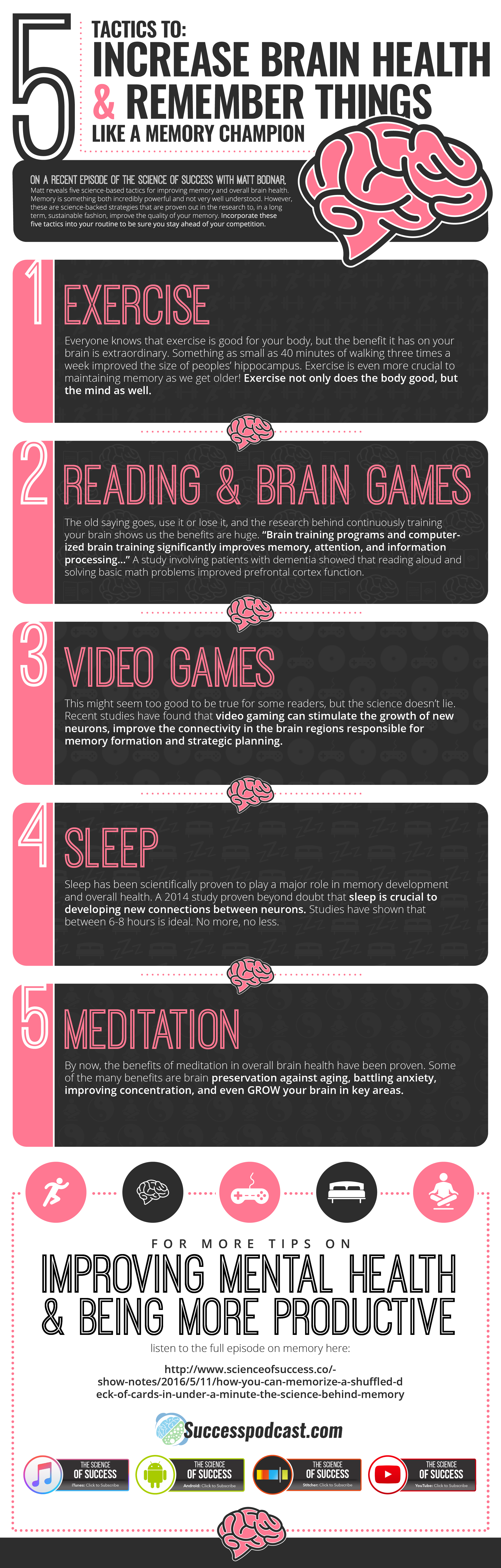


Thank you so much for listening!
Please SUBSCRIBE and LEAVE US A REVIEW on iTunes! (Click here for instructions how to do that!).
SHOW NOTES, LINKS & RESEARCH
[Book] Moonwalking with Einstein: The Art and Science of Remembering Everything (see here)
[Book] The Guardian of All Things: The Epic Story of Human Memory (see here)
Aerobic exercise increases hippocampal volume in older women with probable mild cognitive impairment: a 6-month randomised controlled trial (see here)
The association between aerobic fitness and cognitive function in older men mediated by frontal lateralization (see here)
Association of Crossword Puzzle Participation with Memory Decline in Persons Who Develop Dementia (see here)
Reading and solving arithmetic problems improves cognitive functions of normal aged people: a randomized controlled study (see here)
Reading aloud and arithmetic calculation improve frontal function of people with dementia. (see here)
Gaming for Health: A Systematic Review of the Physical and Cognitive Effects of Interactive Computer Games in Older Adults (see here)
Computerized and Virtual Reality Cognitive Training for Individuals at High Risk of Cognitive Decline: Systematic Review of the Literature (see here)
Sleep deprivation and hippocampal vulnerability: changes in neuronal plasticity, neurogenesis and cognitive function (see here)
Sleep, cognition, and normal aging: integrating a half century of multidisciplinary research. (see here)
What are the differences between long-term, short-term, and working memory? (see here)
Meditation’s Effects on Emotion Shown to Persist (see here)
Regular exercise improves cognitive function and decreases oxidative damage in rat brain. (see here)
Sleep to remember. (see here)
Mindfulness meditation improves cognition: Evidence of brief mental training (see here)
Mindfulness practice leads to increases in regional brain gray matter density (see here)
Computerized training of working memory in a group of patients suffering from acquired brain injury (see here)
A pilot study of an online cognitive rehabilitation program for executive function skills in children with cancer-related brain injury (see here)
A cognitive training program based on principles of brain plasticity: results from the Improvement in Memory with Plasticity-based Adaptive Cognitive Training (IMPACT) study. (see here)
Exercise training increases size of hippocampus and improves memory (see here)
A neuroimaging investigation of the association between aerobic fitness, hippocampal volume, and memory performance in preadolescent children (see here)
Hippocampal Binding of Novel Information with Dominant Memory Traces Can Support Both Memory Stability and Change (see here)
[Peak End] Patients’ memories of painful medical treatments: real-time and retrospective evaluations of two minimally invasive procedures (see here)
[Daniel Kahneman Ted Talk] The riddle of experience vs. memory (see here)
[Memory Palace] Improve Your Memory by Speaking Your Mind’s Language (see here)
[Joshua Foer Ted Talk] Feats of memory anyone can do (see here)
[Memorizing a Deck of Cards] How to Memorize a Shuffled Deck of Cards in Less Than 60 Seconds (Plus: $10,000 Challenge) (see here)
EPISODE TRANSCRIPT
In this episode, we're exploring the fascinating enigma of human memory; how memories are created and stored; why we remember certain things but not others; and how to improve your memory long-term; as well as an incredible tool to hack your short-term memory used by national memory champions; and much more.
Memory is something that is both incredibly powerful and not very well understood. How is your memory? Do you have a good memory? Do you have a bad memory? Do you forget things all the time? Memory is something that's vitally important. In many ways, our memories shape who we think we are. But memory is also something that's not well understood in many ways by the scientific community. In fact, I wanted to open with a quote from a fascinating book on memory, titled The Guardian of All Things by Michael S. Malone. Here's how he describes it. "What we do know is that a quarter million years after mankind inherited this remarkable organ called the brain, even with all the tools available to modern science, human memory remains a stunning enigma." Today, we're going to dig into memory a little bit. We're going to talk about how memories are formed. We're going to talk about the way your memory works; what happens when you recall a memory; and the difference between the experiencing self--the you who is experiencing this moment right now, who's listening to this podcast--and the remembering self--the image that you have of your life, of the experiences and the things that have taken place; and we're going to talk about and dig into how you can improve your memory both from a sort of long-term, sustainable standpoint, but also ways that you can trick your memory or use memory hacks to remember things like a deck of cards or pi to the 20th digit or whatever it might be, and these are often tricks that are used by national memory champions and people who compete in these memory competitions. So, we're going to really dive deep into memory today and I'm really excited about this topic. It's something that I've always been fascinated by and I can't wait to share some of these findings with you.
How Memory is Defined
Let's start out. I want to talk about how memory is organized to really define and understand memory, and I think there's another great quote from Michael Malone to give you some context about this. "Architecturally, the organization of memory in the brain is a lot more slippery to get one's hand around, so to speak. Different perspectives all seem to deliver useful insights. For example, one popular way to look at brain memory is to see it as taking two forms: explicit and implicit. Explicit, or "declarative", memory is all the information in our brains that we can consciously bring to the surface. Curiously, despite its huge importance in making us human, we don't really know where this memory is located. Scientists have, however, divided explicit memory into two forms: episodic, or memories that occurred at specific points in time; and semantic, or understandings (via science, technology, experience, and so on) of how the world works. Implicit, or "procedural", memory, on the other hand, stores skills and memories of how to physically function in the natural world. Holding a fork, driving a car, getting dressed--and, most famously, riding a bicycle--are all nuanced activities that modern humans do without really giving them much thought, and they are skills, in all their complexity, that we can call up and perform decades after last using them." Now, there's a lot of information in that quote. There's a lot to really unpack and I know it was a long quote, but it's something that I wanted to share because I think it explains very clearly the different components and the different structures of how our memories are sort of categorized, stored in the brain; what is understood; what's not understood; and the different components of memory itself.
Let's take a look at how memories are created, how memories are stored. They're stored using a process called encoding. It's a biological phenomenon. It's rooted in the senses and it begins with perception. We've talked before about how biology underpins and constrains and defines our minds in many ways. In fact, the first episode ever on The Science of Success was a podcast called The Biological Limits of the Human Mind, and if you haven't listened to that, it's a great primer on sort of the topic of biology and how it factors into psychology and neuroscience and how it controls the brain. But the encoding process is fundamentally rooted in biology and it begins with the process of perception. So, the hippocampus, which is a part of the brain, along with another part of the brain called the frontal cortex are responsible for analyzing all of our different sensory inputs and deciding whether or not they're worth remembering. This sort of filtering idea, this process of filtering out the mass amounts of information that fly in and hit you from every single instance of conscious experience is something we talked about in the episode about the reality of perception. We talked about how our belief structures are the filters that our mind uses to determine whether or not we should remember something, whether or not something was important or useful to remember.

But to be able to properly encode a memory, you have to be paying attention. You have to be focused on that event or that thing consciously. And constantly, every day, we filter things out or we never encode them to begin with, and so our memories don't exist. The simplest way to think about this is the example of lost keys. I'm sure everybody's had a moment where they came home, they misplaced their keys, and they don't know where they are. Or, you know, you walk through the door, you set your keys down somewhere, you're on the phone, you don't...you're not really paying attention, and then 20 minutes later you have no idea what happened to them. The crazy thing about this--and the way that encoding factors into this idea--is that many times when you've misplaced something, when you've lost your keys, even if you were just thinking about it, you've often not technically forgotten where your keys were placed, which is the sort of language that we use to describe that. And we talked about how language can shape our perceptions of reality when we talked about NLP in one of the previous episodes. But the language we use--say, oh, I forgot where my keys are--that language isn't really appropriate because what actually happened is that your encoding process, your conscious attention, was not focused on that, so you didn't forget where the keys were -- it never got into your memory to begin with. It was filtered out, and so you can't find, mentally, where they were placed. It's not a question of you forgetting something; it's a question of the encoding process in your mind never recording the keys' location to begin with.

So, one of the themes you're starting to see that's going to continue to emerge as we explore memory more deeply is that almost every piece of the process of both storing, recalling, understanding memory is fraught with sort of processing errors, is fraught with places where our memories aren't necessarily true or real or don't necessarily describe reality accurately. And we'll get into that more, but we also went in-depth on the implications of that idea in the episode about perceiving reality. So, if you haven't listened to that podcast, it really talks about once you understand the premise that memory is falsifiable, that memory isn't really true or real in many very physical and scientific ways, it starts to ripple through your life and you can really think about your beliefs, your world structure, the things that are happening around you. But I won't go too far into that. Again, there's an episode about that--perceiving reality--that we've already talked about it. But you're going to see a number of different instances of how what we call "memory" isn't something that's set in stone, that's a perfect definition of what happened in the past that we're recalling. It's often something that's very fluid, changing, and dynamic, and even when it's being recorded on the front end with encoding, processing errors can happen, things can be left out, and our memories themselves may not reflect what actually happened or things might be left out of her memories to begin with.

We hear a lot about the distinction between short-term memory and long-term memory, so I wanted to just address that, talk about it, and give you some simple working definitions of each of those so that you would have them and sort of have a deeper understanding of how each of them works. Short-term memory, very simply, can hold roughly seven items for about 20 or 30 seconds. And your short-term memory, it swings up and down a little bit. The actual sort of range is really about between five and nine items, depending on a number of different factors, for roughly 20 or 30 seconds. And one of the caveats to that is that if you have a deep network of long-term memories or information that's mapped in your neural network, if you see something, it can actually very quickly be taken from your short-term memory and placed and plugged into a specific slot or component of that larger long-term memory neural network about whatever that topic is. And so things can, especially if you're an expert or you have a very detailed understanding of something, something can immediately sort of jump from your short-term memory into your long-term memory if it's plugged into the right piece of that mental network. And that's something that Charlie Munger, who we've talked about before on the podcast and are huge fans of, really digs into when he talks about the idea of sort of an interconnected or interlaced network of mental models that is self-reinforcing.

When you have deep knowledge of something, when you have a lot of myelin in your brain around the neural networks or around the patterns of understanding something very deeply, it can more quickly be placed from the short-term memory into the long-term memory. But there are really two fundamental distinctions between short-term memory and long-term memory. One is the concept of temporal decay, i.e. the idea that things fall out of your short-term memory after about 20 or 30 seconds. And the second is that your short-term memory has capacity limits, right. Your short-term memory, it can only hold a certain amount of information, whereas your long-term memory can hold vast amounts of information and, despite sort of the challenges with encoding and recalling memories, in many ways is relatively permanent. And, again, we talked about at the top how it's not fully understand or totally known how and where all of our memories are stored, but it's believed that short-term memory is the primary function of the prefrontal cortex of the brain.

To look at and describe long-term memory, I'll share another quote from Malone. "Chemically, we have a pretty good idea of how memories are encoded and retained in brain neurons. As with short-term memory, the storage of information is made possible by the synthesis of certain proteins in the cell. What differentiates long-term memory in neurons is that frequent repetition of signals causes magnesium to be released, which opens the door for the attachment of calcium, which in turn makes the record stable and permanent. But, as we all know from experience, memory can still fade over time. For that, the brain has chemical processes, called long-term potentiation, that regularly enhances the strength of the connections, or synapses, between the neurons and creates an enzyme protein that also strengthens the signal -- in other words, the memory inside the neuron." So, getting a little bit deeper into the science and really talking about the physical processes, remember, memory fundamentally is a biological process rooted in your mind and that's how memories are physically encoded into cells. But, take that with a grain of salt because we don't fully understand exactly how memory works.

Now, let's examine how to recall a memory. This is a critical point in something that is very interesting. There's a 2013 study in the Journal of Neuroscience by Donna Bridges, and the study shows that when we recall a memory, it actually makes...every time we recall a memory, it makes the memory less accurate. Think about that. Let that sink in for a moment. The reason that's the case is because when you pull up a memory and then you put it back, your brain makes tiny changes to the memory every single time that happens. And if you think about it almost like the game of telephone, where you whisper something down the line into somebody's ear and they whisper it to the next person, et cetera, the message often gets completely distorted after it's been passed through a number of different people. The same thing can happen to our memories. Every time we recall something, we're putting it back with slight tweaks, slight changes, and, over time, again and again and again, we can completely distort or create memories that never existed to begin with. Here's how Donna Bridges describes it in her study. "A memory is not simply an image produced by time traveling back to the original event. It can be an image that is somewhat distorted because of the prior times you have remembered it. Your memory of an event can grow less precise, even to the point of being totally false with each retrieval." That's a pretty clear statement. That's a pretty clear distinction. Point blank, the researcher in this study is saying that your memories can be totally false. Really let that sink in for a minute. And, again, we talked about a lot of the implications of what happens when we realize that our memories are false in a prior episode about the reality of perception, so if you want to dig into that topic or that's something that you're sitting in your chair thinking, wow, that's crazy; I can't believe that my memories literally can be false, check that episode out because we talk about what that means and how that can impact your reality and a way that you can really use that your advantage in many ways.
The next idea is something that ties into the notion of how our memories can be false or how our memories can be manipulated. This is something called the peak-end phenomenon. You may have heard of it. The peak-end phenomenon essentially states that every memory you have of any experience is sort of shortened down to two, fundamental things. One is the peak--either the emotional high or the emotional low of that experience--and the end. Your mind essentially takes both of those things, kind of merges them together, and says, okay, this is what the memory of this experience or this event is. And in a 1993 study, Nobel Laureate Daniel Kahneman, the author of Thinking Fast and Slow, which is an amazing book--highly recommended and one of the books that I previously gave away to listeners as one of my favorite psychology books--they've done a number of different studies ranging from colonoscopies to waiting in line, all kinds of different things. But they have a very simple study where they had people keep their hands submerged in freezing cold water for 60 seconds. They then had the same people stick their hands in freezing cold water for 60 seconds--the same temperature--and then 30 seconds after that in a temperature that was one degree Celsius warmer, which created the effect of... It was slightly warmer to the point where it was slightly more comfortable, but, overall, it was still 30 seconds longer and still relatively uncomfortable and relatively painful. If people were totally rational and our brains were totally rational and memory was perfect, everyone would have chosen, if they had to do it again, to do the 60-second version instead of the 60- plus 30-second version, right. Nobody's going to pick basically a 50% longer period of suffering. But when they actually had people do it and gave them the choice to pick either the 60-second version or the 90-second version, 69% of the people, of the participants in this study, chose to repeat the longer version of the experience. They chose to go for the 90-second version, and the reason is simple: Their memory of the experience was skewed overall by the end of the experience. Their memory of the slightly warmer water... It was one degree Celsius warmer, which is about two and a half degrees warmer in Fahrenheit perspective. One degree warmer Celsius -- they chose that longer experience because that ending was slightly less painful than the other ending. And, again, those results have been replicated in a number of different studies looking at a number of different things, including colonoscopies, where they had people sort of rate the pain and the experience of their colonoscopies, and the people who had...even if they had a much longer colonoscopy that had much more painful, sort of high-intensity moments, at the end was better, people would rate it as shorter, people would rate it as a better experience overall because their memory of it was much better because the end had such a huge, disproportionate weighting on their total experience of it.

There are obviously huge implications to this. Not only do your memories of most of your experiences not necessarily accurately reflect the experience as a whole, but there are also ways you can use this to trick yourself or game yourself or tweak experience that you have so that you can remember them in a certain way, either positively or negatively, depending on how you want the experience to be remembered, and you can also modify experiences that other people are having that you're in control of in a way that you can have them have a more positive or more negative experience just by changing the ending of the experience. Kahneman also talks about--in a fascinating TED Talk, which we're going to link to in the show notes, titled The Riddle of Experience Versus Memory--about the distinction between what he calls the experiencing self and the remembering self. And, essentially, your experiencing self is your conscious self right now, in this moment, and the experiencing self experiences things for about three seconds. Consciousness is defined as roughly kind of a three-second interval of experience. Your remembering self is the self that looks back and says, oh, this was an amazing trip; oh, this was a fun experience; et cetera. The reality is that your experiencing self and your remembering self have very different perceptions of happiness; of events; of reality; of what they like; of what they dislike, and those can have dramatic implications for your experiences and for your memories. I'm going to talk more about the implications of the remembering self versus the experiencing self and how you can use things like the peak-end phenomenon to tip the scales in the favor or to structure your days or to structure the experiences in your life to optimize for either more positive experience or more positive memories.

Now let's dig in and talk about some of the tactics you can use to improve your memory. And, again, this is distinct from what we'll talk about after this -- more mind hacks or tips and tricks you can use to game your memory, to make it more effective, or to remember things like a memory champion. These are more science-backed strategies that are proven out in the research of ways to, in a long-term and sustainable fashion, improve the quality of your memory. The first is exercise. A 2011 study found that exercise increases the hippocampus size and improves memory. Specifically looking at just brisk walking, they found that 40 minutes a day, three days a week improved the size of people's hippocampus. We don't know the exact specifics of how memories are stored, but we do know that the hippocampus is a critical component of memories, both short-term and long-term, and so improving the size of the hippocampus via exercise is something that you can do to help yourself get a better memory. Another study in 2010 found that physically fit children performed better on a memory test and had a 12% larger hippocampus than children who were in the control group that didn't have as high quality of physical fitness. Another study found that the brains of older adults who exercised, in an MRI scan, looked more like the brains of younger adults. Additionally, there have been several other studies linking exercise, particularly aerobic exercise, to memory maintenance and improvements in cognitive function. And, in the show notes, we're going to include links to all of these research studies. So, if you want to dig, if you want to do your own homework, and you want to check some of these sources out, you can just go to scienceofsuccess.co--scienceofsuccess.co--click on the "Show Notes" button, and you'll see all of the show notes, all of the research for this episode and you can dig into every study that we've mentioned and talked about on the episode.

The next thing you can do to improve your memory is keep your brain active with things like reading and brain games. A 2008 randomized controlled study found that reading and solving simple arithmetic problems improved the cognitive function of people. There was also a 2005 study, that simply reading aloud and doing simple math problems improve the prefrontal cortex function of people that had dementia. So, even people who are having dementia or deterioration of their brain function can use something as simple as reading and doing simple math problems to improve the quality of their brain, to improve the quality of their memory. There's also a 2009 study, titled A Cognitive Training Program Based on Principles of Brain Plasticity, that showed that brain training programs and computerized brain training significantly improved memory, attention, and information processing, and that people who trained with brain-training software were twice as fast in processing information and they scored as well on memory and attention tests as people who were 10 years younger than them. A 2011 study also showed that crossword puzzles were an effective tool of warding off memory loss and of warding off the onset of dementia. So, something as simple as keeping your mind engaged with reading, with brain training, with crossword puzzles -- all of these things help keep the memory alive, help keep your memories functioning as you grow older and as your memory begins to deteriorate.

The next thing you can do, which is related to the topic we just talked about, is to play video games to improve your memory. And I love this one. You know, as longtime listeners will know, I'm an avid video gamer, so this is something that makes me very excited. But there was a 2013 study, titled Gaming for Health: A Systematic Review of Physical and Cognitive Effects of Interactive Computer Games in Older Adults, that found that the cognitive domains of attention, executive function, and memory showed consistent improvements across the board for people who played video games. So, if you need an excuse to play some extra video games, tell yourself that you're working on improving and protecting your memory.

This next tool for improving memory shouldn't come as much of a surprise. Sleep is as an incredibly powerful tool that you can use to improve memory function. A 2015 study, titled Sleep Deprivation and Hippocampal Vulnerability: Changes in Neural Plasticity, Neurogensis, and Cognitive Function, had a number of findings about the importance of sleep for brain function and for memory function in particular. Sleep benefits neuroplasticity, which we've talked about on previous episodes how important that is, the ability of your brain to change and adapt and grow and improve. Sleep deprivation impairs the hippocampus, which we talked about earlier in this episode, about how the hippocampus plays a vital role in both storing and encoding memories and holding them for the long term. Sleep deprivation reduces hippocampal neurogenesis and hippocampal volume, so this shows that sleep deprivation has a number of negative implications for the volume and the neurogenesis in the hippocampus. And, lastly, chronic sleep disruption contributes to cognitive disorders and psychiatric diseases. I don't think it's any secret that sleep is incredibly important, but this shows you that just getting a good night's rest can be integral to keeping your mind healthy and keeping your memory healthy. And we talked about in one of our previous episodes, where we interviewed the podcaster Gregg Clunis, some of the tactics and strategies that he uses to improve the quality of his sleep. A 2015 study, titled Sleep, Cognition, and Normal Aging: Integrating a Half-Century of Multidisciplinary Research, found that maintaining a good sleep quality promoted better cognitive functioning, protected against age-related cognitive declines, and helped improve memory. And, again, we've talked about in previous episodes how important meta-analyses are. So, this was an analysis of a number of different studies, looked across correlations, looked at the results of a number of different studies and found that, across the board, high-quality sleep led to improved cognitive function and improved memory function.

And, last but not least, meditation is an incredible tool that you can use to improve your memory, your working memory, and your recall. Thiis shouldn't come as a surprise. In fact, we have a previous podcast episode about meditation where we talk about a ton of the science behind it, how important it is, and give simple and easy tools that you can use to learn how to meditate. A 2011 study found that meditation changes brain structure, improves attention span, and increases gray matter in the hippocampus specifically. People who meditated for 30 minutes a day for 8 weeks saw their hippocampal density increase as measured by an MRI scan. The control group, who did not meditate, had no changes in their brain density. So, that's a pretty clear-cut, compelling example of how meditation literally changes the structure of your brain, increases the size of your hippocampus, and improves your ability for recall and for working. memory. There was also a 2010 study that found that short, 20-minute meditation studies improved your concentration. When comparing the participants to the control group, they found that the participants who have meditated for 20 minutes a day fared much better than the control group on timed, concentration, and memory tests. And, again, encoding, when we store memories in our brain, having the ability to have a really clear focus, to be able to capture information in the present is a critical component of storing and building memories that truly reflect reality. So, meditation is not only a tool that helps grow the size of hippocampus, but it also helps you focus. It also helps you capture that information on the front end so that you can more effectively store it in your memories.

Now, let's dig into a couple memory hacks. And these aren't necessarily physical ways to improve your long-term brain health, but they're simple ways that you can remember more information. The core technique is something called a memory palace, and this an idea that I originally discovered in the book Moonwalking with Einstein. It's a book about a science journalist who goes to the U.S. National Memory Championships and he initially has the idea of learning about the event, covering it, maybe discovering some eclectic characters. But what he comes away with -- he gets kind of roped into the community and actually ends up training under Ed Cooke, who's a memory Grand Master and one of the sort of best memory competitors in the United States. He ends up training with Ed Cooke for a year, comes back, and wins the memory championship the next year. It's a great book. It's a fascinating read to begin with, but it can also really dive into some of these ideas. But the memory palace has been around since Ancient Rome. It's something that orators and speakers in Rome used to use to memorize their speeches and it's something that enabled the eight-time World Memory Champion Dominic O'Brien to memorize 54 decks of cards in sequence, which, if you look at that, that's 2,808 cards in sequence, viewing each card only a single time. So, a memory palace is an incredibly powerful technique.

A memory palace is an idea that taps into the visual-spatial components of our memory. Our minds are designed... And if you think back, again, to the biological limits of the mind, from an evolutionary standpoint, the things that we're best at remembering are spaces and places. And so a memory palace essentially takes a place that you know incredibly well and you plant in pieces of information across that space. So, the simplest way to do a memory palace, the simplest place to think about as a memory palace, is your childhood home or your current home. If you pause for a moment and think about it right now, you can probably picture in intimate detail every component of the house -- the front door when you walk in, the living room, all the different bedrooms, the bathrooms, the kitchen, et cetera. You can see all the various components of that house. And what you do is basically create a map of that memory palace, and you can do it with any location. You can do it with a number of different locations. But you create this map and then you place different components into different pieces of the memory palace, and you follow them in a predetermined path. So, essentially, you want to create sort of a visually associative story, a string of things that lets you remember a huge list of numbers, entire decks of cards, et cetera.

And there's another component to this called memory pegging. This is essentially the idea of taking a predefined concept and some sort of visual image and tying it back into something that you want to remember, whether it's a number, whether it's a playing card, whatever it might be. And that's actually where the title of the book, Moonwalking with Einstein, comes from, because these memory champions use the brain's incredible power to think in images and to think in stories, and they create a very vivid, unforgettable image for each different playing card. Each one has its own, unique, defined image, and then when you stack the playing cards together, they basically tie each image to the next image. So, for example, Moonwalking with Einstein was a technique that the author of the book had used to tie in two different concepts together because it's an unforgettable image. Similarly, you can tie any two things together. All you have to do is create ahead of time an associative framework of each of the different...whether it's numbers or playing cards or whatever it might be, and I'll give you a very simple example. If you wanted to associate numbers--let's say the numbers one through ten--with certain things, you could associate the number one with a candle because it sort of looks like a candle, and then that's something you can use when you want to remember the first thing or you want to remember something that involves a one -- you create a mental image with a candle. The second: If you wanted to create something for the number two, you could use a swan because a swan sort of looks like a number two. And we can go down. You could use a heart for number three. If you turn a three on its side, it kind of looks like a heart. We could use a sailboat for the number four. It kind of looks like a sailboat. All the way down.

You could do it with anything you wanted to associate, but let's just use those four numbers. If I wanted to remember the number 41, I could simply take the image of the sailboat, which is number four, take the image of the candle, and we could have...create some kind of ridiculous image. Let's say I wanted to remember the key code to my garage. Let's say it has a keypad and the keypad's four digits, and the number is 4331. So, if we go back to the images we've created, we've got the sailboat, which is number four; we've got the heart, which is number three; and we've got the candle, which is number one. If I wanted to lock that memory in so I could never forget it, I think about the mental image of that keypad in my garage and I think about a gigantic sailboat with two bright red hearts painted on the side of it or even carrying two giant hearts, and a candle on top that's melting wax on all these different hearts, crashing into my keypad. This huge sailboat falls out of the sky with two giant hearts on it and a candle on top, crashing into the keypad. It's a ridiculous image, it's totally over the top, but it's something...those kinds of over-the-top, insane images are something that the brain latches onto and captures. And so when you go back, the next time you see the keypad, you trigger that visual association of a giant sailboat with two big hearts on it and a huge candle on top, melting wax on top of the hearts, and you really try to tie that in. You want to feel it. You want to smell it. You want every piece of the experience. And next time you see that keypad, you think of that crazy image that you thought of and suddenly you know that the thing is, okay, we've got 4331. That's what the...That's exactly what the passcode is.

So, that's how you tie in those memories and that's the same technique that these memory experts use to memorize an entire deck of cards by looking at each card a single time, or use to memorize pi to the 50th digit, or whatever it might be. Some of the feats that these guys accomplish are incredibly ridiculous. Similarly, memory champions do the same thing by associating every single card in a deck of cards with an individual person. For example... And there's actually a matrix that you can use or create that you can kind of fill in and tag each of these associations. But, for example, you could associate Michael Jordan with the ace of diamonds and you could associate Lady Gaga with the six of spades, and so if you have those two in order, suddenly you create this crazy mental image of Michael Jordan bumping into Lady Gaga or whatever it might be. While this sounds a little bit over the top, this is a way to speak the same language as your brain. This is a way that you can communicate with your brain in a visual-spacial sense, with unforgettable visuals that let you kind of tap into and harness the power of memory. And we're going to include a couple links in the show notes where you can really dig down and go deep on both the concept of memory palaces, the concept of memory pegging, which is essentially the idea of tying specific objects--whether they're numbers, whether they're playing cards, whatever they might be--to specific, ridiculous images so that you can chain them together into these memories. And we're going to provide you with some examples of ways that you can use those things if you want to build those associations so that you can play around with creating these visually associative memory stories in your mind.

Lastly, I wanted to look at how we can sort of hack or trick our memories to change the way that we remember things, to change the way that we remember certain experiences. A good way to think about this is going back to the idea of the experiencing self versus the remembering self, and thinking back to how the peak-end phenomenon also plays into this and how our brain's visual-spatial thinking also plays into this concept. There's two really distinct ways that you can kind of play with your mind and play with your memories. One of them is if you've ever had... Let's say you had a week-long vacation where you go to the beach. Because there's not a ton of differentiation in each specific thing that happens, that memory is sort of consolidated into one memory of "week at the beach" and it feels like a certain link to your mind. But I'm sure you've also had maybe a three-day weekend where you were just packing all kinds of stuff and you were going here, you were going there, you were doing all this new, exciting, different stuff, and those three days felt like two weeks. And it just felt incredibly long and, when you remember it, it seems like...the trip seems almost longer than that week-long vacation at the beach. And that's because, to your memory, it literally is. In your mind, when you have a memory of something that there's not any variation, there's not any difference, you're going to remember that as sort of one specific experience. But if you have 20 different things that all happened, those are all specific and different memories that are all tied into the same thing.

So, how can you apply this to your life? Ed Cooke, who's a memory Grand Master, has a great example where he talks about the concept of if you have a dinner party and you have people over at your house. If everyone sits in the same room for the entire time and does the same thing, you're going to have one memory of that dinner party. It's going to be people in that room doing that thing. However, if every 30 minutes or every hour of the dinner party you move to a different room in your house, you put on different music, and you do something different, suddenly you're going to have distinct chunks of that memory. It's going to be broken out into different components, and so the memory's going to feel much more rich, it's going to feel much more detailed, and it's going to feel like you did a lot more, you accomplished a lot more things.

So, those are kind of some ways that you can think about how to modify your conscious experiences so that when you look back at them from a memory standpoint, the memories feel much more rich and much more detailed. If you just do the same thing for 12 hours straight, your memory is doing that one thing. But if you spend each of those hours doing something completely different, your memory is going to be much more rich and diverse and, when you come back to it, it's going to feel...you're going to have a lot more texture to that memory. And you can change places and spaces, and that will change and kind of trigger your memory to remember something new because novel, new, and unique things are what get flagged and what get remembered. Things that are the same or that are ubiquitous just kind of get lumped into the same memory category. So, those are a couple different techniques and tricks that you can use, kind of memory hacks that you can use to improve your memory both from a physical standpoint, from a long-term perspective, but you can also use a number of these in the short-term to be able to memorize an entire deck of cards. And we'll include... Again, we'll include a couple links in the show notes so that if that's something you're interested in doing, you can check out some of the articles and go through some the exercises that you can actually memorize pi to the 20th digit, you can memorize a deck of cards, et cetera, using the memory palace and memory pegging techniques.
The Neuroscience Behind Einstein and Isaac Newton’s Biggest Breakthroughs

In this episode we will talk about the incredible neuroscience behind the biggest breakthroughs of some of the world’s smartest minds, how those same principles apply to a world champion’s "daily architecture," and how you can design your day the same way to harness this powerful strategy.
This episode goes deep on:
The neuroscience behind Einstein and Isaac Newton’s biggest breakthroughs
How one world champion structures his entire day around this one key principle
Simple steps to structuring your day in the same way to harness the untapped power of your subconscious mind
How to harness the subconscious mind for huge creative insights
How to break through challenging questions and problems
The 4 Phases of the Creative Process
What the science says about cultivating creativity and creative incubation
And much more!


Thank you so much for listening!
Please SUBSCRIBE and LEAVE US A REVIEW on iTunes! (Click here for instructions how to do that!).
SHOW NOTES, LINKS, & RESEARCH
Creativity—the unconscious foundations of the incubation period (see here)
Enhancing Creative Incubation (see here)
The Incubation Effect: How to Break Through a Mental Block (see here)
The Science of Creativity (see here)
Incubation and creativity: Do something different (see here)
[Electrical Current Study] Noninvasive transcranial direct current stimulation over the left prefrontal cortex facilitates cognitive flexibility in tool use (see here)
[Wallis Model] Wallis' model of the Creative process (see here)
[The Real Neuroscience of Creativity] (see here)
[Understanding Research Studies] Battling Bad Science Ted Talk (see here)
[Importance of Meta Studies] Why Most Published Research Findings Are False (see here)
EPISODE TRANSCRIPT
In this episode, you're going to learn the secret behind both Einstein and Isaac Newton's greatest insights; how a world-champion martial artist and national chess champion structures their daily architecture; how to harness your unconscious mind for huge, creative insights; the science behind creativity; and much more.

Have you ever had that aha moment (the eureka moment, as they sometimes call it)? I'm sure you've heard the stories about famous eureka moments throughout history, whether it's Isaac Newton, one of the most prolific physicists of all time and many ways one of the founders of modern physics has a famous story about an apple falling from a tree and hitting him on the head and giving him some of the insights into gravity and physics and how it worked. Another classic story is that of Archimedes and his bathtub. That's actually the origin of the eureka moment. Another one is Einstein and his insight about relativity. But I'm sure you've had some of these moments in your own life, too. Have you ever had that situation happen, where you're dealing with something that you're kind of stuck? You know, you're grinding away. You can't overcome this challenge or you can't put this thing together, or you can't... Maybe it's even sometimes if you're playing a game and you get stuck against this boss and you can't beat them, and then you go have lunch, you go step away for an hour, and you come back and boom — you immediately do it. You fix it. You achieve it on your first try. I think we've all had that moment, and that's connected with the same kind of idea, the same theory of these aha moments, these eureka moments, and it's a concept that's rooted in science. It's something called creative incubation. Creative incubation is defined as a process of unconscious recombination of thought elements that were stimulated through conscious work at one point in time, resulting in novel ideas at some point later in time. Today, we're going to explore the science behind creative incubation and how we can use it in our daily lives.

Remember Josh Waitzkin? We've talked about him on a number of other episodes of the Science of Success. Josh is a multi-time national chess champion; the person who was featured in the documentary *Searching for Bobby Fischer*; a child chess prodigy who then went on to be a two-time world champion martial artist; and now is a performance coach for some of the most successful people on the planet.

Josh talks about an idea of building a daily architecture around maximizing your creative process, leveraging the concept of creative incubation. To paraphrase him, you want to create rhythms in your life that are based on feeding the unconscious mind, which is the wellspring of creativity, and then tapping it. And I want you to remember creativity shapes everybody's life. Even if you're not an artist; even if you're not a creative; even if you're an accountant; even if you're a CFO; even if you're an engineer; you don't think that creativity applies to you... It fundamentally applies to everything. Everybody has an art. Everybody has a craft. Business could be your art. Accounting could be your art. Engineering can be your art, can be your craft. It can be something that you're constantly refining, constantly applying. Creativity is such a broad and important topic, and it often gets kind of shoveled into a certain realm of sort of marketing creativity, art, all that kind of stuff. But the reality is every single businessperson, every single teacher, every single engineer, every single accountant... Whatever it might be, you can benefit from creativity. You can benefit from leveraging the process of creative incubation to make yourself smarter and to solve difficult challenges that you encounter along the way.

We're going to start by looking at the four phases of the creative process as it's defined by the Graham Wallas model in neuroscience. This was uncovered in the 1920s — a framework that neuroscience and psychology have since used to think about and understand the creative process. And there are four phases. There's preparation, incubation (which we're going to focus on today primarily), illumination, and verification. All four of these phases are relatively straightforward.

In the preparation phase, it's all about defining the problem; understanding the problem; gathering the information that you need, sometimes from unique and disparate sources; and feeding all the information into your mind so that your subconscious can then process it and put it together and recombine it in new and unique and different ways.

The next phase, incubation—which we're going to get into the weeds on here in a minute—is about taking a step back from the problem. It's about focusing on something else. It's about letting go of the conscious focus on the issue and then returning to it in a structured way later on to kind of tap that unconscious power, to harvest what your subconscious mind has processed, and then bring that to the forefront — and that's what illumination is about.

Illumination, the third phase, is where these ideas arise in the mind and, based on what the subconscious has processed, you start to see the challenge from a new perspective, from a new light. You start to gain a new insight.

And, lastly, verification is kind of fact checking. It's thinking, okay, does this new insight make sense? Does it apply? Testing it out and figuring out if you can actually use it to solve the challenge that you're dealing with.

Those are the fundamental components of how science defines the creative process, but incubation in itself is still not very well understood. Researchers know the effect exists, but they're not 100% certain what neural networks are involved, what parts of the brain are involved. They don't know exactly how or why the process functions, but they do know that is exists. And we're going to look at a couple different studies that kind of describe or examine the process and the effect of incubation, and sort of show that it's true and that it's real.

The first is a study from 2003 titled *Incubation in Problem Solving and Creativity*. This was a meta-analysis, a meta-review of a number of different studies, and I want to pause for a second and talk about this concept. If you've ever done much digging into the different kinds of studies, science, good science, bad science, how bias an affect the conclusions of research studies, et cetera... It's a deep rabbit hole and there's some interesting topics on it, which I'll include some articles in the show notes, that you can really kind of dig into that if you want to. And I'm going to include, also, all this research in the show notes as well, which you can access just by going to scienceofsuccess.co/show-notes or just scienceofsuccess.co and you can click the "Show Notes" button.

Anyway, meta-reviews or meta-analyses are, in many ways, sort of the king of studies. They're studies that look across many different other studies that have taken place and they kind of say, okay, if we have 30 different studies that have examined this topic, what are the shared conclusions? What are the things that we can kind of pull out of this and say, okay, maybe a couple of these studies had biases, maybe a couple of these studies had flawed methodologies, but we can pull out some real learning, some real information from this? So, the first one—the 2003 study—was a meta-review of 39 different studies around incubation, and what they concluded was that 29 of those 39 experiments found a significant incubation effect and that one of the major findings across all those studies was that preparation activites substantially increased the effect and the power of the incubation effect. So, that's something we're going to talk about once we talk about how to leverage and apply this concept to build a daily architecture, but just keep in mind that preparation is an essential component and that across 40 different studies, essentially, they found a very strong and significant effect from incubation.

The second study in 2009, titled *The Incubation Effect: Hashing a Solution*, was another meta-review of 117 independent studies across all kinds of different aspects of incubation and the incubation effect, and, again, they found a strong, positive correlation. They found strong evidence of the incubation effect existing across the majority of the studies that they looked at. So, this is something... This is not just a colloquial idea. It's not something that is sort of woowoo or made up. It's something that you can tap and harness and leverage the science to apply, to make yourself more effective in your daily life. And, again, both of those studies are meta-reviews. They're meta-studies, and that is often kind of considered the king of research studies because it draws from so many different areas and it helps sort of mitigate and filter out a lot of the biases. Think of it in the same way that you'd think of the power of diversification from a financial standpoint. Similarly, having a vast array of studies, you kind of cancel out some of the errors in many ways and you're able to really let the cream rise to the top.

The last study—and this factors, again, into the importance of how do we structure daily architecture around this—looked at the importance of sleep. This is a 2001 study titled *The Committee of Sleep: How Artists, Scientists, and Athletes Use Their Dreams for Creative Problem Solving and How You Can, Too*. This was an interview study focused around artists, scientists, even Nobel Prize winners, and it looked at everything from math, music, business, all kinds of different elements. Again, this is an incredibly important point. Just because you don't think that creativity necessarily applies to what you're doing, it absolutely does in many different ways. Even in contexts that you wouldn't necessarily think about, you can leverage these creative tools to empower and improve your decision-making and your problem-solving abilities. And what they found was that sleep was a very important factor in the creative incubation process and that sleep was a vital tool to kind of fueling and empowering the subconscious in a way that enabled people to solve these challenges using creative incubation.

Now, let's look at structuring your daily architecture around these principles of creative incubation. The first important step is preparation and conscious focus on the question or the challenge that you're dealing with, and I can't understate this enough. There's a study titled *Creativity: The Unconscious Foundations of the Incubation Period* in the journal of *Frontiers of Human Neuroscience*, and this is one of their findings. "Although unconscious processes can be a powerful source to facilitate creativity, only engage in daydreaming or sleeping to produce groundbreaking discoveries or great artistic creations will not do the trick. A plethora of raw materials has to be available to be connected and one has to be able to focus on some options out of an array of options. In this sense, conscious processing is needed to establish a knowledge base, to know what problems to tackle, and to verify and implement new ideas."

What does that mean? It means you need to feed your brain. It means you need to constantly be picking up and use the conscious elements of your brain to focus on both the problem and the challenge that you have, but also potential solutions, potential alternatives, and even sometimes things that you wouldn't necessarily consider as possible alternatives because your subconscious is able to combine, recombine, use distinct and different elements to create something that you would consciously not be able to do, to connect things that you consciously wouldn't be able to connect to form a novel and unique solution.

The next step is to let go, right, is to focus on something else, and this is a critical component. You have to be able to release yourself from that challenge or from that focus, from that question. If you are trying to creatively incubate a problem and you sort of consciously turn your focus to it, and then 15 minutes later you're checking your email or you're thinking about it again or whatever, you're not going to gain the benefits of creative incubation. You have to let go. You have to focus on something completely different. You have to just let that problem melt away. And in the context of structuring a daily architecture, one of the ways to think about this is... We'll talk about this in a second when we get back to how Josh Waitzkin thinks about his daily architecture and how you can structure it, but you want to end your day with quality. You want to end your day with a focus on whatever problem or challenge is most relevant, is the biggest hurdle in your life right now, the biggest challenge that you're dealing with right now. You want to, at the end of your work day, consciously turn your attention to that question, to that challenge, and even to the extent of writing it down and saying, you know, "How am I going to deal with X?"

And then you have to let go. So, let's say at the end of your work day, you end it with quality, you end it with that focus, again, feeding the brain, preparing the conscious mind to give the information to the unconscious. And then you release the problem and you let go. You cease your focus on your work, you spend some time with your family, maybe you read, watch TV, play video games, whatever is your cup of tea, right. The next critical component in this daily architecture, after you've had that sort of unwind period, the period of letting go, is to sleep, and we talked about before the study, the importance of how critical sleep is. But sleeping really enables you to kind of fuel and supercharge that processing power.

The next step of this daily architecture is when you wake up, you want to return to the problem, but there's a key distinction. When you return to the problem, you want to do it in a way that's pre-input. You want to do it in a way that you're not getting up, laying in bed, checking your emails, suddenly you have seven different things bombarding your mind that you need to deal with. You need to get up and to really kind of harness this daily architecture. As soon as you wake up, before you check your email, before the world sends all of its demand to you, spend ten or 15 minutes just journaling or addressing or coming back to that problem or that challenge, and the critical component here is you have to do it in a state of mind where you're still proactive. You're not reacting to everything, and this is something that Josh Waitzkin is incredibly adamant about in the way he talks about leveraging creative incubation to structure your daily process, you have to have that space before the world interrupts you that you can really untap and really let the subconscious mind kind of flow into solving the problem. As he says, if you don't do this, quote, "Your creative process becomes dominated by external noise instead of internal music." End quote.

And to sum things up, here's how Josh Waitzkin himself describes this entire process. "What I work on is feeding the unconscious mind, which is the wellspring of creativity. Feeding it information and then tapping it. For example, ending the work day with high-quality focus on a certain area of complexity where you could use an insight, and then waking up first thing in the morning, pre-input, and applying your mind to it, journaling on it, not so much to do a big brainstorm but to tap what you've been working on overnight." End quote.

That's, in essence, how you can sort of structure a simple daily architecture around leveraging the creative incubation process. But there's actually another thing you can do in sort of a short mini-burst to capture the same effects of creative incubation in a different context, and that's if you're going to lunch, if you're going to the gym, if you're taking a break, if you're going for a walk, whatever it might be, you can do the same thing. You can post a question or a challenge to yourself and then go to lunch, and then go for a walk, whatever it might be. Come back an hour or two later and do the same sort of mini-journaling and tackle the question again. Often, these short sort of mini-bursts will enable you to, throughout the day, multiple times tap your subconscious processing power and really leverage the power of creative incubation to be able to solve challenges and problems that you're facing.

So, while the biggest use of this—and again, we talked about how important sleep is as part of this process—the biggest and best use of this is to structure your daily architecture in a way that you're ending the day with a quality question of focus using the conscious mind to feed the information to the subconscious mind, letting go of the problem, sleeping, then waking up and returning to it before the world has had a chance to hit you with all kinds of inputs. That's the overarching way to leverage creative incubation for your biggest challenges, but you can also do it on a smaller scale with smaller issues or challenges by using these sort of mini-bursts or mini-breaks with things like lunch, gym visits, going for a walk, et cetera.

There's two or three other considerations to think about when you're structuring your daily architecture like this. One of them is that flow states, especially our play states, with something that's really engaging and engrossing, where you're totally focused on it. Enable you to kind of break from the conscious focus on that problem. So, even something like taking a break for 45 minutes to play video games, often you can return back to the problem you were dealing with and, because you've been so engrossed in that, your conscious attention is completely focused on it. Your subconscious will be able to process all that information using creative incubation. You can return and have a new insight into whatever you're dealing with.

Another thing that can sort of supercharge, or be a powerful factor in improving the quality of your creative incubation, is to use meditation as a tool and to build that into the daily architecture, end the day with quality, let go, go to sleep, wake up, meditate, and then go to journaling on that process. Meditation is a force multiplier when you factor it into the process of creative incubation. We talked about meditation. We have a recent episode about it that's awesome, and if you haven't listened to it, I highly recommend checking it out. It gives you a very simple way to get started a framework, and talks a lot about the science behind why meditation is such a powerful tool. But meditation can be something that can exponentially increase the power and the ability of your daily architecture structured around the power of creative incubation.

That pretty much sums up the topic of creative incubation and creativity. This daily architecture, or even just using mini-bursts, is something that you can apply in your daily life that can help you become much more effective and help you solve some of the biggest problems and challenges that you're dealing with. I really think you should give it a shot. Try it for a day or two. Try it with a specific problem or challenge. See if it works for you and let me know on Twitter or in the comments or send me an email, whatever you want to do. I'm really curious to see how creative incubation works for you.
Hacking Sleep, Improving Creativity, and Research Backed Strategies for Success with Gregg Clunis

In this episode you’re going to learn how a few tiny leaps can help you achieve your goals, how to optimize your day around your biorhythms, the truth about the difference between night owls and early birds, how to invest in improving your sleep, practical steps to increase your creativity, and much more with our guest Gregg Clunis. Gregg is the creator and host of Tiny Leaps, Big Changes - a rapidly growing podcast that shares simple research backed strategies to get more out of your life.



Thank you so much for listening!
Please SUBSCRIBE and LEAVE US A REVIEW on iTunes! (Click here for instructions how to do that!).
The Surprising Data-Backed Truth About Achievement with Business Psychology Expert Peter Shallard

In this episode you’re going to learn the surprising data-backed truth about achievement, the one personality test that can predict success in the real world, the incredible importance of willpower, the ultimate indicators for personal growth, and much more with our incredible guest Peter Shallard.
Known as “The Shrink for Entrepreneurs” - Peter is a renowned business psychology expert and therapist gone renegade, he works with entrepreneurs from around the globe to help them master the psychology of reaching their goals of success faster, better, and with a bigger impact.
We talk about:
-What Peter Learned from More Than 10,000 1on1 Phone Calls with High Achievers
-Why A Select Few Have Advantages In Achieving Their Goals
-The Amazing Finding of the “Marshmallow Experiment"
-How to Refuel Your Willpower
-And more!


Thank you so much for listening!
Please SUBSCRIBE and LEAVE US A REVIEW on iTunes! (Click here for instructions how to do that!).
EPISODE TRANSCRIPT
Today, we're excited to have an incredible guest on our show, Peter Shallard. Known as the shrink for entrepreneurs, Peter is a renowned business psychology expert and therapist gone renegade. He works with entrepreneurs from around the globe to help them master the psychology of reaching their goals of success faster, better, and with a bigger impact. Peter, welcome to The Science of Success.

Peter:	Thanks for having me.

Matt:	So, Peter, tell us a little bit about your background.

Peter:	Yeah. So, as you just said, I've got a background in psychotherapy and psychology. I started out actually running a private therapy practice working with civilians back in the day, and since then I've kind of specialized and I found myself as a specialist working with entrepreneurs, which has been a really fascinating experience for the last... almost ten years now, I think. And the practice that I've built, it has me really get this incredible insight through one-on-one consultation some of the brightest and best people doing some of the most crazy, high risk venture pursuit in the world. Along the way I started another company called Commit Action, which is really about helping people who are starting out in business overcome a lot of the psychological obstacles that really prevent them from getting started, and that's been kicking around for the last two years and has gotten me obsessed with, you know, pretty much the title of your podcast: the science of success. We're trying to really look into empirically what is it that moves the dial for helping people turn their intentions, their hopes, that desires, their dreams and all of that into actual concrete results and what really you know makes a difference in a tangible, measurable way. So, yeah. That's the world that I play in.

Matt:	So, you work with some of the smartest minds in neuroscience as part of what you're doing at Commit Action. What have you picked up from kind of running in those circles?

Peter:	Yeah, that's right. So, along the way, we figured out that we wanted to put together a solution for these entrepreneurs who are starting out. You know, the hundreds of thousands of people who are joining the self-employment kind of movement every year. We know that number is growing and growing and we realized to really get into the science of it we needed to approach some of the folks who are working at the absolute cutting edge in the academic world and who are doing some of this research. So, we worked closely with the professor of positive psychology at NYU. We've worked with some Harvard neuroscience folks to try to really get an insight into the vast wealth of knowledge that these guys have with the research that they're doing, and so, you know, I have all sorts of exciting little nuggets to talk about that we've picked up from some of these people are on our company's Advisory Board. And also, you know, that we we've used to inform the work that we do it Commit Action with our members, and we've actually become a bit of a statistical force to be reckoned with, because in the last, I think, three years, we've conducted of over 10,000 one-to-one phone calls with entrepreneurs all around the world, and when we're doing that, we're collecting all sorts of data about how these people are accomplishing their goals, you know, what sort of intentions they're setting, what the follow-through looks like. We're basically empiricizing the science of achievement and tracking all of this stuff, and so, our long-term intention is actually to be working with some of these incredible academics who are figuring out amazing, amazing stuff through these studies, that to be honest, primarily revolve around undergrad students coming into a lab and playing various games and doing kinds of examinations to figure out these different hypotheses. We're really hoping to be able to take some of the stuff and apply it to the business world, where there's this bottom line metric, which is, can you help somebody who's made it their mission to build a business, who's maybe quit their job with the intention of starting a web design company or finally creating that widget that they've always had as a hobby and they want to see if they can bring it to market and make that their source of income and whatnot, and can these insights into the psychological science that really show that, you know, at least in the lab, this is how you can predict someone's performance, this is how you can improve someone's performance, this is how you can make a goal more achievable. Will this stuff actually move the dial in the real world? We're starting to see some really exciting signs of that happening, and then as we grow our business and get to even more of a significant statistical sample, we'll be working closely with these guys to hopefully be running efficacy studies of our own.

Matt:	That's fascinating. So, over 10,000 one-on-one phone calls collecting all kinds of information.

Peter:	Yeah. I mean, at this point, we're also... you know, we have a proprietary web app, which is an amazingly powerful tool that our members use to plan out their goals. I mean, I don't want to talk too much about what the actual business does because I don't want to just pimp it out here. It's not my intention. But the thing that we do is we meet with our members every week over the phone and help them essentially plan their goals to the next week, so at a primary level, the service we provide is kind of like personal training for productivity. Just like you'd go to the gym and have someone yell at you and spit in your face to make you do push-ups, we're actually providing a service where these entrepreneurs, many of whom incredibly isolated, they feel, in the real world at least, that there's not too many people and their friends and family groups who sort of understand or get what they're going through. They'll meet with one of our coaches over the phone and also through this virtual experience that our app facilitates, and they'll plan out the week ahead, you know, create incredible clarity around what they should be focusing on, and then leverage the accountability of having a pro help them with all of this to actually make sure that they get it done. So, we've created this kind of revolving seven-day ritual. Now, the exciting thing about that from a scientific point of view is it gives us this amazing snapshot of people's lives and really gets solid data on how many things are people actually accomplishing that they articulate as clearly defined actions, and what is the effect of applying more specificity to go setting, and things like that. You know, any particular question you might have about how an entrepreneur goes about accomplishing a goal, we can basically run a survey out to hundreds and hundreds of people within seven days and get, like, a 99% response rate and have some really interesting data to play with. So, we're really trying to figure out what is it that really matters, what is it it really helps people succeed in an area and an industry, honestly, that I believe there's just so much noise, there's so much BS, to be honest. There's so many people peddling all kinds of, like, we can help you be successful type products and services, and yeah, it's our mission to be the one that actually works.

Matt:	So, what are some of the take-aways that you've seen from kind of diving into those snapshots of people's lives?

Peter:	Yeah. So, this is the whole reason I was excited to talk to you, and I think that the place that I'd like to start the conversation is to say that what the science tells us is--and this is going to be a big let down for everybody here--is that the truth about achievement, about I guess the science of success, is that it's deeply un-sexy. There's a lot of really cool ideas that are out there kicking around the personal development industry.
You can go out on a retreat. You can pay thousands of dollars to go to some retreat where you do a sweat lodge or some incredible heart cracking wide open ceremony where you're going to have an epiphany and maybe cry like a little baby and have this amazing, almost psychedelic insight into what's been holding you back, uncover limiting beliefs, and really examine the very essence of your soul. What we've discovered is that that stuff very rarely actually makes a difference. The things that really help people actually simply get more done or accelerate progress towards a clearly defined outcome, you know, literally things like increasing profitability of a small business, that sort of stuff, that is actually really deeply un-sexy, that it has to do with a lot of basic psychological concepts, which I'm happy to talk about in a lot more depth, that at first look seem really kind of intuitive and boring and kind of like, "Oh, yeah, I know I should be doing that," but when you look a little deeper I think that where it gets exciting is that a lot of these concepts and ideas are, I guess, things that we might think we know about but that so few people are applying, and that's what we've really discovered. I mean, one of the most shocking things that has kind of come up as sort of a hypothesis that we're brewing and that we're seeing a lot of evidence for is that, initially, when I started this business, when we started working with these beginning entrepreneurs and new folks to entrepreneurship, I sort of believed that success was a spectrum, right. I thought that, you know, just intuitively there was probably people who are really struggling and there's people who are, you know, really, really crushing it, hitting home run after home run, serially successful entrepreneurs, and then everyone in between all the colors of the rainbow. Once we started looking at these psychological dynamics, these kind of core ingredients that seem to really make up, you know, the ability for someone to be able to set a goal and achieve it, I guess as easily as possible. We found that there was an almost binary difference, or at the very least there was a big chasm, a huge gulf between the kind of haves and the have-nots, that there's a huge number of people, the vast majority of people who are aspiring entrepreneurs, which is the only the sample population we deal with. They actually are totally lacking a lot of this stuff that seems very intuitive, and then there's a very tiny fraction of a percent of really high performers who have what I kind of think of as the psychological equivalent of a silver spoon in their mouth, right. Like, they've got this incredible advantage, whether they've picked it up from, I don't know, their parents, their education, something in their life has conditioned them to think about goals in a certain way, to manage their own performance in a certain way, to sort of measure their expectations in a certain way, and they have this ability that helps them from the outside look like absolute wizards, look like people who are capable of just taking a dream or an idea and blowing it up into something extraordinary. But yeah, that was one of the most kind of shocking things, but when we really look at the individual pieces of the puzzle what we actually find is that, yeah, it's pretty un-sexy stuff. There isn't any magic bullet in here that's going to feel like an epiphany to your listeners, so I want everybody who's listening now, as you got through this podcast you're going to probably learn a whole bunch and it's going to be very real and tangible, but there won't be any moment where your mind is blown by some completely foreign and alien concept, because what actually works is the most un-sexy and real sounding stuff, advice, tactics, strategies of all.

Matt:	So, I'm very intrigued. Tell me more about these, as you call them, deeply un-sexy concepts that underpin some of the highest achievers' results.

Peter:	Okay, cool. So, yeah, the first thing is, you know, one of the things I've always been obsessed with, anybody who's kind of interested psychology loves personality profiles, personality tests, that kind of stuff. Myers Briggs, there's all kinds of... There's a whole spectrum of these, ranging from the ultra-spiritual woo-woo, totally unscientifically validated, but, in my opinion, still sometimes genuinely very interesting systems for splitting up personality and figuring out who you are, right through to the ones that we think of as more scientific. In... I believe it was in the '80s but I'm not totally sure, though, actually, off the top of my head. There was a group of psychologists and social scientists all around the world who got together to try to kind of figure out... They ran a global symposium to figure out, well, what is it about... You know, what is the real personality type? Like, let's get rid of all the noise, let's try to scientifically really dig down and find out what are the traits, what are the fundamental building blocks of personality, and this is the key that we can use to actually predict success, because if you can't use a personality trait or personality type, a label of some kind, to predict anything, then what's the point? Is it actually real? So, these guys got together and they eliminated a huge amount of different systems and basically boiled it down to what are now known as The Big Five personality traits. You're familiar with The Big Five, right?

Matt:	A little bit, but tell me more and kind of explain it so that the listeners can really understand the Big Five or, as I think it's also known, the Five Factor model.

Peter:	Right, yeah, the Five Factor model. So, the five factors that we're talking about here, and what's really important to preface this with, these are not "types" in the Myers-Briggs sense where you can sort of be one or the other, extrovert or introvert, and it's about what kind of unique beautiful snowflake are you. These are almost like... I think of them as levels, like in a video game when you have a character who levels up. So, we're looking at a high score being, you know, implied as superior and higher-functioning and a low score being implied as lower-functioning. The five factors are openness, conscientiousness, extroversion, agreeableness, and then the last one is neuroticism, what is kind of a reverse score. I'll explain that. We'll go through them a little bit. Openness, number one, is basically openness to experience. It's really fundamental curiosity. It's the idea that, you know, some people are more just genuinely open to variety, to the experience of the new in their life, and what these guys figured out is that this trait is really, really important for things like self-actualization, at the top of Maslow's hierarchy of needs. It's really a big part of that we believe people's ability to ultimately be happy, because seeking out new experiences and being open to new experiences is what really gives us a lot of emotional fulfillment. The second trait, conscientiousness, is the one that I really want to talk about today. Conscientiousness is the big success predictor. You know, at the base level, it can really be looked at as just a tendency to be kind of organized and sort of very deliberate. You know, self disciplined in a lot of ways. But when we look a little bit deeper into it, we start to associate conscientiousness with somebody who's incredibly good at an understanding of and an appreciation for delayed gratification. So, conscientiousness is the hard-working personality trait. People who have high levels of this are incredibly good at present moment sacrifice in pursuit of a long-term outcome. And, of course, as you're listening to this, this sounds like an entrepreneur. This is somebody who is willing to work 16 hours a day so that they can really create something for themselves or make some kind of a big impact down the road. Extraversion. This is an important one to kind of clarify because a lot of people are obsessed with this idea of extrovert/introvert that comes from Myers-Briggs. Extraversion in the Big Five is a little bit of a different concept. It's less about how you sort of recharge your batteries, which is the phrase thrown around in the Myers-Briggs world a lot, and it's more about how outgoing and energetic you have the ability to be, how well you cope with the stimulation of others, of groups of people. The thing about Myers-Briggs is that there's a lot of introverts who have the ability to be quite highly extroverted.  They just get really exhausted by it. For the purposes of the Big Five, how your energy responds to being extroverted doesn't really matter. It's about whether or not you have the ability to do it. And so, extraversion is really powerful in predicting things like people's ability of salespeople, all that kind of stuff, and also just predicting help people socialize and play well with others. Agreeableness. These last ones, I'm not... I'm more interested in conscientiousness, but just since we're giving a little bit of a dictionary definition here, we'll power through them. Agreeableness is basically a tendency to basically get on well with others, to be cooperative. It tends to really kind of resonate with people who find themselves matching conversationally with people. So, when they chat with others in a social context, they're more likely to search for shared experiences. They're more likely to say a lot of yeses and make a lot of, literally, agreements in a conversation, rather than seeking to criticize where the other person may be incorrect or sort of analytically pick apart someone's arguments as though conversation is some kind of Socratic dialogue. So, people with a low score in this area are often perceived as very highly competitive, very argumentative people. And then neuroticism is kind of a reverse trait. We actually want to have a really low score with neuroticism. Neuroticism is basically just kind of how solid our grip on reality really is. You know, how well, how good we are at emotional self-soothing, we good we are at kind of controlling our negative emotions and being resilient in that sense. It has a lot to do with emotional stability and impulse control. I often think it's a bit of a shame that they've called it neuroticism. It's because there's a beautiful acronym, OCEAN. Openness, conscientiousness, extraversion, agreeableness, and neuroticism. Really, it should be emotional stability with a positive score, right, so you want to be really good at that. So basically, these five factors... You know, what these these social scientists and psychological scientists figured out, this is the stuff that really, really matters. This was a while ago. These are the traits that we can say pretty empirically that when people have high scores on all of these and a low score on neuroticism, they're going to be a successful person, they're going to be more likely to maybe make a lot of money, maybe stay in a long-term relationship, maybe raise healthy, well-adjusted children, or whatever it is that you really care about. Now, to finish this massive soliloquy that I'm giving here, where we get really excited is in some of the developments that have happened the last ten, fifteen years, particularly in the positive psychology field, breaking down this idea of conscientiousness and really proving that to be one of the most powerful predictors for success in any particular area of life that really matters. And yeah, that's kind of what we're seeing right now, is that conscientiousness and a bunch of associated traits and synonyms for essentially that thing, that ability to appreciate delayed gratification, that ability to work hard, is something that just straight-up predicts phenomenal success, and probably where this began and was with the famous marshmallow experiment, which I wouldn't be surprised if you've had other guests on this podcast talk about. This is a guy called Walter Mischel, who basically had a bunch of kids come in and do this experiment where, really, the challenge was for them to succeed at resisting immediate gratification. So, what they did is they put a marshmallow out in front of these kids and they told them that if they could wait--I think it was something like 15 minutes--in a room alone with a marshmallow sitting on the table in front of them, they would have two marshmallows. They could wait 15 minutes and not eat the first marshmallow. Now, what they found is that the kids who were able to hold out the full 15 minutes... These are very young children. I forget the exact age, but I'm thinking five, six, something like that. These kids who held out for the full 15 minutes did 210 points higher on their SATs down the road than those who caved within the first 30 seconds. Not only did they perform better academically as they grew up, they were also more popular, and in these studies that tracked kids going through into adult life, they earned higher salaries. They also had lower BMIs. They were physically healthier people. And this all comes from an experiment that just basically measures how conscientious are these kids, how good are they at delayed gratification. So, it's through the Big Five and then narrowing down into conscientiousness that we're starting to see in the last few years the science of psychology and performance psychology be able to actually tell us what are the things that really matters, and this is an exciting time because up until very recently, almost all psychology was theoretical, was based on really, really smart guys, admittedly, having a lot of bright ideas and basically writing down incredible theories and just thinking stuff in an armchair. It was almost, you know, the philosophy of psychology, so it's exciting to be able to see this stuff actually create results in a lab.

Matt:	Well, that whole thing is fascinating, and I think that this is definitely the conclusion that people may not agree with or like this message, but the outcome of the marshmallow experiment alone, which I don't think we have talked about before on the podcast, is staggering. How can people really understand or measure their own scores on this test? Is it something you can go out and take, or how can you take a look at yourself as you are today?

Peter:	Yeah. It's a good question. It's funny because, you know, the Big Five... This is the thing that's so un-sexy about it, is that when these guys figured out the big five and conscientiousness and all this stuff, they really realized that they had distilled down personality traits to the point where it was no fun anymore, and there really isn't a test anymore. They actually say, I think... I'm not sure. I'm sure if you look up the Wikipedia for the Big Five or whatever, you'll find that it's kind of widely agreed that if you want to get a measure of the Big Five in adults, you literally just ask people to self-score. You know, there are tests out there, but they're not like these really fun personality tests that people really enjoy where they ask you these sort of [00:25:13] questions, right. Like, it's like, do you prefer pineapples or mangoes? Oh, you're an extravert. These are really questions more along the lines of how do you feel about working really hard for a goal that's down the road, that's in the future? So, because they've distilled it down to these fundamental basics, it's gotten to this place where there isn't any mysticism anymore. So, I think just knowing about these things is the real take-away here. Certainly, you can look online and take a test to figure out what your Big Five score is, but I think it's more useful to really think of these as the ultimate indicators for personal growth, and if our mission is to be happy and successful in life, one of the things that we can look at doing is increasing our openness to experience, increasing our conscientiousness, our ability to do this delayed gratification, working to increase our extraversion, our agreeableness, and just generally lowering our neuroticism and increasing our emotional stability. And so, I think that using them as a guide for growth rather than a place to pigeonhole yourself is really important, because that's what the Big Five have really evolved into. It's not like Myers-Briggs or some of these other personality profiling systems, a method for figuring out your identity. That's really the big difference that folks have to understand, is that when you find out you're an ENTP or whatever in Myers-Briggs, it's really telling you, this is your particular unique, beautiful snowflake. Enjoy this. These are your strengths. Maybe you might behaviorally try to, once you find out you're really extraverted, maybe you'll do a little bit more of that, or whatever. But the Big Five is different in that it's more of a recipe, a guide for us to tell us what to improve. So, I think it's less about asking yourself what you are, because I think that at a fundamental level, in our bones, we know if we have a problem with conscientiousness. We know if we have a problem with extraversion, you know. It's more about using these tools to figure out how you can improve.

Matt:	So, I really like the kind of description, that these are indicators for personal growth. It's kind of the road map in pointing you in the direction of where you need to be thinking about, in terms of how you can kind of level yourself up.

Peter:	Right.

Matt:	And so, do you think that... And I guess, what does the research say about how fixed are these traits? You know, I can hear somebody now saying, well, how can I change my neuroticism, or how can I shift to being more conscientious? Is it something that can actually be kind of improved and leveled up, or is it something that's unchangeable?

Peter:	Yeah. So, the science of conscientiousness is something that we're obsessed with at Commit Action. You know, myself and everybody at the organization, this is the number one thing that we're focusing on, because, as I said, where conscientiousness has been proven several times over to be one of the only accurate predictors for success, and particularly for financial success, and obviously we're working with entrepreneurs that care about this stuff. So, we're obsessed with it, and what we're actually doing, you know, we provide a service that's designed to level up conscientiousness, and there are a lot of ways that you can go about doing it. The best and brightest minds who are studying conscientiousness and associated traits, there's a lot of synonyms for it that are kicked around the psychology world like willpower, like grit, determination, that kind of stuff. These guys all kind of agree that this thing... The best metaphor for it, I guess, is a muscle, and a lot of the best researchers are really happy with that as a metaphor, and what that means is that it's a part of our personality. It's a mental faculty that we have that becomes stronger the more we work it out. And to be clear, that also working it out makes it really exhausted, right, as anybody who is a big kind of gym junkie knows. If you go to the gym and you do some crazy leg day workout, tons of squats, that sort of thing, the next day your legs are going to feel incredibly shaky, right? Like, you're going to have trouble getting out of chairs. But if you do this over a period of months, you're eventually going to be able to be objectively stronger. You're going to be able to squat a far bigger weight or deadlift a much bigger weight. That's pretty much exactly how conscientiousness in particular really works. It's something that we can work out, and the way we work it out is by hitting it like we would a muscle, by hammering it, by demanding of ourselves that we use this ability. And so, it doesn't really matter where you are with conscientiousness. What matters, I fundamentally believe, that we approach this, that all of us approach this with a fundamental optimism. You know, that we can, in fact, go and build this skill.

Matt:	So, what are some of the practical ways that either you guys use at Commit Action or maybe some of the listeners could employ in terms of actually kind of building that muscle and really working it out?

Peter:	Yeah. So, that's a great question. It depends a little bit on where you're kind of at with it. Like, where you feel your ability lies with conscientiousness. I think that it's always best to start small, particularly if you feel like you're a very undisciplined person, that you struggle with delayed gratification. It's something that you can begin to actually exercise with something as simple as actual exercise. Like, working out, at a fundamental level, is an exercise in delayed gratification. You know, going for a run, going to the gym, it doesn't feel good in the moment. It does feel good afterwards, but what you're pursuing is a long-term result, like in a year you get to have a six pack or you get to lose a bunch of weight or whatever it is that you're looking for. You get all of the benefit much further down the road. So, if you've never really done anything like that before, that can often be a really good place to start. Now, for the entrepreneurs we're working with, we're trying to directly apply this to business pursuits. So, we'll do a lot of different things. I mean, we have a one-to-one service. We put one of our incredible productivity and accountability coaches one-to-one on these phone calls with our members. But we'll have them do things like dedicate a certain portion of the day, you know, five days a week, they'll do something that is incredibly scary to them. Like, a really common one, because we have so many folks who are starting businesses, they're in the first few years of getting going, they need to be doing something called cold calling, which is literally jumping on the phone and prospecting for business. Particularly common for people who have business to business businesses that they run, where they're selling things to other companies. And so, this is a terrifying exercise for a lot of newcomers to entrepreneurship, a lot of people who don't have sales experience. I mean, to be honest, it's terrifying even for people who do have that experience sometimes. And so, it meets the criteria of that delayed gratification exercise, right? Because it's painful up front. It's very difficult to pick up the phone and call a stranger and run the risk that you may be horribly rejected in pursuit of maybe opening up an opportunity when one in ten calls is maybe going to go your way, and even if it does, you're not actually going to sell something to that company that you just called, you know, for another month or two or three or six. Right? So, it's this incredible slow process, yet we know beyond a shadow of a doubt that it actually works. You know, billions of dollars of business are done this way all around the world every year. So, we'll play little games with our clients. We'll have them do things like take an hour out of every morning where they do nothing but cold call. We'll build an entire ritual around that. We'll have them understand that if they narrow the scope of the challenge down to 60 minutes, or even 30 minutes to get started, or even just kind of making one call, if they're really resistant, that they can build up a habit of sort of doing this thing that hurts, of doing the delayed gratification thing, of conscientiously applying themselves outside of their comfort zone. And what actually starts to happen is this extraordinary thing where the person does it and then creates a psychological feedback loop that gives them this incredible sense of confidence and well-being because ultimately, they feel great because they've started doing the thing. Now, this is the same thing that you'll see when somebody without an exercise habit spontaneously develops one. They start running. You know, a couple of weeks in, they're not getting the results yet, but they really start to feel incredible. I think, because of the internal narrative that we have of, like, "Hey, I'm doing this. I'm finally taking action on this." So, I'm trying to cook this down into a sort of a practical take-away for your listeners, but I think that if you've got something that you're horrifically procrastinating... And that's fundamentally why everybody who works with us comes to us in the first place. They know that there's something they should be doing, and they know they should be doing it. They need to do it. If you've got something like that, you can begin to build your conscientiousness muscle by creating a highly specific challenge as sort of a daily ritual or a very, very short-term implementation goal, but I'm tapping into all sorts of other psychological science, you know, using these sort of buzzwords here, and when you really just focus on that one thing, it demystifies the enormity of the project, right? I mean, just thinking about making ten cold calls a day for the rest of your life is horrifically... You know, it's terrifying, right? But when it's sort of like I just have to pick up the phone today, you look at this from a different perspective and you'll do it, and it will engage that willpower muscle, that conscientiousness muscle, and you'll be depleted at the end of that hour or that half hour. You'll be really worn out. But if you do this enough, you'll come back and get stronger and stronger and stronger before you become, in the case of our members, the kind of entrepreneur who eats cold calls for breakfast. And that's really what it's all about.

Matt:	I love the phrasing, kind of thinking about it in terms of the idea of embracing discomfort. That's something that we've talked about on the past on Science of Success. We actually have a whole episode about the concept of how to embrace discomfort, and we actually kind of tie in another thing that we call the sphere of discomfort, which is a very similar sort of concept, that the more you kind of play at the edges of your comfort zone, the more that that expands and broadens, and then you can really kind of create... You know, open up new frontiers and new opportunities that would have been essentially invisible to you before you kind of built that muscle.

Peter:	Absolutely. Yeah. I mean, I think that this is fundamentally... This is the un-sexy truth about real personal growth, about real... You know, I almost sort of wince to say this, but real personal development. Not in the epiphany sort of seminar, raise your hands in the air and scream about it sense, but in a tangible, can you measure this in your business's bottom line, can you measure this on your scales, can you measure this in some way that actually matters. And it does have to do with leaning into these ultimately painful experiences. One of the things that I think is very counter-intuitive that a lot of people sort of don't understand about this is that there is a real drain. There's a real psychological drain that some researchers have kind of pinpointed and described as ego depletion, and this is the draining of the fuel tank. This is the wearing out of the muscles, and one of the ways that we see these entrepreneurs over at Commit Action really kind of shooting themselves in the foot, tying themselves in a knot, creating self-sabotage of all kinds, is that they have these phenomenally high expectations of themselves, and this is true of, I think, anyone who sets out to be an entrepreneur. Almost universally, they have these enormous expectations. A lot of folks in the world have these very high expectations for themselves, and it becomes a problem because the high expectations are 24/7. They sort of think to themselves, if I can do this once, I can do it whenever. I should be performing at this high level. I should be working, you know, maybe 16 hours a day while I'm really building this business, or whatever it may be. What this doesn't account for is this phenomenon, well studied and measured and quantified at this point, phenomenon of ego depletion, and what ego depletion is is when we engage that psychological muscle, we're actually really draining... I sort of hesitate to use the word energy, but that's kind of what it is. We're really draining this mental energy. Now, this has actually been backed up and validated by all sorts of brain science. It's been understood... There was a study out at the University of Toronto, I think, that showed that ego depletion causes a slow down in the anterior cingulate cortex. So, the brain area that's basically cruicial for regulating self-control. And what is actually going on is that when we engage it, when we wake up in the morning and make ourselves go for a run and it takes a lot of willpower, it takes a lot of effort, we have to sort of grit our teeth and go do it, we now have less of that. We are now depleted, in a sort of metaphorical, energetic capacity, and in a real, neurological capacity, and we have less of that fuel to pour into other activities throughout the day. And so, it's this science that is at the heart of every entrepreneur's favorite story about entrepreneurial Jesus, a.k.a. Steve Jobs, and his decision to wear the same black turtleneck and mom jeans every single day, because one of the things that we've discovered is that ego depletion happens at a massive rate whenever we engage our mind in decision making. So, if you find yourself staring into your closet perplexed at what to wear today and thinking about, Well, I'm going to go out, I have this meeting, what should I put on, what temperature is it, blah blah blah, you're actually using this valuable mental fuel to make that decision. If you've ever found yourself low blood sugar, really hungry, trying to figure out a late lunch, and you're gazing into the fridge and you just can't possibly figure out what you should eat, what's going on is that you've had so much ego depletion throughout the day, you've been engaging this mental muscle so much that you now have none of it left. You're kind of running out of that juice, and that's that brain fuzz that people experience in the late afternoon and the evening where even the smallest decisions just feel completely overwhelming, and it's in that state that you're not going to be able to engage your mind to do that cold calling exercise or go on that workout. You know, the thing we know beyond a shadow of a doubt is that people who build a habit of working out early in the morning, at least when they're high-performing executive types, they tend to have a lot more success than folks who try to make it happen at the end of the day, and it's for a fundamental reason. Ego depletion happens all day, every day, because of all the different stuff we have to make ourselves do with conscientiousness, with willpower, and the only thing that really resets it... Well, two things. The biggest one is sleep. We get a new tank when we wake up every morning. And the other one is food, but it's vastly less effective. So, there's all sorts of studies that have happened that show that when people consume a bunch of calories, it does give them a boost in terms of decision making willpower. It gives them that mental kind of function back. But the problem is it's temporary and it follows what we are figuring out about nutrition science, which is that if you have a bunch of sugar, you get a short-term lift but then ultimately you pay the price later on. So, really, it's sleep, which means that we have a day's tank every single day and we have to wake up and choose to spend it the best that we can, and this is why you'll see these high-level entrepreneurs who work very systematically to eliminate decision making, superfluous and unnecessary decision making for their lives, for the reason that they're trying to save up, whether because they know the science and they've talked to me or they just intuitively do this, they're trying to save up all the mental juice they can for the ego depletion that really matters. They want to spend that willpower, they want to engage that conscientiousness muscle on making those cold calls or really performing in that negotiation meeting, or whatever it may be.

Matt:	And I think another name for ego depletion is also the concept of decision fatigue, which we've, I think, talked about in one or two episodes in the past, and I think it's a critical point and something that's super important.

Peter:	Yeah. Decision fatigue is absolutely a part of it. Ego depletion encompasses also what happens when we simply engage conscientiousness, right? Like, when we engage our conscientiousness skill. So, if you need to... You know, decision fatigue happens to... Everybody who goes shopping for their wedding registry, right, like go and talk to any salesperson at Macy's or Sachs or somewhere like that, and they'll tell you that the couples really struggle. It burns them out. They have little fights. They get glazed eyes and they're just zombies by the end of a shopping experience, and the reason is you're basically putting yourself in an environment where you have to go and pick hundreds of things. You have to make hundreds of individual decisions. That's decision fatigue. Ego depletion includes decision fatigue, but it also includes the drain to our willpower that we experience when we try to do anything that involves delayed gratification. So, when the kid at the marshmallow experiment table is trying to resist eating that marshmallow for a full 15 minutes, there's some phenomenal ego depletion taking place because it requires willpower for that kid to literally be good, to be the best version of themselves, right, to follow through and do this good thing, and so it's constantly draining muscle while he's doing that, and a lot of these really fun experiments they do with these undergrad students and whatnot have shown that if you have... There's a great one. I'm going to butcher the paraphrasing of this here, but there's a great one where they had people resist eating... Like, they had people starve themselves so they'd be hungry. They'd come to the lab. The lab would be filled with the aroma of freshly baked cookies, and they'd have these folks resist eating the cookies. Like, you're not allowed to eat the cookies, but they'd just be sitting there looking good, smelling good, and then they'd say, "Now you go watch this movie in this comfortable lounge and there's all these snacks there and you can eat whatever you want. This is your reward. Just chill out." Now, of course, what they're actually measuring is how many of those snacks do people really eat, and what they've found is that the control group, the people who didn't have to sit and watch the cookies and smell the cookies but resist eating them, they would snack. They would have a few chips and M&Ms and that kind of stuff while they watch the movie. But the people who had been forced to engage their willpower and resist the cookies for half an hour, whatever it was, they would just go to town on these snacks while watching the movies, because their willpower had been depleted. This ego depletion thing had happened and they didn't have any of that juice left.

Matt:	Fascinating. So, what are some ways that people might be able to kind of eliminate random or superfluous decisions throughout their day?

Peter:	Well, to answer that question, I think we should talk a little bit about what we really do at Commit Action and the sort of philosophy behind it. Our hypothesis and the point of our service is to create a weekly ritual for our clients that becomes the place that they make decisions about their implementation intentions throughout the week. So, that's a fancy way of saying we help people set goals for the next seven days on one recurring point, one time, one date throughout the week. Now, the reason that this is important is that it drains us, it engages decision fatigue and ego depletion, to sit down and try to do some work, whether you're an entrepreneur, an employee, or an artist or anything. If you're sitting down at your desk and thinking, Now what should I do?, everything that we know about the science is telling us that that's a really wasteful use of your mental faculties. So, probably the best place to get started for people who are interested in the science of success is by doing exactly what we do, by building a really solid ritual of planning out what it is that you're going to be doing, what objectives you're going to be chasing, with a solid level of specificity every single week. And so, that's the ritual that we do to try and eliminate some of that wondering what to do next, and we've found that this is incredibly helpful at helping people move forward, pick up the ball and move it forward on their most important projects.

Matt:	So, what books or resources do you recommend for the listeners who want to dig deeper into the Five Factor model or ego depletion or some of the other topics we've covered today?

Peter:	That is a good, good question. I mean, the first... Trying to think of a book before I give a shameless plug here. I'm looking at my bookshelf. There's a lot of different stuff. Look, honestly, the thing that... If you want to learn more about this, if you're interested in particularly the science of success in the sense of helping yourself really move forward, eliminate any procrastination or self-sabotage or overwhelm or anything like that, and basically turn all of your goals and ideas into actual concrete progress, that's exactly what we do at Commit Action. Our marketing philosophy is a pretty simple one. We believe in generosity, so I've given away basically the best nuggets of all of our research and the stuff that we've figured out. We have a series of videos that are a tutorial training program, and it's absolutely free for everybody to come and check that out, and these videos will detail exactly how you can built these kind of concepts--we call them the pillars of this stuff--into your life to become an extraordinarily productive and effective person. Particularly if you're a business owner or you aspire to be a business owner, this stuff is going to be really useful. But arguably for anyone who is interested in success and high levels of achievement, you guys should come and check this out. So, I was excited to come on the podcast today and what I've actually done is set something up special just for the people who are listening to this podcast, because I know that this audience is probably a little more obsessed with the science of all of this than everybody else. So, we have a video training series that's available to the public. You can go to commitaction.com and sign up, but if you go to commitaction.com/science, which is a page that only exists for listeners of this podcast, you can pop your email address in there to get access to the video training platform and unlock all of these videos that we have that are free, that tell you how to do this stuff in your own life. We're also going to send the people who opt in there, the listeners of this podcast, an extra training that will focus on just the best nuggets, the best kind of psychological pieces of the puzzle that have come to us from our advisory board, and yeah. So, you'll get a bit of an insight into the actual research itself and go into a little bit more detail, and also the practical implementation steps, what you can take away from this science and really build into your life. So, I'm really excited to go into even more detail with the folks who are interested in that stuff. So, go to commitaction.com/science, and you'll also hear in that video series from Dan Lerner, who's the professor of positive psychology at NYU. He's going to chime in and talk a little bit about some of the science stuff as well. All and all, it's a really kick-ass program and the intention of it is that you can use that to walk away and build this stuff in your life and be more effective absolutely on your own, and, of course, we do it because we want people to know about our science and our technology and how we might help them, but it's a great resource for everybody anyway.

Matt:	Well, that's awesome, and I think the listeners are going to be really excited to check some of that stuff out, so thank you very much for putting that together for everybody.

Peter:	Absolutely.

Matt:	Yeah. Well, I mean, I think that pretty much wraps up the episode, so thank you so much, Peter, for being on The Science of Success. I think this has been a fascinating discussion and I think everybody's really going to want to dig into some of the science and the research behind this, and in some ways, you might call it an un-sexy conclusion, but at the same time, kind of a surprising twist about what really predicts success and what really people should be focusing on in terms of trying to achieve results in their lives.

Peter:	Yeah. And that's ultimately the message that I want to share and what our mission is all about, is understanding that an incredible amount of personal development, personal growth stuff that most people are chasing is a bit of a misnomer. There is a lot wrong with it. But when we look at the science of what actually works, what it presents is this optimistic view that the things that really make humans superhuman achievers are simple skills that we can work to level up and strengthen, just as you would a muscle in the gym. And to me, that's exciting. That's the most optimistic kind of view one could take, because it means that we all have a shot at doing better.

Matt:	Awesome. Well, thanks for being on The Science of Success.

Peter:	Thanks for having me.
Unleash The Power of Meditation

This episode we are going to talk about Meditation – we’ve had a lot of listeners ask about this and I am really excited to cover this topic!
It’s something that I’ve done nearly every day for over 2 years and something that has a ton of research-proven benefits.
In this episode we will talk about the myriad benefits of meditation, look at a few different ways to meditate, discuss a simple and easy way to get started on meditation – that finally got me into a daily meditation practice- and much more!


Thank you so much for listening!
Please SUBSCRIBE and LEAVE US A REVIEW on iTunes! (Click here for instructions how to do that!).
SHOW NOTES, LINKS & RESEARCH
Meditation Improves Your Ability to Be Introspective (see here)
Meditation Decreases Depression (see here)
Meditation Increases Immune System Function (see here and here)
Meditation Improves Your Ability to Regulate Your Emotions (see here)
Meditation Increases Grey Matter (see here)
Meditation Increases Brain Size In Areas Related to Emotional Regulation (see here and here)
Meditation Increases Cortical Thickness In Areas Related to Paying Attention (see here)
Meditation Increases Your Ability to Focus & Multitask (see here and here)
Vishen Lakhiani's Envisioning Method (Description + Guided Meditation here)
Vishen Lakhiani on Mixergy (see here)
The Reality of Perception Episode (see here)
The Power of Compassion (see here)
Understanding e=mc2 (see here)
"We Are All Connected" (see here)
[Meditation Music] Zen Garden (pt 1) by David & Steve Gordon ( see here)
[Meditation Music] It Shall Be Beautiful by David & Steve Gordon (see here)
[Meditation Music] Ravi Shankar Sitar Music (see here)
[Meditation Playlist] Matt Bodnar's Zen Garden Spotify Playlist (see here)
EPISODE TRANSCRIPT
I'm really excited today because we're going to talk about meditation, which is something that I am really passionate about and something that, as I mentioned in the intro, I've been doing for more than two years on an almost daily basis. And I wanted to kind of open with an old Zen proverb that I really like, which is: If you don't have 20 minutes to meditate, you need two hours. That's something I think we should all think about. Meditation, as we'll discuss on the podcast and I'm sure that many listeners are already aware of, is something that is incredibly beneficial to you. There's tons of research about the benefits of meditation, but a lot of people get sometimes kind of caught up or confused by the fact that there are so many different ways to meditate; there's so many different methodologies; there's so much noise. It's hard to kind of distinguish the signal from all of that. So, what we're going to talk about today: I'm going to give you the way that I got started meditating. I'm going to give you a really simple method. It's very easy. It takes between five and 15 minutes to do, typically in the morning or at night right before you go to sleep, and it's something that really... You know, I kind of intermittently meditated for a year or two when I first became interested, and I'll kind of tell my whole story about how I got started on meditation. But once I discovered this methodology, it gave me sort of the framework and the guidelines that enabled me to meditate on a consistent and ongoing basis, and start to really reap a lot of the real benefits of meditation.

So, let's start out with a couple of my personal favorite reasons why meditation is so important. I think, in a meta sense, meditation enables you to view your own thinking and capture and be aware of what's going on in your mind; being aware of the dialogue that's constantly running; being aware of the things and the thoughts that sometimes kind of appear in your mind almost on autopilot. And that awareness, that self-awareness of your thought patterns, of what's happening in your brain, being aware of that gives you the ability to effect so much more change in your life. And, you know, going back even to the last episode where we talked about NLP and we talked about the software running in the back of your mind with Andy Murphy, meditation is the tool, in many ways, that enables you to kind of pause to see those patterns, to see that language in your mind that's telling you that you can do something or that you can't do something or that's kind of a script on autopilot from your past. Another episode, we talked about limiting beliefs. One of the best ways to kind of catch limiting beliefs in your mind is with meditation. When you meditate, you're able to kind of pick up on that chatter, that mental...those mental messages and you're able to say, hey, hold on. What was that feeling? What was that thing that I just had, that I just felt? That sort of twinge of doubt or that little phrase that just fluttered through my brain. And you can say hold on a second. That's something that I need to write down. That's a limiting belief, something that's been lurking in the back of my subconscious, that's been stopping me from doing what I really want to do. And the episode we did on limiting beliefs really drilled down into that, so if it's something you want to explore more, I highly recommend checking that episode out.

Another incredible benefit of meditation is, and the way it kind of ties into being able to grow and to challenge yourself and to push yourself... We talked a lot more about this in the episode on embracing discomfort. But one of the ways that you grow and improve is by expending and playing in the edges of your comfort zone, playing in the places where you're uncomfortable. And meditation gives you, again, that same kind of mental ability to sort of flag a thought and say, you know what? This is me hiding from this uncomfortable situation and this is an opportunity, instead of hiding, to step up to the plate and say, I'm not going to let...I'm not going to back down from this situation. I'm going to force myself to do something that's uncomfortable and push myself outside of my comfort zone.

So, here are a few more benefits of meditation. And, trust me, there's literally a laundry list of things, and all of these are research-backed and we're going to include a bunch of them in the show notes. But meditation has been proven by psychological research to reduce stress, reduce depression, and reduce anxiety. I know that that comes as a shocker to many people. Another interesting benefit is that meditation has been shown in research to actually boost the function of your immune system. Another one: Again, this shouldn't come as much of a surprise, but meditation improves your ability to regulate your emotions, right, to control your emotional state. Meditation increases the gray matter in your brain. This is a pretty amazing finding. It literally increases the size of your brain and, not only your brain as a whole, but it increases the volume and specifically in areas related to emotional regulation, positive emotions, and self-control. Meditation also increases the cortical thickness of your brain in areas specifically related to paying attention, which yields dividends and increase in your creativity; increase in your ability to focus; increase in your ability to multitask; and so many other things. Again, I'm not going to drill down into all that research. We could spend hours talking about every single one of the studies that showed how powerful and beneficial meditation is. But I think you already know, deep down, how important meditation is and how powerful it really can be.

So, let's dig into some of the different kinds of meditation and some of the different ways that people meditate. One of the biggest misconceptions that I want to clear up is that there are many different meditation methodologies. There are many different ways to meditate and there's no right way. There's no right way to get started. You don't necessarily have to sit in a Lotus Position. You don't have to have a mantra. You don't have to have a certain kind of breathing. Part of the reason people get intimidated and don't start meditating is because they get overwhelmed with the deluge of information on the internet. You know, you can google how to meditate. There's 15 different methodologies or more in any given blog post that you're going to look at. The key is to just find something simple, find something easy that can help you get started. You know, that is always the hardest part. You want to just figure out what's the easiest, simplest thing I can do to begin on this path.

And I'll tell you the story of how I started meditating. It was kind of almost on a whim. It had been something that I'd been interested in for a long time, and even when I was when I was in high school, I was fortunate enough... I traveled to Southeast Asia and I randomly bought this book on Buddhism and I read it cover-to-cover. I didn't really understand most of it, but it was just something that was really fascinating to me. I've always had kind of a fascination with Zen and East Asian religion and Buddhism and all that stuff. And I read about meditation--that book--and I tried it once or twice, but it really didn't take hold. It didn't really have any effect and I kind of forgot about it. That was when I was 16 or 17. Years and years and years later--it was probably four or five years ago--I was just sitting in my office, working, and I got this urge to search for something on Pandora, and I just searched for the phrase "Zen garden". I don't know why, don't know what prompted me to do that, but I searched for the phrase "Zen garden" and just created a Pandora station that was sort of this chill, like, spa music. And I was just working, kind of listening to it. It was early in the morning and, you know, that's of my favorite time of day. And I listened to three or four songs and then suddenly I just got this really powerful urge to just sort of sit down and sit in kind of a Lotus posture and meditate. And I didn't know what I was doing, but I just started doing that and it was really enjoyable and I kind of started seeing... I didn't do it every day. I would do it once a week, couple times a month. Whenever I sort of got this urge, I would just pop on some kind of chill spa music and I would meditate. But I couldn't really establish a daily practice with that. I was... Sometimes, it felt really fruitful, it felt really engaging and enlightening in some ways, but oftentimes I would just feel like, what am I doing? What is this? What going on? And it wasn't really until I stumbled upon the particular methodology that I use to meditate now that I really was able to build it into a daily practice.

But before we dig into that, there's a couple just rough considerations I want to talk about. One of the biggest buzzwords that gets thrown around a lot when you're talking about meditation is the difference between guided meditation and unguided meditation. And, again, there's no right or wrong answer here. The best way... The best analogy that I've ever heard for thinking about the difference between guided meditation and unguided meditation is that guided meditation is like riding a motorcycle and unguided meditation is like riding a bike. Both will get you where you need to go, but only riding a bike you actually build the muscles that you need to get there yourself. So, if your focus is solely on the destination--you know, anxiety relief, stress relief, that sort of stuff--guided meditation can get you there. And there's a ton of apps and YouTube videos and all kinds of stuff based around guided meditation, which is essentially someone walking you through each phase of some sort of meditation process. I'm sure many of you have either used some of these apps or heard of these things, or tried guided meditation at one point or another. And, again, there's nothing wrong with guided meditation. Actually, guided meditation, in many ways, is how I started down the path of getting a daily meditation practice.

Unguided meditation basically means meditating on your own. Now, you can still meditate with sort of a framework that's been predetermined, or you can focus on what's called mindfulness meditation. That's another buzzword. That's another thing you hear a lot when people talk about meditating. Mindfulness meditation is essentially the idea of focusing your thoughts on one particular thing. The reason people talk about mindfulness meditation or the things that people think about when they talk about mindful meditation, a lot of times, it's focusing on breath, right? We've heard that again and again. Focus on your breathing, that kind of thing. Another thing that people think about or do when they're talking about mindfulness meditation is focusing on either a single thought, a single word, or a mantra. That's where you get into things like transcendental meditation, et cetera. Again, if you want to do mindfulness meditation, it's totally fine. It's a very valid form of meditation, but you don't have to do that. There's other kinds of methodologies, other ways that you can meditate that don't have to be just focusing only on breathing, focusing only on saying "om" over and over and over again. But, you can also incorporate parts of mindfulness into another meditation framework or another meditation methodology.

But one of my favorite sort of quotes about meditation, specifically around the idea of focusing on breath, that... I think people get really, really discouraged when they try to meditate. They sit down five minutes, ten minutes, and their thoughts are just racing, things pinging back and forth. Oh, I've got to do this. I've got to call so-and-so. Oh, I've got this thing to do. Oh, I need to write this down. And it seems very stressful. And then, you know, maybe eventually they'll kind of come back and be like, oh, I'm supposed to be meditating and I'm terrible at this. I can't clear my brain. I can't get all these thoughts to stop bouncing around. And this this quote really helps kind of clarify that. If you sit down and you do that, you haven't failed at meditating. Meditation is the return to breath. That's the quote. Meditation is the return to breath. Think about that. It's not focusing on your breathing. It's not focusing on that thought or whatever it might be. It's returning back to that after you've been distracted, after you've had your mind racing and running around. It still happens to me to this day. I've been meditating for years and my mind will drift, it will wander. Even this morning when I was meditating, I started thinking about all this stuff, and then [deeply inhales and exhales] returned to my breath. I just returned back to that place. So, meditation cultivates kind of that ability to not be frustrated. Remember, we talked about this, actually, in the episode about dealing with setbacks. It's not about being frustrated and angry that your thoughts kind of went astray; it's pulling back, it's remembering to just return to breath, return back to the methodology that you're using.

So, with that in mind, again, it's about getting started as easily as possible. Pick something, start something, and just begin there. And I'm going to give you a methodology that we're going to talk about now that can help you get started, and this is the methodology that I used, that helped me get started with meditation. The method that I use to meditate is something called the envisioning method. This is a meditation framework that was created by a guy named Vishen Lakhiani. He's the founder of the company Mindvalley, and I originally discovered his framework from an incredible talk that he gives on the website Mixergy. If you've never listened to it, I would highly recommend checking that out. This framework is also very similar to the daily meditation routine that Tony Robbins follows and many other people recommend. And we'll include a link to this in the show notes as well, but if you look Vishen Lakhiani up on YouTube, you can find him. There's about a 20-minute clip where he actually walks through every piece of the envisioning method and then does, at the end of that clip, a 15-minute guided meditation where he actually walks you through each of those steps. And, remember, guided meditation is a lot like training wheels It's something that can help you go through the various pieces of a meditation practice with someone else walking you through. And once you've used guided meditation to kind of get started to follow the process, eventually you can build the muscles, build the skills to meditate on your own without some sort of guided practice.

The envisioning method is a six-part framework. The total time it takes to meditate using the envisioning method is approximately between five--if you're really in a hurry--and 15, maybe 20 minutes. It probably takes 10 to 15 minutes on average if you do sort of a normal run through of each of the six pieces. So, if you're thinking 10 to 15 minutes, six pieces, it's approximately two to three minutes on each different piece of the framework. The first piece of the envisioning method--the first one which I honestly think is the single most important piece of the entire framework--is a focus on gratitude, is a segment about gratitude. So, what does that mean? Basically, you take two to three minutes and you focus on a few things that you're really, really grateful for in your life. You focus on maybe some big things in your life. You focus on even the smallest things, you know. Just tiny, little things. One of my favorite quotes from Tony Robbins is: The key to happiness is to trade your expectations for appreciation. But the crazy thing about gratitude... And, actually, the majority... Not every piece of the envisioning method... Again, it's a six-part framework. Not every piece of it is it scientifically-backed and totally rooted in research and we'll talk about that when we get to the piece that isn't, but the majority of the sort of legs of this framework are rooted in the science and the research of positive psychology.

So, gratitude, for example. This is one of my favorite studies they did a research study where they had two groups of people. They had the research group and the control group. The research group, they had them write in a gratitude journal for seven days. They had them write three things that they were grateful for for seven days. That's it. After the seven days, they stopped. They didn't do anything else. The control group did nothing. Six months later... And they measured them for a six-month period. Six months later, the people who had spent one week writing down three things they were grateful for each day were 10% happier than the people who had done nothing. Think about that. That was one week. They stopped after a week of doing that. That's the power of gratitude. Again, it's research-backed. And I think everybody knows, fundamentally, gratitude is one of the most important pillars to happiness, one of the most important pillars to living a fulfilled life. And gratitude is something that is, to me, the single most important piece of the envisioning method and the thing that brings me back to doing it every single day. Now, if you think about that, if you think about somebody doing that for seven days, it has an impact on their happiness six months later. Imagine if you do it every single day. Imagine the compounding effect of that focus on gratitude every single day. You start your day. The first thing you do is focus on how incredibly grateful you are to be alive, how incredibly grateful you are to have the blessings that you have in your life. There's no better way to start your day. There's no better way to begin your meditation, either.

The second piece is compassion or connectedness, and, to me, there's a couple things that I focus on in this segment. And, again, these things are actually more rooted in kind of the ideas of physical science, physics, and biology, but they're things that, to me, just sort of resonate very deeply. The goal of the compassion segment or the connectedness segment of the envisioning method is to cultivate a deep sense of care, a deep sense of empathy, a deep sense of compassion for the other people in your life, for those around you, for everyone that you interact with. We talked about this a little bit in the episode on perceiving reality. We also talked about compassion and how important it is in-depth in the interview that we did with Chris Cook. It's an incredible episode. But compassion is so important and the idea is, basically, you think about how interconnected all life truly is and it really kind of ties you back into a deep sense of compassion for others and for those around you.

And I think about a couple different things that sort of root and really ground this for me. And, again, these...all three of these, as crazy as some of them may sound, are rooted fundamentally in physical science. The first is an incredible quote by Neil deGrasse Tyson, and I'm sure many of you know who Neil deGrasse Tyson is. If you don't, he is the narrator of the most recent edition of the TV show Cosmos. He is a very prominent astrophysicist and scientist. But this quote really resonates deep with me and it's something that I focus on every time that I come back to the idea of compassion and idea of connectedness. And the quote is: We are all connected to each other, biologically; to the Earth, chemically; to the rest of the universe, atomically. If you really think about that at each of those different levels, that's a fundamentally true statement from a scientific standpoint, right. We are all connected to the universe atomically. What does that mean? If you really think about it, at an atomic level, the atoms in your body are the same as...the components of the atoms in your body are the same as the components in the sun; the components in the planets in our solar system; the components in the stars throughout our galaxy.

Another thing that I think about is energy-mass equivalence. E=mc2 -- everybody's heard that equation. What does that actually mean? Energy equals mass times the speed of light squared. That's a core component of physics. It's an equation that's incredibly well-known. But what it actually means is that mass is energy. All mass is nothing but energy. Everything around you. You. It's all just energy and, to me, that really helps kind of ground me and connect me to not only other people in my life, but the entire universe.

The last is one of my favorite quotes. It's from Carl Sagan, who I'm a big fan of. "The nitrogen in our DNA, the calcium in our teeth, the iron in our blood, the carbon in our apple pies, were made in the interiors of collapsing stars. We are made of star stuff." Again, this is something else that's rooted in physics, rooted in physical science, and is a true statement. Every atom in your body, except for the helium and the hydrogen, was formed in a collapsing star, and the reason that's the case is because helium and hydrogen--which are the two most common elements in the universe--can only fuse together at such great temperatures to form other elements that it has to be in a supernova--it has to be in a collapsing star--for those elements to form together and form everything else on the periodic table. So, the vast majority of not only your body, but everything around you was formed in the explosion of a collapsing star. You and everything around you is literally made from stars. You were born out of a star.

Again, this stuff sounds kind of crazy. It sounds a little bit woo-woo, but all three of those things are fundamentally true, scientific statements. And the reason I like those statements is because they're true, they're scientific, but they really kind of create this sort of unique feeling that makes you kind of think about the universe. It ties you back in. You know, whatever your religious beliefs are, those statements kind of tie you into the idea of, hey, there's an underlying connectedness here. There's an underlying kind of need for a root cause of compassion. And we talked about how important compassion is on the episode where we interviewed Dr. Chris Cook. But, you know, that's why you have this compassion segment as part of the envisioning method.

The third component of the envisioning method is forgiveness. One of my favorite quotes about forgiveness is a quote from Gandhi. "Forgiveness is an attribute of the strong. The weak cannot forgive." And one of the things that took me a long time to come to grips with about the idea of forgiveness is that the reason forgiveness is important is not because someone else deserves to be forgiven; it's because it's bad for you to hang on to that bitterness, to hang on to that anger. They actually did a research study at Johns Hopkins. Dr. Karen Schwartz says, "There is an enormous physical burden to being hurt and disappointed. Chronic anger puts you into a fight-or-flight mode, which results in numerous changes in heart rate, blood pressure, and immune response. Those changes then increase the risk of depression, heart disease, and diabetes, among other conditions. Forgiveness, however, calms stress levels, leading to improved health." Again, this stuff isn't made up. This is backed by research. It's backed by medical studies. The reason it's important to forgive is not because someone else deserves it if somebody has wronged you; it's because the only way to truly move forward, the only way that you can ever really reach happiness, is by letting go, is by forgiving. It's because you will benefit from forgiveness, not because they deserve it. If you think about people like Gandhi, people like Nelson Mandela, their incredible power for forgiveness is what enabled them to create such incredible results. It's what enabled them to achieve so much. And that's why... The part of the forgiveness practice is basically not only to forgive yourself, which often is the hardest part--it's often the hardest to forgive yourself--but it's to forgive other people who have wronged you even for this smallest things. You want to forgive somebody who cut you off in traffic. You want to forgive somebody who was rude to you. I'm reminded of, again, another Tony Robbins story that he tells or a thing that he talks about is the idea of it's easy to be nice to people when they're nice to you. The way you build the muscle of compassion is to be nice to people when they are mean to you, when they are rude to you, because we know that the vast majority of the time, the reason that they're being mean, the reason that they're being rude -- it has to do with them. It doesn't have to do with you. It has to do with the situation they're in. It has to do with the mood or the state that they're in. It has to do with a lot of things, of which probably none of that has to do with you.

And so forgiveness... And the reason you practice this every day is because, you know, when you start getting into this practice, you're going to be really searching and thinking for...thinking about forgiveness for things that maybe are some big things in your life that you've been really holding on to, some grudges, some things you're angry about from your past, et cetera. You want to slowly work through all that stuff. But you once you've done that, you can start forgiving people even for the most minor, trivial things that happen in your daily life. And the ability to let go of those things during your meditation practice also enables you to let go of them in real time. In your life, when something happens, you can step back and be like, you know what? I forgive this person. It's not worth...It's not worth it for me to hold on to this anger, to hold on to this grudge, to hold on to this bitterness. I'm just going to let go because my happiness is more important than being right or than being bitter or angry at this person because of some sort of wrong that they did to me. And I think the forgiveness segment is, in many ways, one of the hardest parts of the envisioning method, but it's something that I think is incredibly important. And, again, all three of the segments we've talked about so far are rooted and backed in research. These are not made up, woo-woo ideas. All of these things are grounded in research or science that shows how this is practically beneficial for you.

The next two parts of the envisioning method--part four and part five--are both around the idea of positive visualization. The first--part four--is about positively visualizing your day, visualizing how the day is going to unfold, and kind of really creating a vision in your mind of everything going perfectly, everything going the way that you want it to go, everything going...everything being ideal. The second part, five, is about visualizing your life three years from now. And Vishen Lakhiani talks about the concept that we can accomplish less than we want to in one year, but we can accomplish much more than we believe we can in three years. And so the idea is to look three years in the future and envision your perfect like, envision everything that you want, all of your dreams coming true, your goals coming true, everything that you're working towards--the best-case scenario--and then double it. And the reason you do this both with your day and with your kind of ideal future is because positive visualization has been shown by research to open up new neural pathways, to open your mind's eye to the possibility of some other alternate route, some other journey, just the same way that... And we talked about this in-depth in the episode about the reality of perception and how the way we perceive reality doesn't necessarily mimic, don't necessarily actually represent what reality really is. We also talked about this in the episode about limiting beliefs. But the concept that the way...the map that you use to understand reality, the belief structure that you have that tells you what reality is can be flawed. It can be based on faulty assumptions or imperfect assumptions, and that map interprets all the information that you get from the world. And so positive visualization helps reshape that map in a positive way, in a way that opens the door for new opportunities, new possibilities, and things that you might never have seen before; doors that you might never have thought about before; paths that you would never have taken before. That's why it's so powerful.

There's an incredible study around the idea of exercise. There's a doctor named [INAUDIBLE 00:31:05], who's an exercise physiologist at the Cleveland Clinic Foundation in Ohio, and he did a study where he had one group of participants actually lift weights and do physical practice. He had another group simply mentally visualize that they were lifting weights, that they were doing practice every single day. The group who actually lifted weights had a 30% muscle increase. The group who only conducted mental exercises of weight training increased their strength by 13 1/2%. Think about that. This is three months after the experiment, when they took these measurements. By never going to the gym, only visualizing the fact that they were going to go to the gym, that they were lifting weights, they increased their muscle mass by 13 1/2%. It's incredible when you think about the fact that just using your mind can physically reshape your body, just visualizing physical training can grow your muscle mass. If you think about that when you apply that to the rest of the areas of your life, positive visualization can help you improve, can help you grow, can help open up new doors and new possibilities for your reality.

The last part of the envisioning method is something called the blessing, and this is the one...this is not scientifically-based, but it is something that Vishen recommends and something that I think is a worthwhile component of the envisioning method. It doesn't matter necessarily if you're religious, if you're an atheist, but the idea of the blessing is that you sort of imagine a positive energy flowing through your body and supporting and healing you. And it sounds kind of woo-woo, but, again, think about the fact that we talked about earlier, that energy is mass, right. Everything around us, including ourselves... We are nothing but energy. So, the idea is you envision...you sort of visualize a positive healing energy flowing into your body to heal you, to support you, to bless you, and to kind of help you along the journey, help you along your path. And, again, if you want to get more details and you want to get an actual guided walk-through through the entire envisioning method, Vishen has a YouTube video where he does the entire thing and we will link to it in the show notes, or you can just search his name or you can search the envisioning method on YouTube and you can find all that stuff.

The last piece I want to talk about is the environment, that how do you meditate, through some of the sort of specifics and the logistics. Personally, I like to meditate first thing in the morning when I get up, and I think that, to me, either first thing when you get up or right before you go to sleep are the two most important times to meditate. And either or. I mean, you can do both if you want as well. But the reality is the day gets so busy, it gets so hectic that if you don't carve out and set a time and really say, I am going to do this every single day at...you know, as soon as I wake up, you're not going to do it. And it's not a huge time commitment--again, 10, 15 minutes; five minutes if you're really in a rush--but the power of meditation is that doing it every single day is what builds that mental muscle. It's what increases physically the gray matter in your brain. It's what changes the structure of your brain -- building that practice every single day. Think back to the gratitude journal, the idea that just doing it for one week has that powerful of a benefit. Imagine stacking that every single day for years. It can completely transform your life.

In terms of what I physically do when I meditate, I, personally, typically sit in a Lotus posture, but it doesn't really matter. You can sit in a chair. You can lay on the floor. Most people recommend that you don't meditate laying in bed simply because often you'll just fall asleep. But sometimes I'll just lay on the ground. But, you know, I like to sit in a Lotus posture and one of the things that really kind of helps me get in-state, helps me get into my meditation zone and block out whatever might be going around--I've meditated on a plane before; I've meditated all kinds of places--is having a sort of meditation playlist, and I have a couple songs and artists that I recommend personally that I love to listen to when I meditate. But it really helps me kind of get in the zone and get to the place of being calm, being centered, and get back to that kind of meditation state of mind. One of them is the song Zen Garden by David and Steve Gordon. I absolutely love this song. There's a couple different versions of it, but there's about a 30-minute version, so you're not going to run out of time, you're not going to run out of song if you're only meditating for 10 or 15 minutes. But it just, to me, personally, it really centers me, brings me to that kind of place and that space I want to be when I'm meditating. The next is there's an album by the same artists, David and Steve Gordon, called Gratitude that's incredible. That really helps me kind of get centered and meditate. And they're some of my favorite artists kind of in this segment that really have some awesome music. Another one is sitar music by Ravi Shankar. And if you're not familiar with Ravi Shankar, he's a fascinating guy. But if you kind of have... If you're in the mood for something to kind of get a little bit more of an Indian vibe, that sitar music is really, really cool to meditate to. And, actually, I meditated to sitar music this morning. But if you want to find some of this stuff, I created a Spotify playlist titled "Zen Garden". If you want to follow that, you can get all those songs. You can just look me up or look that up on Spotify. You can find it. All the music is on there or you can find a lot of it on YouTube, SoundCloud, something like that.

But, again, the key about meditation is just get started. The benefits are there. You know the benefits are real. The question is: Can you commit 10 minutes a day to all these amazing benefits? Can you commit 10 minutes a day to this kind of framework? Find the easiest, simplest way for you to get started and just do it. Try it for a week. Try it for two weeks. You'll start to get addicted to it and realize that it's awesome and that you look forward to it and it's something you really enjoy.
Uncover The Software Running Your Mind with Andy Murphy

In this episode of The Science of Success, we dig deep into how to uncover the software running in the back of your mind and how to re-wire your brain by understanding your neural pathways. You will get a helpful definition of the term “peak state”, learn how to create a better Alter Ego of yourself and much more with our guest Andy Murphy.
Andy Murphy is a performance coach who has worked with VIP clients including Saudi Arabian Royalty, TV producers, and world champions, he’s a master practitioner of Neurolinguistic Programming or as it’s commonly known “NLP” - and he's also the host of the podcast Mindset by Design where he talks about NLP, Self-Improvement, and World-Class Mind-Hacks for Peak Performance.
In this episode you will also learn:
All about NLP (and what it is if you've never heard of it)
How the concept of "peak state" works and why it’s so important
How the patterns in your mind can shape your reality
How to change and interrupt those patterns
And much more!




Thank you so much for listening!
Please SUBSCRIBE and LEAVE US A REVIEW on iTunes! (Click here for instructions how to do that!).
EPISODE TRANSCRIPT
Today we're excited to have a guess on the show, Andy Murphy. Andy is a performance coach who has worked with VIP clients including Saudi Iranian royalty, TV producers and world champions. He's a master practitioner of neuro-linguistic programming or as it’s commonly known as NLP, and he's also the host of a podcast Mindset by Design where he talks about NLP, self-improvement and world class mind hacks for peak performance. Andy welcome to the Science of Success.

Andy: 		Hey Matt! So nice to be here, is so nice to be here, thank you for having me on.

Matt: 		Yeah, we're really excited to have you as a guest today.

Andy:		 I'm excited to be here, mate. This is going to be fun.

Matt:		Great! Well so, Andy, tell me a little bit about kind of neuro-linguistic programming, maybe some of the key tenants and…you know we have…we’ve mentioned once or twice it’s come up in a few interviews on the Science of Success but, you know, we’ve never really dug into it and I thought this would be a great opportunity to share some of the lessons of NLP with our listeners.

Andy:	Yeah, for sure, for sure, it’s…I mean…it’s a buzzword right now and it’s taking [Laughs] a long time to get here for sure but it’s use right now, and Frank Kern obviously is taking about, and NLP in video marketing and all over the internet, and it’s right through every type of industry now and it’s…I love it, it’s one of the things that I really look to teach because it’s one of the biggest things I’ve found and available in the world today, to be able to catch this old patterns, break them, rewire your own brain for new beliefs, new attitudes,  and really for world class performance, you know? In general but, what NLP really is a derivative from psychology from the seventies. But, what was really…it looked out as…I use this as an example, right? And the classic difference between psychologists, is someone you use NLP for example, is that classical psychologies don’t want to look all the reasons why someone is doing something, right? The root cause or the depression, or why someone’s making that same mistake, and the challenge is, is they take you back to that root cause and go over and over, and over old patterns but, when you begin to understand that neural nets or mind muscles, or your unconscious mind, nerve system, whatever the hell that you want to call it, it’s all the same thing.
When you start to understand that work it’s just like a muscle then you got to understand that by repeating these old patterns you’re making the muscle a beggar. So, what NLP does is gives you a system, structure to recognize this things and start building the patterns that we do want, which would be the confidence, excitement, drives that leads to focus, that self-talk and when we can start to build those patterns that starts to form a new habit and that’s how we begin to think, feel and act a different way.

	Does makes sense to you, sir? It was a bit of a random example [Laughs].

Matt:	No, I think that makes a ton of sense and I don’t have some of those science right in front of me but, I know that there’s a bunch of research that backs that commonly idea of the more you use a neural network or a neural pathway the more you reinforce it and that’s you can build and reinforce connections.

Andy:	That’s absolutely right. That straight neuroscience and that’s great to seek and I’ve been doing this for thirteen years over the world, and with a lot of industry leaders, you know, a world champion, athletes and clients like Saudi Arabian royalty and the top into that markets in the world and it really is, if you start to look at the brain is that...well, the difference is this you have a conscious mind and an unconscious mind. And that unconscious mind is a lot more of what people think about, think it really is but, people use it in the wrong way, again, with normal therapy and normal self-development or personal development what they trying to do is, they trying to give you lots of tools to…yeah, try and control this conscious mind but, this conscious mind is just this bit of the mind that me and you are talking in right now.
	So, what we really need to do is give you a toolbox, and that toolbox is to hack this patterns with just your focus, to change this internal dialog to be able to change this kinesthetic, the feelings and the moment. That’s the toolbox you need, and then you got to understand what this unconscious mind is. Now, my definition behind it and…yeah, I’ve perhaps said this a thousand times before but, my definition of the unconscious mind is that is this software that plays in the background of the computer. What does that mean? Well, it runs automatically, it gets outdated, and it makes you perform a certain way.
	Now, this is the same with your brain, and another way to look at the unconscious mind is also called your body-mind. That’s the bit of your mind that blinks you, breaths you, affects your lymph system, your adrenal glands. So what you think else effects, yeah, your motivation, your drive, your belief system, your attitudes, how you value yourself and all of these things are running in autopilot back there in the background of your head. So, if that muscles on auto-pilot then that muscle is also getting thicker which means, it gets hard very for entrepreneurs to break these patterns but, when we develop a system around it then we can rewire it, which mean we can build new muscles new ways of thinking and acting.  Again, does that make sense, Matt? I’m dancing all over the place today, mate.

Matt:	No, I think it makes a lot of sense and I think that’s a very good kind of crystallization of what NLP is and why is such an important concept, especially…you know, I love the analogy of it’s the software that’s running in the back of your mind…

Andy:	Right.

Matt:	And, kind of what is…what has you autopilot that you might not be aware of.

Andy:	Exactly, exactly and the thing about this…I mean, people talk with classical psychology again and everyone talks about the imprints day, which is zero to seven years old in your life and that’s when you form like a blueprint for life. So, when we look on mentals or different stages of our life, these mentals that we look at are our parents, right? And when your parents argue about money, stress or relationship, or whatever it is, we think those people are one hundred percent right so, we have to model them, copy their thoughts patterns, and we think that this is right, and as we get older we realize that [Laughs] hey, people are just doing their best, our parents don’t know everything for sure, right?
	This leaves us with a certain blueprint, right? That can help us or hurt us. It was the same thing like…people like Richard Branson, and why Richard Branson, Richard Branson well, we all come into earth saying we are all the same way so, what’s the difference? Well, his neural nets, the way he’s thinking, what he’s producing neurochemicals and affecting your central system and all of this stuff. But, he was reinforced to have a certain belief, certain way of looking at the world and the thing about that is that people don’t have that, right? We got to take control of this, and that’s the whole point with NLP and neuroscience and all these cool stuff, it’s about taking control of your mind, so you can control the way you feel.
Once you can control the way you feel then you’re able to step in and out of these peak states, which means you begin to learn to control your results, and that result could be use it sit down in that computer and write in a blog or step into a video, in a business merger, or whatever the heck is, right? This…again, Matt this is making sense?

Matt:		Oh, it makes a lot of sense and I think there’s really two kinds of offshoots from that I’d love to dig into more.

Andy:	Sure.

Matt:	One is how do people…you know, I think everybody is kind of on board with the idea that we got the software in the back of our minds that’s running everything. How do we tune into that? How do we become aware of that?

Andy:	Beautiful. I love it, that’s a direct question and that’s the point, right? Why I try to do in the thirteen years is get rid of all the BS, the full off and really work out what exactly creates new connections, and what exactly creates performance. So, the first thing people has got to understand is that you’re…another way to look at your unconscious mind  besides the body mind is also your nervous system, right? That’s really what we’re training reformat these habits of your system.
		So, realize this, when we’re born our mind is blank canvas. Now, is that strictly true? No, because we have genetics and epigenetics and all of this other stuff but let’s just pretend your mind is like a blank canvas, every single time we have an experience whether is good or bad, what happens is, is that we form the neural-net or the mind muscle, whatever you want to call it and at the end of that, that piece of software there’s like a movie, okay? And that movie is about the experience that we made and that movie is something we make a decision about and that can direct us into completely different ways, like me and you Matt, and somebody walk into the room and that person reminds me of somebody and I don’t like them, that person reminds you somebody and you love them, right? So, the end of the day these decisions we make about certain experiences start to form different patterns in the way we believe the world in ourselves.
So what I’m trying to say, mate… [Laughs] I’m trying to say your brain and everyone’s brain listening it just has thousands and hundreds of thousands of millions of these movies. So, what does that mean? That’s the first place we have to start. Is by becoming consciously aware of what’s playing unconsciously, right? So, what does that mean? Well, if I say to the listeners or whatever. Where are you? And, what are you doing in six month time on this day?…not on this day but,  on this date and this time. Most people would have a vague idea or they go “oh, I don’t know” what is going on in your business in five years? What is going on in your business in two weeks? most people won’t really have a clear picture, or a picture they comment and is not what they want is like, overwhelmed and is creating anxiety and fear.
Well, then end of the day that’s just the neural-net or brain movie that’s playing, right? So, that’s the first step to understand, is that every time you have to think about the future or the past a movie or a memory is coming up. Could be future memory or past memory as I call them but, still a memory right? That’s what’s on autopilot so, when people start to think about the businesses in a certain way in the future, anxiety, and pressure, and stress and fear coming up. Well, guess what? That’s what beginning the programming, that’s what is installed in your head.
	So, what we have learn to do then, is something called a pattern interrupt. What the hell does that mean? It means we got to start to catch what’s playing. How do we do that? Well, there’s two ways to do it, I’ll teach you one today. Nice and simple, I want people to start getting used to and catching what feeling is playing, that’s the kinesthetic, something I call a drive and we’re talking about changing states, and you talk about in a few minutes but, once people can start to become aware of what feeling it is, then the next step for them is become aware of what memory or what movie is playing in their head. From there you can start to use different systems and change, and change it.
	But, does this makes sense, Matt? First of all.

Matt:	Yeah, I think that makes a lot sense.

Andy:	Awesome. And that’s what we want. So, the next step is to them once we’ve interrupted it we become consciously aware of what’s playing. So then, what we have to do is change it. Now, the biggest way to change it and the fastest way is…no, there’s different ways but, a nice way to do is start to use our internal dialog, right? Because this is an amazing thing that… I had a client once that…I remember this, they were like “Andy I nearly shut up the self-talk! I nearly shut it down I’m so close, can you help me get rid of it” and I’m like “why the hell you want to get rid of it, man? This is…this is your best friend” because what we got to understand is that internal dialog is that, is on constant autopilot and we actually say around fifty thousand words to ourselves inside of our own heads every day, right? And if you’re saying fifty thousand words to yourself inside of your own head every day and each one of those words is connected to an emotion then, often you got to stop understanding that…is like someone saying in your ear “[vocal sound] you suck, you suck, you suck, you suck” [Laughs] right? So, that’s the feeling that you’re playing, that’s your belief that is going to be playing, is it anyone of that people that’s stuck, is it anyone of that people that think about the future and go “I’d love to do that” and there’s a little voice that’s on autopilot saying to yourselves “you’re not good enough to do that, you couldn’t do that” is that anyone that we got stuck inside its boundaries, of course it’s not.
So, to be able to use this internal dialog right in the moment, to guide or navigate ourselves to the image of what we exactly wants. So, when we can start to understand that, if we look at these two different versions of you, there’s an old you and a new you, or a daily you and a very specific version of you. Now, this is something I call states, not peak mental states or alter egos this is all these other stuff but, for now you just have to understand is state.
What’s a state? Well, that’s a version of you and what I do with professional fighters and I’ve work with a lot of professional fighters is for example, I use them is an extreme example in the entrepreneur world, right? Because an extreme example of a state for a fighter is when I put them into a ring or a cage, right? [Laughs] and that’s a very unique experience, that breathing rate, the heart rates, their adrenal glands, the focus, the belief system. All of these is a…like a tightly wound neural net, or peak states, or a hat, or a role that you put on to perform a very specific way.
Now, that isn’t the same state as when you’re talking to the [coughs] moment, or they’re going on a date, or you’re trying to relax and also, is not the same as the working on a business, right? So, understand this is the same for entrepreneur, the version of you that’s picking up a sales call is not the version of you that’s sitting down and writing a blog, is not the same version of you is going to be onstage, is not the…the are different versions so, when we can start to understand that each one of these versions is entirely one neural-net with its own belief systems, with the same emotions, with the same internal dialog and it’s on autopilot unless we’re able to change it.
Then what happens is, we can get so stuck in patterns and there’s an old version and new version example, right? The old version is doing everything that it was done and giving you the results that you’ve got right now. So, every decision, or every aspect or every moment that you do next is going to lead you forward, it’s going to build a neural-nets and mind muscles that we want so, when we can start understanding that all these movies are on autopilot, all these conversations are on autopilot and so, we pass and interrupt it, catch it and then we can start to use, this is the best thing that entrepreneurs can apply today, is than guiding themselves through situations using that internal dialog so, instead of going “okay, I’m stressed. What’s going on? I don’t know what to do. I’m freaking out” right, that’s because it’s on autopilot so, the next step is to go “oh, I’m stressed [deep breath] Okay” we cut the pattern now you can start to use internal dialog to guide yourselves back to what we want so, the first question should always be what is it that I want? Because what that does is it that points your unconscious mind or your focus to that key moment in time when you know what you’ve want. And when we start to do that we start to forming new pattern or new version and then by talking ourselves into the emotions that we want and the belief systems that we want. How would the future…How would [snap fingers] the world class version of me deal with this situation right now? How would the world version of me…what would that beliefs be? What would that dominant emotion be? Right? How would they stand? How would they breathe?
When we can start to create that new image, the new version we start put this neural-nets and then, this million different systems that got guide us from the old to the new but, when people don’t understand this, as a lot of entrepreneurs out there have a little idea but really not understanding in depth, the challenge becomes…is that they’re bringing emotion from your home which is stressful maybe, and you’re bringing that into work and then you work becomes stressful, and then you don’t want to train at night because you don’t want to be fit because of stress, right? If we don’t learn to separate these states we’re not going to interrupt these patterns, we’re not going to be coconsciously aware, what happens is everything just gets wide and messy just becomes a messy ball of emotion rushing inside your head, and then we have to ask the question, you wonder why people get overwhelmed and procrastinate, right?
Making sense, Matt?

Matt:		It makes ton of sense. There’s so many jumping off points from that, you know? I love that…the description of that kind of peak state time and back to that physical neural network, I think that’s something that some listeners may have heard of the term peak state tossed around a time or two, and if you’re familiar at all with Tony Robbins, talks a lot about that concept but, I’ve never heard it articulated in a way that peak state is…you know, a different hack or a different version of yourself and it’s actually…I was never quite sure it...you know, is there one peak state? Is peak state…you know other multiple peak states and I think the description that there’s kind of a different peak states for different kind of versions of yourself, and bringing the best self to different situations.
 I think that’s a great way to thinking about it and look at it. Then time that back into those peak states what they really are from a very a physiologically stand point, and neurological stand point, there are literally patterns and neural networks in your brain that are kind of buildup and strength and together and fire as one.

Andy:	You got it, that’s exactly it. Then the challenge with that is it…I did a podcast recently called the twenty one day habit, right? Because for one reason I got sick of people talk and try to talk to create change so fast. People that been lied to, media bias wise for long, long time. It talk about twenty one days to form a new habit well, it’s not true, right? The studies are showing that simply, simply the studies are showing that the…from London University that the average is sixty six days to formulate a new habit but, they even…I have issues with that is not true as well, it actually takes between sixteen and two hundred and sixty eight days to form a new habit, right? And I hold a forty five minute podcast around this.
The challenge is…people because of the society  and the way we’re conditioned, and the belief systems we’re pointing to, society trains our brain a very different way and you got to understand, society is also a business, right? And it’s designed to make money so, when we can start to look at the culture behind society and why we are taught certain things. Well, it also begins to understand that the brochure or the magazine right? The media bias, isn’t anything all the information in the world. It’s just it what’s in…on that brochure to hook you in, that’s also the same thing that withhold these days from very instant gratification.
We’re taught this way because the media shows, these companies or these people that incredible results but, one we don’t show all the people that try to create the results and failed, or they don’t show the journey of this person or all the pain they’ve been through, they just show that end step. The end moment, it was like when WhatsApp got sold , right? Everyone started creating communication apps. Why? Because WhatsApp, “Oh, I’m going to be the next WhatsApp” Really? Not that’s done, right? So, understand this is the same thing with life. We’re taught in a certain way and things take time.
If you build a muscle on the outside you don’t certainly expect to look like Arnold Schwarzenegger, right? In 21 days, no, of course you don’t, right? Or whatever it is. So understand you brain is functioning the same way, the difference is as you reconnect this neural-net you also get…your brain gets flooded with chemicals, right? And this is a chemical cocktail and if we get these chemicals…because wrong we’re firing the wrong thoughts and this is what leads to depression, this leads to lack of self-worth and all of this because I always say this, I like extreme examples, Matt. If like if you’re…if you’re thinking about your dog that died when you were a kid, right? And you kept thinking about it all the time how you going to be feeling? Not too good.
That’s the same with anything, if your thought is focus on a certain thing what’s emotion that that thought is bringing to you. Is it going to make you take action? Or is it going to keep you where you are? And this is the same when you got to stop thinking about the future, we stop thinking about the future and the emotion that’s coming through is either fear, procrastination, anger, overwhelmed, stress and guess what? You need to address this, you need to start looking at this so, the best thing that people can do besides catching patterns and changing internal dialog, changing states and all of that stuff is why I call my company [Laughs] mindset by design. The reason, the academies are for reasons is designed to build the patterns that they want and at the end of the day that’s all that this life is.
	Its building the patterns that we want until the momentum takes over and starts to flow in that direction and does that means there’s not ups and downs? Of course! Does it mean that hitting the gym building muscles in good days and bad days? Of course, it’s the same thing but [snap fingers] what makes ‘em world class or not is the ability to catch that pain and redirect in the moment to who and how you want to perform.

Matt:	So, this kind of segues into that…one of the things that you mention earlier is sort of creating the world class version of yourself so, how would the class version of myself handle this challenge…

Andy:	You got it.

Matt:	How do you go about sort of cultivating or creating, or saying… what if somebody’s stuck and they don’t know what the world class versions of themselves would be? Or maybe  they’re…you know, they don’t know what their goals might be. How do you kind of build that infrastructure so that when you have that moment you can direct your emotions and you can use NLP to kind of get to the state you want to be in?

Andy:	I love it. Well, there’s different ways to keep it simple for everyone listening today but, there is a reason why I call my brand mindset by design. You have to sit down and design what you want. Now this comes back to this period of my life that I was twenty seven, twenty eight years old that…just gone into bankruptcy and just been a nervous breakdown because I’ve been ripped off by my business partner because we put in together a fifty million dollars resort in Fiji, this is what we were doing, the top peak person in the country and investments real state sales and everything was going good until that moment. And I lost everything, yeah, I lost everything and it sent me to a bad place, and the reason right there I rebuild my life I was living in New Zealand at the time, I’ve lived in Australia, New Zealand, California, Bali, I’ve lived everywhere.
I’d lost everything and a professional model is a girlfriend, second five series BMW and beautiful house blah, blah, blah, to basically living in the basement of a gym and training and fighting everyday ‘cause I do these martial arts and what happened was, it was from there that I rebuild my life, and this is why the whole brand and everything is built around this because I had to sit down and truly work out what the hell I wanted. Because I said to myself okay, Andy you seen over two thousand people face to face, you know you got this sales,  you know you’ve got to do, so what do you truly want? Is in that moment that I really sat down and wrote pages and pages of my perfect day, and every vivid detail as vivid as you can possibly make it so, the description are which handmade. I move over, which part of my hand hits the bottom and automatic blind that open up, to one eighty ocean view. So the call it to the texture, to the feelings, once that becomes really clear…well, guess what? In NLP we called something been associated, what does that mean? That means being inside the emotional, the seen and that is the same that I want everyone to start doing with their business, right? What’s the end result in these periods of time? What’s that exact moment? How vivid can we make this? It’s also something with designing everything and if you don’t know what’s the business you want. Well, guess what? You need to write down the options because how the unconscious mind works is [Laughs] if you give it one option? It would do it! If you give it ten options it will find the one that excites it the most.
	So, when I’m thinking about new ideas for anything I put around with possibilities, constant possibilities, options, options, options because the unconscious mind would find the one that excites it most and when you can do that, when you can start writing something in such a vivid detail it associates in your brain, your neural-net starts to build and your belief system and the emotions towards the start to grow.
Does that makes sense Matt?

Matt:	It makes a ton of sense and I think that’s such a critical thing is the importance of starting with your goals and I think Neil Carnegie says “learning beginning with the end in mind”…

Andy:	You got it, yeah.

Matt:	And that’s the exact same approach that I use to when I’m working with the company, when I have some kind of strategic challenge or issue? Immediately you have to figure it out what are your goals? What do you want to achieve? And once you answer that question everything else sort of cascades and flow into that kind of definition that you set originally. What is the end state? Whether is a mental state or a physical state or whatever that be, that you want to get to and how can you channel you actions so that you do that.

Andy:	That’s it, that is what exactly that moment that ends step. And now, the thing about all of this is part trickery with the brain because what we do is…this is the other mistake that entrepreneurs I find make, those set a certain image of themselves around a certain goal, whatever it is, right? And then become obsessed with it, okay? Now, this is counter intuitive to probably every other coach is going to tell you this but [Laughs] they’re wrong and I don’t care who they are, right? And this goes from a couple of different examples but, in experience… but, when we become obsessed with it in external thing, right? We come obsessed with it and unless you’ve tried that path before what is the generally the emotion that’s being blasted every day for the average person? it’s not confidence and excitement, it’s not. It’s stress, is fear that you never going to achieve it, you’re not there, not feeling good…you know, whatever it is, right? is the pressure and the anxiety and the stress of getting there. So, from my sight, from rewiring brains, what do you think that does? That’s bad wiring, to get there so, what happens is, we have to use the obsession in a different way, we have to use it internally to make yourself world class.
To make yourself world class…and I teach this all the time, you make yourself world class your business and your life will mirror it, when you become externally obsessed, the challenge is that image or those things can change. They’re supposed to change but, what we do is we build this goals or we build the character version of us to kind of trick ourselves, it pull us forward and that’s what we want, and then when we’re growing ourselves into being world class and that evolution, then what happens is those external things? Well, they grow and evolve with us, which means new people would come in that we don’t even know they can present opportunities, new places, it all start to change around us. But, what happens is, and this comes from mistake, you know? This is why I was obsessed about when I was twenty seven, twenty eight years old those resorts, building those companies and that’s because I changed my focus to obsession externally instead of [Laughs] OCD and obsession internally which allows what I love. Then, what happens is, is we don’t allow what’s around of us flow and adapt and change which is the definition of the evolution.

Matt:	I think that’s awesome. So, I want to change gears a little bit and…I mean I think we still can layer in some of these lessons from NLP but I’m curious…what is some of the commonalities that you see among the world class performers that you coach and that you work with?

Andy:	You know, one of the biggest things…the biggest thing that I’ve taken away [Laughs] and I love my job for this reason, I get to hang out with people like you Matt, I get to hang out with people…just superstars, I think that are earning like millions a year and they come to me and I learn from them business stuff but, I learn from them how they think, because then I take that blueprint and I can install the approach or do whatever with it but, the biggest thing that I’ve found is was this client,  one of the top internet marketers in the world, very, very famous guy and for…in the amazon world that’s just say that.
	He came to me and he was very interested because is many different things I learn here, he came for this one day, we had a meeting in like five o’clock and he brought his business partner because he was trying to make a decision, and he was trying to make a decision that was about some…It brought some people and connecting with family it was a messy situation. So, we spoke of five and we finished by six o’clock, I message him at nine o’clock the next day…the next morning and was “hey, how did it go?” and he went “oh, that? Oh, yeah. Oh, that’s been done, these people were allocate in this and change this, I did this contract, hire this person, did this…” That was by nine o’clock the next morning. So, the biggest lesson or one of the biggest lessons I found is taking immediate action, right? There is no procrastination it is immediate action. There is no dimmer switch [Laughs] it’s on or off, and that the biggest thing that I found with  people that perform at that level is that the hesitation goes away because they make decision fast. Does that help?

Matt:	Yeah, I think that’s great and I think it was super important, and I was actually at the National World War II museum last weekend and I was looking at some stuff about general Patton and I think he has a quote that “a good plan executed today is better than a perfect plan executed next week”.

Andy:	[Laughs] right, right. I love it, I love it and then, the other biggest thing I’ve found is that being very clever at putting the right people around them as fast as they can and what do I mean by that? I mean, you have to put that team around you, on the wealth dynamic team or whenever you want to come from. But, they also have the ability…and I love this and I’ve learn this a lot, is not to again it’s hatch to the person. That person is coming to that team to fulfill a role, a role can’t be fulfill a person needs to go on and do something else that’s going to be happier and more money about, role can’t be inside the organization.
	What a lot of people do in growing businesses they hold on to people even though those people aren’t living up to their potential or not standing by what they say that they would do or whatever it is, a person that you know wont step up. So, when you start to understand that that the team you need around you must focus on the same vision and you’re not attached to the person, of course you care for them, of course but at the end of the day they come in to help you build your vision, not the other way around. And, when you can understand that and you take action on top of that, then starts to change things fast.

Matt:	And I think actually Elon Musk autobiography I think it must be is a great example of somebody that is so powerfully driven about a particular mission and so laser focus that if you’re not onboard with it…I mean, one…the missions are actually powerful tool in the sense that, people gravitate to him and enables him to track the talent but, when his mission is…you know, colonize mars…

Andy:	Yes, the sake of human race [Laughs] is a great autobiography. I did a podcast on his autobiography actually, amazing, amazing guy.

Matt:	Yeah, yeah but, you know he has the same kind of ruthlessness about if you’re not on his…if you’re not aligned with the mission, you know, you’re gone.

Andy:	Exactly and again, I teach this as well and I teach to a lot of different high-learned people, it goes back to that why, I know it sounds cheesy [Laughs]I don’t even me saying it Matt but, what is that wife Elon he doesn’t really cared about his family, or anything, his drive, his driving, his obsession is to become to the best version of him so he can step up and save humanity.
		Now, we need people like Elon but, you know the happiest people that I’ve ever seen in the world? Are the people that have very little and they lived in Bali, right? And they’re just doing their daily things. So, for everybody is about your level…you want to play in your life because some people just want to earn…you know, five thousand dollars a month on autopilot and then done, that’s it. I’ll just maintain this and I’ve traveled the world for the rest of my life and you know what? That’s pretty damn amazing.
	So, for some people they want to safe humanity, some people you just want to be able to relax and enjoy life so, it simply depends on what is that person driving force. I also don’t think that everybody should be trying to change the world, right? Because that’s not my dri…my drive is to change like a hundred thousand entrepreneurs achieve that dream in my life but, that’s my vision, that’s my dream. Now, for someone else’s everything change so I think is a very personal thing and when I say world class I don’t mean trying to be the president, right? I mean, world class is your individual world class. You know, whatever makes you happy that to me…then you’re winning on this journey of life, right?

Matt:	I think that’s a critical distinction it’s be the best version of yourself.

Andy:	Yeah, because who else you’re going to be, right? What happens is that I know what drives me every day and I’m sure is the same with you Matt, I know cause you just obsessed with learning, and growing, and evolving and I love that about you, mate. And, I think is the same thing, you have to become your best version because the thing is doesn’t matter, I know this from martial arts, right? It didn’t matter how awesome I thought I was at that point, right? I’ve been training my butt off, everything that day for just beat you and you go like damn, so it doesn’t matter if you trying to earn a million dollars, there’s someone with a hundred thousand million dollars, if it trying for a hundred million dollars there’s someone with a billion dollars, right? If you try to be the fittest athlete in the world there’s someone who comes along that’s fitter. So, to me is not be in competition with everybody else, is being in competition with yourself and when you can use that you’re always creating momentum, the other side of it is when we start focusing on other peoples missions, or journeys, or what they’ve achieved it can knock you back, it can really like…give you self-doubt “oh, that person achieved that and that in that time and I’ve been doing this for this long and still haven’t got there” right. Well, what happens maybe you’re not meant to maybe, or you change your business model, or you change your balance in your lifestyle. What is it about yourself that you need to change? because when you look at other people you’re thinking like this, which is a very powerful question by the way.

Matt:	So, what is one piece of homework to do to give our listeners in terms of concretely implementing some of this stuff in their daily lives?

Andy:	Beautiful question and its going back to real…again,  I feel a  little bit cheesy even saying this but, it comes from my own personal growth, it’s understanding anchoring and it’s understanding what that really means and what do I mean by anchoring? Anchoring is a NLP term that’s thrown around everywhere by people who [Laughs] don’t really understand what the hell it is. I heard that a real top…a top guy recently and putting courses, a really good guy, work with amazing people I’ve got a lot of love him, a lot of respect but, he was talking about anchoring and he was saying that you have to have an external anchor, or an anchor it’s a trigger and I’ll talk about that more in a second but, just to understand it what’s a trigger. So, you can only set triggers or anchors externally, well, you can, it’s also internally it’s both things and what do I mean by that, what’s an anchor? It goes back to Pavlov dog experiments it actually goes back even before that but, Pavlov made it publics and notable, and what he was he was tuning fork, dogs and food, and tuning fork, put the dogs food down and it salivates because they associate the tuning fork with food so, then what happens was take the food away to a point where just the tuning fork, the dog will still salivate because it associated the tuning fork with food.
	So, in our lives we’ve got negative and positives anchoring you know, you could look at your phone and see someone’s name and go “oh my god! I don’t want to talk to them but, that person could be offering you a million dollars, you don’t know” That’s an anchor so, how you looking at people, places things, events, music, your office, everything they start to become anchors and going to trigger a certain emotion in you. So, the best behavior advice that I can give you, is a couple of different things, one, your routine.
	Now, everyone talks about morning routines and all of that, yeah but there’s a reason I won’t go into the science behind it today but, we want to change those neurochemicals in the morning we want to light up the neural-nets that we want, basically we want to step into that peak state in the morning, why? Because its allowing us to build those neural-nets that we want, and so whatever you do understand is when you can settle a routine for yourself in the morning, or night time or whatever it is before you stand to pick in the phone, or before you stepping into a meeting or whatever the heck it is, you can have a little routine, what this starts to do is that starts to build an anchor, ta-da! Which does the anchor do? It starts to light up certain feelings in you and certain belief.
I put it in a less…a less…a simpler way Matt, how many times you hear a piece of music? And it instantly takes you right back to that moment, those thoughts, those feelings, you can taste it, that’s an anchor. So, we can use that in a performance enhancing way and when we can do that by surround ourselves with the right music, the right people, the right environments than those things start to become anchors and that’s how we get momentum, right? But, does that makes sense first of all?

Matt:		Yeah, I think it makes a lot of sense.

Andy:		I can go on forever but I’m sure of it, otherwise I keep talking [Laughs].

Matt:		So, what are some books or other resources that  you can recommend for people who want to learn more both about anchoring or more broadly about NLP?

Andy:		The best guy is one of the co-founders now, he’s a little crazy but, he’s amazing and there’s two different guys, John Grinder and Richard Bandler. Richard Bandler is ac…they’re both the co-inventors of NLP, now, Bandler is more simple and I find him exceptionally powerful. The other one side is Grinder which is way more technical meaning use lots of different language pans, the method model and all of this other stuff. So, anything by John Grinder or Bandler, and…but, at the end of the day the challenge is with such a deep subject that people get lost in it so…I mean, even simple things like by Paul McKenna, right? Paul McKenna is an English guy, nice and simple hypnosis but he’s very, very powerful, the other side of it for business and using NLP, well, that’s why I build my brand, you know? For that simple reason.

Matt:		So, where can people find you online?

Andy:		Type those words in, Mindset by design the podcast, we’ve done like a hundred and fifty, a hundred and twenty episodes and so, the podcast on iTunes or simply go to mindset by design dot co. co for company or co for whatever you want to call it, right? And that’s the best way to connect with me but, at the end of the day this is why I build this brand because there’s so much people really getting into NLP right now, and it’s really about getting over, kind of weight loss or smoking and all feeling good it’s nothing specifically about entrepreneurial business acceleration, you know?

Matt:		Got it! Well, thank you so much for being on the podcast Andy and I think the listeners are going to love a lot of these stuff is some great information about neural networks, NLP, peak state and kind of had a really understand you own emotional state. So, you know, I think this is some great content. Thank you very much we really appreciate having you on the Science of Success.

Andy:		Appreciate being here and I hope I helped out your listeners so, anytime, for anything you need me buddy, I’m always here.

Matt:		Thank you very much, Andy.

Andy:		Thank you, Matt.
The Surprising Power of Compassion with Dr. Chris Kukk
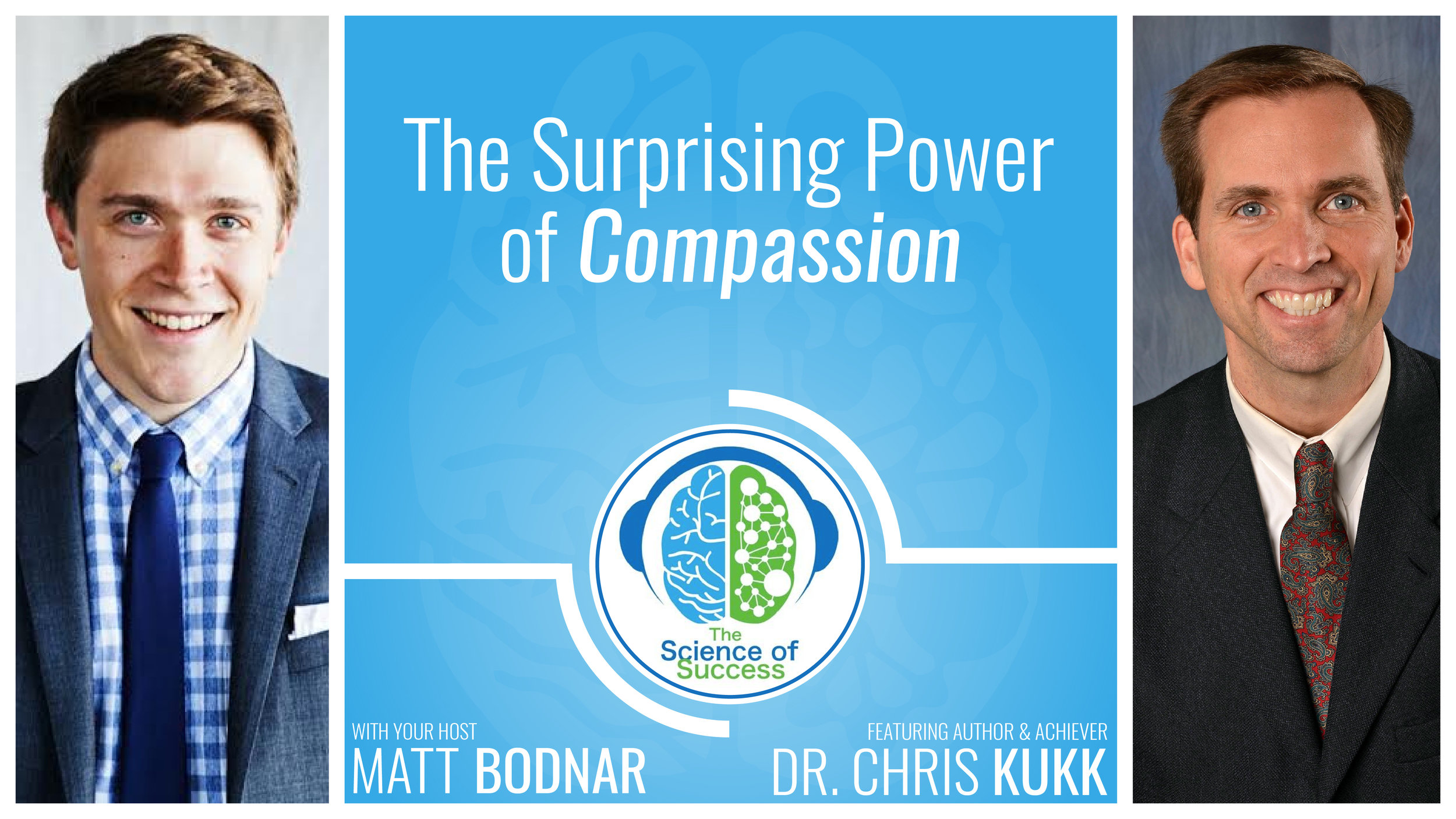
In this episode of The Science of Success, we dive into what it’s like to have breakfast with the Dalai Lama, the difference between compassion and empathy (and why it's important), and how you can harness compassion to achieve more and be a better version of yourself with Dr. Chris Kukk.
Dr. Kukk is a former counter-intelligence agent, the founding Director of the Center for Compassion, Creativity, and Innovation, a professor of Political Science at Western Connecticut State University, and author of the upcoming book The Compassionate Achiever.
In this episode you will learn:
The physical and chemical differences between compassion and empathy (and why that matters)
How compassion can help you achieve your goals
How to avoid emotional quicksand
How compassion fuels creativity
How to cultivate emotional resilience
What we can do to widen our circle of compassion
And much more!


Thank you so much for listening!
Please SUBSCRIBE and LEAVE US A REVIEW on iTunes! (Click here for instructions how to do that!).
EPISODE TRANSCRIPT
Today we’re excited to have another great guest on the show, Dr. Chris Kukk. Chris is a former counter-intelligence agent, the founding director for the Center of Compassion, Creativity, and Innovation, a professor of political science at Western Connecticut State University. And author of the upcoming book, The Compassionate Achiever. Chris, welcome to the Science of Success.

Chris:	Thank you for having me, I love the podcast.

Matt:	We’re so excited to have you on here. So, to start out, obviously you have a very deep and kind of fascinating background. Tell me, how did your interest at the intersection at neuroscience and social science emerge initially?

Chris:	As a political scientist, I wanted to understand why people would want to cooperate, or why would they fall into conflict with one another, or why do they just ignore each other? And I think if you exclude neuroscience, what’s happening in people’s brains, what’s happening in their perceptions. How they perceive reality. You’re never going to get to an answer if everything stays superficial. So, I wanted to blend both the neuroscience - what happens inside - to what happens inside. You know, in science, it’s not nature or nurture - it’s nature and nurture. I think we need to understand that more deeply when it comes to the social sciences. When it comes to the social sciences neuroscience hasn’t been there, and so I decided to jump in.

Matt:	I think that’s so important, and actually one of the people that we’ve talked about on the podcast, I’m a huge fan of is Charlie Munger. And he kind of explores the same thing which is basically the notion that psychology fundamentally underpins any phenomenon or any endeavor that involves human beings. Whether it’s business, psychology, economics, whatever it might be, and any understanding that doesn’t incorporate psychology is a fundamentally flawed understanding.  Fundamentally imperfect or incomplete picture of whatever that field might be.

Chris:	And I think that’s the case and I think with psychology, there’s this cool dialogue going on between psychology and neuroscience, and now the social sciences. You know, you have fields now called neuroeducation. And you have Paul Zack, who calls himself a neuroeconomist. And so, I think it’s a combination of different disciplines and I think if we take those disciplines and treat them like a combination lock, and combine them together in different ways, I think we’ll come out with not only new ways to move forward in resolving issues, and overcoming problems, but to also give us new ways to go back to research, to get a better understanding what’s happening inside the human brain.

Matt:	So, one of the kind of core defining characteristics of everything you do is the notion of compassion. And that’s something we haven’t really talked about on the podcast. Tell me a little bit about how you were drawn into the study of compassion, and how do you even define compassion.

Chris:	Let me start with the definition of compassion. Since I found the debate team on campus, you always have to define your terms.

Matt:	I was a debater in high school, for the record, so…

Chris:	So then you know! You know! You have to have topicality, we call it.

Matt:	Exactly.

Chris:	So, I define compassion as a 360 degree understanding of a problem or suffering of another. So it’s two parts here. That’s the first part: 360 degree understanding of the suffering or problem of another. Then, number two, is you take action to alleviate that suffering and address the problem. So that’s how I define compassion. From my counter-intelligence days all the way through my work on international water issues, to my work here on various educational settings, it’s about working through problems that I think for the most part have divided people. And where I’ve seen compassion come into it - it acts as a glue to unite people to move forward. And I even saw this in my military unit. The units that always try to find a way through a solution without leaving anybody behind were the most successful units. We still have that model, right? Leave no one behind. And we’re willing to sacrifice anything. We’re willing to do anything to get our fellow trooper back.

	So, this is not something that’s a surprise, it’s just something that’s been sitting in front of us, and you’ve had it in a previous podcast before. It’s one of those invisible gorillas, right? And we sometimes just don’t look at it. It goes by us. So, all I did was slow down, and my kids help me slow down a little bit and ask me all those types of questions. And it’s one of the advantages of being a dad. You get to slow down and answer a lot of questions. And that was one of the questions I had in my mind. Then I was always told “Oh you’re too nice!” And by that saying - you’re always going to not succeed. You’re going to have problem getting ahead because people are going to take advantage of you. That hasn’t been the case. People come together and we resolve problems and overcome things. Building an honors program at Western Connecticut State University and a very successful CEO just donated one million dollars. So I didn’t see it that way, but other people did. They would give me that line that people like to say all the time about Charles Darwin. “It’s survival of the fittest.” And Charles Darwin did not say that. He hypothesized that in the Origin of the Species, but most of his work - a good chunk of his work, over 90% of his work, including The Descent of Man, shows that is quite the opposite. It’s really survival of the kindness. Especially in chapters 2, 4, and 5 of Descent of Man, he literally says, Matt, that “the species that has the highest number of his members” - and this is words, “that are sympathetic”, meaning altruistic, generous, or compassionate, “will move up the evolutionary ladder more efficiently and effectively than other species.” And when you take that idea and you overlay it on problems of water, and you overlay it on problems that have political and economic ramifications, you change your perspective. Survival of the fittest - it’s just survival of the kindness. You find new answers, and new doors that you can jump through. To not only help you succeed, but the people around you succeed.

Matt:	That actually reminds me of the book called The Moral Animal. I don’t know if you’ve ever read it but it’s by a guy named Robert Right. But it basically talks about a similar idea which is essentially that evolution sort of preprograms us to be geared towards compassion because it actually has a positive survival benefit.

Chris:	It’s science. It’s inside us, too. When we think in a compassionate way, we actually activate release - outside hormone called oxytocin. Now, oxytocin activates two neurotransmitters, called dopamine and serotonin. And dopamine is that reward type of feeling we get. For me, it would be when I drink chocolate milk. I love chocolate milk, I get a high off of it. Or when I see my wife. I release a lot of dopamine. Serotonin is the calming level. If you think about a successful environment or successful person. Are they optimistic, happy, and calm? Or are they mad, angry, frustrated? Which one is going to create more success? This is not rocket science. OK, so it may be neuroscience, but - it’s in us. And we can choose to activate that path by the choices we make. We can choose to be compassionate. Or we can choose to be apathetic, or callous. That’s up to us! Then we create that environment. We can talk a little bit more about that science, especially when it comes to education. There’s a lot of great research out about what happens in compassionate positive environment in learning environments like school classrooms. What they do to a gene called DRD-4, it’s pretty awesome. I think you combine all the science together then you can see what’s happening in the real world. You combine it together you get these really amazing new insights into what we should be doing to achieve more success.

Matt:	So tell me a little bit more about the hormonal - chemical reactions that take place when we feel compassion. Talking about oxytocin and dopamine and all of that stuff.

Chris:	A lot of the work started with Antonio Damasio, one of my favorite books called Decartes Error and when we can go back a little bit further and review that in a moment if you’d like, but then I think really about five years ago, Dr. Tonya Singer from Germany did a number of studies using MRI scanners to show what happens when people thinking an empathetic way, compared to a compassionate way. And when we think in an empathetic way, when you have empathy on your mind. She found that the brain areas that light up are the same areas as pain. So your brain doesn’t know the difference right? It’s lighting up the pain areas when you thinking an empathetic way. But when you think in a compassionate way, you light up different areas. It’s the same areas as love. The reasons why this is so important for reality, for practical purposes, is that we’ve been talking about burn out in important fields, like first responders. Nurses. Teachers. Firemen. Policemen. You name it - those professions that help other people constantly. You have these higher rates of burnout. Since the 1980s, it started in the nursing area, we called it compassion burnout. But Dr. Tonya Singer’s work is really a misnomer. If anything, it’s called empathy burnout. Because in empathy you’re feeling the same emotion as someone else. You’re stepping into what I call the emotional quicksand of another person. And you can get stuck in that. You can get overwhelmed by that emotion. But compassion, I think, helps you ride the wave of emotions. You have this 360 degree understanding. This kind of multi-disciplinary look at a problem, so you can stay out of the quicksand, or you have branches to grab to get you out of the quicksand. So, the science is showing some really cool insights, especially Tonya Singer. I think we need to start applying it to the real world to help those people who are helping other people.

Matt:	So, I think a lot of listeners might basically think of compassion and empathy and synonyms. How would you distinguish between the two of them? Obviously, we’ve defined compassion. On a chemical level it sounds like you’ve talked about this, but tell me a little bit more about the distinction of compassion and empathy.

Chris:	So. Empathy is basically, in simple terms, feeling the same emotion as someone else. So if they’re sad, they’re depressed, you’re going to be sad, you’re going to be depressed. You absorb that feeling. And compassion is this kind of understanding, it’s this acquiring of knowledge or learning of why a person is down, why they’re going through specific incidences. You can have compassion without empathy. I think empathy can help at sometimes, but empathy is not necessary for compassion. Compassion is one step - it’s this emotional absorption. You’re feeling this same emotion. Compassion you’re feeling kindness towards someone else. Not sympathy. Sympathy is something completely different. In compassion you want to try to help. You want to try to assist. We all know where good intentions could leave, right? They could leave to more problems. So, you have to want this understanding - this learning. And you want to ask these questions about why someone’s down. You’re going to address them in a way with respect that tries to move them forward so that they don’t get stuck, and you don’t get stick. And empathy that one step absorption - compassion is two step. Understanding and then you take action to resolve the problem.

Matt:	So compassion is much more action-oriented than empathy.

Chris:	Correct. And I think we see that constantly. Compassion, I think this is one of the reason the Dalai Lama says compassion is not religious. We have a lot of people who confuse compassion with some type of religious notion. No. An atheist can have compassion, and I know plenty that do! This idea of compassion is a building process. It helps not only people get up when they’re down, but it moves towards success. And we see this in teams when those guys on baseball - Wallstreet Journal article had this great piece about - they called it “The Glue Guys” on baseball teams. They’re not the guys with the high stats, they’re not the guys that the media is looking after to interview after the game because they want the big name. But they’re the guys that keep the team together. They’re the guys that do the simple things that back each other up. So the second baseman isn’t a star, but he’s backing up a first baseman. So, if the first basemen misses the ball, he’s there to scoop it up. The stats are not really going to show up, but he’s helping his team out, and he’s always there for everyone else. The “Glue Guys” those are the guys helping everyone else, making their team succeed. And I think you look at some of the sports teams that have won the big games, especially in the NBA recently, it’s not necessarily the teams with the superstars on it. It’s the teams that play together and help one another. They know where they’re going to be at.  And I think we seem to overlook that fact a lot and so compassion, not only helps people when they’re down, but it builds success.

Matt:	So, at a chemical level in your brain, compassion triggers the hormones that are more aligned with sort of the feelings of love and happiness as opposed to empathy which triggers feelings more about pain and suffering? Is that a good way to think about it?

Chris:	I think that’s a great description of it, yes. And basically if you look at it a little sideways equation. You have compassion to your left, compassion activated oxytocin to your right, oxytocin activates dopamine and serotonin. Dopamine and serotonin creates happiness and optimism and this calmness, right? What usually leads to success. People thinking in a happy, optimistic, in a calm way.

Matt:	So, do you think that compassion is something that is innate, or is it something that can be learned, can be trained?

Chris:	Matt, it’s both, and let me explain that. Jean-Jacques Rousseau, famous for The Social Contract, he wrote that we have, in his words, “Natural compassion”, but in society, we tend to unlearn that natural compassion. And think about what we teach on the playgrounds. This really came home to me when I was teaching over in Europe in 2007-2008. I was teaching international relations class, and I was explaining realism, the theory of realism in international relations. Using the “king of the hill” metaphor that we have for kids out in the playground here in the United States. So I say “When you’re on the King of the Hill, top of the hill, what are you supposed to do?” And a hundred and nineteen European students were looking at me like “What are you talking about?” And so, I had to explain. One young lady from Poland breaks her hand and she said “Dr Kukk! What’s king of the hill?” And that explained to 119 European students that when you get on top of the hill, what our kids do in playground is push each other down so they’re on top of the hill. They don’t play king of the hill. They don’t play kill the carrier. So it was a wakeup call to me about “What do we teach our kids in society?” Do we teach them to reach down and help people up, or do keep people from pushing people down? These are practical matters. And we can change that, but we decided to focus on survival of the fittest, instead of survival of the kindness. I think it’s natural and we can unlearn it. And if we can unlearn it, we certainly can learn it. And there have been plenty of studies out there showing that we can learn it, and the United States Marine Corp has also moved in on that as well. They’ve had two studies, two different years now, one million dollars donated to each on mindful training for Marines.

Matt:	That’s fascinating. So, how can we - how can the listeners and how can the both of us kind of move towards being more consciously compassionate?

Chris:	There’s a lot of different ways to do this. Let me just go through cheap practical ways that I think made news, or even headlines recently. But I want to talk to people about it like, I didn’t see that. Cover of Time Magazine not too long ago had “Mindfulness” on the front of its cover. And I think if we take time out and for some of us, I do meditate in the morning. And I do compassion meditation. It’s quick, takes no more than ten minutes, and you’re off and you kind of just registered yourself to look at yourself to look at the world in a way that, you know, “I’m going through it, and I can help others.” But I always start with someone, for example, my grandmother, who has always helped me.  And when I’m out driving, I’m not the guy when someone cuts me off, I’m not the guy who flips them off. I actually bless myself; my grandmother raised me catholic. It’s those guys who think the guy who cut me off was like - that’s the nicest thing anybody’s ever did, and it was a great conversation afterwards. It’s those little things.

	In schools, there’s a thing called social and emotional learning that funding for it just passed with the “every student succeeds” act. Senator Blumenthal of Connecticut was a major writer of that section of the bill. That means in learning of values, such a courage, compassion, that help students become more emotionally resilient, and to also recognize and to understand the emotions of others around them. That the world just doesn’t revolve solely around them. That the world is really a combination of relationships and interconnections, and we should start learning that right in Kindergarten all the way up. So those are just two very different ways. Everything from mindful meditation to social emotional learning in school, and let me go to the business world. General Mills, this past year they were a 17.9 billion dollar company. They are famous for a mindful leadership program that they have. Google has it, too. A lot of the successful businesses know that compassion and mindfulness raises the bottom line, it makes their employees have higher intention, employees stay, employees want to stay. Because in the environment it creates more productive employees. This is not something that’s soft, something that - did you hug your dolphin today idea? This is real, this is just real ramifications, consequences, and the effects helps everyone around you. And I think it leads to success in a much more constructive way than the “king of the hill” “survival of the fittest” mentality.

Matt:	You touched on so many different things that I want to dig into. One of the meditation obviously, I’m a huge believer in meditation personally I meditate every day for the last couple of years. And we just did a podcast on meditation where we dig into a bunch of different pieces of it. And one of the kind of core components of my personal meditation is sort of very similar. It’s kind of a forgiveness component. And that reminds me of one of my favorite quotes of all time which is from Gandhi, which is “The weak cannot forgive. Forgiveness is an attribute of the strong.” Kind of the notion you’re talking about when you get cut off by someone when you’re driving, the idea that you should forgive people not because necessarily that they deserves it, but because for your own emotional wellbeing and there’s research that backs a lot of this up, it’s bad for you to hold onto grudges. It’s bad for your blood pressure, it’s bad for all kinds of things. The more you can go through life kind of forgiving people and even when we talked in an earlier podcast episode about how to, not necessarily understanding or seeing every piece of reality, right? You might not understand why that person might be in a bad mood today, and so there’s so many different reasons that I think forgiveness is so important. It’s not just about being right or getting revenge or whatever, it’s like you gotta forgive them for your sake, not because, not for their sake necessarily.

Chris:	That’s so true and I also just want to build up that you’re right, Matt. The other is self-forgiveness, or self-compassion as well. And there have been plenty of studies as well on self-compassion and how that boosts creativity. So you’re right. I always think when there’s an older woman or older man in front of me, that’s someone’s grandpa, that’s someone grandmother, and you know I can be a minute or two late to where I meant to go. I should have left earlier, it was my issue. But it also builds compassion. And when you step into a place that has compassion flowing through its halls and in its rooms, you can feel it. You can feel the energy. You can feel the electricity and the creativity that’s flowing around.

	And speaking of flowing, this is another thing that gets me that I had one mom when I was speaking to a school saying - she literally said this, I don’t want my son to learn compassion, because I don’t want him to be weak. So I asked her, we were in the state of Washington. We’re surrounded by rocks here. Washington State has a lot of rocks. So it’s one of the hardest elements that we have, but the softest element can actually cut through rock. And that’s water. Water with its perseverance and it’s gentleness can still cut through some of the hardest materials we have. We just have to sometimes do some intellectual judo on our own selves to look at the world in a more constructive way. It’s right in front of us, but a lot of times we don’t either see it or want to see it because of the thing that happened to us. Your idea of forgiveness is really key for that. I think it moves us all along and then people are quite surprised when you do do it, and then it leads to better relationships and a better community.

Matt:	I love the analogy of water and I think there’s so many I don’t want to go down this road at all but there’s so many different ways you can think about the power of water and energy flow and all of that stuff. It’s such a powerful metaphor for so many different things. But I want to change directions and actually touch on something you brought up a little bit earlier. Tell me a little bit more about the idea of emotional resilience and how can we teach children to be emotionally resilient. We talked about dealing with setbacks and embracing discomfort and some of those other topics in earlier podcast episodes and that’s something that I think is probably one, if not the most important traits that someone can have is kind of the ability to deal with hardship. Tell me a little bit more about that whole kind of concept and how that ties in with compassion as well.

Chris:	I think what we’ve done throughout society, is we created this fear of failure. And failure, as you know, [INAUDIBLE 00:25:28] businesses. Some of the major successes come from failures. Right? Because they failed and then they see another door and they’re like “OH!” When they’re down, they can look up and they see the door differently and they can walk through that door and it becomes highly successful. Well, the way we have our focus on tests in schools, kids are afraid to fail. And if we create a place where — most business fail and then they succeed! But when we do it in school? The kids are - they’re just flattened by the idea. Even the idea that you can fail. And have projects that don’t work the first time, but then maybe you have a secondary plan to teach them to look for a secondary way to achieve whatever goal they want to achieve. That’s going to help them in life. In many different ways.

	When I was growing up, only the top team received a trophy. And you worked for that trophy. But our coaches didn’t put us down, he’ll build us up. And one of the things that I do with my kids is I have them try things first, and if they don’t succeed I talk - I ask them, I don’t talk. I usually question them, I use a lot of questioning. I question them - how are THEY, not me, how are they going to solve the problem? The more they do that, the more practice they have in finding new ways, new solutions. I tell you, our conversations around the dinner table are awesome because they’re always challenging me from different perspectives. I have so much fun trying to field their questions because they’re constantly coming at me from up, down, sideways, diagonally. And that skill will allow them, I believe, to become resilient in any situation because when they’re down, which they inevitably will - we all get down - I’ve taught them to literally, when you’re down on the ground you look up for that door. Because now you see something different. And that is so much fun to see my kids, my oldest now, he gets excited when something goes wrong because something better is going to happen. You know, maybe that’s a little too far on one side, but that’s what we’re looking to do.

	And compassion, if you look at compassion. Dopamine. Oxytocin starts dopamine. And dopamine, in cognitive terms, you know John Medina in his book Brain Rules he has this great analogy for dopamine. He called it the Post-It note for memory. When you have a lot of dopamine flowing around, you tend to remember whatever it is that you’re studying. It’s a brilliant metaphor. I use it all the time with my kids and my students. So, generating oxytocin, generating that compassion creates neurochemical systems in their brain that all of a sudden starts bringing back memories that they think, wait a minute, that’s the answer that I can move forward on to the next thought. And that dopamine increases their feeling of reward. So all of sudden you’ve created - by establishing compassion in an environment - not only something that’s better for them cognitively, but something that will make them more emotionally resilient in finding ways forward. And then serotonin kicks in so it keep them calm so they don’t go flying off the handle or flipping out. That’s how it happens! That’s how it moves forward. That’s how I think you can create emotionally resilient kids. This is something that, I remember my 5th grade teacher, Mrs. Peck, this is exactly what she did, her classroom - I couldn’t wait to go to school even when I was sick. She made me love learning just because of the environment she created. She might get arrested now though, nowadays. She used to massage every one of us for ten seconds during a test. I don’t think she’ll be allowed to do that right now in our day and environment. But I couldn’t wait to go to school because she made learning a life-long love of every student she ever touched. That’s what we need. We need more Mrs. Pecks around the world.

Matt:	It’s amazing that, when I think about some of the stuff we’ve talked about on earlier episodes whether it’s the growth mindset. You know, earlier before we started recording, Chris was showing me the book Mindset which we’ve talked about on the podcast. Whether it’s stoicism, these two thousand year old lessons. There’s this - the more you study a lot of this stuff, and it’s amazing that the more you find, it’s all rooted in Science. It’s just these fundamental lessons that span thousands of years in human generations that you know, it’s sort a core kernel nugget of truth that you have to be resilient and you have to be focused on overcoming your failures.

Chris:	Yes. And life’s about that. If you think about it — I love white water rafting. Life is a lot like white water rafting, or surfing. There are different rocks, different bends in the river, or in surfing - the waves come t you. You can’t choose what waves come at you, but you certainly can choose which waves you’re going to ride. And helping people find those waves that they want to ride to the shore of life? Oh my God, it’s a beautiful thing. Watching them choose their own waves as they get older? That’s what it’s about. And creating an environment where they feel safe enough to do that. Where they’re willing to take chances. If they’re willing to take chances, they’re willing to fail. And if they’re willing to fail, they’re willing to get themselves back up. They’re willing to get themselves back up - watch out for the society that that’s happening in because it’s going to take off.

Matt:	I totally agree. I think that stuff is so important. So, I’m curious, in your Ted-X talk, you talked about - again, this ties in a little bit back into the idea of parenting and dealing with children. You talked about the idea of - I think it was even about talking to your kids about why there’s so much evil in the world, right? And how can we kind of widen our - I think you used the term “circle of compassion” to sort of deal with that, or counteract, or — you know, I don’t remember the exact terminology. But tell me a little bit more about that concept and how from a broader perspective we can start to widen that circle of compassion.

Chris:	Yeah, thanks for that. The Sandy Hook town is less than 15 minutes away from our house. And so they knew what happened. And I came home early from school so I made sure I took them off the bus and we just sat in the living room and talked about what happened. Even though they were very young, you can’t hide it, they know. They’ve heard. And so I wanted them to talk about it and their concerns about it. But that comes from a visit from the Dalai Lama at Western Connecticut State University, we hosted His Holiness for two days of talks here. And it was pretty amazing, hopefully we’ll get him back again. And what I wanted, and what we’ve done, I didn’t want just a one-and-done event, I wanted an event that would carry on and have ramifications and effects and consequences in a good way after he left. So we started putting together - there were quite a few - the Center for Compassion, Creativity, and Innovation. And he loved it so much, saw what our mission was, what we wanted to do. And he donated the first $107,000 dollars to move the center along. And basically what the center does is widen that circle of compassion. Because we go around and help towns and cities and universities and schools become school and university and towns of compassions. And what we try to help them do. We help the chart for compassion which was started by Karen Armstrong, she wanted that Ted Talk one year, I’m forgetting - I think it was around 2006. For the charter for compassion, creating charters all around the world and - we thought that was a great idea. But we wanted every single community to tailor-fit that charter of communication for them. Because every community had its own issues, its own problems they need to solve. So there’s no kind of one compassion suit to fit all. There’s different ways to get there. And so what we do is, we help those schools and universities and cities and towns move forward in that direction. And that is one way that we do it.

	We also do it on the practical on a very local level. I’ve combined high school students with college students to address the homeless problem in our area. So, in the past year, we had 50 backpacks that the students, high school and college students, found donors for. Getting dental clinics - got toothpaste and toothbrushes. Went to the hotels in our area. So everyone else pitched in and they see the kids try to overcome the problem. And so they donated more than what we asked. It just kind of rolled. And became bigger. It’s kind of like when you create a snowman, and you’re rolling that little snowball becomes the base. That’s exactly what happened - we created this whole compassion base and we can build whatever snowman we want, and by the way, it gets pretty cold here so it won’t melt away. And it’s so awesome to see that it started with kids helping adults find their compassion. So everything from helping policy happen, to helping address the homeless issue. Now we even have a project - we convinced the Mayor of the city of Danbury to give us the land all around city hal to create a compassion garden, representing all the ethnicities in the city of Danbury. So, high school students now even elementary school students, we got women’s gardening club wanting to help. Some corporations are donating the flowers and the whole areas are going to have a walk-in path representing all the ethnicities in that city. And they’re calling it a compassion garden. So, everything from gardens, homelessness, to creating policies to move policies along. That’s how we’re doing. That’s how we’re widening the circle of compassion.

Matt:	That’s fascinating. And you kind of spoiled one of my questions - I was going to ask you, I was very curious. About how you had met the Dalai Lama.

Chris:	We invited him to come to campus, and we thought he was going to come for a day - but he stayed for two! Which was amazing. It’s up, recorded, on our website. And the Center for Compassion, Creativity, and Innovation are linked to those hour - little over an hour long presentations by His Holiness.

Matt:	Well, I’m curious, for listeners that are really interested in compassion and learning more about this, what are some of the resources or books that you would recommend that they check out?

Chris:	Wow. There’s so many. Just looking at my bookshelf right now. I have - one of my favorites. I used it quite a lot, was the Dalai Lama’s The Universe in a Single Atom.

Matt:	I love that title.

Chris:	It is a great book, as well. The Compassionate Instinct is another good one. Buddha’s Brain is a great one. Anything by Dave [INAUDIBLE 00:36:51] fantastic. On the more social learning side, the newest book out, it was published this year, 2016, Emotions, Learning, and the Brain by Mary Helen Immordino-Yang. Fantastic book. The forward is written by Howard Gardener, and the afterward by Antonio Demasio. So, you have this great education in neuroscience book out there that I think moves it forward. How to be Compassionate by the Dalai Lama, another good book. Mindfulness, with Nurture Effect. There’s so many great ones out there, I think those are some of the top book that

Matt:	So, what is one piece of sort of actionable homework that you would give to our listeners in terms of maybe applying compassion in their lives?

Chris:	Okay. One it to understand, to listen. The first step in compassion is to be a great listener. What I mean, listeners - you don’t listen to reply, you listen to understand. And if you want to be compassionate, you have to understand that person that you’re trying to help. We have a culture that listens to reply right now. And I think if we take a little bit longer to simply listen to understand, we’d be able to move forward together in a much more constructive way.

Matt:	I love that, I think that’s great. There’s actually a bunch of research on the communication side that you build report much better with people when you listen with the intent of understanding as opposed to listening just so you can say whatever you want to say after that.

Chris:	Exactly!

Matt:	So what is the best place for people find you online?

Chris:	My website. It’s chriskukk.com You’ll see there also, there will be a new book coming out called The Compassionate Achiever that will address a lot of these steps and show you practically how to get there. But the first step is listening.

Matt:	Awesome. Well, Chris, thank you so much for being on the Science of Success. The audience is going to absolutely love all of this stuff. I think compassion is something that we don’t talk about enough and it’s so important. And it’s scientifically validated as kind of a chemical, neurological level, something that can create positive results in your life, and it’s something that can spread out into your community. So, thank you so much for being on here, Chris.

Chris:	Well, I can’t thank you enough, Matt. I’m a big fan of the podcast so this is an honor for me to be on the Science of Success. Thank you.

Matt:	Thank you very much.

Chris:	Bye.
Why An Almost-Empty Cookie Jar Is More Valuable Than A Full One

This is the FINAL episode in a six-part series on "The Science of Success" titled WEAPONS of INFLUENCE, based on the best-selling book “Influence” by Robert Cialdini. Each of these weapons of influence are deeply rooted and verified by experimental psychology research (of which you'll get a ton of amazing examples).
So what are the 6 weapons of influence?
Today you’re going to learn about Scarcity Bias, and what happens when you take people’s cookies away; how changing a single phrase drove six times more sales; and why open outcry auctions turn your brain into mush. Like many of the weapons of influence, this is something we intuitively know and understand, but often don’t realize how powerful it is or how much it impacts our decisions at a subconscious level through daily life.




Thank you so much for listening!
Please SUBSCRIBE and LEAVE US A REVIEW on iTunes! (Click here for instructions how to do that!).
EPISODE TRANSCRIPT
Today, you’re going to learn what happens when you take people’s cookies away, how changing a single phrase drove six times more sales, and why open outcry options turn your brain into mush.
	This is the final episode in a six part miniseries on the Science of Success titled Weapons of Influence, based on the bestselling book Influence by Robert Cialdini. Each of these Weapons of Influence are deeply rooted and verified by experimental psychology research which you’re gonna get a ton of amazing examples of, if you’re just now tuning in to this episode definitely go back and listen to the series because there is some amazing content in there.
	Last week we talked about why con artists wear lifts in their shoes, how a normal person can administer lethal shots on innocent research subject, why 95 percent of nurses are willing to give deadly doses of drug to their patients, and much more. If you haven’t checked that episode out yet, listen to it after you listen to this one.
	I actually can’t believe that Weapons of Influence is already coming to an end. It’s been such a fun miniseries and I love the book influence by Robert Cialdini so, it’s been great for me to go back and really dig into somebody’s research examples and really learn about them, and it’s been awesome to share it with everybody on the podcast but, just because Weapons of Influence is ending…you know, we’ve got some amazing…really, really exciting contents an awesome interview some really deep dives and some cool subjects coming up in the next couple of weeks. Stay tuned and get excited but, this week we’re going to talk about the scarcity bias. Like many of the Weapons of Influence this is something that we intuitively know and understand. But, often don’t realize how powerful it is or how much it impacts our decisions at a subconscious level or throughout our daily lives.
	Here’s is how Cialdini describes scarcity bias, note how he describes something psychological reactive theory, this is a key part of the scarcity bias and also something that Charlie Monger touches on by another name, he call it deprival super reaction syndrome. Anyway, here’s how Cialdini describes it “according to the scarcity principle, people assign more value to opportunities when they are less available, the use of this principle for profit can be seen in such complainants techniques that limited numbers and deadline tactics. Where in practitioners try to convince us that access to what they’re offering is restricted by amount or time.
The scarcity principle holds for two reasons, first, because things that are difficult to obtain are typically more valuable, the availability of item or experience can serve as a shortcut queue to its quality, second, as things become less available we lose freedoms.
According to psychological reactions theory we respond to the loss of freedoms by wanting to have them, along with the goods or services connected to them more than before.
	The scarcity principle is most likely to hold true under two optimizing conditions: First, scarce items are heightened in value when they are newly scarce. That is, we value those things that have become recently restricted more than those that were restricted all along. Second, we are most attracted to scarce resources when we compete with others for them. Compliance practitioners’ reliance of scarcity articles as a weapon of influence is frequent, wide ranging, systematic and diverse. Whenever this is the case with a weapon of influence we can be assured that the principle involved has notable power in directing human actions.”
	One of the most interest things that Cialdini mentions in that quote, is the fact that we want scarce things even more when we are competing with other people for those goods, and we’ll dig into a couple pieces of research that kind of showcase that but, lets dig into the research now and look at how the scarcity principle can impact your behavior.
	Let’s start out with an experiment that showcases the scarcity principle at work on kids as early as age two. A study in Virginia had researchers take two toys and place them in a room divided by a Plexiglas barrier. For half the kids the barrier was one foot high posing no barriers to the child ability to access the toy. For the other half of the kids the barrier was high enough that they were obstructed from reaching the toy without going around it.
With the small one foot barrier children showed no preference for either toy. However as you would expect, once the barrier went up, children went for the obstructed toy three times faster than to the easily accessible toy, as the researchers said “the boys in this study demonstrated the classic terrible two’s response to a limitation of their freedom, outright defiance”.
	I think the fascinating thing about the two year old Plexiglas experiment, is the fact that the behavior starts to manifest itself at such an early age, right? And this ties it again to the thing that we heard again and again, is that these biases are built into our minds, they’re ingrained into our bodies, in our brains by our a society, by evolution, by all kinds of different factors very, very deeply ingrained and that’s why they have such a powerful effect on shaping human behavior.
	The next study takes a looks at how we perceive items that are banned, limited and restricted from us, and this result has been repeated across several other and different banned items with the same results. But, in this particular study it was in Dave County, Florida. The government imposed a ban prohibiting “the use and possession of laundry and cleaning products that could contain phosphates.” Cialdini described how the residents of Dave County reacted in two parts. “First, in what seems a Florida tradition, many Miamians turn to smuggling. Sometimes with neighbors and friends and large ‘soap caravans’, they drove to nearby counties to load up on phosphates detergents, hoarding quickly developed and in the rush of obsession that frequently characterizes hoarders, families boasted of having a twenty year supplies of phosphate cleaners.”
	That behavior looks pretty ridiculous and shows the lengths that people go once they perceive something scarce but, that’s only really scratching the surface of the underlying subconscious shift the people had towards the phosphates cleaners products after the ban is to me the most striking finding. This passage also helps to explain the concept of psychosocial reactive’s that we talked about at the top and how it underpins the scarcity principle. “The second reaction to the law was more subtle and more general than the deliberate defiance of the smugglers or hoarders. Spurred by the tendency to want but no longer have, the majority of the Miami consumers came to see phosphate cleaners as better products than before, compared to Tampa residents who were not affected by the Dave County ordinance, the citizens of Miami rated phosphate detergents gentler, more effective in cold water, better whiteners and fresheners and more powerful on stains.
	After passage of the law they have even come to believe that the phosphate detergents poured more easily. This sort of response is typical of individuals who have lost an established freedom and recognizing that it is typical, is crucial to understanding how psychological reactions and the principles of scarcity work.
When something becomes less available our freedom to have it is limited, and we experience and increase desire for it, we rarely recognize however that psychological reactance has cause us to want the item more, all we know is that we want it. To make sense of the heighten desire for the item we begin to assign it possible qualities”.
This is an extremely important finding and a very, very relevant distinction that Cialdini makes in that piece of research, psychological reactance theory…the fact that we have the freedom of having that detergent that was taken away, that’s what a subconscious level makes us want it even more but, what happens is we start inventing this conscious justification for it, we started inventing this imagine that changes of the trades and the characteristics of that item that we want and this is all taking place at a subconscious level and consciously this justifications make a ton of sense and we believe that, “oh, yeah, phosphates cleaners they’re better in cold water, they’re fresheners and whiteners, they’re better and even pours more easily.” All these things sort of bubble to the conscious mind and believe them, that those are the reasons why we are mad that they took away the phosphate cleaners but, the real reason, the real thing that worked here is the scarcity principle, it’s the fact that it was taken away, creates the subconscious desire to have it back, that visceral two year old response of “you can’t take away my toys” and we consciously develop all kinds of fake justifications for why we actually wanted it.
Something that really want to be tuned to really understand, because this happens all of the time, our subconscious makes a decision often because of the psychological bias, often because we’ve been influenced by one of these Weapons of Influence and consciously we make up with a completely different justification for why we made that decision or why we happen to like this thing more than others, why it happens to buy this thing more frequently than another thing.
	The next study that we’re gonna look at takes place in a more commercial context: How do buyers respond when what they want suddenly becomes scarce. I like to call this “where’s the beef?” This experiment showed how this subtle turn of  phrase and the way that information was presented in this content as exclusive information about an impending scarcity, drove more than six times the amount of sales for buyers. Robert Cialdini explains here, “The company’s customers, buyers for supermarkets and other retail food outlets were called on the phone as usual by a sales person and asked for a purchase in one of three ways. One set of customers heard a standards sales presentations before being asked for their orders.
Another set of customers heard the standard sales presentation plus information that the supplier of the imported beef was likely to be scarce in the upcoming months. A third group received the standard sales presentation and the information about the scarce supply of beef. However, they also learned the scarce supply news was not generally available information. It had come, they were told, to certain exclusive contacts that the company had. That’s the customers who received this last sales presentation learned that not only was the availability of the product limited, so too was the news concerning, the scarcity double-whammy”.
	So, you probably see what’s gonna happen next, right? Cialdini continues, “The results of the experiment quickly became apparent when the company sales people begin to urge the owner to buy more beef because there wasn’t enough in the inventory to keep up with all the orders they we’re receiving. Compared to the customers who only got the standards sales appeal, those who were also told about the future scarcity of beef bought more than twice as much. The real boost in sales, however, occurred among the customers who heard the impending scarcity and the exclusive information. They purchased six times the amount that the customers who had received the standard sales pitch did. Apparently the effect of the news about the impending scarcity was it self-scarce made especially persuasive.” I love the phrase scarcity double-whammy. This experiment is such a simple and powerful demonstration of broad reaching and it impact of scarcity principle can really be.
	When the information about the impending scarcity was given to the customers, they doubled their beef. That alone is a fascinated finding, right? You double your sales just by leveraging the scarcity tactic. But, as soon as that information itself somehow become scarce they had six times more sales. That one really made me pause and think. It’s amazing how much scarcity can drive human behavior, just the scarcity itself more than double itself but, the fact that the scarcity was scarce information in its own…six times more it’s incredible.
	This next experiment is one of my favorites and we’re gonna look it at three different parts, and I call it the cookie experiment. The first part of the experiment was simple enough. People were shown a jar of cookies. It either had ten cookies in it or it had two cookies in it, and they were asked to rate the cookies across a number of factors. Unsurprisingly, when there were only two cookies in the jar they were rated “as more desirable to eat in the future, more attractive as a consumers item, more costly than the identical cookies in abundant supply” then the experiment has mixed things up a bit, they kept the part of the experiment there were people in the jar that had two cookies in it but, the people with the jar of ten cookies had the jar taken away then replaced with the jar than only had two cookies.
	The goal of this particular twist was to measure how people reacted to a change in scarcity, instead of just a constant scarcity condition, Cialdini explains, “In the cookie experiment the answer is plain, the drop from abundance to scarcity produced a decidedly more positive reaction to the cookies than did constant scarcity, the idea that newly experienced scarcity is the more powerful kind applies to situations well beyond the balance of the situations study. For example, social scientists had determine the such scarcity explain is that primary cause by a political and thermal unbalance.” The researchers weren’t done having fun with cookies yet. They wanted to dig even deeper and so they looked at how suggest what react to cookies scarcity created from different sources. Cialdini elaborates here: “Certain participants were told that some of their cookies had to be given away other raiders in order to supply the demand for cookies in the study. Another set of participants was told that the number of their cookies had to be reduced because the researcher had simply made a mistake and simply given them the wrong jar initially.
The result showed that those whose cookies became scare through the process of social demand like the cookies significantly more than then those whose cookies become scarce by mistake. In fact, the cookies became less available through social demand were rated the most desirable of any in the study. This finding highlights the importance of competition in the pursuit to limited resources not only do we want the same item more when it is scarce, we wanted most when we are in competition for it. This is a key distinction and one that underpins an important learning about scarcity, we want things more when we’re in competition for them, not just when they’re scarce.”
Here’s the last fascinating bit from this series of cookie experiment, who would have thought you could learn so much from cookie jars, the one thing that held constantly through the research at no point did the subjects say the cookies tasted any better. They only rated them higher, more attractive and they say that they would pay a higher price for them. Cialdini concludes, “Therein lies an important insight the joy is not in the experiencing of a scarce commodity but, in the possessing of it”.
	It turns out that we like having our cake more than eating it as long as is scarce enough. I found the cookies experiment interesting  I think there’s so many different takeaways from it but, you know I’m really amazed that this research were be able to pull out just from using a few jars of cookies and measuring human behavior impacts the way people perceive that but, two things that I really think it’s important for you to draw out from the cookie experiment one, obviously is the idea of people wanted it more when they were competing with other people for the cookies, that’s what made it them wanted it most, and when you think about this tie that back to the idea to the biologically limits of the mind which we talked about in an earlier podcast there’s very much kind of a visceral real sort of revolutionary feel to that, right? The idea that in wild…in the times before society existed people were competing for resources and if somebody else has…you know, more resources than you, you wanted even more, you’re more fueled to go get it. And, I think the other thing that is fascinating that a not point do they actually rate the cookies any better the enjoyment of the cookies themselves was unchanged but, the scarcity bias materially impacted their desire for the cookies.
I think that’s the part that is really, really critical, the cookies didn’t taste any better but, the possession of the cookies just because they were scarce is what made people want them so much, is what the people really cared the most about.
	Lastly, I wanted just include a quote about open outcry auctions, right? Open outcry auctions, are a great example of not only scarcity but also, many of the other Weapons of Influence and how they come together to social proof, etc...I’ll give you this quote from Charlie Monger were he kinds of talks about how multiple biases can compound together in what he calls a lollapalooza effect to basically multiply the power and the influence of all of these different biases. “Finally the open outcry auction. While the open an outcry auction is just made to turn the brain into mush, you got social proof the other guy is betting, you get reciprocation tendency, you get deprival super reactions syndrome and this thing is going away. I mean, it’s just absolutely it’s designed to manipulate people into idiotic behavior” and Charlie Monger get…he’s the billionaire business partner of Warren Buffet, and he and Buffet are both famous for saying that they avoid open outcry auctions like the plague but, open outcry auctions is just an interest example because they really demonstrate how all of this biases don’t just exist in a vacuum and that’s something as wrapping up weapon of influence series, that’s something I really want you to take home and think about is the fact that we’ve seen a number of instances and cases where the biases kind of blend together and interact and there’s instances were liking and social proof tied together,  and there’s instances where authority and social proof, or authority and liking tied together, or scarcity and authority tied together there’s…in the real world things are never as neat and as simple as they are when we’re just talking about an individual bias.
 In the real world all of this stuff is interplayed and intervolved and mixing together and is a lot more cognitive biases that we’re doing future episodes on, we are going to drill down and talk about that as well. This happen to be some of the biggest and most powerful ones but, in real life its much messier and the reality is that all this stuff can compound is not just edited when these things can merged together its multiplicative, its… it really stacks up and it can really get absolute result, and the crazy outcomes, and the more biases you have kind of stacking together, the more you get ridiculous human behavior and I mean…we’ve seen throughout this series a number of crazy, wacky…you know, absurd research findings of just simple little turns of phrase, or tweaks, or all kind of minors changes that can result in changes can make huge impacts.
	If you hadn’t gone back and listened to some of the other episodes after you wrap this up, you should really check the whole series, because it all ties together and it is all so important but, as we kind of finish this series the things that I want you to think about is the fact that in the real world all this stuff is mingled together and  that makes it even harder to compound some of these biases but also, gives you the opportunity to really deep down and understand all these individually, and then how they work together so that you can formulate away to really be able to be aware of this biases, to combat them so they don’t impact into your decision making in the negative fashion.
	So, what’ve we learn about the scarcity bias? I think we’ve learn quite a bit and this quote from Cialdini sums it up nicely. One of the challenges in dealing with the scarcity bias is as a 2005 study showed, it’s a very physical bias. “Part of the problem is that our typical reaction to scarcity hinders our ability to think. When we watch as something we want become less available, a physical agitation sets in, especially in those cases involving direct competition. The blood comes up, the focus narrows, the emotions rise as this visceral current advances the cognitive rational side retreats, in the rush of arousal it is difficult to become and studied in our approach.”
	So, there’s really a couple takeaways about scarcity that I wanna make sure you understand. There’s two primary reasons that the scarcity bias is so powerful. The first is because things that are difficult to obtain are typically more valuable and so, at a subconscious level, it’s kind of like a mental shortcut, you know, is something like scarce is typically valuable. “Okay, this thing’s scarce so it must be valuable.” But, that’s not always the case right? That’s why we see these crazy outcomes. But, that’s one of the underpinnings one of the reasons why the bias operates. The second is that as things become less than accessible we lose freedom and that ties back at the idea that psychological reactance theory, it goes back to that example of the two year olds, when we have our freedom taken away, or the detergent examples is an amazing kind of studying how that takes place and when we get those freedoms taken away, that’s when that really physical emotion and scarcity bias takes place and there’s two conditions that really set the stage for the scarcity bias to be the most powerful.
	The first is that scarce items are heighten their value when is newly scarce, that leads back to the cookie jar experiment when something is recently becomes scarce,  we want it even more and we rated and think it about as more favorable, more desirable, and the second thing is that when we’re in competition with other people for that particular resource that makes us even more prone to want whatever that is, want whatever we can’t have because somebody else’s have, when somebody else is competing for it. So both of those factors are two conditionings that if either or both are present, they really amp up and magnified impact of scarcity bias. And both the detergent example and the cookie jar experiment showcase how powerful those can be.
	And, I think the other thing that I really want you taking away from this is, thinking back to the detergent experiment, when people had the detergent taken away they rated it as more favorable, better cleaning, you know, all of these things when in reality the reason that they wanted it was because it had been taken away but, they consciously invented all this justifications for why they wanted it. That’s a very insidious, very dangerous behavior, one that you should take great care to try and be aware of and really understand what’s the real reason that I feel a certain way,  that are thinking sort of thing and is the reason that I’m telling myself a justification that I made up instead of an actual reason.
	So, how do we defend against scarcity bias? I’ll start with the quote from Cialdini. “Should we find ourselves beset by scarcity pressures in a compliance situation then our best response would occur into a two-stage sequence. As soon as we feel the tide of emotional arousal that flows from scarcity influences we should use that rise and arousal as a signal to stop short. Panicky feverish reactions have no place in wise compliance decisions. We need to calm ourselves and regain our rational perspectives. Once that is done, we can move to the second stage by asking ourselves why we want the item under consideration. If the answer is that we want it primarily for the purpose of owning it, then we should use its ability to help wage how much we would to expend for it. However, if the answer is that we want it primarily for its function that is we want something good to drive, drink or eat then we must remember that the item under consideration would function equally well while scarce or plentiful. Quite simply, we need to recall that the scarce cookies didn’t tasted any better.”
	And, I think one of the most important parts of what Cialdini says is the importance of maintaining a calm, rational perspective, and I’ve talked…I’ve referenced Charlie Monger times and I made future podcasts suggest about him and he’s such a fascinating individual and incredibly successful businessmen, but also so wise about psychology and how it impacts human decision making. But, if you look at him, but you look at Warren Buffet, the reason they’ve been so successful is…and they’ll say this many times is, partially because of the huge focus on rationality and really try to be as objective as possible. And in one of the earlier podcasts episodes of the Science of Success, we talked about the ideas of accepting reality and the reality of perception, and the sooner you have a totally objective, rational acceptance of the way reality is, the faster you can recognize things like the scarcity bias the faster that you can recognize any of these Weapons of Influence from kind of seeping into your thoughts and impacting your decision making.
We’ve seen countless examples of how powerful, how insidious, how dangerous these biases can be and the best way to combat it is to cultivate that rationality, is to cultivate that awareness, is to cultivate the ability to both see and understand your own thoughts and we think back again to the detergent example, to see…you know, why do I really like this thing, what’s really driving my behavior? Am I deluding myself into thinking one thing when the reality is something different?
	That’s it for this episode of scarcity and that’s it for the Weapons of Influence miniseries, it’s been an absolute blast to do this miniseries but, I’m also super excited about some upcoming episodes that we have. So, stay tuned, because it’s going to be awesome.
Why Co-Pilots May Ignore Instinct and Let A Plane Crash

This is the FIFTH episode in a six-part series on "The Science of Success" titled WEAPONS of INFLUENCE and based on the best-selling book “Influence” by Robert Cialdini. Each of these weapons of influence are deeply rooted and verified by experimental psychology research (which you will get a ton of amazing examples of).
So what are the 6 weapons of influence?
This week we're going to talk about the Authority Bias. This bias can create some astounding effects in the real world, such as: Why con artists wear lifts in their shoes; how a normal person can administer lethal shocks to an innocent research subject; why 95% nurses were willing to give deadly doses of a dangerous drug to their patients; and much more.


Thank you so much for listening!
Please SUBSCRIBE and LEAVE US A REVIEW on iTunes! (Click here for instructions how to do that!).
EPISODE TRANSCRIPT
Today you’re going to learn why con artists always wear lifts in their shoes, how a normal person can administer lethal shocks to an innocent research subject, why 95% of nurses were willing to give deadly doses of a dangerous drug to their patients, and much more.

This is the fifth episode in a six-part series on the Science of Success, titled Weapons of Influence. And based on the bestselling book Influence by Robert Cialdini. In each of these weapons of influence are deeply rooted and verified by experimental psychology research, which you will get a ton of amazing examples of. Last week, we talked about what made a guy named Joe Gerard the greatest car salesman of all time, how Tupperware grew their sales to 2.5 million dollars a day, why uglier criminals are more likely to go to jail, and much more. If you haven’t checked out that episode yet, listen to it after to you listen to this one.

This week we’re going to talk about the authority bias. This bias can create some astounding effects in the real world, and as some of these research studies can show, can often impact life and death decisions. Authority bias is one of the most adaptive and ingrained biases. Partially, because much of the time, listening to authorities is beneficial and the right thing to do. Just like the other weapons of influence, however, our minds can play tricks on us, and those automatic Click, Whirr responses that we talked about in the episode on the biological limits of the mind, can misfire at the worst possible times. Here’s how Cialdini describes the authority bias in Influence.

QUOTE: We rarely agonize to such a degree over the pros and cons of authority demands. In fact, our obedience frequently takes place in a Click, Whirr fashion with little or no conscious deliberation. Information from a recognized authority can provide us a valuable shortcut for deciding how to act in a situation. Conforming to the dictates of authority figures has always had genuine practical advantages for us. Early on, these people, parents, teachers, etc, knew more about we did. And we found that taking their advice proved beneficial. Partly because of their greater wisdom, and partly because they controlled our rewards and punishments. As adults, the same benefits persist for the same reasons, though the authority figures are now employers, judges, and government leaders. Because their positions speak of greater access to information and power, it makes sense to comply with the wishes of properly constituted authorities. It makes so much sense, in fact, that we often do so when it makes no sense at all. END QUOTE.

Long time listeners will know that I’m a huge fan of Charlie Munger, Warren Buffet’s billionaire business partner. Here’s how he describes the authority bias, and in particular a study using flight simulators and the authority bias.

QUOTE: They don’t do this in airplanes, but they’ve done it in simulators. They have the pilot do something where an idiot co-pilot would know the plane was going to crash. But the pilot’s doing it, and the co-pilot’s sitting there. And the pilot is the authority figure. 25% of the time the plane crashes. I mean, this is a very powerful psychological tendency. UNQUOTE.

I think one of the most important things that Cialdini said, is that authority bias is adaptive. What do I mean when I say it’s adaptive? I mean it has an extremely positive evolutionary  benefit. It’s incredibly rewarding and beneficial, especially when we’re growing up to learn to authority figures. They control our rewards and punishment. They know what’s going on. They provide us with wisdom. And most of the time, it makes a ton of sense. But occasionally, ti completely misfires. Just like the other weapons of influence, this is something that, on the surface, seems relatively obvious. Yes, authorities can exert influence over people, but when you look at some of the manifestations in the ways that authority bias plays tricks on our mind, it’s fascinating. Let’s dig into some of the research examples.

Of course the most well-known example of the authority bias in action is the infamous Milgram experiment, using electronic shocks. In this experiment, ordinary people were asked to deliver increasingly deadly electric shock to a test subject, who was in fact a paid actor and was not receiving real shocks. The results were shocking. And defied much of what people thought about human behavior at the time. Here’s how Cialdini describes the experiment in depth.

QUOTE. Rather than yield to the pleas of the victim, about 2/3s of the subject in Milgram’s experiment pulled every one of the thirty shocks which is in front of them, and continued to engage in the last switch, 450 volts, until the researcher ended the experiment. More alarming still, almost none of the 40 subjects in this study quit his job as teacher when the victim first began to demand his release. Nor later, when he began to beg for it. Nor even later when his reaction to each shock had become, in Milgram’s words, quote “definitely an agonized scream”. The results  surprised everyone associated with the project. Milligram included, in fact, before the study began, he asked groups of colleagues, graduate students, and psychology majors at Yale University, where the experiment was performed, to read a copy of the experimental procedures and estimate how many subjects would go all the way to the last 450 volt shock. Invariable, the answers fell in the 1-2% range. A separate group of 39 psychiatrists predicted that only about one person in a thousand would be willing to continue to the end. No one then was prepared for the behavior pattern that the experiment actually produced. UNQUOTE.

Here’s how Milgram himself said it.

QUOTE. It is the extreme willingness of adults to go to almost any lengths on the command of an authority that constitutes the chief finding of this study. UNQUOTE.

The Milgram experiment is the bedrock of the authority bias. And also, one of the most controversial and talked about studies in psychology. Cialdini elaborates more on the importance and the significance of the Milgram experiment by saying,

QUOTE. In the Milgram studies of obedience, we can see evidence of strong pressure in our society for compliance with request of an authority. Acting contrary to their own preferences, many normal, psychologically healthy individuals, were willing to deliver dangerous and severe levels of pain to another person, because they were directed to do so by an authority figure. The strength of this tendency to obey legitimate authorities comes from the systematic socialization practices designed to instill in members of society the perception that such obedience constitutes correct conduct. UNQUOTE.

And again, the person in this experiment wasn’t actually receiving electric shocks. What they did was they had an actor who was the test subject, but the actual subject was the person administering the shocks, and then they had another - they had a researcher in a white lab coat basically saying “continue to shock them” “shock them at a higher level”. And they weren’t actually being shocked, but the actor was - the person administering the shocks by every right believed they were actually administering real shocks and the person who was - they would say this person being shocked and begging for release and saying “please stop shocking me” and they would keep doing it because the authority was telling them to do so.

Many of you have probably heard of this experiment. The Milgram experiment is very, very talked about. If you’ve read even some rudimentary psychology research, I’m sure you’ve run into it or heard it talked about or uncovered it. But, you can’t have a conversation about the authority bias and not have a prominent in the discussion about the Milgram experiment. At the time, it was totally ground breaking and even today the findings are astounding.

So let’s look at a few other different examples. One of them is about symbols of authority. Cialdini cites a number of actors who play tv roles, from doctors, to Martin Sheen playing the president on West Wing as examples on how people defer to authorities who have no actual substance, but only the appearance and the trappings of authority. We talked about this in the previous episodes when we talked about the liking bias. Celebrity endorsements are harping on the connection between authority and liking bias, and the fact that you have celebrities who don’t have any credentials or any credibility to be talking about some particular things, but they just happen to be an actor playing a particular role. But the symbol of that authority alone is enough to impact people on a subconscious level, and to drive that behavior. Here’s how Cialdini puts it.

QUOTE. The appearance of authority was enough. This tells us something important about unthinking reactions to authority figures. When it in a Click Whirr mode, we are often as vulnerable to the symbols of authority as to the substance. Several of these symbols can reliably trigger our compliance in the absence of the genuine substance of authority. Consequently, these symbols are employed extensively by those compliance professionals who are short on substance. Con artists, for example, drape themselves with the titles, the clothes, and the trappings of authority. They love nothing more than to emerge elegantly dressed from a fine automobile and introduce themselves to their prospective marks as doctor or judge or professor or commissioner someone. They understand that when they are so adorned, their chances for compliance are greatly increased. Each of these types of symbols of authority titles, clothes, and trappings, has its own story and is worth a deeper look. UNQUOTE.

That ties into another research study which I find really funny, but a crazy example that again kind of ties back into the liking bias, we talked about how important physical attractiveness can be. People perceive the same person to be more than 2.5 inches taller simply when their title was changed from “student” to “professor”. This is a study they conducted in 1992. Here’s how Cialdini describes it.

QUOTE. Studies investigating the way in which authority status affects perceptions of size have found that prestigious titles lead to height distortion. In one experiment, conducted on five classes of Australian college students, a man was introduced as a visitor from Cambridge University in England. However, his status at Cambridge was represented differently in each of the classes. To one class, he was presented as a student. To a second class, a demonstrator. To another, a lecturer, and to yet another a senior lecturer. To a fifth, a professor. After he left the room, the class was asked to estimate his height. It was found that with each increase in status, the same man grew in perceived height by an average of a half-inch. So that the professor, he was seen as 2.5 inches taller than the student. Another study found that after winning an election, politicians became taller in the eyes of the citizens. UNQUOTE.

A crazy corollary of this study is of course the reason why con artist also wear lifts in their shoes. So that they can appear taller, because it works both ways. Again, this kind of ties back into the concept of the liking bias.

The next experiment is something I like to call the Astrogen experiment. After they conducted this experiment, they surveyed a different group of 33 nurses and only two indicated that they would have done this, they would have done what happened in the experiment, which you’re about to find out what that is. Showing off just how massive the gap between what we think we do and what we actually do really is. It ties back into this same thing. The power of the subconscious mind. The power of all of these weapons of influence. The power of the Click, Whirr responses that are biologically built into our brains. Again, when surveyed, a different group of nurses, only 2 out of 33 said they would have done what happened in this experiment. Here’s how Cialdini describes the research.

QUOTE. A group of researchers composed of doctors and nurses with connections to three Midwestern hospitals became increasingly concerned with the extent of mechanical obedience to doctor’s orders on the part of nurses. One of the researches made an identical phone call to 22 separate nurses stations on various surgical, medical, pediatric and psychiatric wards. He identified himself as a hospital physician and directed the answering nurse to give 20mg of a drug Astrogen to a specific ward patient. There were four excellent reasons for the nurses caution in response to this order. One, the prescription was transmitted by phone, in direct violation of hospital policy. Two, the medication itself was unauthorized. Astrogen had not been cleared for use, nor placed on the ward’s stock list. Three, the prescribed dosage was obviously and dangerously excessive. The medication containers clearly stated that the maximum daily dose was only 10mg, half of what had been ordered. Four, the directive was given by a man the nurse had never met, seen, or even talked with before on the phone. Yet, in 95% of the instances, the nurses went straight to the ward medicine cabinet where they secured the ordered dosage of Astrogen and started for the patient’s room to administer it. It was at this point that they were stopped by a secret observer, who revealed the nature of the experiment. The results are frightening indeed, that 95% of regular staff nurses complied unhesitatingly with a patently improper instruction of this sort, must give us all as potential hospital patients, great reason for concern. What the Midwestern study shows is that the mistakes are hardly limited to the trivial slips in the administration of harmless ear drops or the like. But extends to grave and dangerous blunders. Additional data collected in the Hawkling study, the study we’re talking about, suggested that nurses may not be as conscious to the extent to which the doctor sways their judgement or actions. A separate group of 33 nurses and student nurses were asked what they would have done in the experimental situation, contrary to the actual findings: only two predicted that they would have given the dose. UNQUOTE.

Again, this highlights the massive gap between how we perceive ourselves and our behavior, and how our behavior actually is. We have this conscious interpretation that, of course something is obvious as liking or social proof, or authority isn’t going to really impact my decisions. I’m smarter than that. I’m not going to fall prey to something so silly, right? I mean, it makes me think of the experiment we talked about last episode about judges and how they can fall prey to one of the most starkly obvious biases imaginable, physical appearance. It’s astounding. But in this research study, only two out of 33 nurses thought that they would have done that. But in reality, 95% of them were willing to administer an illegal and deadly dose of medicine from a person they had never met, never spoken to, simply because they referred to themselves as a doctor.

This next experiment I find particularly hilarious. I call it “Give that man a dime”. They conducted a number of variants on this, but I like this one the best because the authority figure himself was actually around the corner when this request took place. I’ll let Cialdini explain the experiment for you.

QUOTE. Especially revealing was one version of the experiment in which the requester stopped pedestrians and pointed to a man standing by a parking meter 50 feet away. The requester, whether dressed normally or as a security guard, always said the same thing to the pedestrian, quote, “You see that guy over there? He’s over parked but doesn’t have any change. Give him a dime.” The requester then turned a corner and walked away, so by the time the pedestrian reached the meter, the requester was out of sight. The power of his uniform lasted, however, even after he was long gone. Nearly all of the pedestrians complied with his directive when he wore the guard costume, but fewer than half did so when he was dressed normally. UNQUOTE.

When you think about it on the surface, it doesn’t seem like anything crazy, bizarre, or weird is happening, right? Yeah, I mean, if you see someone in a security guard outfit they’re probably an authority, you should probably listen to them. But the reality of this bias is just because a total stranger happens to be wearing a different set of clothes, drastically changes the way that people react to them. Right? That’s really a great example, and a concrete way to think about the authority bias. Nothing about that person changed, except for the clothes that they were wearing. And those clothes materially impacted the way that people reacted to their statement to give that man a dime. It changed the way that people behaved and perceived that person simply by changing their clothes. Something that, in reality, had no impact on their credibility. No impact on their authority. No impact on whether or not someone should have complied with their request.

In another research study that I call the suited jaywalker, they had somebody gross the street. They had somebody jaywalk. In half of the cases, the person jaywalking was in a freshly pressed suit and tie and looking very nice and looking very formal. And in the other half, they just had them wearing a work shirt and trousers. What they really wanted to monitor was how many pedestrians standing on that street corner would follow the jaywalker. What they actually discovered was that three and a half times as many pedestrians were willing to jaywalk following the suited man as they were willing to follow the person that was dressed in regular, every day clothes. Again, a similar instance in the fact that just changing your clothing, just changing your appearance can communicate at a subconscious level that “hey, this is somebody of authority. This is somebody we should listen to. This is someone whose advice we should take, someone who’s model we should follow.”

So, what are some of the learnings from this episode? What are some of the learnings from this research? There are a number of major drivers of the authority bias. The first is that the authority bias is adaptive. It’s ingrained in us since childhood. And frequently, it has very positive effects. Here’s a quick quote by Cialdini on this.

In addition, it is frequently adaptive to obey the dictates of genuine authorities, because such individuals usually possess high levels of knowledge, wisdom, and power. For these reasons, deference to authorities can occur in a mindless fashion as a kind of decision making shortcut. ENDQUOTE.

Again, this is the same learning that we’re getting from many of the different weapons of influence. These are things that are evolutionary beneficial. These are things that are positive traits and positive characteristics, but occasionally they just have these wacky misfires that end up with people doing ridiculous things. The second learning is that symbols of authority, however vacuous, have the same effect as actual authority. We talked about celebrity endorsements, we talked about the research studies that backed that up. The second learning is that symbols of authority, however vacuous, have the same effect as actual authority. There’s a couple different ways that manifests itself. We talked about titles and how they have a massive impact. Thinking back to the Astrogen experiment, how just a total stranger on the phone using the word ‘doctor’ was able to drive those nurses to administer a potentially lethal dose of medicine. Here’s how Cialdini elaborates on it a little bit more.

QUOTE. Titles are simultaneously the most difficult and the easiest symbols of authority to acquire. To earn a title normally takes years of work and achievement, yet it is possible for somebody who has put in none of these effort to adopt the mere label and receive a kind of automatic deference. As we have seen, actors in TV commercials and con artists do it successfully all the time. UNQUOTE.

Another one of these vacuous symbols of authority is clothing. Clothing alone can create compliance and the illusion of authority. Think back to the jaywalker and the “give that man a dime” experiment. Right? Here’s how Cialdini sums it up.

QUOTE. A second kind of authority symbol that can trigger our mechanical compliance is clothing. Though more tangible than a title, the cloak of authority is every bit as fake-able. UNQUOTE.

I think one of the last big learnings about authority and we see this learning across the weapons of influence. But it’s that people massively underestimate how much authority bias actually influences them.

When we think back to the Astrogen experiment, only two out of the 33 nurses said they would have done that, but in reality when actually tested in an experiment, 95% of them did that. Here’s how Cialdini explains that

QUOTE People were unable to predict correctly how they or others would react to authority influence. In each instance, the effect of such influence was grossly under estimated. This property of authority status may account for much of its success as a compliance device. Not only does it work forced on us, but it does so unexpectedly UNQUOTE.

So how can we defend against the authority bias? Something that we naturally underestimate, something that can really operate at a subconscious level. Again, the defenses for a lot of the weapons of influence really stem back to the same ideas of awareness, of asking the right questions, of being self-aware and understanding what thoughts are going in your mind, what things you’re thinking about and the way that you’re feeling. Being able to tap into that and kind of say, “Hey, something seems amiss”, right? “Why am I complying with this person’s request?” But Cialdini specifically sites two questions that he suggests we ask as a way to combat the authority bias.

The first question he suggests we ask is - “Is this authority truly an expert?” Right, and this asks us to boil down and really think about - do they actually know what they’re talking about? What makes them a real expert? And in many of the research instances we’ve cited, it’s patently obvious that if you pause for one moment and think “Okay, no, this person isn’t an expert, so I shouldn’t let their opinion or their comment bias me unnecessarily.” The second question which we really only answer if the person actually happens to be an expert, is “How truthful can we expect this expert to be?” especially given the situation, and the context of the situation. Right? And what that kind of tries to tap into, is that even though authorities, if they’re a true expert, may actually be the most knowledgeable, have the most experience, be the experts, do they really have our best interest in mind? Or are they, in this particular instance, trying to manipulate us, or trying to drive us to perform a certain action or do a certain thing. So try to keep those questions in mind, trying to ask: is this authority really an expert? Is somebody crossing the street just because they’re wearing a suit, do they know more about crossing the street than anybody else? Is this person who just called me on the phone and said they’re a doctor, how do I know that they’re really a doctor? Is this person really an expert - and two, if they really are an expert, how truthful can I really expect them to be? Again, the way that you tap into that automatic subconscious processing that’s going on in your mind is to develop the presence and the ability to understand and to see what thoughts are taking place in your mind.

Meditation is an amazing tool for doing that, which we’ve got an upcoming episode on, which is going to be awesome.
Why Ugly Criminals Are 2X As Likely To Go To Prison

This week we are continuing our new miniseries within "The Science of Success" called "Weapons of Influence". This is the fourth episode in a six-part series based on the best-selling book Influence by Robert Cialdini. If you loved the book, this will be a great refresher on the core concepts. And if you haven't yet read it, some of this stuff is gonna blow your mind.
So what are the 6 weapons of influence?
Each one of these weapons can be a powerful tool in your belt - and something to watch out for when others try to wield them against you. Alone, each of them can create crazy outcomes in our lives and in social situations, but together they can have huge impacts.
Today’s episode covers the fourth weapon of influence: Liking Bias. In it, we'll cover what made Joe Girard the greatest car salesman of all time; how Tupperware grew their sales to 2.5 million per day; and why uglier criminals are more than TWICE as likely to go to jail; and much more.



Thank you so much for listening!
Please SUBSCRIBE and LEAVE US A REVIEW on iTunes! (Click here for instructions how to do that!).
EPISODE TRANSCRIPT
Today, you’re going to learn what made Joe Gerrard the greatest car salesman of all time, how Tupperware grew their sales to $2.5 million a day, and why uglier criminals are more than twice as likely to go to jail, as well as much more.

Because the Science of Success has taken off like a rocket ship since launch, with more than 80,000 downloads, we made the front page of New and Noteworthy on iTunes, and much more, I wanted to offer something to my listeners. I’m giving away my three favorite psychology books to one lucky listener. Just text ‘smarter’, that’s s-m-a-r-t-e-r, to 44222 to be entered to win, and if you’ve been listening and loving the podcast, please leave us an awesome review and subscribe on iTunes. It helps spread the word so more people can master the science of success.

This is the fourth episode in a six part series on The Science of Success titled Weapons of Influence, and based on the bestselling book, Influence, by Robert Cialdini. Each of these weapons of influence are deeply rooted and verified by experimental psychology research, which you’re about to get a ton of amazing examples of.

Last week we talked about why news coverage makes school shootings more likely by a factor of 30 times, which is crazy; how someone can get stabbed to death in front of 38 people and no one does a thing; and why you should always point at the dude in the blue jacket and tell him to help you. The topic we covered last week was the concept of social proof and how it is so powerful that it can literally override someone’s desire to live. If you haven’t checked out that episode yet, listen to it after this one.

Today, we’re going to talk about the liking bias. Liking bias sounds pretty straightforward, but some of the research is pretty astounding. You’ll be amazed to learn what impacts our perceptions of what we think we like, and how easily those perceptions can be manipulated in a way that materially impacts our decision making. Here’s how Cialdini describes the liking bias: “People prefer to say ‘yes’ to individuals they know and like. Recognizing this rule, compliance professionals commonly increase their effectiveness by emphasizing several factors that increase their overall attractiveness and likeability.” If you’re unfamiliar with the term ‘compliance professionals’, we talked about that in the first episode of Weapons of Influence and it’s essentially a term that Cialdini uses to describe somebody who is wielding these weapons of influence to convince other people to comply with their requests.

There are a few primary drivers of the liking bias. One of the biggest culprits is physical attractiveness. As Cialdini notes: “Physical attractiveness seems to engender a halo effect that extends to favorable impressions of other traits such as talent, kindness, and intelligence. As a result, attractive people are more persuasive in both terms of getting what they request and in changing other’s attitudes.”

The second major driver of the liking bias is similarity. As Cialdini says: “We like people who are like us, and we are more willing to say ‘yes’ to their requests, often in an unthinking manner.” That actually brings up an interesting point. If you remember from the last episode where we talked about the idea of social proof, and we talked about how whenever there’s front page coverage of a suicide there is an unexplained uptick of more than 50 related suicides. The factor that drives that, and we get much more detail on it in the previous episode of the podcast, but the factor that drives that more than anything is when similar others see somebody like them doing something it drives them to that behavior. It’s a similarity, and a crossover, between that liking bias and social proof, but if you want to learn more and dig deeper into that concept, the previous episode does a great job of explaining that.

The third thing that really drives the liking bias is familiarity. Familiarity breeds liking in an insidious and subconscious fashion. Here’s what Daniel Kahneman says in his book Thinking Fast and Slow, which is another fabulous book about psychology, by the way: “A reliable way to make people believe in falsehoods is frequent repetition because familiarity is not easily distinguished from truth. Authoritarian institutions and marketers have always known this fact.”

The fourth major way that liking bias works is via Pavlovian association, or mirror association, as it’s sometimes called. Here’s what Cialdini has to say about it: “The linking of celebrities to products is another way advertisers cash in on the association principle. Professional athletes are paid to connect themselves to things that can be directly relevant to their roles: sports shoes, tennis rackets, golf balls, or wholly irrelevant: soft drinks, popcorn poppers, panty hose. The important thing for the advertiser is to establish the connection. It doesn’t have to be a logical one just a positive one. What does Tiger Woods really know about Buicks, after all?”

Okay, now let’s dig into some of the research examples that support and demonstrate some of these different manifestations of the liking bias. The first example is Tupperware parties. Now, Tupperware parties are something that today aren’t quite as popular, and aren’t as frequent, but in the late ‘80s, early ‘90s was a huge social phenomenon. You see it today. People do different socially themed parties to sell things, and the reason that this sort of sales methodology is still around is because it’s so incredibly powerful. I’ll let Cialdini describe it here: “In fact, consumer researchers who have examined the social ties between the hostess and the party goer in home party sales settings have affirmed the power of the company’s approach. The strength of that social bond is twice as likely to determine product purchase as is the preference for the product itself. The results have been remarkable. It was recently estimated that Tupperware sales now exceed $2.5 million a day. Indeed, Tupperware’s success has spread around the world to societies in Europe, Latin America, and Asia, where one’s place in a network of friends and family is more socially significant than the United States. As a result, now less than a quarter of Tupperware sales take place in North America. What is interesting is that the customers appear to be fully aware of the liking and friendship pressure embodied in the Tupperware party. Some don’t seem to mind, others do, but don’t seem to know how to avoid these pressures.” I think that’s a really critical distinction and something to draw out of that quote, the fact that people are consciously aware of the bias, and consciously aware of this sort of awkward obligation to purchase the Tupperware. Or, if you’ve ever been to a Trunk Club show, or there’s a lot of other social sales settings, and home party sales settings, that people use to bring to bear the liking bias, and to drive sales. Tupperware showcases how they’ve used this gorilla underground marketing strategy, driven in a psychological bias that’s rooted in science, to grow the organization to more than $2.5 million a day in sales.

The next example is the greatest car salesman of all time. It’s a guy named Joe Gerrard, and he was actually named the greatest car salesman of all time by The Guinness Book of World Records. So, I didn’t just make that title up. That’s something that he was awarded by The Guinness Book of World Records. The question is: How exactly did Joe achieve that goal, right? Obviously he had to sell a lot of cars, but what did he leverage, or what tools did he use to sell so many vehicles? I’ll let Cialdini tell the story: “There is a man in Detroit, Joe Gerrard, who specializes in using the liking rule to sell Chevrolets. He became wealthy in the process, making hundreds of thousands of dollars a year. With such a salary we might guess that he was a high level GM executive, or perhaps the owner of a Chevrolet dealership, but no. He made his money as a salesman on the showroom floor. He was phenomenal at what he did. For 12 years straight he won the title of number one car salesman, and averaged more than five cars and trucks sold every day that he worked. He’s been called the world’s greatest car salesman by The Guinness Book of World Records.” The quote continues later: “Joe Gerrard says the secret of his success was getting customers to like him. He did something that, on the face of it, seems foolish and costly. Each month he sent every one of his more than 13,000 former customers a holiday greeting card containing a printed message. The holiday greeting card changed from month-to-month: Happy New Years, Happy Valentine’s Day, Happy Thanksgiving, and so on, but the message printed on the face of the card never varied.”

 I’m gonna pause and interrupt the quote for a second because this is a critical thing to pay attention to, and it’s so simple, and so transparent, and it’s almost a no-brainer when you think about it, but pause for a second and ask yourself: What do you think the card that he sent said every month? The quote continues: “The card read: ‘I like you’. As Joe explained it: ‘There’s nothing else on the card. Nothin’ but my name. I’m just telling ‘em that I like ‘em.’ I like you. It came in the mail every year, twelve times a year like clockwork. ‘I like you’, on a printed card that went to 13,000 other people. Could a statement of liking, so impersonal, obviously designed to sell cars, really work? Joe Gerrard thought so, and a man as successful as he was at what he did deserves our attention. Joe understood an important fact about human nature: We are phenomenal suckers for flattery.” Again, this highlights a very similar principle, which is the fact that people can be totally aware of the liking bias. It can be totally transparent and yet it still drives behavior. It still influences the way that people think. It still gets into your mind, and still impacts your thinking, and that’s one of the core lessons across all the weapons of influence. None of these things are totally shockers, right? I mean, liking bias, that’s not something that takes a rocket scientist to come up with. Congratulations, if you like somebody you’re more likely to want to interact with them, do business with them, listen to them, etcetera. Great, but the reality is when you look at how it impacts people’s behavior, when you look at how something as simple as a printed card that just says, ‘I like you’ drove Joe Gerrard to becoming the greatest car salesman of all time, according to The Guinness Book of World Records. That’s a lesson that’s worth paying attention to. There’s something in there that’s worth digging down and really figuring out: What other manifestations of the liking bias are taking place in your life? What other ways has the liking bias shaped your decision making? What are some of the ways that you can use the liking bias to achieve the goals that you want to achieve?

Let’s look at another example: physical attractiveness and the judicial system. This comes from a study in 1980. Researchers rated the physical attractiveness of a number of different defendants in court cases. They had 74 people in total, but they rated their physical attractiveness. They came back several months later, after the decisions had been made, the court rulings had been made, and they looked at: How did those trials fare, and did physical attractiveness play a role in the outcome of the cases? Here are the results from Influence: “When much later the researchers checked court records for the results of these cases they found that the handsome men had received significantly lighter sentences. In fact, attractive defendants were twice as likely to avoid jail as unattractive defendants. In another study, this one on the damages awarded in a staged negligence trial, a defendant who was better looking than his victim was assessed an average amount of $5,623, but when the victim was more attractive of the two, the average compensation was $10,051. What’s more, both male and female jurors exhibited the attractiveness-based favoritism.” I don’t think there’s an example of something that we think of as more objective, more rational, more bias-free than the judicial system. Obviously, there are a lot of issues with the judicial system, which we are not gonna get into, but when you think about human institutions, obviously everyone makes mistakes, humans are fallible, but at some level, I think subconsciously especially, we hold the judicial system in high regard, but when you look at the research, physical attractiveness has that sizeable of an impact on court cases. It’s staggering.

Another study, which I don’t have in front of me, but I think we’ve actually mentioned before on the podcast- the results... I don’t remember exactly what it was, but essentially they looked at when the judge had last eaten, and basically right after the judge had eaten, like taken a lunch break, or when they had eaten breakfast, their sentences were much lighter and much easier, but then right when they were coming up to lunch time, or right when they were getting to the end of the day, their sentences were much harsher. Again, it blows my mind that something that seems so… that should be so objective, and so rational, something as base as physical attractiveness can exert that much of an influence. I think, personally I feel… probably most of the people listening to the people listening to this podcast, if you were to ask anybody: “Hey, does physical attractiveness impact the way that you feel about people?” we’re taught from the age of two to be like, “No, of course not,” right? Don’t judge a book by its cover. Well, even in the judicial system highly educated judges are making decisions at a subconscious level based on physical attractiveness, and based on the liking bias.

Another example is something called mirroring and matching. This is actually something you can try at home, and if you are a follower of Tony Robbins at all, he advocates this, and talks about this, a lot. Mirroring and matching is something that’s really fascinating, and I’ll tell you kind of an example that you can do and then we’ll talk about the research, but one thing you can do is actually… the way to build rapport with people is to mirror and match their behavior, which basically means somebody’s talking in a certain tone, match their tone of voice. If somebody’s sitting a certain way, sit the same way as they do. If somebody has their arms crossed, cross your arms. If they’re leaning forward, lean forward; etcetera. There’s all kinds of- you’ve heard that stat that X percentage of communication is nonverbal. What that really means is that mirroring and matching, and sort of doing exactly what someone does physically, is a way to subconsciously create a connection with somebody, and build rapport with someone even without ever saying anything. One of the ways you can try that is: If you’re ever at a restaurant, or at a bar, pick out somebody, like a total stranger- and this an exercise I think Tony Robbins came up with- just start mirroring and matching everything that they do. When they take a sip of their water, take a sip of your water. When they scratch their head, scratch your head. All of the activities, everything they do, mirror their activity exactly, and what will happen is a lot of times that person will come up to you randomly and be like, “Hey, do I know you from somewhere?” because their subconscious has picked up on some sort of similarity between the two. They like you at some level because of the fact that you’ve been mirroring and matching them. Because you’ve been doing physically the same thing as them.

So, I’ll just read this brief quote from Influence where they talk a little bit about how mirroring and matching ties into the liking bias: “Many sales training programs now urge trainees to ‘mirror and match the customer’s body posture, mood, and verbal style. As similarities along each of these dimensions have been shown to lead to positive results.’” Here’s another quote: “A 1970 study conducted at the University of Pennsylvania, by a guy named Dr. Ray Birdwhistell”- quite the name- “concluded that 93% of our communication takes place nonverbally and unconsciously.” Mirroring and matching is part of the way, or part of the reason, that that takes place.

Alright, now let’s take a look at a research example that talks about familiarity. Familiarity can be an extremely powerful bias. It’s something that Cialdini draws on, and that Daniel Kahneman, who we talked about before, calls the ‘mirror exposure effect’. Drawing again from Thinking Fast and Slow, here’s a fascinating experiment about familiarity that Kahneman and his associates conducted, where they showed images rapidly and then later asked participants to rate if the images were good or bad. Here’s how Kahneman describes it: “When the mysterious series of ads ended, the investigators sent questionnaires to the university communities asking for impressions of whether each of the words ‘means something good or something bad’. The results were spectacular. The words that were presented more frequently were rated much more favorably than the words that had been shown only once or twice. The findings had been confirmed in many experiments using Chinese ideographs, faces, and randomly shaped polygons. The mirror exposure effect does not depend on the conscious experience of familiarity. In fact, the effect does not depend on consciousness at all. It occurs even when the repeated words, or pictures, are shown so quickly that observers never become aware of having seen them. They still end up liking the words or pictures that were presented more frequently. As should be clear by now, system one can respond to impressions of events of which system two is unaware. Indeed, the mirror exposure effect is actually stronger for stimuli that the individual never consciously sees.” Wow, that’s pretty crazy. Think about that. If you see an image more frequently, you’ll like it more. You’re more familiar with it and that drives you to like it more, but the crazy thing is if you see it only at a subconscious level, you actually have a stronger positive association with it. This is a really, really dangerous way that liking bias can manifest itself. It’s something that, at a subconscious level, the more you’re exposed to something- that’s why Kahneman calls it the mirror exposure effect- the more you’re exposed to something, the more times you see it subconsciously, the more that you like it. The more that it can drive your behavior. It doesn’t matter what it is. They did it with words, faces, Chinese characters, randomly shaped polygons, all kinds of different things, and the effect still held. It was more powerful when they showed it at such a speed that people were not consciously aware of it. It never ceases to amaze me that the human mind can be manipulated, or impacted, by something like that. It’s fascinating. If you don’t think about it, if you don’t understand it, it can impact you, but there are ways that you can still combat that and defend against that, and that’s one of the things that Cialdini talks about in Influence, and we’ll talk about it in the learnings and recap section of this episode. That particular experiment is, to me, maybe the most powerful, the most interesting, experiment on this episode.

The next piece of the liking bias is something that, on the surface sounds very similar to familiarity, and there are similar undertones, but we’re gonna talk about Pavlovian association. The Pavlov experiment is the experiment where he rings the bell while he’s feeding the dogs, and he does that for a while, conditions them to do that, and then rings the bell without feeding them and they salivate. The way that’s typically taught, or the way people react to that is: “Okay, cool. So, the bell rang and the dog salivated. Congratulations.” What does that really mean? What that really means is that any two completely unrelated phenomenon can be linked together, and can drive your perception, and the way that you think and feel about that particular object. One of the most obvious manifestations of Pavlovian association is when you see an advertisement that has a celebrity endorsement, and often the celebrity has nothing to do with the product they’re endorsing, but just having the celebrity endorsement itself is what drives those sales; what drives people to like that particular product. If you like Peyton Manning and he’s endorsing something on TV, at a subconscious level you draw the association, the connection, between those two things, and you like whatever he’s endorsing more. In Influence they cite a number of examples of TV doctors, actors who play doctors on TV, doing commercials where they advocate certain medicines, or certain medical procedures, or whatever it might be. It has a huge positive impact on the sales of that particular procedure, or product, or whatever it is, which is totally ludicrous if you think about the fact that just because they play a doctor on TV, they have absolutely no medical credibility, but because of the Pavlovian association between seeing that actor on television playing a medical expert, people are driven to believe what they have to say, and listen to what they have to say.

I want to tie this in with a quote from Charlie Munger, who’s somebody I’m a huge fan of, and somebody we’ve talked a lot about on the podcast. He really hammers home how widespread, and how relevant, Pavlovian association is, and how much it impacts huge swaths of our society in our everyday lives without us having any knowledge, or any realization. “Practically three quarters of advertising works on pure Pavlov. Just think how pure association works. Take Coca Cola, where we’re the largest shareholder. They want to be associated with ever wonderful images: heroics, the Olympics, music, you name it. They don’t want to be associated with president’s funerals. The association really works at a subconscious level, which makes it very insidious. The Persians really did kill the messenger that brought the bad news. Do you think that is dead?” I love the analogy of Coca Cola advertising and the fact that, if you think about it, if you see any advertisement they’ve ever done, it’s all about happiness and ‘make the world a better place’, and ‘let’s all be happy’, and open happiness, all that stuff. They’re not running advertisements with president’s funerals, and that’s because those have a very negative, very sad association, but the reality is whatever they’re advertising with, the association that they’re drawing doesn’t necessarily have anything to do with what they’re actually talking about. It’s just like the dog and the bell. Two completely unrelated phenomenon, and just through repeating them over and over and over again, as the Kahneman experiment shows, you can link those things together and make people feel, and really believe, that there’s a positive association there.

One other thing I wanted to touch on briefly is the impact of flattery and compliments, and how those tie into the liking bias. They did a study in 1978, and they found that, quoting from Influence, “Positive comments produced just as much liking for the flatterer when they were untrue as when they were true.” I mean, that’s something that’s pretty simple and straightforward, but again it’s so transparent, and it’s so obvious. You can give someone a compliment that isn’t even true and it will increase, at a subconscious level, their liking towards you and how they feel about you.

So, let’s tie this up. Let’s wrap this up and talk about some of the key learnings about the liking bias. I know we touched on a bunch of research, and some of this research is mind-blowing, but there’s really four or five core drivers of the liking bias. We talked about physical attractiveness, we talked about how that impacts the supposedly objective judicial system. We talked about similarity and how similar others can- and mirroring and matching- can drive a subconscious connection, a subconscious liking bias. We talked about familiarity, how just merely seeing something, and being more familiar with it, even at a subconscious level, makes you like something more. We talked about Pavlovian association, about how just connecting two unrelated things, again and again and again, can drive somebody to like something. And we touched briefly on the power of praise and flattery even if it’s totally transparent and totally obvious.

How can we defend against the liking bias? Cialdini cites two ways to potentially catch ourselves, or defend against, falling prey to this bias. The first thing he recommends is to focus on finding, and being aware of, the feeling that we’ve come to like something, or someone, more quickly and more deeply than we would have expected to. If you just met somebody and suddenly you’re thinking, “Oh my gosh, I love this guy,” or like, “We are new best friends and we just met,” maybe there’s something at play there. Maybe that should be a trigger to just press pause and think, “Hold on a second. I need to pull back, and I need to think about this a little more deeply. Why have I suddenly jumped in and become so- why have I started liking this thing so much so rapidly?” Again, as we talked about in previous Weapons of Influence episodes, the way to cultivate the mental awareness to be able to flag those thoughts in your mind and catch on to them, is with tools like meditation, which we will talk about in a future episode.

The second thing that Cialdini recommends is the simple recognition of the fact that we like something so much when it isn’t really warranted by the facts, or isn’t really warranted by the data, it is one of the best ways to combat that. Again, there’s no perfect solution, but it really stems from self-awareness and trying to be objective, and even if you can just catch yourself liking something more than you should, or liking something for a totally- no reason that you can rationally determine, flagging that thought in your mind is enough to start building the awareness, and slowing down and saying, “Hold on a second. Why am I falling prey to this bias?”

That wraps up our episode on the liking bias.