The Secret Weapon of The 21st Century

In my conversations with some of the world’s top experts I kept hearing this one idea come up again and again.
It seemed as if almost every guest I interviewed on The Science of Successkept bringing up the same key skill necessary for success in today’s world.
That skill is self awareness.
In fact, I kept hearing self awareness crop up so frequently in my interviews with experts, neuroscientists, and psychologists that I sought out a leading research psychologist who specializes in self awareness — Dr. Tasha Eurich.
She called self awareness “The Secret Weapon of the 21st Century.”
Self awareness underpins nearly every other skill. If you’re self aware, you can grow, improve, learn, and get better. If you’re not, you usually plateau and end up stuck.
Here’s how Dr. Eurich puts it:
“The reason self awareness is the meta-skill is basically our self-awareness sets the upper limit for so many of the skills that we need to be successful in the world right now. Things like communication skills, influence, emotional intelligence, collaboration. We can only be as good at each of those things as we are self-aware. The other thing I call it sometimes is the secret weapon of the 21st-century. So many people think they’re self-aware, but they actually aren’t. So people that work on it are the ones that really I’ve seen reap the rewards time and time again.” — Dr. Tasha Eurich
Are You Self Aware?
According to Dr. Eurich’s research — 95% of people think they are self aware, but only 10–15% of people actually are.
That’s pretty scary stuff. The even crazier thing is that those who have the least self knowledge are often the least aware of it.
The good news is that research also shows that self awareness is an “infinitely learnable skill” according to Dr. Eurich.
So what happen when you don’t have self awareness?
- You don’t see yourself objectively.
- You don’t understand your own strengths, and much more importantly your own weaknesses.
- You aren’t aware of your own cognitive biases.
- You aren’t aware of the thought patterns and mental addictions that prevent you from achieving what you want.
- Deluding yourself.
- You reject criticism and feedback because you don’t like it
- You reject ideas because you don’t like them.
- You make blame and excuses for your failures instead of taking responsibility for them
- You don’t know your own limiting beliefs.
- You don’t recognize patterns of self sabotage that repeatedly manifest in your life.
Developing Self Awareness
You have to know your own strengths and weaknesses.
Ray Dalio, the billionaire founder of the hedge fund Bridgewater, created an incredible book called Principles that teaches the philosophy of how he views the world. Self knowledge and the search for objective truth are the core ideas of his work. For some bonus points you can also view his TED Talk here.
Here’s a sample:
“Let’s imagine that your goal is to have a winning basketball team. Wouldn’t it be silly to put yourself in a position that you don’t play well?If you did, you wouldn’t get what you want. Whatever your goals are, achieving them works the same way. If you see that you are not capable of doing something, it is only sensible for you to have someone else do it. In other words, you should look down at you and all the other resources at your disposal and create a “machine” to achieve your goals, remembering that you don’t necessarily need to do anything other than to design and manage the machine to get what you want.
If you find that you can’t do something well, fire yourself and get a good replacement! You shouldn’t be upset that you found out that you are bad at that — you should be happy because you have improved your chances of getting what you want. If you are disappointed because you can’t be the best person to do everything, you are terribly naïve because nobody can do everything well. The biggest mistake most people make is to not see themselves and others objectively.” — Ray Dalio

Accepting When You Make Mistakes
We’ve heard it from a billionaire, now let’s see what a research psychologist who’s studied tens of thousands of people has to say. Here’s a paraphrased passage from one of my favorite books of all time — Mindset by Carol Dweck.
“Instead of trying to learn from and repair their failures, people with a fixed mindset simply try to repair their self esteem…by assigning blame or making excuses…You can still be in the process of learning from your mistakes until you deny making them.” — Carol Dweck in Mindset
That last line is extremely important. The only way to learn from your mistakes is to actually accept that you made them. To be self aware enough to say “yeah, I screwed up” and to take responsibility for it.
Without self knowledge, you are constantly ignoring feedback from reality. Carol Dweck explains this further in a recent interview.
“If you’re looking to repair your self-esteem, maybe you’re looking for people who did worse, maybe you’re looking to place the blame, maybe you’re looking to deny the failure, in any of those cases, you’re not going to be better off going forward.
Neuroscience research shows that when people are in a fixed mindset, the part of their brain that processes errors is hardly active. They are just turning away from that error as quickly as possible. As a result, they’re not correcting the error at the next opportunity as much as people in a growth mindset.
In a growth mindset, that area of the brain is on fire, it’s just super active, they’re looking at the error, they’re processing it, they’re learning from it and they’re correcting it.” — Carol Dweck
The resounding lesson taught by everyone from Navy Seals to ancient stoic philosophers is clear — take responsibility for your own mistakes — be self aware that you screwed up and own it — that’s the only way to create a learning opportunity.
Tools To Build Self Awareness
So what can you do to improve your self awareness?
Here are a few simple evidence based strategies you can use starting right now.
- Meditate. Yeah, everyone says meditation. That’s because there is a ton of science about how it really does work. One of the first things meditation teaches you is how to be aware of your own thoughts and biases. That’s a key step in the journey of self awareness and self knowledge. This podcast “The Skeptic’s Guide To Meditation” is a great place to start.
- Develop a Growth Mindset. Carol Dweck touched on this earlier — and goes much more in depth in this interview as well as in her book. Developing a growth mindset gives you permission to look at your own mistakes and shortfalls without ego or defensiveness getting in the way. A growth mindset gives you the ability to objectively judge your own abilities. This is a cornerstone of self knowledge.
- Journal. Journalling helps put thoughts on paper, clear up your thinking,develop self awareness, and lets your return later to assess your thought process.
- Read up on rationality and cognitive biases. Check out people like Charlie Munger who speak about mental models and cognitive biases so you can learn to spot them in your own thinking.
- Check out this interview with Dr. Eurich to learn more. She’s an expert in self awareness after all. Listen to that episode, check out some of her work, and learn the strategies she recommends for becoming more self awareness.
So there you go — this is the first step on the journey towards rationality and clear thinking — start developing your self awareness!
If you enjoyed this…
I study strategies for evidence based growth. Sign up below to get a TON of specific books, resources, and recommendations on being happy and successful.
This One Sentence Could Change Your Entire Life

I was recently asked “what one sentence has changed your life?”
This was my answer.
“You cannot learn from a mistake if you deny that you ever made it.” -Dr. Carol Dweck
Pretty simple — most people make excuses, blame others, and do everything they can to refuse to admit that they made a mistake — but the reality is that when you do that, you rob yourself of the ability to learn from that mistake and grow.
This is a huge reason why we have such a hard time even agreeing on what’s objectively true.
That single quote is also one of the biggest things that distinguishes people who achieve their goals and are very successful from those who plateauand can’t figure out why they are stuck.
This is based in hard psychology science from an acclaimed Stanford psychology professor Dr. Carol Dweck.
Here’s what Dr. Dweck said about the robustness of the research in a recent interview:
“We’ve been doing research on the fixed and growth mindset for about 35 years. We have actually, and others have hundreds of studies with people of all ages. For example, in some of the studies, we might measure people’s mindsets about their intelligence, ask them to answer questions like this, agree or disagree. Then we look at say in students, we look at their achievement over time and we have often found that students endorsing that growth mindset, achieve more in terms of grades or test scores or going on to college or graduating from college. Achieve more over time. Recently we did a study with all the 10th graders in Chile, 168,000 students. Those who held more of a growth mindset, achieved substantially more at every level of family income.” — Dr. Carol Dweck on The Science of Success
You See… It’s all about Your MINDSET
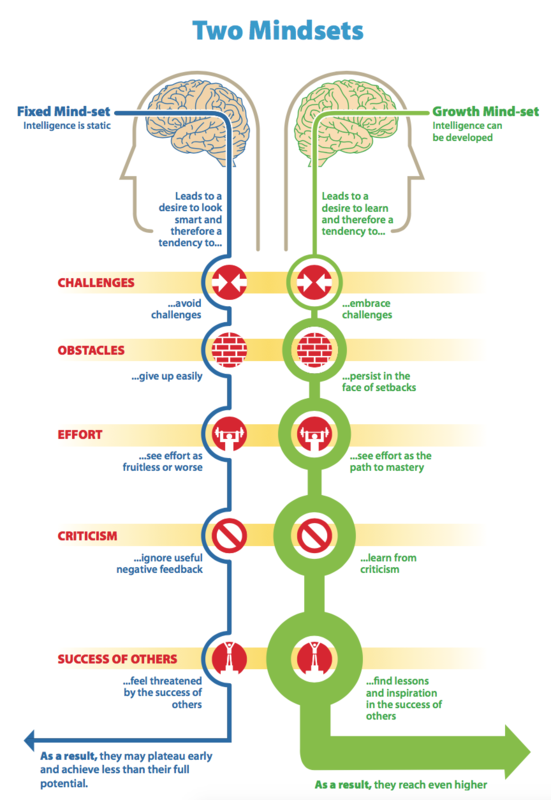
The above graphic (which was created originally by Nigel Holmes) summarizes the essential lessons of having a “growth mindset” (which is what Dr. Dweck calls it).
One of the key items here is to understand that when you’re in a “Fixed Mindset” you care about appearances — you care about demonstrating how great you are, showing everyone how smart you are — but you’re secretly terrified to ask a dumb question or look dumb.
OK — but what does that mean — the fixed mindset and the growth mindset?
Dr. Dweck’s recent interview goes much deeper on explaining this topic, but here are a few key lessons and highlights that may help explain the core idea behind Dr. Dweck’s work.
What Exactly Is a Mindset?
“Well, when I say mindset in the sense that it’s used in my book, I mean people’s beliefs about their most basic abilities and talents. When people are in a fixed mindset, they believe their basic abilities, talents, personal attributes, personalities. That these are fixed traits, you have a certain amount, you have a certain type and that’s it.
But, when people are in more of a growth mindset, they believe that, people differ but everyone can develop their talents, abilities and personal qualities.Again, it doesn’t mean everyone’s the same or everyone will go to the same place ultimately.” -Dr. Carol Dweck on The Science of Success
What Does It Feel Like To Be In A Fixed Mindset?
Being in a fixed mindset sucks. I should know, I was incredibly fixed mindset before I read Dr. Dweck’s book.
If you are worried about looking dumb or think that being eager and asking basic questions will somehow hurt you, instead of helping you, you’re probably in a fixed mindset.
Dr. Dweck goes on in this interview to explain the pain of having a fixed mindset in your daily life:
“When you’re in a fixed mindset, you think, for example. My intelligence is just fixed, I have a certain amount, I can’t do anything about it, I really value being intelligent. The goal of my life becomes to look smart at all cost and all situations and never look dumb.
When you’re in that fixed mindset, a voice in your head says, maybe you shouldn’t do this, maybe you’ll mess up here. Hey, do this, people will think you’re really brilliant. When someone else is looking really smart, you feel threatened by that, when you’re working on something hard and maybe struggling a little, you get really anxious, you think, maybe I’m not as good at this as I hoped I was, as I want to be.
When you hit a setback, that’s a calamity, that’s a real condemnation of your natural talent. If you are so talented, would you have had that failure? Would you have plunged into this mistake like that? Will everyone know it? Will you be unmasked, will you be found out finally? The fixed mindset system is kind of this fear based system, kind of fear alternating with arrogance because if you’re going around thinking it’s fixed and you have this arrogance you feel, I’m better than other people who have less of it but if you’re struggling or having setbacks, then you’re feeling really kind of insecure.
But, what we found in our research whether you’re in the arrogant phase or the un arrogant phase, you’re not primarily a learner. You’re not looking always to grow your skills to create teams that will help you develop and so forth. You’re primarily about showing you’re smart.” — Dr. Carol Dweck on The Science of Success
What Does It Feel Like To Live In a Growth Mindset?
Having a positive outlook and a growth mindset can massively transform the way you live your life, think about yourself, deal with setbacks, handle criticism, and much more. Dr. Dweck continues:
“The growth mindset as I mentioned is a place where you believe your abilities can be developed. Again, it doesn’t mean you saying you’re Michael Jordan or Mia Ham or Yoyo Ma but you understand that abilities can be developed through hard work, learning good strategies, pushing out of your comfort zone as often as possible.
Just keep pushing that limit and getting lots of great input and mentoring from others. It’s a place where if you’re not pushing out of your comfort zone, something’s wrong. If you’re just feeling smart but not feeling you’re getting smarter, something’s wrong.
When you get feedback rather than being threatened, you try to learn from it. If you see someone who is really better than you at something you pride yourself on, instead of thinking, maybe they’re the ones with the talent, you think, I wonder how they got there? I wonder what they can teach me? I wonder how I can get as far as they got or maybe even further.
The focus is, not on looking and feeling smart all the time or being perfector beating out the competition for smartness all the time. But, it’s about becoming smarter, growing, learning. Again, pushing out of your comfort zone, using mistakes and setbacks as opportunities to learn. It was a long time before I could really get in to the idea that setbacks were welcomed, setbacks were inevitable because it’s so different from a fixed mindset place.” — Dr. Carol Dweck on The Science of Success.
Want To Learn More About Mindset?
There is a tremendous amount of research, information, and actionable insight from Carol Dweck’s work, and going much deeper is beyond the scope of this article. To that effect, I wanted to provide you with some additional resources to follow up, check out, and absorb if building a growth mindset is something that interests you.
If you want to learn more about developing a growth mindset and implementing the things Dr. Dweck mentions above, you may enjoy checking out the following books, interviews, and podcasts:
- The book Mindset by Dr. Carol Dweck
- This interview with Dr. Carol Dweck on Mindset
- Dr. Carol Dweck’s Ted Talk “The Power of Believing That You Can Improve”
Moving into a growth mindset is a critical piece of putting on your rationality oxygen mask. It helps you move ego out of the way and accept things as they are, so that you can move forward and grow.
If you enjoyed this…
I study strategies for evidence based growth. Sign up below to get my weekly “Mindset Monday” email, more content like this, and an awesome guide on “How to Organize and Remember Everything.”
Research Reveals How To Deal With Negative Emotions

What does science say about the best way for you to deal with difficult or negative emotions?
Dealing with negative emotions was a very personal challenge for me and so I set out and tried to find as many experts as I could to interview on that subject.
In fact, negative emotions are a topic I cover a ton on The Science of Success and something I’ve spent a lot of time thinking about and working on personally.
I sought out neuroscientists, Harvard PhDs, and more.
These are the core lessons I learned from talking to them.
What Do Negative Emotions Mean?
Let’s start with two core ideas about emotions and what they mean.
(1) Emotions are unavoidable.
You cannot avoid experiencing negative emotions — and by trying to or by pushing them down, ignoring them, and distracting yourself — you are actually causing these emotions to intensify and become greater. Trying to avoid experiencing negative emotions, paradoxically, makes you experience them more frequently and with more intensity.
Tal Ben Shahar — who taught the most popular class in Harvard’s history which was on Happiness — famously says that only two types of people never experience negative emotions — psychopaths and dead people. He has also shared a number of paradoxical strategies to embrace and accept negative emotions and improve your happiness.
Emotional perfectionism — or the idea that you should always be in positive emotional states — can cause some serious problems — and worsen the experience of going through negative emotions. Cultivating self compassion and a more realistic perspective that negative emotions are inevitable and natural helps tremendously (more on Emotional Perfectionism and Self Compassion in minute).
Your emotions are messengers trying to send you information. The sooner you accept that and listen to what they are saying, the better off you will be.
(2) Emotions are data, not direction.
Negative emotions provide you with meaningful and relevant information that you can use to make decisions, prioritize, and understand that something is going on in your life. Listen to that message. But also know that emotions aren’t necessary correct or right — they don’t mean you have to go in that particular direction, but they are providing you with incredibly useful information that you should listen to and incorporate into your behavior.
In fact, when you look at high stakes performers like stock traders and professional poker players — they don’t try to remove emotion from the equation — they leverage their emotions to improve their decision-making process.

Two Reasons To Handle Your Emotions
It seems to me that there are two obvious reasons you want to better handle your emotions:
- Performance
- Peace of Mind
Here are the key strategies for doing each of those (and there is a lot of overlap between these strategies as well).
Mastering Your Emotions For Peak Performance
I would suggest studying someone like Josh Waitzkin — a multi-time national chess champion who then became a multi-time world champion martial artist. This guy knows what it takes to master both mind and body at the highest levels of global competition, and he wrote an amazing book about it called The Art of Learning.
Here’s an awesome quote from The Art of Learning that gets at the core of how you can work to master your mind and emotions:
“My whole life I have worked on this issue. Mental resilience is arguably the most critical trait of a world-class performer, and it should be nurtured continuously. Left to my own devices, I am always looking for ways to become more and more psychologically impregnable. When uncomfortable, my instinct is not to avoid the discomfort but to become at peace with it.” -Josh Waitzkin, The Art of Learning
Cultivating the ability to embrace discomfort and expand beyond your comfort zone are the cornerstones of becoming mentally resilient and, as Josh puts it, psychologically impregnable.
You can practice the ability to embrace discomfort in, as Josh puts it later on in that passage, “the little moments of our lives.” It’s all about expanding your sphere of discomfort day by day and getting past what makes you uncomfortable.

Mastering Your Emotions For Peace Of Mind
Now — lets look at the two primary tools for mastering your emotions to create peace of mind.
The first is meditation. Meditation is proven again and again in the science to be one of the most effective paths of dealing with anxiety, stress, and negative emotions.
In a recent interview I did with Dr. Rick Hanson, author of the book Buddha’s Brain, which is about the neuroscience behind meditation, he shares a number of insights into how meditation helps deal with stress and anxiety.
The second strategy for mastering your emotions is self compassion. This helps combat emotional perfectionism and build an understanding that it’s OK to experience negative emotions.
The Importance of Self Compassion
Self compassion is at the root of taking better care of yourself both mentally and emotionally. We often reserve the most brutal and severe self talk for ourselves — we say things to ourselves that we would never dream of saying to a close friend facing the same challenge, and we expect things of ourselves that we would never expect of anyone else.
Self-compassion is not woo-woo or soft — its very much grounded in psychology research. For example, Dr. Susan David, a Harvard Medical School psychologist and author, discusses self compassion at length in this interviewincluding the below statement:
“The idea of being self-compassionate can seem very woo-woo and very soft.People might think, for example, that being self-compassionate is about being lazy or it’s about being weak or it’s about going easy on yourself. In fact, the research shows the opposite. The research shows that when people create a self-forgiving and safe psychological space within themselves, that those individuals tend to be more experimental, more able to take risks and to take chances, because they recognize that if they fail, that they still save their self-face. That individuals who are self-compassionate tend to be less weak, less lazy and, in fact, more honest with themselves and are able to get through setbacksand transitions more effectively.” Dr. Susan David
Dr. Susan David goes on in that interview to discuss specific strategies for implementing self compassion in your life, beyond just the intellectual acknowledgement that it’s important, including the following passage:
“Recognize how you might speak to yourself, because, of course, we all speak to ourselves. We all have inner dialogue. Some studies show that we have something like 16,000 spoken thoughts every single day and many, many, many, thousands more course through our minds. So many of these thoughts are about ourselves. We will have a dialogue with ourselves where we will say, “You’re such an idiot,” or, “You’re being a fraud,” or, “You are not cut out for this.” A lot of our language is lacking in self-compassion, where we would not use that language with people who we truly love and yet we use it with ourselves. A first aspect of cultivating self-compassion is simply become aware. Simply start noticing the language that you use to actually attack yourself, and that’s really critical.
A second part of creating this felt experience of self-compassion, there are many different ways, but one of the ways that’s frequently very powerful is when you’re going through a setback or a difficulty and you’re starting to be really hard on yourself, is to imagine yourself as a very young child running to yourself as, you, the adult and saying, “Oh my goodness! This happened to me today,” and imagine in yourself how you would treat that very young child, that three or four year old who’s failed at something, who’s done wrong at something and to imagine the kind of love that that child actually needs and the experience that that child actually needs of someone reaching out and giving a hug. That can be really powerful.” — Dr. Susan David
Emotional Perfectionism
One of the biggest things working against self compassion is emotional perfectionism. This is the mistaken belief that you need to be in a positive emotional state all the time and can actually worsen your subjective experience resulting in behavior like “getting anxious about being anxious” or “being angry about being angry” etc.
One of the most profound and personally impactful conversations I’ve ever had about smashing emotional perfectionism was this discussion with Megan Bruneau. We discuss how perfectionism creates an illusion of control and distorts your reality, how to become aware of the critical inner voice at the root of your pain and unhealthy habits, the incredible power of self compassion, and much more.
Cultivating Self Compassion & Mindfulness
Dr. Ronald Siegel, another psychologist with Harvard Medical School, he discusses proven strategies for cultivating mindfulness and self compassion (one of the cornerstones of which is meditation). He share this insight:
“When we are hurting, when we notice that we’ve had a disappointment, we’ve had a failure, something hasn’t turned out well, which [it] inevitably will. Inevitably, we’ll have these moment of defeat, that we can just be nice to ourselves and give ourselves a hug, feel the feeling of vulnerability, feel the feeling of failure, and trust that that’s okay too, that it’s just part of the cycle and we don’t have to identify with that or believe in it. Because as it turns out, none of us are so great and none of us are so terrible.” Dr. Ronald Siegel
Meditation, along with loving kindness practices, can be powerful tools for cultivating and building self compassion. So if you want to take better care of yourself mentally and emotionally, start with the simple act of being more loving and compassionate to yourself.
One More Tool… Emotional Intelligence
One last tool is building the skill of Emotional Intelligence.
Emotional Intelligence is at the cornerstone of managing both your own emotions and understanding what’s going, emotionally, with others. Dr. Daniel Goleman is credited with popularizing and sharing the concept. In this interview titled “How To Master Emotional Intelligence & Why Your IQ Won’t Make You Successful” Dr. Goleman discusses a number of critical ideas including the four pillars of emotional intelligence, how to development emotional intelligence and how to cultivate emotional self control.
If you enjoyed this…
I study strategies for evidence based growth. Sign up below to get my weekly “Mindset Monday” email, more content like this, and an awesome guide on “How to Organize and Remember Everything.”
The Biggest Threat Humans Face in 2018
Objective truth is under attack.
College students are protesting objective facts as a tool of the patriarchy. Politicians are labeling anything they disagree with as fake news. The government just banned the Center for Disease Control from using the word “evidence-based.” Huge chunks of the population don’t believe in statistics anymore.
We can no longer determine, or even agree on, what basic facts are. This war on truth, this lack of an objective reality is a threat to the very fabric of our society.
And the crisis our society faces is rooted in a crisis we each face individually. We are profoundly unaware. We live in a bubble where algorithms confirm everything we want to believe, without any regard for what’s actually real.
This deafening lack of self-awareness is at the heart of the crisis our society faces. It’s the biggest threat we face in 2018.
Why This Matters For You
If you want our society to survive this crisis, if you want to grow and thrive, you must start with putting on your rationality oxygen mask first.
You have to wake up and help yourself before you can help others.
But modern personal development is in the midst of the same crisis. It has failed to deliver on its promise. The self-help world is filled with charlatans and half truths.
You don’t even know if there’s oxygen flowing to the mask. Or which mask to wear.
As the voice behind the popular podcast The Science of Success, I’ve been surprised by the overwhelming conclusion every guest I’ve interviewed makes.
The world’s most respected neuroscientists and psychologists agree — as do the spy-recruiters, hostage negotiators and even astronauts I’ve spoken to: our society is in grave danger.
At the heart of this danger is a pervasive lack of self-knowledge. We are deluding ourselves. Specifically:
• Not seeing yourself objectively
• Rejecting criticism you don’t like
• Rejecting ideas you don’t like (worse!)
• Blaming and externally rationalizing failures
• Unawareness of your cognitive biases
• Not understanding your strengths
• Failing to perceive your weaknesses
We need these vital skills to save our society and ourselves.
There’s still true, real and valuable information out there. But we have confusion en masse and a huge signal vs noise problem.
Where can smart, rational people who crave the genuine insights and improvement necessary for themselves and our society turn?
That is where Evidence Based Growth comes in.
The Quest For Objective Truth
Between the sociopolitical battle over truth’s very nature and the natural biological biases and limits of the human mind — it’s becoming harder and harder to figure out what’s true. We’re slowly slipping into an Idiocracy.
There are people who unwittingly inundate themselves with inane unproven ideas that are toxic and insidiously sabotaging.
There’s a cynically motivated war on truth itself that victimizes those caught in the crossfire of misinformation.
Then there’s also the ambitious intellectual elite who fail to spot, understand and admit to the flaws in their own thinking, in the most destructive way possible.
Objective truth solves all this. We need more truth seekers. We need rational optimists. We need to collectively push forward and rub the dirt from our eyes.
I’m asking you to join this movement.
To join a group of truth seekers dedicated to blowing apart bias and self delusion. To become one of the people who believes that truth is NOT relative and WILL set us free.
We believe humans must quest for truth and answer these questions before it’s too late:
- What’s true about our society?
- What’s true about human nature?
- What’s true about how the world works?
- What’s true about ourselves?
- What’s true about making the world better for all us?
Evidence Based Growth
The Evidence Based Growth movement is organized around the deep belief that objective truth can be found, that there are real answers out there, and evidence and science can improve the lives of us as individuals and WE as a civilization.
We are champions of rationality and clear thinking. We’re ruthlessly investigating our own biases and mental addictions. Our mission is to build a better world out of truth, facts and clear thinking.
We’re harnessing the wisdom of the smartest people on our planet to transform ourselves and to rise to the challenges of our time.
That’s what the Evidence Based Growth movement is all about. We’ve been waiting for you.
Join The Evidence Based Growth Movement
Sign up below to join the movement. Every Monday you will get the the latest evidence based content for your journey towards transformation and objective truth.
How Do You Become Mentally Strong?
Mental toughness is one of the most common traits of top performers. So how do you become mentally strong?
Let’s look at the strategy used by a world champion
One of the absolute best strategies to become mentally strong is to embrace discomfort.
Josh Waitzkin is a multi-time national chess champion who transitioned into becoming a world champion martial artist. To put it simply, this guy knows what is takes to perform under serious pressure at the absolute highest levels.
He wrote an amazing book about his journey and what it takes to be a top performer called The Art of Learning. You can also get a great summary of some of the key ideas from The Art of Learning in this incredible interview Josh did with Tim Ferriss a few years ago.
My favorite quote from The Art of Learning perfectly answers the question of how to build mental toughness:
“My whole life I have worked on this issue. Mental resilience is arguably the most critical trait of a world-class performer, and it should be nurtured continuously. Left to my own devices, I am always looking for ways to become more and more psychologically impregnable. When uncomfortable, my instinct is not to avoid the discomfort but to become at peace with it.When injured, which happens frequently in the life of a martial artist, I try to avoid painkillers and to change the sensation of pain into a feeling that is not necessarily negative. My instinct is always to seek out challenges as opposed to avoiding them. This type of internal work can take place in the little moments of our lives. I mentioned how my style over the board was to create chessic mayhem and then to sort my way through the chaos more effectively than my opponents. This was a muscle I built up by training myself to be at peace with the unclear and tumultuous — and most of the training was in everyday life.” — Josh Waitzkin, The Art of Learning
Josh provides some incredible wisdom in that quote. Embracing discomfort and becoming at peace with it is the best way to cultivate mental toughness and resilience — and this is key — that work takes place in your everyday life.
The little moments where you can push yourself beyond your comfort zone and get uncomfortable build tolerance and slowly expand your ability to get tougher and tougher.
The Sphere of Discomfort

I call this the “sphere of discomfort” and it reminds me of this quote:
Everything you’ve ever wanted is on the other side of fear. — George Addair
When you do something for the first time it’s scary. When you do it for the 10th time, you’re staring to get the hang of it. When you do it for the 1000th time, you’re practically getting bored.
When you play on the edges of your comfort zone, those edges slowly expand, and expand, and expand — and you start to be able to do more things, to push more boundaries, to achieve goals you never thought possible.
The strength and courage to break out of your comfort zone happens, as Josh said, in those little moments of your life. Take the opportunity to make yourself uncomfortable. Take a cold shower. Talk to a stranger. Ask the coffee shop for a free cup of coffee, just because. That’s how you start to get more and more comfortable with discomfort. Rejection therapy is another great tool to start really getting out of your comfort zone.
In the podcast episode below, I even tell a story of how this very Medium post would never exist without me, personally, progressively embracing discomfort!
How To Get Uncomfortable
For a few resources on how to go deeper on this I would recommend checking out the following:
- In this Google Talk — Josh Waitzkin explains many of his ideas and concepts around performance.
- In this podcast episode I break down a number of strategies for embracing discomfort in your daily life (and go deeper on Josh’s story).
- In this interview Jia Jiang discusses “rejection therapy” which can be a great way to familiarize yourself with discomfort (especially if you struggle with social situations).
- In this interview Dr. Andy Molinsky, a professor of psychology, explains a number of strategies for getting outside your comfort zone.
All of those resources, along with the book The Art of Learning, would be a great starting point toward becoming mentally tougher.
If you enjoyed this Sign Up For My Email List
I study strategies for evidence based growth. Sign up below for more epic content like this, and a few free goodies including "How To Organize & Remember Everything."
The Biggest Lesson From Studying Billionaires

I’ve studied many of the most successful people in the history of our planet from titans of industry like John D. Rockefeller and Andrew Carnegie to modern day financial wizards like Warren Buffett, Charlie Munger, and Ray Dalio.
What I’ve discovered from studying such a wide array of incredibly successful individuals is there are some striking similarities between what enabled a 19th century oil baron to succeed and what makes modern day billionaires like Bill Gates, Jeff Bezos, and Elon Musk thrive.
In fact — there is a core principle that holds the secret to what these uber-achievers unlocked — and it’s something I call “high leverage thinking.”
But before we dig into the core ideas of high leverage thinking — and how you can harness them for yourself, starting right now, it’s important to understand the relationship between time and value creation.
The Secret of Leverage
There is a non-linear relationship between time and value creation. The amount of time you spend on something does not have a direct relationship to the amount of value you create.
This doesn’t just have to do with financial success — but it is extremely easy to demonstrate this principle using money.
For someone making $50,000 a year, if they work twice as a hard, maybe they can double their income to $100,000 a year. Once you start moving up the ladder, this logic really starts to break down. It wouldn’t be possible for the same person to work 10x as hard to make 10x as much ($500k a year), because that would require working 400 hours per week, and the week only has 168 hours!
The numbers get crazy when you look at billionaires and titans of industry. According to Wealth-X data from 2013, Warren Buffett made $12.7bn that year which breaks down to $37mm per day and $1.54mm per hour. Now that’s a serious hourly rate.
Is Warren Buffet working 254,000 times harder than someone making $50k a year?
In fact, Warren Buffett says himself that he spends 80% of his day reading! But we will come back to the tactics and strategies these ultra achievers use to be so productive in a minute.
So what gives? How is this possible? What’s the missing ingredient?
The missing piece of the puzzle is LEVERAGE. Warren Buffett, Bill Gates, and all of these titans of industry are masters of leverage. Achieving more by doing less and focusing on what’s important. Warren Buffet is making 254,000x more per hour because he is more high leverage.
The math behind this phenomenon is the 80/20 principle, which pervades huge amounts of our lives describing everything from the distribution of craters on the moon, to the size of files on your hard drive, to rabbit populations, pea pods, and the distribution of wealth of both nations and individuals.
Simply put, the 80/20 principle (which is a “Mental Model,” more on that in a minute) states that a few of your inputs create most of your outputs. A few high leverage activities create the vast majority of the results in your life, and this powerful economic principle, applied many times over, is the math that drives the mammoth differential between Warren Buffets return on time and yours or mine.

The Art of Decision-Making
So now we know that these titans of industry are vastly more high leverage than people who are making millions per year. But what are they doing?
After studying them deeply, interviewing the experts, reading dozens biographies, combing through speeches and articles, and picking apart activities and daily routines — I’ve uncovered the two core strategies these uber-achievers use to become as high leverage as possible.
The first strategy of high leverage thinking is improving your decision-making ability — this is what I call “The Art of Decision-Making.”
Here are five core components of The Art of Decision-Making:
- Use contemplative routines to determine what’s most important to focus on
- Harness the power of compounding by building on your knowledge and getting 1% smarter every day
- Focus on and study things that don’t change or change very slowly over time — master the principles and you can invent the tactics
- Follow the path of worldly wisdom and focus on acquiring multidisciplinary knowledge across academic disciplines like psychology, mathematics, and biology
- Build a toolkit of mental models so that you can better understand reality and achieve their goals.
Contemplative Routines
Lets borrow some wisdom from Charles Duhigg the author of Smarter, Faster, Better and The Power of Habit.
In a recent podcast interview, Charles discussed how research shows that the most common rituals that highly successful people share are what he calls “contemplative routines.”
What actually seems to correlate with success is that the people who are most productive and most successful, they tend to have what researchers refer to as contemplative routines, as habits in their life that push them to think more deeply.
Journaling is a great example of this, because the act of journaling often times forces us to sit down and to try and make sense of how we spent our time recently.
What our goals actually ought to be as opposed to what we happen to just get obsessed with or fixated on right now, and how we should arrange our life so that those priorities, so that our energy and our activity is actually focused on our priorities rather than instantly responding to life’s many sort of busy work request. The basic insight here is that, particularly now, being busy and being productive are not synonymous.” — Charles Duhigg
The Power of Compounding
Improving your ability to think, understand reality, and make better decisions is one of the core principles of high leverage thinking. The more time and energy you invest in your decision-making ability, the more it continues to build and build on itself by harnessing the power of compounding(compounding is another example of a Mental Model, by the way).
Becoming a master at the Art of Decision-making cascades through everything you do. It’s not incremental growth in your knowledge, it’s exponential growth. Einstein described the power of compounding as the “eight wonder of the world” — and if you’ve ever crunched some numbers on a compound interest calculator you know how powerful compounding can be over time.
If you get 1% better at thinking — at understanding how the world works, how human behavior works, how economic systems function, and understanding your own brain — that 1% improvement impacts everything you do. You’re not just going to benefit at work, but when you deal with your spouse, or negotiate the purchase of a new car, or decide where to invest your savings. You’re entire life is essentially a long chain of decisions. Wouldn’t it make sense to invest in the ability to make better decisions and continuously improve that skillset?
These small incremental improvements in decision-making aren’t noticeable at first, but they eventually result in a huge transformation in how you think, act, and understand the world.
Here’s a quote from our dear friend Warren Buffett, when asked what the key to success was he pointed to a stack of books and said:
“Read 500 pages like this every day. That’s how knowledge works. It builds up, like compound interest. All of you can do it, but I guarantee not many of you will do it.”

Study Things That Never Change Over Time
A key piece of building a compounding machine of knowledge — that over time will let you vault over almost everyone on the planet in terms of sheer brain power — is focusing on knowledge that doesn’t change or changes very slowly over time.
Many people focus their time and energy on learning rapidly changing tactics, the minutiae, highly specific actions and pieces of advice without a broader context. As Sun Tzu once said “tactics without strategy is the noise before defeat” and Ralph Waldo Emerson said:
“As to methods, there may be a million and then some, but principles are few. The man who grasps principles can successfully select his own methods. The man who tries methods, ignoring principles, is sure to have trouble.”
I’m here to teach you how to be one of the people who masters the principles that govern reality — so that you can wield them to achieve whatever goals you want to achieve.
People gobble up the latest article “10 Things You Can Do To Improve Your Email Opt-In Rate” but the problem with studying knowledge like that is that it changes — it doesn’t give you something to build up and build upon over time — in 18 months all of the advice in that article will be useless. If you spent a year in 2004 reading every book on high performance banner ads — none of that knowledge would be relevant today.
But if you flip that, if you study the strategy — spend your time mastering the core principles that underpin psychology and human behavior, reading things like the book Influence by Robert Cialdini — you can invent marketing tactics on the fly — because you understand the bigger picture. And that knowledge changes very slowly over time — it’s a core foundation that you can build upon and grow from.
This also means that the best kind of knowledge to focus on and spend your time investing in is not ephemeral junk like facebook, twitter, and buzzfeed, but the core pillars of human knowledge and the major academic disciplines, which brings us to the principle of Worldly Wisdom.

Worldly Wisdom
The next key component of The Art of Decision-making is cultivating what Charlie Munger (the billionaire business partner of Warren Buffett) calledWorldy Wisdom.
Here’s a great description of the concept of worldly wisdom from Robert Griffin’s book “Charlie Munger: The Complete Investor:”
Munger has adopted an approach to business and life that he refers to as worldly wisdom. Munger believes that by using a range of different models from many different disciplines — psychology, history, mathematics, physics, philosophy, biology, and so on — a person can use thecombined output of the synthesis to produce something that has more value than the sum of its parts. Robert Hagstrom wrote a wonderful book on worldly wisdom entitled Investing: The Last Liberal Art, in which he states that “each discipline entwines with, and in the process strengthens, every other. From each discipline the thoughtful person draws significant mental models, the key ideas that combine to produce a cohesive understanding. Those who cultivate this broad view are well on their way to achieving worldly wisdom.”
Being multidisciplinary means collecting knowledge from lots of different disciplines and areas of life and building an approach to understanding the world that integrates all that knowledge into a cohesive framework.
In order to get what you want you have to understand how to get there, and in order to do that, you have to understand how things work — things like human behavior, economic systems, money, biology, and mathematics. Josh Kaufman explains this beautifully in The Personal MBA:
“Every business fundamentally relies on two factors People and Systems…To understand how businesses work, you must have a firm understanding of how people tend to think and behave — how humans make decisions, act on those decisions, and communicate with others. Recent advances in psychology are revealing why people do the things they do, as well as how to improve our own behavior and work more effectively with others.
Systems, on the other hand, are the invisible structures that hold every business together. At the core, every business is a collection of processes that can be reliably repeated to produce a particular result. By understanding the essentials of how complex systems work, it’s possible to find ways to improve existing systems, whether you’re dealing with a marketing campaign or an automotive assembly line.”
The problem is that too many people have a very narrow focus — they master one piece of the puzzle, say marketing or finance, and think that has all the answers. But reality is messy and complex and interwoven. Most big events in our lives aren’t caused by one simple explanation; they are the result of an interplay of factors.
A multidisciplinary approach intertwines and strengthens itself by enabling you to pull from different disciplines of knowledge and bring the exact tools necessary to understand and solve tough challenges and to achieve complicated and difficult goals. As Peter Bevelin writes in Seeking Wisdom:
“Since no single discipline has all the answers we need to understand and use the big ideas from all the important disciplines: Mathematics, physics, chemistry, engineering, biology, psychology, and rank and use them in order of reliability.”

A Framework of Mental Models
Now its time to go deeper into Mental Models, which we briefly touched on earlier. A mental model is simply a concept, an idea, a tidbit of wisdom that in some way explains how the world works. Mental models are one of the cornerstones of high leverage thinking. In fact, Charlie Munger puts it pretty bluntly:
“Developing the habit of mastering the multiple models which underlie reality is the best thing you can do.”
When a billionaire tells me something is “the best thing I can do” — I listen.And I’ve spent a tremendous amount of time studying billionaires, people like Charlie Munger, and mental models so that you don’t have to.
A few examples of mental models would be concepts like the 80/20 principle and compounding, both of which we discussed earlier, as well as concepts like expected value and base rates from mathematics, notions such as confirmation bias, anchoring, and social proof from psychology, the prisoner’s dilemma from game theory, or the concept of natural selection from biology.
While this may seem a bit overwhelming, the good news is that you don’t have to become an expert in physics and chemistry just to become a high leverage thinker. The whole idea is to master the big ideas . Take the major principles from a 101 textbook and combine them into a framework of mental models that offers a rich and deep tool kit to look at, understand, and manipulate reality to your ends.
The Key Ideas
Remember the core ideas behind the Art of Decision-making:
(1) Use contemplative routines to determine what's most important to focus on
(2) Harness the power of compounding by building on your knowledge and getting 1% smarter every day
(3) Focus on and study things that don’t change or change very slowly over time — master the principles and you can invent the tactics
(4) Follow the path of worldly wisdom and focus on acquiring multidisciplinary knowledge across academic disciplines like psychology, mathematics, and biology
(5) Build a toolkit of mental models so that you can better understand reality and achieve your goals.
When you combine all of these factors, you are putting your brain on a high leverage rocket ship — and with the power of compounding you will start leaving other people in the dust.
But making great decisions is only half the battle. What can the titans of industry teach us about the other key element of being high leverage?

Here’s What Rockefeller & Carnegie Do
We just went deep on The Art of Decision-making — now let’s look at the other big strategy used by high leverage thinkers like Bill Gates, John D. Rockefeller, and Andrew Carnegie — hiring people to replace yourself.
Hiring people and constantly replacing yourself is one of the single greatest ways to continuously gain higher and higher leverage on your time. Too often entrepreneurs get caught up in the trap of having to (or feeling like they have to) do it all themselves. This is a dangerous road to walk — and while it can be useful in the early days — it quickly becomes a detriment and ends up bottlenecking your growth.
You often see the most high leverage people doing things that an average person would think is “wasting money” — like hiring someone to do their grocery shopping, paying for lawn care services, having a maid, hiring a handyman to do the work around your house, or paying for a virtual assistant.But it is exactly because a high leverage persons time has become so valuable — that they cannot possibly fathom investing it in an activity that they could outsource for 1/10th or less of their own hourly rate.
This applies in your business too. Anything that anyone else can do 80% as good as you can — in order to leverage your time as effectively as possible you have an obligation to replace yourself as quickly as you can.
I want to share two of my favorite quotes on this topic from some serious titans of industry.
The first is from the book Andrew Carnegie by David Nasaw:
“When A.B. Farquhar, a Pennsylvania businessman, boasted that he was in his office every morning ‘by seven in the morning’ and was the last one to leave in the evening, Carnegie laughed at him. ‘You must be a lazy man if it takes you ten hours to do a day’s work. . . . What I do . . . is to get good men, and I never give them orders. My directions seldom go beyond suggestions. Here in the morning I get reports from them. Within an hour I have disposed of everything, sent out all of my suggestions, the day’s work is done, and I am ready to go out and enjoy myself.’”
The playbook for success has been out there for a long time — over a hundred years ago some of the most successful individuals in history where sharing their exact strategies for how to leverage your time as effectively as possible. But, Andrew Carnegie was only the second wealthiest person in modern history. Let’s hear from the wealthiest.
The next quote is from John D. Rockefeller (from the book Titan by Ron Chernow) when he was speaking to a young recruit at the Standard Oil offices:
“Has anyone given you the law of these offices? No? It is this: nobody does anything if he can get anybody else to do it . . . As soon as you can, get someone whom you can rely on, train them in the work, sit down, cock up your heels,and think out some way for the Standard Oil to make some money.”
That is high leverage thinking in a nutshell. As soon as you can — find someone you can train, replace yourself, and spend your time thinking, reading, learning, and focusing on the big picture — as Michael Gerber would call it — working on your business not in your business — that is the essence of being becoming high leverage.
As Carnegie notes above — you want to hire good people to replace yourself, and that’s not always easy. Going deep on the hiring practices and strategies is well beyond the scope of this post, but I did want to offer a great resources for that journey. The book “Who: The A Method for Hiring” by Geoff Smart and Randy Street is a great starting point for learning how to both source and evaluate talent when hiring people.
Let Go (Of The Need To Do Everything)
One of the first big steps to replacing yourself is letting go of the need to do everything. Needing to do everything is the same thing as knowingly becoming a bottleneck to your own success. It’s rooted in perfectionism and does nothing but hold you back.
Sadly, this is actually more of a curse for people who are very talented — because they know they can do a great job at every piece of the puzzle — they often can’t tolerate when someone doesn’t do it just as they would have liked. The end result, however, is that these people end up frazzled, trying to do 3 people’s jobs at once, and mired in busy work and minutia that they have to do “just right” — missing the bigger picture and destroying their ability to achieve leverage on their time and output.
The sooner you can let go of the need to be in the middle of everything, andrealize that it’s OK if someone else does it a bit differently — the faster you can start leveraging your time. As Tim Ferriss notes “what you do is infinitely more important than how you do it.”
A good rule of thumb here is that if someone can perform as task 80% as well as you can, go ahead and give it to them and move it off your plate. Peter Drucker makes this point abundantly clear in The Effective Executive:
“[The effective executive’s] first look at the time record makes it abundantly clear that there just is not time enough to do the things the executive himself considers important, himself wants to do, and is himself committed to doing. The only way he can get to the important things is by pushing on others anything that can be done by them at all.”
Design A System — And Let Your Team Execute It

It always amazes me to see the same themes and ideas echoed across centuries. Ray Dalio is describing the same strategy that John D. Rockefeller espouses — designing and managing a machine that lets you get what you want. A key part of that strategy is constantly replacing yourself in any area where you are weak.
Ray Dalio is a billionaire who was named by Time as one of the 100 most influential people in the world and named one of the 100 wealthiest by Forbes. Ray is known for his unrelenting pursuit of truth — and provides great insight, in his book Principles, into why you should constantly focus on understanding your own strengths and weaknesses and replace yourself with someone as quickly as possible:
“Let’s imagine that your goal is to have a winning basketball team. Wouldn’t it be silly to put yourself in a position that you don’t play well? If you did, you wouldn’t get what you want. Whatever your goals are, achieving them works the same way.
If you see that you are not capable of doing something, it is only sensible for you to have someone else do it. In other words, you should look down at you and all the other resources at your disposal and create a “machine” to achieve your goals, remembering that you don’t necessarily need to do anything other than to design and manage the machine to get what you want. If you find that you can’t do something well, fire yourself and get a good replacement!
You shouldn’t be upset that you found out that you are bad at that — you should be happy because you have improved your chances of getting what you want. If you are disappointed because you can’t be the best person to do everything, you are terribly naïve because nobody can do everything well. The biggest mistake most people make is to not see themselves and others objectively.”
You don’t have to be the person working any given part of the machine — but you must be the one designing it and managing it — guiding it towards the goals that you ultimately want to achieve.
Once you have a system and a trusted team — delegate and give them a large dose of responsibility. In the book The Outsiders by William Thorndike the author examines eight companies that outperformed the SP500 by an average factor of 20x — and uncovers the strategies their management team used in order to achieve such incredible results. One of the core strategies used by these unconventional CEOs was described as “delegation to the point of anarchy.”
Constantly Replace Yourself

I consider myself a pretty lazy person — and that’s why I’ve always loved the Bill Gates quote:
“I always choose a lazy person to do a difficult job, because he will find an easy way to do it.”
In fact — I’ve been able to wield my laziness as a weapon to constantly and relentlessly replace myself in anything I am doing that is not my absolute zone of strength. Whenever a task lands on my desk from one source or another — the first thing I ask myself is how can I delegate this, and if I can’t — the next question I answer is how can I build a system so that it’s possible to delegate this in the future.
It is only by continuously asking “it is really necessary that I do this” that you can start to free yourself from the self imposed constraints of perfectionism and move forward with building a system and a team to execute it — freeing your time to focus on bigger and more important issues.
Focus On Your Strengths
By building a team and replacing yourself — you can focus on your true areas of strength, and spend the most possible amount of time living and working in your strengths. By doing this you achieve a double compounding effect — more if your time is spent in your strengths and you are getting better at those strengths (by investing that time in the Art of Decision-making). Once you truly start to move down this path, you begin to achieve more and more leverage.
It’s been said many times, but I think Peter Drucker sums it up wonderfully in the Effective Executive when he says:
“Making strengths productive is therefore much more than an essential of effectiveness. It is a moral imperative, a responsibility of authority and position. To focus on weakness is not only foolish; it is irresponsible. A superior owes it to his organization to make the strength of every one of his subordinates as productive as it can be.
But even more does he owe it to the human beings over whom he exercises authority to help them get the most out of whatever strength they may have. Organization must serve the individual to achieve through his strengths and regardless of his limitations and weaknesses.”
Focusing on your strengths not only lets you be more high leverage — its literally a moral imperative to only do what you’re good at, and surround yourself with other people who’s strengths fill in your weaknesses.

Becoming A High Leverage Thinker
So there you have it — the essence of becoming incredibly high leverage. These are the major tools and strategies used by history’s most successful individuals. The common themes between a 19th century oil barron and a modern day hedge fund master of the universe are no accident — these principles are the timeless strategies that top performers use to become exponentially more effective than an average person.
Just like compound interest, these changes accrue very slowly, almost imperceptibly, at first, but before you know it — you will look back and be shocked at the incredible leaps and bounds you’ve made and find it hard to pinpoint the exact moment of departure, when you become a High Leverage Thinker too.
Sign up below to get even more detail in my free guide "Four Steps To Making Better Decisions" - and tons more content like this focused on helping you become as high leverage as possible.
Turn Your Childhood Hardship Into Career and Life Success

Dr. Jude Miller Burke explains how you can turn your childhood hardship into career and life success!
In her latest new book, The Adversity Advantage, Dr. Jude Miller Burke, discusses how childhood trauma and adversity, in all forms ranging from abuse and neglect to poverty and violence, does not have to deter you from attaining personal happiness and career success. Survival skills learned during childhood can be used to enhance career success. Drawing from her background of counseling hundreds of men and women for over 25 years, as well as her most recent phase of research into childhood adversity and work success, Dr. Burke continues to study factors that lead to and interfere with career success and paints a clear picture on how to ensure childhood problems are not compromising your career and how to use hard-won survival skills to your advantage at work.
In her latest book, The Adversity Advantage, Jude Dives Into...
- Adversity affected the men and women at the same rate.
- The Big 5 Personality Traits that enhance success regardless of one’s childhood
- How to Rebuild Shattered Self-Confidence from Past Trauma
- How to Recognize and Resolve Your Emotional Triggers at Work
- The Importance of Setting Healthy Boundaries in Your Career
- And much more!!
Learn more about Dr. Jude Miller Burke - http://judemillerburke.com/
Purchase Her New Book - https://www.amazon.com/Adversity-Adva...
Building A Mental Model Toolbox - With Shane Parrish
Learning how to make better decisions is a lifelong endeavor. Just as important as learning how to learn is learning WHAT to learn.
In our interview with Shane Parrish from the Farnam Street Blog we discuss the importance of learning things that do not change over time, keeping a decision journal, and how to get started building a mental model toolbox to face any situation. All this and more with Shane Parrish in our full interview below.
Shane is the founder and author of the Farnam Street Blog. His work has been featured in Forbes, The Wall Street Journal and more! He writes on and teaches topics such as decision making, learning, and mental models.
Farnam Street Blog: https://www.farnamstreetblog.com/
Follow Shane on Twitter: @farnamstreet

Conduct The Perfect Job Interview - Without Any Questions
You’re a trained interviewer, seeking to exert your mythical superpower of looking into the soul of your interviewee, when you ask, “What is your greatest weakness?”
This is your fifth interview today and it’s not the first time you’ve asked that question. You’ve heard it all day, “My greatest weakness is I just work too darn hard.” Is this what you really want to know, or are you seeking something else? Does this persons’ ability to get the job done, and do it well, really hinge on a question like this?
Our common sense tells us that this “verbal tango” during a job interview does nothing to help us achieve our goal, which is to find the best candidate based on the skills required for the job. We sense there is a better way but decades of momentum tells us that this is the way that job screenings are done. Otherwise wouldn’t someone have found a better way to screen employees? This must be the best way…
Or is it??

You’re a trained interviewer, seeking to exert your mythical superpower of looking into the soul of your interviewee, when you ask, “What is your greatest weakness?”
This is your fifth interview today and it’s not the first time you’ve asked that question. You’ve heard it all day, “My greatest weakness is I just work too darn hard.” Is this what you really want to know, or are you seeking something else? Does this persons’ ability to get the job done, and do it well, really hinge on a question like this?
Our common sense tells us that this “verbal tango” during a job interview does nothing to help us achieve our goal, which is to find the best candidate based on the skills required for the job. We sense there is a better way but decades of momentum tells us that this is the way that job screenings are done. Otherwise wouldn’t someone have found a better way to screen employees? This must be the best way…
Or is it??
The “Job Interview” has evolved into asking fuzzy, situational, non-pertinent questions. So, to achieve better results, let’s change the Job Interview description to “Demoview” and forbid the asking of any questions. As the job interviewer, this is a better way to get the information you need out of an interview and find the right person – with the right skills.
Preparation for the “demoview” will be different. Instead of identifying questions to ask, you will be identifying the skills the potential employee needs. You won’t be asking about those skills, you’ll simply be saying, “Demonstrate those skills for me.”
Your Preparation
All of the tasks a person performs on the job require skills. Make a list of all of the skills a person needs on the job, then divide that list into two groups.
"A skill, is any ability that a person has as a result of learning to do something correctly."
The first group of skills includes those that you provide training on before the person begins the job. Once you have this list, file it and ignore it for now. You don’t need it for the job posting or the interview.
Your focus is on the second group of skills; the skills that a person needs to bring with them to the job interview - the prerequisite skills. The ideal job candidate needs to already possess these skills because they are:
- Used on the job, but not trained in the training program
- Prerequisites for learning the trained skills, such as already being able to navigate a particular software so they can learn the specific application of that software during training.
These prerequisite skills are the skills that belong in the job posting because this is how you are going to screen the job candidates.
Your preparation for the “demoview” is to set the stage to be able to test the “demoviewee(s)” performance of these prerequisite skills to the standard you’ve established. For example, if the prerequisite skill is to design a web page using specific software, give them the information or content that will be available when they are doing it on the job, give them access to that software, and let them design the page for you.
The Standards
In addition to setting up the demonstrations, you need to identify the standards to which the candidates must perform. For example, if a requirement is to speak and read French for an international client, you still need an objective standard. You might have a set of instructions in French from the actual job so you can have the candidates demonstrate their ability to read and follow the instructions in a certain amount of time. Or, make arrangements with a French-speaking associate to test the “demoviewee’s” ability to not only communicate in French but in the required software language. A much greater test, than “tell me your greatest weakness.”
The Event
For each skill that can be demonstrated, don’t just talk about it; say “Show me.” Do this for as many of the prerequisite skills as possible.
"Don't Tell Me, Show Me"
The degree to which you can have the job candidates demonstrate prerequisite skills is the degree to which you can validate that the candidate qualifies for the job.
What About “Soft Skills”?
You will hear, “We are concerned about the person fitting into our culture,” or “We need to make sure the candidate is a team-player,” or “They need to have strong communication skills.” This is definitely true! These soft skills can be treated like any other skill to be demonstrated if you first translate them into observable performances.
As soon as a soft skills requirement leaves the lips of a requesting manager, have this conversation with them:
“You’re right. They do need to _________________ (insert the soft skill). When you observe a person demonstrating ________________________ (fitting into our culture/being a team player/having strong communication skills), what are you observing them do?”
Keep them talking. You’re simply making a list of the performances they describe. Take the necessary time to complete that conversation. It may be difficult to pull out all of their meaning, and may take some time, but it’s a worthwhile investment. The result will be a list of observable performances defining that particular soft skill. That list is the same as the observable skills. Instead of talking about those soft skills, you can now have the job candidates demonstrate the observable performances that define the requirement.
Keep The Fish Out Of The Trees
Albert Einstein once said:
“Everybody is a genius. But if you judge a fish by its ability to climb a tree, it will live its whole life believing that it is stupid.”
Your effort is to keep the proverbial fish out of the trees.
People that are hired without having the skills they need to learn and to perform their jobs are the fish. They may be geniuses in another area, but this job will end badly.
When you implement the “demoview” vision, you will have a way to observe each prerequisite job skill demonstrated by your job applicants. You will be keeping the fish out of the trees. When your client or boss evaluates your interviewing performance, your assessment will be a definite: “NAILED IT!”
About The Author: Rex Connor

Rex Conner is the author of What if Common Sense Was Common Practice in Business? The lead partner and owner of Mager Consortium, he applies the uniquely effective processes of Dr. Robert Mager to the entire spectrum of human performance in the workplace. Conner has witnessed the common violations of common sense while working as a trusted partner inside of more than 50 companies in dozens of industries over the last three decades.
For more information, visit www.magerconsortium.com, and connect with Conner on LinkedIn.
Creating a Brand of Optimism with Life is Good Co-founder John Jacobs
By now, most people have heard of the brand "Life Is Good", but many have never heard the journey and the meaning behind its beginnings. We sat down with co-founder John Jacobs and learned how he and his brother grew this business, the lessons learned, and the true meaning of life is good.
Check out John and his work below!
Website: https://www.lifeisgood.com/our-story.html
Twitter: @Lifeisgood
Learn To Defeat Panic - With Justin Stenstrom of Elite Man Magazine
Panic Attacks can sneak up on us in stressful times and make everything worse! So much anxiety and emotions hit our system at once and we either freeze and don't know what to do or, it leads to bad decision making.
Luckily we can take back control if we know what to do. We sat down with Justin Stenstrom and learned his easy 5 step process to overcoming panic attacks and taking back control. Justin is the founder of Elite Man Magazine, an entrepreneur, author, and speaker. He like many others fell prey to these panic attacks until he developed these steps to "Defeating Panic" and now she's them with others. You can learn more about Justin's work below.
Elite Man Magazine: http://elitemanmagazine.com/
Justin Stenstrom: http://elitemanmagazine.com/justinste...
Twitter: @JustinStenstrom
Full Hour Long Interview Here
Daily Practices To Infinite Success - With Yogi Cameron
The Yogi Code
7 Universal Laws of Infinite Success
Today we are featuring some special content made exclusively for you, The Science of Success listeners! The esteemed Yogi Cameron swings by to break down the 7 Universal Laws of Infinite Success in the Yogi Code and how you can use these steps to improve every aspect of your life.
If you like what you hear (we know you will) and wish to learn more, visit Yogi Cameron and reach out to him on his website.
Yogi Cameron's book is released May 9th, 2017 and can be found HERE.
If you truly want to begin the path the self-healing. Lose Weight, Look, and Feel Better - join Yogi's course Transform Your Health HERE.
Yogi Cameron
Yogi Cameron is one of the most celebrated Ayurvedic and Yogic practitioners in the world. Since 2003 he has been taking these ancient teachings from India, were he was trained and also lives part time, and bringing them to people around the world through his TV show and other media outlets. He is the author of ‘The Guru In You’ and ‘The One Plan’ and is now bringing you his new book The Yogi Code which holds 7 of the most important and powerful teachings of the Yogic path.
Yogi Cameron has been featured on The Dr. Oz Show, The Ellen DeGeneres Show, The Today Show, Extra, E! News, The Insider and many other news and entertainment outlets. He has also been featured in The New York Times, Wall Street Journal, ELLE, Vogue, The London Times to name a few. YC is a resident expert on ‘Conversations with Maria Menounos’ on SiriusXM.
Yogi Cameron has launched ycmembership.com, a private portal where many gather to share ideas, thoughts and experiences while receiving guidance and expertise on Yoga, Meditation and Ayurveda as a lifestyle. You can find out more by visiting yogicameron.com

The Hostage Negotiator's Jedi Mind Trick You Can Use To Become Instantly More Likable
Chris Voss has been a part of some tense negotiations. Unlike most negotiations however, when Chris was involved it was a matter of life and death. Currently the founder and CEO of The Black Swan Group, Chris spent 24 years in the FBI. During his time there Chris acted as the FBI’s lead international kidnapping negotiator working over 150 kidnappings worldwide in some of the less forgiving areas of the world such as the Middle East and Haiti.

Chris Voss has been a part of some tense negotiations. Unlike most negotiations however, when Chris was involved it was a matter of life and death. Currently the founder and CEO of The Black Swan Group, Chris spent 24 years in the FBI. During his time there Chris acted as the FBI’s lead international kidnapping negotiator working over 150 kidnappings worldwide in some of the less forgiving areas of the world such as the Middle East and Haiti.
Recently, Chris appeared on The Science of Success Podcast with Matt Bodnar and shared his number one negotiation “Jedi Mind Trick” and how hostage negotiation tactics can be used in everyday life and business to make you successful and more likable. “It’s a little tactic called mirroring” Explains Voss. Most people, when they think of mirroring they think of mimicking the other person’s body language for instance “Let me stand like they stand...If they're leaning against a wall, let me lean against a wall… but that’s not it.” According to Voss “It’s simpler and much more powerful.”
“The mirroring a hostage negotiator does… is just the repetition of the last one to three words that someone has said.” Sounds simple, right? It is! “It’s a great simple tool that feels enormously awkward when you do it… the biggest barrier to these tools is not their complexity...The barrier here is feeling awkward because it’s different” So while you might be feeling awkward practicing mirroring, remember on the surface it’s not about you it’s about making them like you and trust you explains Voss, “You feel awkward, the other person however, feels listened to.”
By repeating the words back to your boss, coworker, or the other side of the table in a negotiation you make them feel listened to. Not only that but you also invite them to go on and further clarify their points, potentially revealing their root motivation or issue. Oftentimes when we are speaking to someone and trying to explain a problem, desire, or issue we use the words that make the most sense in our minds. Which can cause unintentional miscommunication since we don’t all think alike. “There’s a pretty good chance actually, that the other person doesn’t think the same way we do and your perfect words are kind of missing the mark.” Mirroring, unlike asking someone “What do you mean?” causes others to rephrase their words as opposed to just repeating their point over and over.
“What a mirror does is it flips that switch so the person will repeat what they’ve said using different words.” Voss explains to Bodnar. “It’s how you get someone to paraphrase themselves so you don’t have to paraphrase for them, thus increasing your understanding of their meaning.” By repeating the last three of four meaningful words in the other person’s sentence you cause them to unknowingly explain their point of view or desires from a different angle. Thus increasing the amount of knowledge you have regarding their stance as well as clarifying their intentions. Not only that, but the other person will begin to favor you because they feel welcomed to do all the talking and can tell you are actively listening and interested in their points.
Voss closes by explaining “Every hostage negotiation team whether in Japan, whether they are in China, if they are in Nigeria, Latin America, they all use these skills and they have been road tested in every culture… and they work because we are human beings.” So next time you're gearing up for a negotiation, asking the boss for a raise, or entering an emotional or tense conversation remember the universal power of mirroring. “A lot of the people I have trained begin using this tactic and they come back to me and say WOW! This is a Jedi Mind Trick!... and it works everytime.”
You can listen to Chris’s full hour long interview with Matt on The Science Of Success website or on iTunes, Stitcher, or the Android Store.

How To Defeat Depression and Anxiety – A Letter To A Listener In Need
If you struggle with depression or anxiety, you may benefit from reading this and realize that there is hope and there is a path forward that can lead you to a happy and more fulfilled life. The following is an actual response I wrote to a listener email – but this is a topic that I deeply care about, and something that I felt really needed to be shared more broadly with the world.

[Disclaimer – I am not a doctor and I don’t pretend to play one on the internet, speak with a medical or psychiatric professional if you need help.]
Do you suffer from depression or anxiety? Do you ever feel like there is no hope, like you’re trapped? Like it’s hard to be brave and struggle through moment to moment?
I’ve felt that way too. I know how bad it feels.
Depression and anxiety are things I have dealt with in my own life, spent lots of time researching, and battled back from.
If you struggle with depression or anxiety, you may benefit from reading this and realize that there is hope and there is a path forward that can lead you to a happy and more fulfilled life.
The following is an actual response I wrote to a listener email (which has been edited for readability and to preserve their privacy, and their name has been changed) – but this is a topic that I deeply care about, and something that I felt really needed to be shared more broadly with the world.
Without further adieu, here’s the email:
The Email
“James - thanks so much for writing in. I'm so glad that you wrote to me and I really hope that I can be helpful to you. I've dealt with depression and anxiety in my own life and I know what the struggle is like. Sometimes its hardest to see the light at the end of the tunnel when you're in the midst of it, but know that you can literally change the physical structure of your brain, overcome your struggles, and live a happy and productive life.
I'm going to give you A LOT of resources in this email - but these are all pieces of the puzzle that can help you.
Depression & Your Brain
Before we get into the specific tactics of dealing with your question about how to stay motivated and achieve things while dealing with depression, lets discuss depression broadly and some ways to think about it.
I would recommend several interviews we've done on the show around the core concept that science shows that you can “rewire” and change the physical structure of your brain to pull yourself out of depression or anxiety.
First, I would recommend the interview we did with Dr. Alex Korb, a UCLA neuroscientist who recently wrote a book on reversing the course of depression.
That interview is called “How to Break Free from Depression & Anxiety by Changing Your Brain Chemistry” and in it we discuss the following (among many other things):
- How people (like you and me) can get stuck in a loop of anxiety or depression
- How to strengthen and grow new neurons to literally change the structure of your brain
- Why nothing is wrong with your brain when you get stuck in a loop of depression or anxiety
This means that – no matter what – there is always hope – there is always a path forward, a way through the darkness. There’s nothing wrong with you if you feel depressed or anxious, and you can get to a place where you feel better.
The second interview I would recommend checking out is the amazing conversation we had with psychologist Dr. Rick Hanson, the author of Hardwiring Happiness, Buddha’s Brain, and several other books. Rick has written extensively about “neuroplasticity” and the science behind how you can change the physical structure of your brain with your thoughts.
In that conversation, we discuss:
- How your thoughts change the physical structure of your brain
- How your brain’s 5 core survival strategies create suffering in your life
- How reality is continually constructed by the underlying hardware of the brain
- How to disengage from stress and suffering
It’s not an accident that I interviewed Dr. Korb and Dr. Hanson – I specifically sought them out because their research was valuable and helpful to me in dealing with some of my own struggles.
Both of them provide the necessary backdrop to understand that it is possible, and demonstrated in scientific research, as well as by the personal experience of myself and many others, to overcome the struggles of anxiety and depression, to build a happy life, to see the sun peeking through the clouds, and live the life you want to live.
Mind Body Interventions To Prevent Depression & Anxiety
Now lets look concretely at some of the mind-body interventions that you can implement to change your brain chemistry, physiology, and ultimately the structure of your brain to make yourself happier and to chip away at the depression and anxiety looming in your life.
What do I mean by mind-body interventions? It sounds complex, but they are very simple and easy to do.
Let’s start with another one of my favorite interviews that I’ve done recently – The Paradox of Happiness with Tal Ben Shahar.
Tal Ben Shahar is a badass. He taught the most popular class in Harvard’s history (which was about happiness) and is the author of several books including Choose The Life You Want, The Pursuit of Perfect and Happier (among others).
In my interview with Tal – we went deep on several of these “mind-body interventions” that can boost happiness and combat depression and anxiety - these sound really simple but research shows them to be as effective if not more effective than antidepressants – specifically the following activities:
- Exercise
- Breathing & Breath Work
- Meditation
Yes those all sound super simple and obvious - and yes they work amazingly well. Daily cardio for me was one of the single biggest factors for breaking myself out of anxiety and depression.
Let’s discuss each briefly and share some specifics:
Exercise
The incredible power of exercise is not in improving your physical health – but in improving your mental health. There was a study of over a million people that demonstrated the powerful effect of cardio on reducing depression (see here and here) and meta studies also demonstrate the same conclusion. Find a way to work 30 minutes of cardio in your day, several days per week. For me, I literally watch YouTube videos on my iPad while doing stationary bike – its super easy to do! Most of the research supports cardio (as opposed to strength training) as the ideal method of exercise for improved mental health.
Breathing & Breath Work
This is a fascinating field and one with some really promising and interesting findings. Just simple breathing and doing the right kind of breath work can help calm the amygdala, reduce stress, and combat anxiety and depression. Check out this article as well as this amazing podcast interview with Tim Ferriss and Wim Hof – and these specific breath exercises that Wim Hof recommends. You can do breathing exercises anywhere, any time - including right now!
Meditation
For meditation, we’ve had so many guests talk about the science and importance of meditation, it would be impossible to list them all here, for starters the Rick Hanson episode does a great job talking about how important meditation is, but we also did an episode specifically about meditation, how to get started with meditation, and went into many of the studies about why meditation is so helpful.
All of these mind-body interventions are dead simple, are scientifically backed, and can be implemented immediately in your life.
I would also suggest watch this amazing video by Tal Ben Shahar where he discusses in depth the power and research behind many of these mind-body interventions and how they can help you.
Expectations About Emotions
Something else that can fuel cycles of anxiety and depression is having certain expectations about your emotions.
You can't expect to be happy and motivated all the time - but many of us do - and those expectations can have serious negative consequences for our mental health (creating a spiral of being anxious that you're anxious or depressed that you're depressed, etc).
The Tal Ben Shahar episode talks about this, as well as our conversation with Mark Manson, but the episode that absolutely drove this point home for me was the interview with Megan Bruneau.
The interview with Megan was life changing for me and really helped me see how my own “perfectionist” expectations about my emotions were at the root of much of my own suffering – and it taught me invaluable lessons about self compassion and how to cultivate it.
Once again, its not an accident that I had these kinds of conversations with these particular people, these are issues I have personally battled with and struggled against, and I know what the fight is like, and I know how to win it. These are some of the tools that helped me do it - and they can help you too.
Creating Motivation & Getting Started
One of the struggles you mentioned was how to find motivation to do anything when you’re battling against depression and anxiety.
What most people don’t understand is that motivation does not create action, it’s actually the reverse. Action creates motivation. The key is to force yourself to get started with the smallest possible step. Get that small win and it starts to snowball.
Have you ever said you were going to just clean up one little thing in your house and then you find yourself two hours later having cleaned a TON and you feel super productive?
That kind of feeling is a result of the fact that action creates motivation. Force yourself to just start even when (and especially when) you don't feel like it. This fantastic blog post from Mark Manson talks about this principle.
Small victories, just starting somewhere, can get you into a flow state of productivity and snowball into more and more motivation.
Achieving Your Dreams
I know you’re worried about achieving your goals and dreams, and how depression and anxiety can get in the way and sabotage what you so desperately want.
But I also want you to know that history is full of amazing people who've struggled through depression to produce incredible things.
Abraham Lincoln, Tim Ferriss, Bob Dylan, Stephen King - in fact here is a monster list of people who've struggled through depression and found tremendous success. You can too!
In our interview with Gail Saltz we talk about this and specifically about how sometimes our challenges are the same thing as our greatest strengths (specifically in the context of depression, ADHD, and more) - I think you would enjoy this as well.
It’s inspiring and empowering to know that other people have gone through the same struggle (even me!) and you are NOT alone.
There Is Hope & A Path Forward
So to wrap up – what have we learned?
- Science demonstrates that you can change the physical structure and chemistry of your brain to reverse depression and anxiety
- There are simple and easy mind-body interventions that you can start today to combat your depression and anxiety
- Self compassion, acceptance, and not expecting to always be happy are key components of winning this battle
- Small wins can help generate motivation and get you going
- Many, many people have struggled through the same thing and come out victorious, and so can you!
I hope this is helpful to you James. There is light at the end of the tunnel. You're gonna kick ass.
Love,
Matt"
Thank You
Thank you so much for reading that email and I hope, for those of you are hurting, that this can help in some way.
The battle against depression and anxiety is something that is very personal for me. After putting so much time and thought into responding to this listener, I felt that I had to share this resource on the website as well.
If you found this valuable, or know someone who is struggling, please share it.