
How You Can Succeed Through Uncertainty and Spark Innovation
Many of us go through our lives largely on autopilot, relying mainly on our long held tried-and-true methods of behavior and beliefs. While this may be comfortable to us, what do we do when a new situation arises? What about when we have a problem we’ve never encountered before?

Many of us go through our lives largely on autopilot, relying mainly on our long held tried-and-true methods of behavior and beliefs. While this may be comfortable to us, what do we do when a new situation arises? What about when we have a problem we’ve never encountered before? In these situations we have to seek out new information and discomfort and the more often we do this on our own, the more comfortable and creative we will become.
Fortunately, (as we have discussed many times on the show) we are not as rigid as some might believe. The power to change is always in our hands. If we’re willing to surrender our obsession with certainty and face risk and new challenges with courage and intention, then an infinite number of possibilities lies ahead of us, forging a path through lands previously thought impassable.
So how can we intentionally step out of our comfort zone and approach new challenges and issues with a creative mind? This week’s guest is here to explain how…
The Imagination Gap and Five Key Elements
“Risk is the will to act on imagination. If you can’t risk something – to try something for a better way – how are you ever going to get out of situations.” – Beth Comstock
Beth Comstock is a business executive with a deep history of leading large companies to success through innovation and new opportunities. Beth is currently a director at Nike, and author of the best-selling book Imagine it Forward - Courage, Creativity, and the Power of Change. In her career, she has mastered creativity, including how to cultivate and apply it.
Beth discusses how our quest for certainty becomes a dead-end. Complete certainty is unattainable and chasing it prevents us from discovering possibilities that exists on paths of risk and creativity. She discusses what she calls “The Imagination Gap”, which is a place where possibility and options for the future go to die when we’re looking for certainty.
Beth advocates taking and seeking necessary risk, the situations which require us to do new things to move forward. She suggests five key elements for generating creativity…
Give yourself permission to try new things in new ways. - The only way to achieve new results is to try new things. If you struggle with this, try an exercise in fear setting to see things more clearly and assess the risks of the action you may be considering.
Everyone must make room for discovery. - If you’re a leader, finding new roads and discovering and experimenting with new ways to do something is not a task you delegate. This is something that leads to tremendous growth and new information. Beth argues this exercise is worth your time no matter where you are in a corporate hierarchy.
Invite conflict and respectful debate from outside perspectives. - Many of us see conflict as something to be avoided. Sure, don’t seek out a scenario where you plan to end up screaming at a co-worker or partner but invite outside views on issues, problems, and welcome spirited debate.
Harness the power of your story, mission, and strategy. - As we’ve discussed before it’s important to create your own personal philosophy and story. Use these as guiding lights when generating creativity but don’t let them handcuff you.
Create a space for experimentation. - Create a space where you can do a lot of experimentation, test and learn from new kinds of partners, new initiatives, seed small projects, and that's a lot of what I ended up speaking to them about, about ways to create accountability, focus on the experiments, be able to take risk and fail in things.
Re-Invention: Get Good at Change and Become Adaptable
“If you’re really rigid, you cannot keep up with the pace and disruptive nature of change.” – Beth Comstock
At the heart of Beth’s philosophy of re-invention is a practice of adaptation. However, more successful people are less likely to change their ways, while those who have nothing to lose are more willing to take huge risks. Which is unfortunate because in the face of technology’s progress towards AI and automation, some of the most important skills one can posses are creativity, strategic thinking, and creative problem-solving.
Her practice of adaptation requires delegating your mind and time to adapting, with a focus on altering your mindset from being fixed to open. Beth’s primary suggestion is to make room for discovery and get out into the world, which provides many benefits:
See new and weird things.
Go to places that challenge and contradict your beliefs.
Learn, ask, connect, and discover patterns.
Going on Threes: She shares her technique of “Going on Threes”, which involves jotting down notes each time she sees something interesting. She simply marks it down the first time she sees it; the second time she asks if it is a coincidence; and the third time she declares it a trend and finds out how to learn more about it.
10% of Your Time for New Things: She urges people to allocate a small amount of their time for trying new things. This can be a simple as driving a new route to work or picking up a magazine you have never read before. Doing something you would never do is a great way to discover a new perspective about the world.
“Open yourself up, go to where things are different or weird, and understand what you can start to learn.” – Beth Comstock
Social Courage and the Power of Small Challenges
“Courage you have to have to connect with others, to open yourself up, to make genuine connections, and to put yourself out there.” – Beth Comstock
Beth shares the story of her personal challenge being an introvert in the word of business, where making connections is oftentimes a critical component for success. She challenged herself with a series of progressively more difficult tasks which would make her more comfortable and familiar connecting to other people, despite how awkward it was.
Her story relates to a common theme in our podcasts: The Power of Small Challenges (such as Rejection Therapy). This is a technique which serves to build up our immunity to discomfort, embarrassment, and rejection all by forcing us to face things which are unfamiliar to us. This is the essence of becoming adaptable.
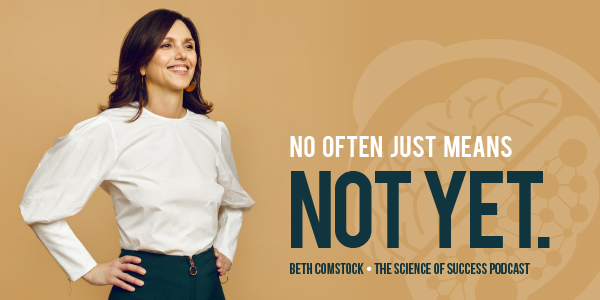
‘No’ is Often ‘Not Yet’: Beth brings up the notion of “Gatekeepers” in our lives (and our own heads), which are those who prevent us from progressing. They embody the fearful notion of “I don’t want a better way. I feel threatened by a better way or imaginative thinking.” The ‘No’ delivered by the Gatekeeps forces us to either abandon the idea or adapt our approach, try something new, and improve where necessary, which makes it a ‘Not Yet’.
Viewing ‘No’ as ‘Not Yet’ allows for a creative solution to emerge, but there are a few things you must do:
You can’t wait for someone else’s permission to act on your imagination.
Find people who see your vision.
Get feedback, find fallacies, and improve your pitch.
Wait for the right time, if it isn’t now.
Go Boldly into the Unknown: Beth opens her book by discussing a tough time in her life, her divorce. She talks about how she needed to take hold of her own story and create her path. Many of us wait for the perfect time or the perfect situation, but it isn’t going to happen, so she advocates for turning off auto-pilot and just going for it.
She proceeds to discuss the benefits of constraints for creative thinking, where the constraints create a framework within which we have freedom. First, we must ask ourselves, “How can I solve this creatively?” Then, all we must do is start. Wherever you are—just start!
Build Bridges, Not Walls
Many people view themselves as being against others, not personally, but as one team versus another. This mindset creates walls between you and them, which weakens you. The alternative is to bridge the gap between these differences, which allows for a sharing of resources and the creation of a team superior to any individual.
Beth suggests forming a bridge between the New and the Traditional, facilitating communication to ensure everyone is on the same page, maintaining a shared sense of humanity between everyone, and bringing in outsiders with authority and expertise. All of these bring the team together, unified against a shared problem.
Invite in your Critics: Beth then advocates inviting in your critics to help show you where you’re wrong. The best ideas are shared, so don’t attempt to hoard ideas because you want the credit and you’re afraid someone might steal it. By saying, “I need help”, you invite feedback and criticism which will help you address issues you are overlooking and provide new perspectives you wouldn’t uncover yourself.
This harsh advice might help you keep up with competitors or prevent you from pursuing a bad idea. By inviting feedback from your team, you can ensure you’re talking about the same problem; you can reframe the problem and refresh your perspective.
“Tell me something I don’t want to hear, because usually I need to hear it and I probably know it’s true but I’m just avoiding it.” – Beth Comstock
Acknowledge Reality: Many people and teams fall into the trap of viewing things as the way they wish they were instead of how they are. This can prevent them from making changes necessary for their success. Beth illustrates this idea by bringing up people who wear lucky clothes for fear of failure, then blame their superstitions instead of their inadequacies when they don’t succeed.
A lack of honesty will hold you back, while competitors charge forward. Fortunately, inviting feedback and criticism will help illuminate a lot of these fantasies before they have time to cause any damage. They can prevent us from deluding ourselves into thinking that things are the way that we want them to be or the way that they “should” be instead of the way that they really are.
“Am I seeing things that are opportunities that I can actually shape or am I hanging on to something that’s a superstition or just a comfortable way of viewing it and it’s preventing me from going forward.” – Beth Comstock
Small Steps to Become More Creative
In closing, Beth provides a few small steps for us to improve our creativity and urges us to “Just start!” because that’s all it takes.
1. Ask yourself, “What’s one thing I want to move forward on?”
2. Ask yourself, “What’s holding me back?”
3. Then write yourself a permission slip to do it.

Lessons and Tools From Spy Recruiters, Astronauts, and Mental Masters
We’ve interviewed some incredible guests on The Science of Success. From many walks of life including spy recruiters, astronauts, bestselling authors, and more. Across each of our guest’s from widely different fields, we see many overlapping mindsets, strategies, and practices for achieving goals and a more effective life.

We’ve interviewed some incredible guests on The Science of Success. From many walks of life including spy recruiters, astronauts, bestselling authors, and more. Across each of our guest’s from widely different fields, we see many overlapping mindsets, strategies, and practices for achieving goals and a more effective life.
We’d like to share with you some of these mindset and strategies to help you achieve your goals. Whatever they may be…

Focus On Your Health
Psychology Secrets of Extreme Athletes, NFL Teams, & The World’s Top Performer with Dr. Michael Gervais — Dr.Michael Gervais has spent years and countless hours in the trenches with high performers. From Red Bull athletes and The Seattle Seahawks to everyday civilians, Gervais has been able to unlock the true potential of his clients by utilizing the psychology of high performance.
What’s Life’s Biggest Trap We Fall Into? — In Matt Bodnar’s widely popular and upvoted Quora answer he takes us through some of the biggest traps people fall into in life and how we can avoid each to get out of our own way in 2018.
The Skeptic’s Guide To Meditation with Dan Harris — Learn more about meditation and the science behind the practice. Dan Harris takes you through his personal journey (including a panic attack live on air) that led him to pursue meditation and report of the science behind the sometimes “woo woo” reputation.
The Neuroscience Behind Building A Sustainable Healthy Lifestyle with Foodist Darya Rose — Sticking to a diet plan can be very, very hard. Darya Rose takes us through how we can set the right physical health goals and use neuroscience to actually stick to them.

Overcome Your Fears
How Do You Become Mentally Strong? — In this Medium article Matt Bodnar take us through an incredible framework for developing mental toughness. Compiling and exploring some of the most validated strategies and tactics to push yourself and grow.
How This Astronaut Survived Going Blind In Space & Tools For Crushing Fear with Chris Hadfield — Chris Hadfield is one of the most decorated astronauts in history. On his first spacewalk he went momentarily blind and was able to remain calm and complete his mission. Chris takes us through some practical knowledge for overcoming irrational fears and accepting others.
Your Secret Weapon To Becoming Fearless with Jia Jiang — Most people actively will avoid rejection. How is this fear holding you back? Jia decided to actively seek rejection each day for 100 days and while his journey is very entertaining, the results he saw were very impactful.

Master Your Emotions
Discover Your Hidden Emotional Insights and What’s Truly Valuable to You with Dr. Susan David — Your emotions are there to communicate through your subconscious. By using Dr.Susan David’s framework and research you can begin to learn how listening to these emotions and using them as a compass can help you make peace with them and achieve more.
The Mental Tools Olympians, Traders, and Top Performers Use To Make High Pressure Decisions with Denise Shull — Denise Shull was the inspiration for Wendy Rhodes character on the Showtime show Billions. She’s coached countless high performers through high pressure situations by using their emotions and inner working to guide them. Find out how!

Get What You Want
Simple Strategies You Can Use To Get Anything You Want with The Godfather of Influence Dr. Robert Cialdini — Dr.Cialdini has been doing incredible work on the art of influence for years. Most recently he unveiled a researched backed tactic that you can begin to use today to help you influence anyone and make a great first impression.
How To Use Influence Tactics Like an FBI Agent — In this article from SUCCESS Magazine we highlight some of the key takeaways from all the military influence experts we’ve interviewed. Everyone from hostage negotiators to FBI Spy recruiters. Learn how you can begin to influence like a secret agent today!

Connect With Others
Never Eat Alone — How Relationship Expert Keith Ferrazzi Built His World Class Network — Keith Ferrazzi literally wrote the book on networking. Through his work and research in relationship building, Keith has identified mindsets and frameworks that you should apply to every interaction and relationship.
Proven Practices for Building The Ultimate Competitive Advantage with Todd Davis — Todd Davis is the Chief People Officer at Franklin Covey and wrote much of the company’s award-winning material. Todd takes us through several ways to build better relationships at work from all hierarchies and how to build the ultimate competitive advantage.

Build The Right Habits
Break Your Phone Addiction (and Your Other Bad Habits) with Charles Duhigg — Charles Duhigg is a Pulitzer Prize winning author and has devoted much of his life and work to discovering why we do the things we do. Specifically how our habits and routines can affect our lives for the better and for the worse. Learn how we can become the masters of our own habits today!
How You Can Use Behavior Design To Create any Habit You Want with Nir Eyal — Nir Eyal has worked with hundreds of companies to make their products more habit forming. From video games themselves to products that pull you back in such as Facebook and Instagram it’s all by design and has Nir’s fingerprints or framework all over it. Learn how you can use Nir’s framework to break your cycle and create the habits you want!

How To Ask Great Questions on a Podcast
The ability to ask good questions is one of the most valuable tools in life. Not only do great questions lead to great podcast content but they also allow you to learn more completely from another’s experience.

The ability to ask good questions is one of the most valuable tools in life. Not only do great questions lead to great podcast content but they also allow you to learn more completely from another’s experience.
The best questions to ask will depend on what the format of your show is. However, I’ve always shared these few pieces of advice to those we consult with at The Science of Success to help them keep things interesting.
Do Your Research Prior
This should go without saying but if someone is taking the time to come on your show, especially someone highly sought after, do your research ahead of time. What I mean by this is take the time to search their recent projects and interviews.
This allows you to pick up on topics and points that they typically hit during interviews. This can be a great way to decide what you want to hit on, and what you want to miss or gloss over. Say your guest told a story on a previous interview and after the story you had a follow up that the interviewer missed. Note the story, mention it in your interview then present your question.
This research allows you to get a feel for what they will want to talk about but more importantly also allows you to find something original to ask that has not been asked before and makes your content original and potentially newsworthy.
Ask Questions You Actually Care About
Remember to ask questions that you actually are interested in hearing the answer to. This does not mean you should ignore the central theme or project they are looking to push. (If they’re on your show you should be interested…right?) But find a way to put your spin, humor, thoughts, or insights into the phrasing or positioning of the questions.
Always stay engaged in the conversation. Nothing is worse than speaking to someone who you can tell is just waiting for their turn to speak. Likewise, most can tell when you are already planning your next question and have checked out during their answer.
Staying more engaged will come with experience as well. If you’re not comfortable on the mic yet it might be harder to stay present but shaping the questions in a way that reflects your interests or personality will lead to a conversational interview.
Go Beyond The Surface
When someone comes out with a new book, makes the news, or starts a new project that is getting a lot of attention, they’re most likely being interviewed A LOT. It’s no fault of theirs but often people fall into routines and tend to give the same answers and stories in each interview they do. This makes things easier on them and ensures consistency in their message.
But oftentimes does not lead to anything original that gives listeners a reason to listen to you over others.
Think beyond the surface. So your TED talk on X topic has gotten over 5 million views? — Let them go over the content in their TED talk — Then don’t be afraid to dig. What was it that you saw in your life or in the world that made you think this was necessary to research? Why do you love X topic so much, how were you introduced to it? What does it mean to you? Who showed you X topic?
All these example questions go beyond what someone can typically find with a google search.
For Example. We interviewed Kamal Ravikant on The Science of Successregarding his latest book Rebirth. He told us about the book and some of the lessons in it but then Matt asked him “Why Spain? Why a pilgrimage?” and the answer we got is not only gold but is something you could never find in a search…
You want the truth? I was in Italy visiting a friend from college, and we were at this beautiful Italian woman’s house and we were very drunk on grappa that her grandmother made, and I was trying to impress her, and she told me about this pilgrimage and I said I would walk it. So I came up with the idea when I was really, really drunk trying to impress a beautiful Italian woman. The next day when I woke up I was like, “Well that was interesting, but it seems cool. Let me just go do it for a few days.” So I went off and I did it, and ended up doing the whole thing. But the whole thing started off being drunk trying to impress a woman, which was pretty much where all a lot of great male stories start. — Kamal Ravikant on The Science of Success.
So now we know the funny and completely original story of how Kamal decided to take his pilgrimage and ultimately experience the source material for his best selling book.
Original stories and thoughts behind the creation are magic. Not just the whatyou did or created, but the WHY.
Don’t Be Afraid To Push and Dig
Not everyone likes to go off script. Sometimes you have to push someone a little more in order to get great information out of someone.
NOTE: BE RESPECTFUL. ALWAYS.
However, don’t be afraid to push someone to open up a little but. Using The Mirroring Technique can be a great way to get someone to divulge more information without even having to directly ask. It goes something like this…
Person 1: To get someone to tip their hand and clarify, simply repeat the last three to five keywords in their sentence.
Person 2: You repeat the last keywords?
Person 1: Yeah, pretty crazy right? What that does is it causes me to explain my point again from a different angle, revealing more information that could be extremely valuable and also it helps you decipher my true desired outcomes and motivations.
- Chris Voss on The Science of Success
See there? Person 1 gave more information and Person 2 never even had to ask directly.
Sometimes however you have to ask directly and a great way to push for more information is to ask about the surrounding emotions behind an action, a project, or story. “How did that make you feel?” “What was your biggest takeaway from that?”
Storytelling Wins…Always
Whenever possible, tee up a story. Stories stick with people. If I simply explain something to you, it’s easily forgotten. If I can picture it in my head and play it out as if it were a movie. I’ll remember it.
Utilize Storytelling!
If you enjoyed this…
I study strategies for evidence based growth. Drop your email here to get my weekly “Mindset Monday” email! I’d also love to talk podcasting with anyone who wants to get out there and have their voice be heard!!
The Research Backed Guide To Being Lucky
Are you a lucky person?
Shockingly, your answer to that question actually has more to do with how lucky you are than anything else.
Let me ask you an important question…

Are you a lucky person?
Shockingly, your answer to that question actually has more to do with how lucky you are than anything else. Recently, science has proven that we actually can create our own luck. This groundbreaking research reveals several evidence-based tactics you can use to help you stumble into that next great opportunity.
Dr. Richard Wiseman has been named “The Most Interesting and Innovative Experimental Psychologist in the World Today” by The Scientific American. His research and experiments have shed light on some of science’s most interesting topics and debunked several common “self-help” practices.
In a recent interview on The Science of Success, Dr. Wiseman explains how you can find more luck in your life today with science based steps.
But First, A Story…
So you think you’re unlucky, huh? Before we get into the steps, let’s review some of the stories from the Luck Experiments. Dr. Wiseman began by gathering thousands of people who considered themselves lucky or unlucky.
To give you some context, this was the experience of one self-proclaimed “unlucky” person…
· 5 Car Accidents Within 50 Miles — On the same trip.
· Signed Up For A Dating Service…
1. First date broke a leg on the way to meet her.
2. Second, ran into a glass door and broke his nose.
3. When she got engaged, the church she was to be married in burnt down the day before her wedding.
So… maybe you aren’t as unlucky as you thought. Despite these experiences, through adopting some of the mindsets in Dr. Wiseman’s research and implementing some new practices in her life, she actually is luckier.
So let’s get into it, here’s how you can go from unlucky to lucky, in no time at all.
The Newspaper Effect — Your Attention Spotlight

One of the most interesting differences between lucky and unlucky people is their attention spotlight. Lucky people are always looking for an opportunity in the details of everyday life. Where the unlucky tend to move forward without paying as much attention and without looking for luck. This hypothesis was proven and illustrated by Dr. Wiseman’s “Newspaper Experiment”
Dr. Wiseman began by asking participants to classify themselves as lucky or unlucky. They were then asked to flip through a newspaper and count the number of pictures they saw. As a reward they would be given $100. What he did not tell participants was that there were two huge time saving opportunities embedded in the newspaper.
“One was a half-page ad with massive type that said “Stop Counting. There are 42 photographs in this newspaper” and the other was another half page ad that said, “Tell the experimenter you’ve seen this ad and collect your $100 now.” Recalls Dr. Wiseman. The findings were extremely clear. Those who considered themselves lucky saw the ad and collected their money immediately. Those who identified as unlucky sat and counted each ad, missing the valuable time saving message.
When those who considered themselves unlucky felt pushed, stressed, or concerned, their attention narrowed, they put their heads down and droned through the task. In contrast, those who identified themselves as lucky expanded their attention to try and grasp the details of what they were doing. Causing them to get “lucky” and spot this time saving message. If we take the time to slow down, pay attention to what we are doing, and believe we’re lucky, studies show, we will be.
Write It Down

In his next experiment Dr. Wiseman set out to see if we could actually change our luck. “We thought, if we take a group of people who are not particularly lucky or unlucky and get them to think and behave like a lucky person, does that increase their luck?” recalls Dr. Wiseman.
In order to shift the subject’s mindsets they were asked to keep a “luck journal”. Dr. Wiseman lays out the rules, “We asked that at the end of each day they write down the most positive thing that happened or most positive thought they had that day. Or, in some cases, something negative that used to happen that no longer happens, or at very least some thought of gratitude.”
The participants who kept these journals reoriented themselves extremely quickly. They began to see the good things in their lives and the opportunities in front of them. “It’s the most simple interventions we found had the biggest impacts,” notes Dr. Wiseman. Journaling and putting thoughts to paper has been proven to have astounding mental health benefits. By focusing on the good that happens each day we rewire our brains to see more opportunity in each day. Thus increasing how “lucky” we feel with each day.
The Silver Linings Playbook
Once you’ve begun focusing on the positive, it can be hard to stop. Carol Dweck was the first to coin the term “Growth Mindset.” One of the key pillars to a growth mindset is learning and seeing the positive in everything. If you try something and you fail, don’t beat yourself up; focus on what you learned and how you can avoid the same pitfalls in the future. This keeps us moving forward and increase how “lucky” we are in the future as we know what not to do.
By constantly thinking you’re lucky it’s incredible how it changes your perspective of everything. Dr. Wiseman recounts a slightly comical but impactful scenario, “A lucky person would take something as negative as falling down the stairs and find the good. Sure, I fell down the stairs and broke my leg, but if I had landed slightly to the left. I would have broken both of them, lucky.”
You may be thinking that breaking one leg is still a poor outcome. It’s those who train their brain to regard themselves as lucky however who do not dwell on the negative but rather find the positive, shift their focus there, and move forward.
Don’t Be Scared of Change

Oddly enough as Dr. Wiseman explains some people enjoy being unlucky. “About 20% of unlucky people rather enjoy being unlucky. Their self-identity is bound up with that.” This 20% enjoy being the clumsy guest at a party, enjoy never having things work out because on some level, it gives them an excuse.
These people according to the experiments are extremely hard to reach. While thinking lucky can dramatically change your life, you have to want to change to make it happen.
So start writing your own luck journal. Shift the way you think about yourself and the rest will trickle down into how you see the world and interact with others. If you want to start being lucky today, believe it to achieve it.
If you enjoyed this…
I study strategies for evidence based growth. Sign up below to get a TON of specific evidence based books, resources, and recommendations on being happy and successful.