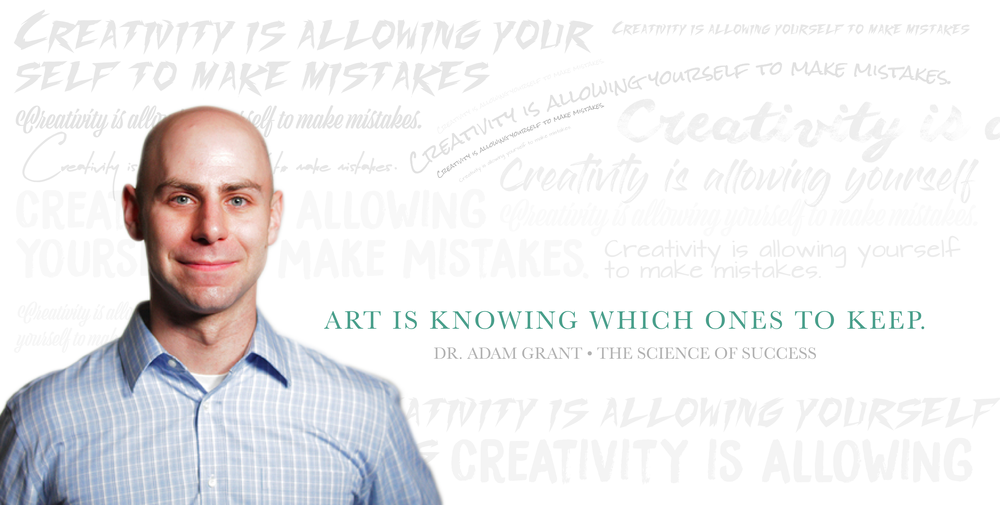
Adam Grant’s Guide To Success and Self-Awareness
As Wharton’s top-rated professor for the past six years running, Dr. Adam Grant knows a thing or two about what it takes to succeed. He’s one of the world’s 10 most influential management speakers, the best-selling author of Give & Take, Originals and Option B and a member of Fortune’s 40 under 40.

As Wharton’s top-rated professor for the past six years running, Dr. Adam Grant knows a thing or two about what it takes to succeed. He’s one of the world’s 10 most influential management speakers, the best-selling author of Give & Take, Originals and Option B and a member of Fortune’s 40 under 40.
In a recent interview, Adam shared with The Science of Success’s Matt Bodnarthe most impactful secrets to success, starting with self-awareness. In the world of self-awareness there’s a lot of talk about recognizing one’s own strengths and weaknesses. Dr. Grant argues, however, that it’s more beneficial and reliable to trust those around you to identify these weaknesses and not rely on your own (biased) soul searching.
Why Is It So Difficult To Be Self-Aware?
According to Dr. Grant, there are two main challenges when it comes to developing self-awareness. First, there are your own blind spots. These are shortcomings that the people around us can easily see, but that we might have a hard time identifying ourselves. As humans, we’re typically better at focusing on how we think we look, versus how others most likely see us. Our blind spots only become visible to us when we solicit outside feedback. When we understand how others view us in the world, it’s easier to change our behaviors and expectations.
Learn the top ten leadership blindspots and how to overcome them here.
We also must face our internal personal bias. Biases include the negative aspects of ourselves that we don’t want to see. For many, it can be easy to see ourselves in our own personal spotlight, as the hero of our own journey, which can lead to overconfidence.
“I think the big lesson here is that any time a trait is easy for other people to see or hard for us to admit, we can’t trust our own judgment of it,” — Adam Grant on The Science of Success
How We Overcome These Challenges
The good news is that these hurdles to becoming more self aware can be overcome. Dr. Grant’s solution is developing two networks of people; a support network and a challenge network.
Build a support network filled with people that you can count on to bring you up when you’re down. These should be the people you trust, those that will always give compliments and increase your confidence.
Your challenge network should be the people who will tell you that you’re not quite where you need to be. These are the people that will push you because they care about helping you get better.
“So if in the last six months somebody has given you really harsh feedback, you’ve probably done everything in your power to drop them from your life. In the short run, that might feel good, it might help with your motivation, but it destroys your opportunity to learn. I think we all need to embrace that challenge network if we want to reach our potential,” — Adam Grant on The Science of Success
When Asked, Be A Graceful Challenger
Many believe the “compliment sandwich,” is a good way to give feedback. This is when you offer criticism in between two compliments in order to lessen the blow. People mistakenly think this is the best way to offer negative feedback, but Grant argues this method only makes it harder for the receiver.
So if you find yourself a part of someone else’s challenge network follow this framework instead. Affirm a skill, value or achievement from one area then give your negative feedback in another. The idea is that you never want to give praise and criticism at the same time for the same project, piece of work or idea. This only serves to delude your feedback all together.
If you want to soften the blow of hard feedback praise something unrelated the receiver has done and start the conversation out in a positive light. Then change the subject to the project at hand and deliver your unbiased feedback. After all, you’re in someone’s challenge network because they trust you to push them. Give them what they expect.
Embrace The Devil’s Advocate
In every situation, business meeting, discussion, etc., make sure there is one person who genuinely disagrees with the majority opinion. It’s important that this person is not just playing a role, but truly has different ideas than the rest of the group. This person should be given the opportunity to argue passionately about their viewpoint thus stimulating divergent thinking. If done properly, the group will be more likely to reevaluate the situation on the table, gather new information, update their criteria and make a better decision in the end.
Make it known that no employee or partner has the right to withhold a critical opinion. Dr. Grant emphasizes the importance of creating a space and culture where dissenting ideas are encouraged. Everyone at the office should feel comfortable speaking up for his or her opinion no matter how different it is from the boss or from the group.
“Personality traits don’t predict behavior. Different ifs activate different thens.” — Adam Grant on The Science of Success
If you enjoyed this…
I study strategies for evidence based growth. Sign up below to get a TON of specific evidence based books, resources, and recommendations on being happy and successful.
The Research Backed Guide To Being Lucky
Are you a lucky person?
Shockingly, your answer to that question actually has more to do with how lucky you are than anything else.
Let me ask you an important question…

Are you a lucky person?
Shockingly, your answer to that question actually has more to do with how lucky you are than anything else. Recently, science has proven that we actually can create our own luck. This groundbreaking research reveals several evidence-based tactics you can use to help you stumble into that next great opportunity.
Dr. Richard Wiseman has been named “The Most Interesting and Innovative Experimental Psychologist in the World Today” by The Scientific American. His research and experiments have shed light on some of science’s most interesting topics and debunked several common “self-help” practices.
In a recent interview on The Science of Success, Dr. Wiseman explains how you can find more luck in your life today with science based steps.
But First, A Story…
So you think you’re unlucky, huh? Before we get into the steps, let’s review some of the stories from the Luck Experiments. Dr. Wiseman began by gathering thousands of people who considered themselves lucky or unlucky.
To give you some context, this was the experience of one self-proclaimed “unlucky” person…
· 5 Car Accidents Within 50 Miles — On the same trip.
· Signed Up For A Dating Service…
1. First date broke a leg on the way to meet her.
2. Second, ran into a glass door and broke his nose.
3. When she got engaged, the church she was to be married in burnt down the day before her wedding.
So… maybe you aren’t as unlucky as you thought. Despite these experiences, through adopting some of the mindsets in Dr. Wiseman’s research and implementing some new practices in her life, she actually is luckier.
So let’s get into it, here’s how you can go from unlucky to lucky, in no time at all.
The Newspaper Effect — Your Attention Spotlight

One of the most interesting differences between lucky and unlucky people is their attention spotlight. Lucky people are always looking for an opportunity in the details of everyday life. Where the unlucky tend to move forward without paying as much attention and without looking for luck. This hypothesis was proven and illustrated by Dr. Wiseman’s “Newspaper Experiment”
Dr. Wiseman began by asking participants to classify themselves as lucky or unlucky. They were then asked to flip through a newspaper and count the number of pictures they saw. As a reward they would be given $100. What he did not tell participants was that there were two huge time saving opportunities embedded in the newspaper.
“One was a half-page ad with massive type that said “Stop Counting. There are 42 photographs in this newspaper” and the other was another half page ad that said, “Tell the experimenter you’ve seen this ad and collect your $100 now.” Recalls Dr. Wiseman. The findings were extremely clear. Those who considered themselves lucky saw the ad and collected their money immediately. Those who identified as unlucky sat and counted each ad, missing the valuable time saving message.
When those who considered themselves unlucky felt pushed, stressed, or concerned, their attention narrowed, they put their heads down and droned through the task. In contrast, those who identified themselves as lucky expanded their attention to try and grasp the details of what they were doing. Causing them to get “lucky” and spot this time saving message. If we take the time to slow down, pay attention to what we are doing, and believe we’re lucky, studies show, we will be.
Write It Down

In his next experiment Dr. Wiseman set out to see if we could actually change our luck. “We thought, if we take a group of people who are not particularly lucky or unlucky and get them to think and behave like a lucky person, does that increase their luck?” recalls Dr. Wiseman.
In order to shift the subject’s mindsets they were asked to keep a “luck journal”. Dr. Wiseman lays out the rules, “We asked that at the end of each day they write down the most positive thing that happened or most positive thought they had that day. Or, in some cases, something negative that used to happen that no longer happens, or at very least some thought of gratitude.”
The participants who kept these journals reoriented themselves extremely quickly. They began to see the good things in their lives and the opportunities in front of them. “It’s the most simple interventions we found had the biggest impacts,” notes Dr. Wiseman. Journaling and putting thoughts to paper has been proven to have astounding mental health benefits. By focusing on the good that happens each day we rewire our brains to see more opportunity in each day. Thus increasing how “lucky” we feel with each day.
The Silver Linings Playbook
Once you’ve begun focusing on the positive, it can be hard to stop. Carol Dweck was the first to coin the term “Growth Mindset.” One of the key pillars to a growth mindset is learning and seeing the positive in everything. If you try something and you fail, don’t beat yourself up; focus on what you learned and how you can avoid the same pitfalls in the future. This keeps us moving forward and increase how “lucky” we are in the future as we know what not to do.
By constantly thinking you’re lucky it’s incredible how it changes your perspective of everything. Dr. Wiseman recounts a slightly comical but impactful scenario, “A lucky person would take something as negative as falling down the stairs and find the good. Sure, I fell down the stairs and broke my leg, but if I had landed slightly to the left. I would have broken both of them, lucky.”
You may be thinking that breaking one leg is still a poor outcome. It’s those who train their brain to regard themselves as lucky however who do not dwell on the negative but rather find the positive, shift their focus there, and move forward.
Don’t Be Scared of Change

Oddly enough as Dr. Wiseman explains some people enjoy being unlucky. “About 20% of unlucky people rather enjoy being unlucky. Their self-identity is bound up with that.” This 20% enjoy being the clumsy guest at a party, enjoy never having things work out because on some level, it gives them an excuse.
These people according to the experiments are extremely hard to reach. While thinking lucky can dramatically change your life, you have to want to change to make it happen.
So start writing your own luck journal. Shift the way you think about yourself and the rest will trickle down into how you see the world and interact with others. If you want to start being lucky today, believe it to achieve it.
If you enjoyed this…
I study strategies for evidence based growth. Sign up below to get a TON of specific evidence based books, resources, and recommendations on being happy and successful.